An MVP development checklist should do one job: stop a founder from spending money on the wrong first version. The checklist is not just a list of features to build. It is a sequence of decisions that confirms the user, problem, core action, minimum path, technical foundation, launch plan, and success metrics before development gets expensive.
The practical test is simple. If the checklist cannot tell you what to cut, what to measure, and what decision the MVP should make easier, it is not a checklist yet. It is a wishlist.
Use this guide before you hire an MVP development partner, brief an internal team, or turn a prototype into software. When you are ready to request estimates, turn these decisions into an MVP agency brief so every partner prices the same core scope and assumptions. The goal is not to make version one large. The goal is to make it trustworthy enough to produce a useful signal from real users.
If you are a non-technical founder, the MVP build management guide explains which product decisions you should own and which technical responsibilities belong with the build partner.
When architecture, integrations, data, security, or AI feasibility are still unclear, add a technical discovery step before the checklist turns into tickets.
If demand is still uncertain, start with the product validation framework before writing a build brief. If you are already comparing agencies, use the MVP development company vetting checklist before signing a full build contract.
What should an MVP development checklist include?
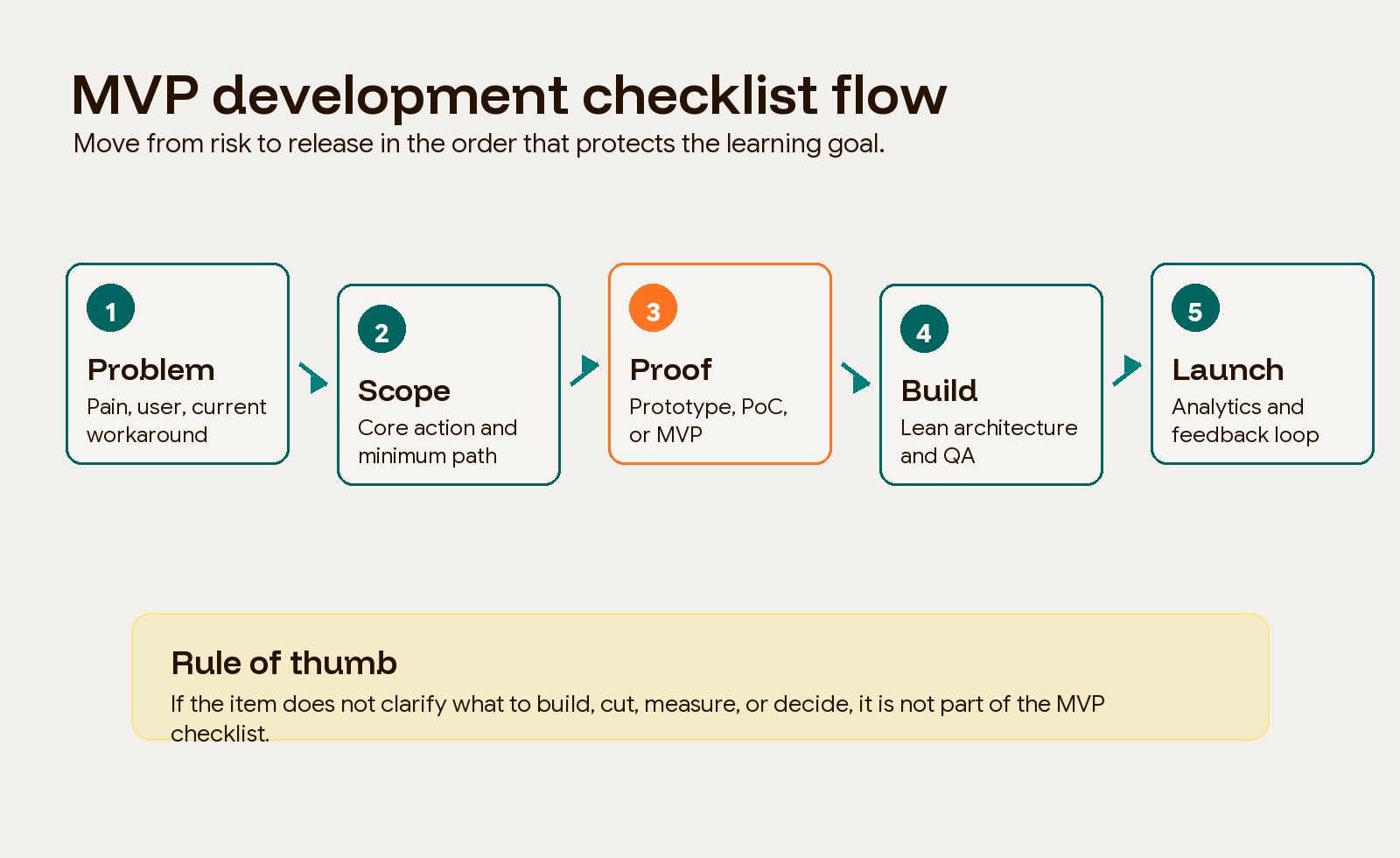
An MVP development checklist should include ten checkpoints: problem validation, user persona, validation artifact, core action and minimum path, feature priority, pre-code usability testing, lean architecture, quality assurance, launch instrumentation, and post-launch decision rules.
That order matters. Many teams start with features because features feel concrete. A better MVP starts with the decision the business needs to make. Are users willing to pay? Will they complete the workflow? Can the product deliver the promised result? Is the technical risk real, or is the market risk bigger?
Before code starts, the team should be able to answer:
- Who is the first user segment?
- What painful workflow are we solving?
- What current workaround proves the pain exists?
- What single user action creates the product’s core value?
- What can stay manual, fake, or deferred without weakening the test?
- What data will tell us whether version one worked?
Hapy’s broader guide to MVP development frames this as building the first version that learns. This checklist turns that idea into a practical review before version one moves from concept to build.
Checklist 1: Validate the problem before you validate the product
The first checkpoint is not “Do we like the idea?” It is “Have we found a painful enough problem in a specific enough market?”
A founder should not start MVP development until the problem has been turned into a testable hypothesis. A useful format is:
We believe [specific user segment] struggles with [painful workflow] because [current limitation], and that [proposed solution] will help them achieve [measurable outcome].
Then test the hypothesis with real evidence.
Problem validation checklist
- Define one first user segment, not a broad market.
- Interview qualified prospective users or buyers in the first segment, then add sessions to investigate unresolved assumptions and contradictory evidence.
- Document the current workaround they use today.
- Separate stated interest from observed behavior.
- Identify the moment where the current workflow breaks down.
- Review competitor complaints on G2, Capterra, Product Hunt, Reddit, or niche communities.
- Write the problem statement in plain language a customer would recognize.
- Decide what would prove the problem is not painful enough.
The last item matters. If there is no disconfirming evidence that would stop the build, the team is not validating. It is collecting reassurance.
For planning, 20 to 30 interviews may be a starting allowance for a varied audience, not a required sample or proof of demand. A narrow segment may reveal repeated patterns sooner; distinct buyers, operators or high-risk workflows need separate coverage. Proceed when the main assumptions and exceptions are understood well enough for the next bounded test. Interviews alone do not establish willingness to pay or population-wide demand.
Checklist 2: Build a user persona that can guide scope
User personas become useful only when they help the team make tradeoffs. A persona full of generic traits will not stop feature creep. A persona tied to a workflow can.
This Hapy planning checklist organizes persona work around context, motivations, friction points, current solutions and buying habits. Each input should affect a product decision.
| Persona input | What to capture | How it affects the MVP |
|---|---|---|
| User context | Role, industry, company size, technical comfort | Sets language, onboarding depth, and workflow complexity |
| Core goal | What the user is trying to get done | Defines the core action |
| Friction point | Where the current process wastes time, money, or trust | Tells the team what not to dilute |
| Current workaround | Spreadsheet, manual process, competitor, internal tool | Sets the baseline the MVP must beat |
| Buying or adoption habit | Who approves, who uses, who blocks | Shapes launch and sales motion |
The persona should be specific enough that the team can say no. If a requested feature helps a future user but not the first user, it belongs in version two.
Checklist 3: Pick the right validation artifact
Not every early product needs an MVP. Some need a proof of concept. Some need a prototype. Some need a landing page or concierge test.
This distinction is where teams save the most money. A proof of concept tests technical feasibility. A prototype tests usability and comprehension. An MVP tests real-world adoption, payment, retention, or workflow completion.
| Artifact | Best question | What it should produce |
|---|---|---|
| Proof of concept | Can the risky technical idea work? | Technical evidence, not a polished user experience |
| Prototype | Do users understand the flow? | Usability feedback and clearer product shape |
| MVP | Will real users adopt, pay, return, or complete the workflow? | Market and usage evidence |
| Concierge or manual MVP | Does the service create value before automation? | Demand signal without full software |
Y Combinator’s MVP planning guidance pushes founders toward a narrow first product for a specific user. That does not always mean writing production code immediately. It means choosing the smallest artifact that tests the riskiest unknown.
Hapy’s POC vs prototype vs MVP article is the internal decision guide to use here. If the wrong artifact gets chosen, every later checklist item becomes less useful.
Checklist 4: Define the core action and minimum path
The core action is the one user action that delivers the product’s value. It should fit in a sentence.
For an invoicing tool, the core action may be sending a correct invoice to a client. For a booking platform, it may be scheduling an appointment with a service provider. For an AI workflow product, it may be producing a reviewed output the user trusts enough to use.
Once the core action is clear, map the minimum path. This is the smallest sequence of steps a user must complete to get the value.
Core action checklist
- Write the core action in one sentence.
- Name the trigger that starts the workflow.
- Map the minimum path from first step to value delivered.
- Keep the first version to one primary workflow.
- Mark every secondary workflow as version two unless it protects the core proof.
- Decide which internal operations can stay manual behind the scenes.
- Define where the workflow should produce measurable data.
For a simple invoicing MVP, the minimum path might be signup, client entry, invoice creation, and invoice sending. OAuth, CSV imports, custom invoice templates, multi-currency support, tax automation, and collection reminders may all be useful later. They are not automatically useful for proving whether users need the product.
That is the discipline. The MVP should feel coherent, but it should not try to feel complete.
Checklist 5: Prioritize features with more than opinion
Feature prioritization should protect the learning goal. Without a method, the loudest stakeholder usually wins.
Use a lightweight sequence:
- Use Kano-style thinking during discovery to separate basic needs from delighters.
- Use RICE scoring when enough data exists to compare reach, impact, confidence, and effort.
- Use MoSCoW to draw the release boundary.
- Use a value-versus-effort matrix for fast sprint triage.
Intercom’s RICE framework is useful when teams need a transparent score for competing ideas. Agile Business Consortium’s MoSCoW guidance is useful when a fixed launch window forces clear Must, Should, Could, and Won’t-have decisions.
MVP feature checklist
- Label every feature by the risk it helps test.
- Mark the smallest required feature set as Must-have.
- Move polish, personalization, automation, and advanced reporting to Should or Could.
- Create a Won’t-have list for the current release.
- Keep technical foundations that protect trust, security, or data integrity.
- Remove any feature that creates more noise than signal.
For MVP work, the Won’t-have list is often the most valuable artifact. It gives the team permission to move quickly without pretending good ideas are bad ideas. They are simply not version-one ideas.
Checklist 6: Validate the flow before writing production code
Pre-code validation prevents expensive rework. Before engineering starts, users should be able to react to the structure of the experience.
Start with static wireframes, then clickable prototypes, then structured usability sessions around the core flow. Nielsen Norman Group’s usability testing guidance argues for small, repeated tests, often with no more than five users per round, because the goal is to find and fix usability issues early rather than document every possible weakness in one large study.
The important part is iteration. Five users are not a magic number for every situation. If the product has distinct user groups, test each group. If the workflow is regulated, high-risk, or complex, add more validation. But do not skip user observation because the team has a clean Figma file.
Pre-code validation checklist
- Create wireframes for the core workflow.
- Turn the core flow into a clickable prototype.
- Watch users complete the task without coaching.
- Record where they hesitate, abandon, or misunderstand.
- Test the wording of the main value proposition.
- Use fake-door tests only when they are honest and low-risk.
- Run tree testing or card sorting if navigation is part of the risk.
- Update the design before development starts.
The goal is not to polish the prototype forever. The goal is to remove the avoidable confusion before that confusion becomes code.
Checklist 7: Choose a lean technical foundation
MVP architecture should support speed without creating a dead end. Underbuild the wrong parts and version one becomes hard to trust. Overbuild too early and the team burns budget before users respond.
For many software MVPs, a modular monolith is a sensible starting point: one codebase with clear module boundaries. It lets the team move faster than a distributed microservices setup while still keeping a path to split pieces later if the product earns that complexity.
Technical foundation checklist
- Choose mature frameworks the team can ship quickly.
- Keep the first architecture simple enough to operate.
- Define API contracts before frontend and backend work diverge.
- Use a version-controlled relational database where data integrity matters.
- Put third-party services behind adapter layers when switching vendors later is plausible.
- Add idempotency safeguards for payments, state changes, and critical transactions.
- Set up basic logging, health checks, and error tracking from day one.
- Confirm who owns repositories, credentials, environments, and IP.
This is where “minimum” is often misunderstood. Minimum does not mean fragile. If payments, permissions, or customer data are part of the validation question, they need enough engineering care to avoid damaging trust.
Checklist 8: Build in small slices and test the critical paths
MVP development works best when the team ships in small slices around the core workflow. Weekly or biweekly sprint checkpoints are useful because they expose unclear decisions early.
The quality bar should match the risk. Do not try to test 100% of the codebase before launch. Do test the flows that could break trust, block value, or corrupt data.
Build and QA checklist
- Break development into one or two-week sprint increments.
- Keep demos tied to working behavior, not slide updates.
- Require code review before production changes.
- Run automated checks for linting, unit tests, and security basics.
- Maintain a staging environment that mirrors production enough to catch release issues.
- Smoke-test availability and deployment health.
- Functionally test the core workflow.
- Usability-test the live interface with target users.
- Performance-test the flows where speed affects trust.
A narrow MVP can still be high quality. The cut should happen in scope, not in the parts of the product users rely on to judge whether the company is credible.
Checklist 9: Instrument launch before launch day
An MVP without measurement is just a release. The launch plan should define how the team will gather evidence before the product goes live.
Choose the launch model based on the risk:
| Launch model | Best fit | What it tests |
|---|---|---|
| Early access | Design partners or high-value users | Value, workflow fit, objections |
| Private beta | Waitlist or selected early adopters | Bugs, onboarding, positioning |
| Soft launch | One niche, geography, or segment | Support, acquisition, pricing |
| Partnership-led | Existing trusted audience | Distribution and adoption quality |
Then instrument the product around the core action. Track activation, completion, repeat usage, conversion, support requests, error rates, and qualitative feedback. Session tools and heatmaps can help diagnose friction, but the main event analytics should answer whether the product created the value it promised.
Launch instrumentation checklist
- Define the activation event.
- Track the core action.
- Track drop-off points in the minimum path.
- Add feedback prompts at moments of high intent or failure.
- Monitor bugs, latency, and production errors.
- Create a weekly review rhythm for usage and feedback.
- Decide what qualifies as continue, change, or stop.
The decision rules should be written before the team falls in love with the build.
Checklist 10: Measure signal, not vanity
The MVP is not successful because it shipped. It is successful if it changes the next decision.
For a demand-led MVP, useful signals may include qualified signups, paid pilots, sales calls booked, or usage from the right segment. For a workflow product, they may include task completion, repeat usage, activation rate, or time saved. For a SaaS MVP, they may include retention, willingness to pay, expansion requests, and cohort behavior.
The Sean Ellis product-market fit survey asks users how they would feel if they could no longer use the product. In First Round Review’s writeup of Superhuman’s process, Rahul Vohra describes the widely used 40% “very disappointed” benchmark as a leading indicator for product-market fit. That benchmark is not a substitute for retention or revenue, but it is useful when the team needs a sharper read on whether users feel real pull.
Post-launch checklist
- Review activation and core action completion.
- Segment feedback by user type, not just total volume.
- Compare stated interest with actual usage.
- Track support themes and workflow blockers.
- Ask what users would do if the product disappeared.
- Prioritize urgent, high-impact blockers immediately.
- Put high-effort, low-impact requests outside the roadmap.
- Decide whether to iterate, pivot, pause, or scale.
Hapy’s guide to MVP development challenges is a useful companion here because many weak MVPs fail after launch for predictable reasons: no analytics, loose scope, unclear QA, weak onboarding, or no feedback loop.
For expectation-setting before launch, use the MVP expectations vs reality guide. Once real users have touched version one, the post-MVP roadmap guide helps turn early evidence into the next build cycle.
What to check before hiring an MVP development partner
If an outside team is helping with version one, evaluate more than technical ability. The partner should make the MVP smaller and sharper, not simply accept every feature request.
If the choice is still between hiring internally and using outside help, compare the tradeoffs in the MVP development agency vs in-house guide before turning the checklist into a contract.
Use this partner checklist:
- They ask what the MVP must prove before they estimate features.
- They can explain technical tradeoffs in plain language.
- They push back on scope creep without dismissing the business goal.
- They show progress in a shared system, not long silent cycles.
- They define ownership of code, design files, credentials, environments, and IP.
- They plan analytics, QA, and post-launch iteration before launch.
- They leave enough budget and attention for version 1.1.
For founders comparing budget models, Hapy’s MVP development cost in 2026 guide covers practical ranges by complexity. The more important point is this: a cheap build that cannot test the real risk is not lean. It is just underbuilt.
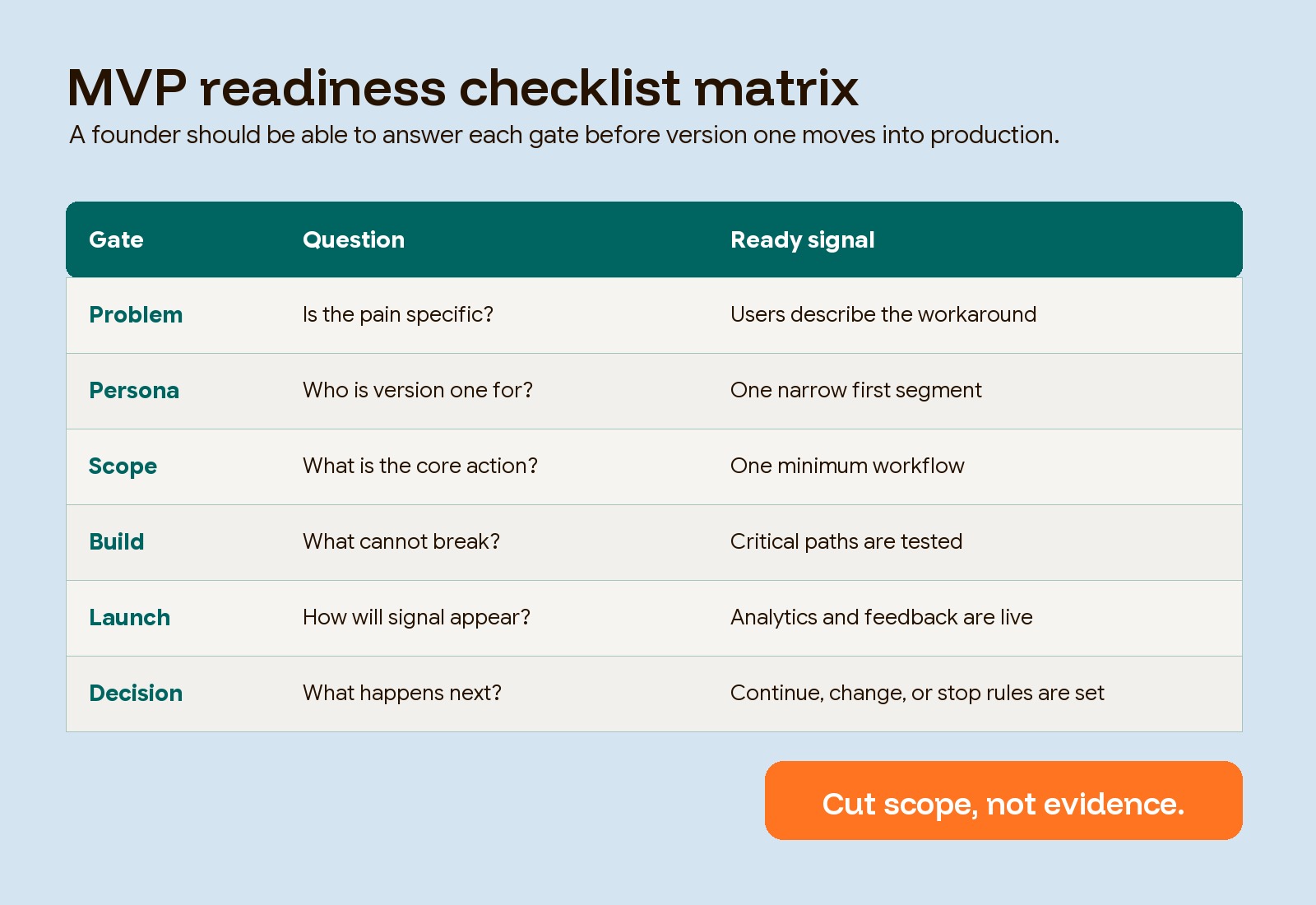
The complete MVP development checklist
Use this shortened version when reviewing readiness with a team.
| Stage | Founder question | Ready when |
|---|---|---|
| Problem | Is the pain specific and urgent? | Users describe the pain, workaround, and cost without prompting |
| Persona | Do we know who version one is for? | The first segment is narrow enough to guide product tradeoffs |
| Artifact | Are we building the right thing first? | The team has chosen PoC, prototype, MVP, or demand test based on risk |
| Scope | What is the core action? | The core action and minimum path fit in one clear workflow |
| Features | What gets cut? | Must-have and Won’t-have lists are agreed before development |
| Design | Can users understand the flow? | Target users can complete the prototype without coaching |
| Architecture | Is it lean but trustworthy? | The stack supports speed, data integrity, and near-term iteration |
| QA | What cannot break? | Critical paths are tested before launch |
| Launch | How will we get signal? | Analytics, feedback, and support are ready before users arrive |
| Decision | What happens after launch? | Continue, change, stop, or scale criteria are written down |
FAQ
What is an MVP development checklist?
An MVP development checklist is a structured review of the decisions a team should make before building version one. It covers the user, problem, core workflow, feature scope, validation method, technical foundation, launch plan, analytics, and post-launch decision rules.
What should be included in an MVP?
An MVP should include the core workflow, basic onboarding, essential data handling, critical integrations, enough trust and security for real use, analytics, and a feedback loop. It should defer secondary workflows, advanced automation, heavy reporting, and polish that does not affect the first learning goal.
How do you know an MVP is ready to build?
An MVP is ready to build when the team knows the first user, the painful workflow, the core action, the minimum path, the must-have features, and the signal that will determine the next move. If those are unclear, spend more time on discovery, prototype testing, or demand validation.
How many features should an MVP have?
An MVP should have only the features required to complete the core workflow and test the main business assumption. The number depends on the product, but the release should usually center on one primary user path rather than multiple broad use cases.
What is the biggest mistake in MVP development?
The biggest mistake is treating an MVP as a smaller full product instead of a learning tool. That leads to bloated scope, weak analytics, unclear launch criteria, and a version one that ships without answering the business question.
What happens after MVP launch?
After MVP launch, the team should review usage data, user feedback, support issues, retention, activation, and willingness to pay. The next step should be based on evidence: improve the workflow, cut weak features, pivot the offer, pause the build, or invest in scale.
Use the checklist to protect the next decision
The best MVP development checklist is not the longest one. It is the one that protects the next business decision.
If the idea is still vague, use the checklist to slow down and validate the problem. If the problem is real but the flow is untested, build a prototype before software. If the market risk is ready to test, build the smallest useful MVP around one core action and measure what users actually do.
For founders who want help deciding whether the idea is ready to build, book an MVP scoping call. We will help separate ideas that need sharper scope from ideas that are ready for a focused version-one build.