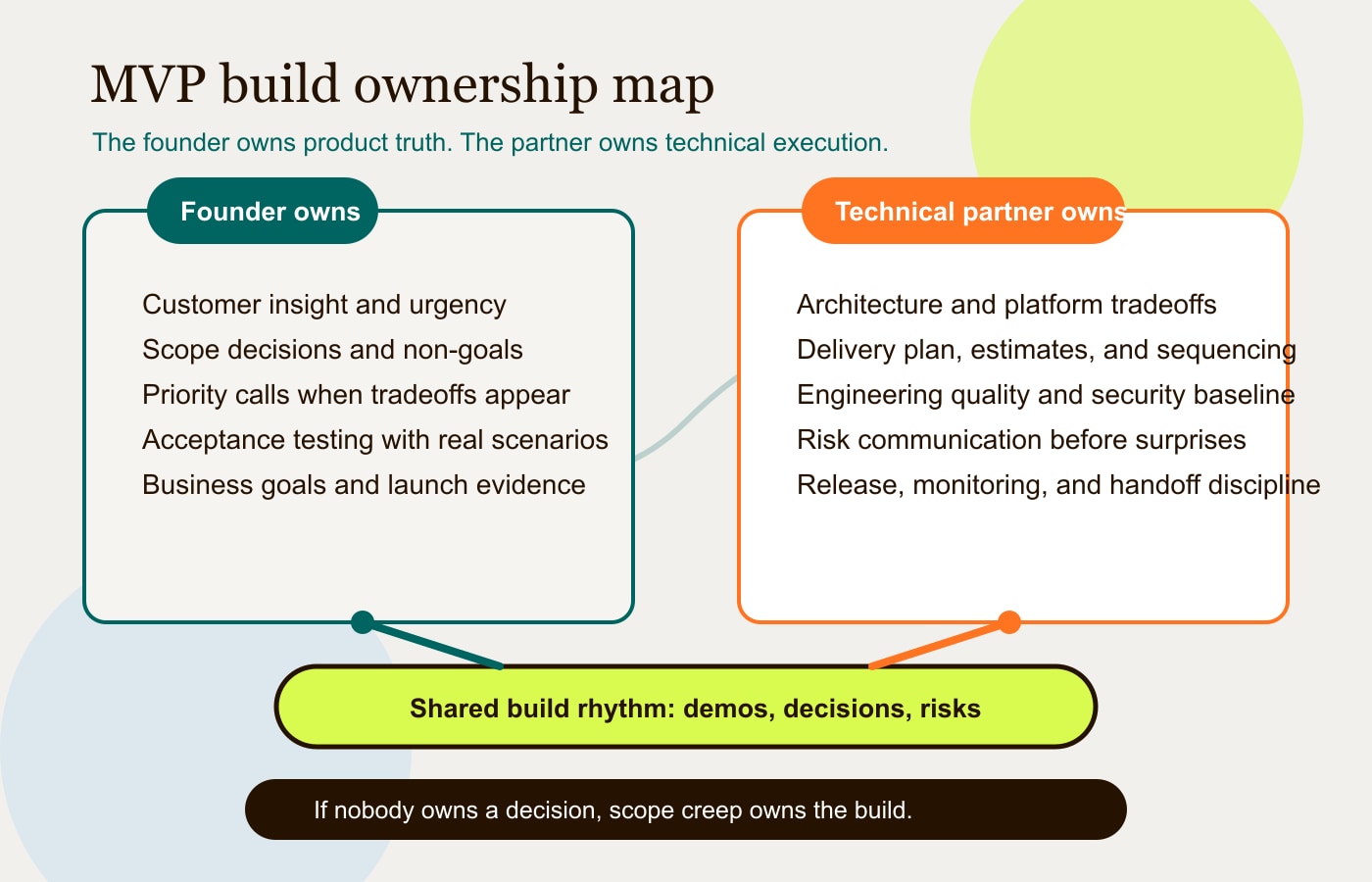
MVP development for non-technical founders is not about learning to code before you hire a build team. It is about knowing which decisions must stay with the founder and which decisions should be owned by a technical partner. The founder owns the customer truth, the scope boundary, the priorities, the acceptance testing, and the business goal. The technical partner owns architecture, implementation tradeoffs, delivery, quality, and risk communication.
That split is where many outsourced MVP builds either become calm or become expensive. A founder who tries to manage every technical detail slows the team down. A founder who delegates every product decision gets a version one that may be technically functional but commercially vague.
The goal is shared ownership with clear boundaries. If you are trying to build MVP without a technical founder, you need enough technical literacy to ask better questions, not enough expertise to dictate the stack. You need enough process to catch scope creep early, not enough ceremony to turn a lean build into enterprise theater.
Before development starts, use Hapy’s MVP development checklist to confirm the user, problem, core workflow, technical risks, launch plan, and success metrics. If architecture, integrations, data, AI, security, or feasibility are still unclear, run technical discovery before the estimate hardens.
Once work begins, use a transparent MVP development rhythm so demos, scope decisions, budget burn, backlog health, risks, and acceptance criteria stay visible without turning the founder into the engineering manager.
How MVP development for non-technical founders should be managed
Non-technical founders must own the business judgment that makes the MVP worth building. That means customer insight, scope decisions, priorities, acceptance testing, and the business goals the product is supposed to prove.
The Lean Startup idea behind an MVP is validated learning: release the smallest useful product, collect customer feedback, and decide whether to persevere, pivot, or narrow the bet. A founder cannot outsource that learning. A development partner can ship the experiment, but the founder has to define what the experiment is meant to teach.
Founders should own five things.
| Founder-owned area | What it means in practice | Why it cannot be delegated |
|---|---|---|
| Customer insight | First user segment, pain, current workaround, buying trigger, and language customers use | Engineers can build a workflow, but they cannot invent the market truth |
| Scope decisions | Must-have release boundary, version-two list, and explicit non-goals | Every unclear feature becomes an estimate risk |
| Priorities | Tradeoffs when budget, timing, quality, or learning goals conflict | Prioritization is a business call, not a ticket-sorting exercise |
| Acceptance testing | Real scenarios that prove the MVP works for the user and business | QA can find bugs; founders must decide whether the product is useful enough to release |
| Business goals | Activation, pilot conversion, revenue signal, retention, or learning milestone | A shipped app is not success unless it answers the business question |
The practical test is simple: if a decision changes what the product should prove, the founder owns it.
What a good technical partner should own
A good technical partner should own the technical path from scoped problem to usable software. That includes architecture, implementation tradeoffs, delivery planning, quality, security baseline, and early risk communication.
This is not just coding. It is judgment under constraints. A partner should be able to explain why a simple managed stack is enough for one MVP, why another product needs stronger tenancy or audit logs, and why a requested feature belongs after launch instead of before it.
Strong technical partners usually own:
- Architecture: application structure, data model, hosting, environments, integrations, and scale assumptions.
- Tradeoffs: what can be manual, what must be automated, what is cheap now but expensive later, and what should be deferred.
- Delivery: backlog shape, sprint rhythm, estimates, dependencies, demos, release plan, and handoff.
- Quality: code review, QA process, regression checks, security baseline, monitoring, and bug triage.
- Risk communication: early warnings when scope, integration access, data quality, or compliance assumptions change.
If the partner cannot explain tradeoffs in business language, the founder will be forced to manage blind. If the founder ignores technical warnings, the partner becomes a contractor taking orders instead of a build partner reducing risk.
This is where fractional CTO services can help. A fractional CTO is useful when the founder needs senior technical judgment but is not ready to hire a full-time CTO. That role can review vendors, shape architecture, challenge estimates, translate risk, and keep technical decisions tied to the business outcome.
Can you build MVP without a technical founder?
You can build MVP without a technical founder when the build model includes technical ownership somewhere else. That could be an MVP development partner, a fractional CTO, a senior technical advisor, or a hybrid setup where an outsourced team delivers under a clear product and technical governance rhythm.
What does not work is hiring individual developers and assuming they will quietly fill every missing role. A solo developer may write code well and still not own product discovery, UX decisions, QA planning, architecture risk, stakeholder communication, backlog management, launch support, and post-launch analytics.
For a non technical founder MVP, choose the build model by the risk you are carrying.
| MVP situation | Safer build model | Founder risk if mismatched |
|---|---|---|
| Simple validation workflow with low technical risk | No-code, prototype, or small scoped build | Overpaying for custom architecture too early |
| Standard B2B SaaS or workflow MVP | Product-led MVP partner with design, engineering, and QA | Founder becomes unpaid product manager and QA lead |
| Complex integrations, AI, payments, or sensitive data | Technical discovery plus senior architecture ownership | Hidden risk appears after the estimate is signed |
| Outsourced team already hired but founder lacks technical review | Fractional CTO or technical lead oversight | Vendor quality and scope decisions become hard to evaluate |
| Fundraising or enterprise pilots depend on technical credibility | Senior technical partner close to roadmap and risk story | Investors or buyers find gaps before the founder does |
If the product touches payments, hosted checkout can reduce some custom payment burden. For example, Stripe Checkout supports hosted, embedded, and component-based checkout flows and uses a Checkout Session plus webhook events to support fulfillment. That still requires technical design, but it is different from asking a team to build payment handling from scratch.
If the product touches sensitive user data, the quality bar changes. The OWASP Application Security Verification Standard gives teams a practical way to think about security requirements and verification. A founder does not need to memorize it, but a credible partner should know how to translate security expectations into launch requirements.
Start with the business question before the feature list
The first scoping mistake is asking, “What features do we need?” before asking, “What must this MVP prove?”
Strategyzer’s guidance on testing ideas starts with the most critical hypotheses across desirability, feasibility, and viability: do customers want it, can it be built, and can it become financially worthwhile? That is a better starting point than a feature brainstorm because it separates market risk from technical risk.
Write the MVP question in one sentence:
We need version one to prove that [specific user] will [complete specific workflow] because it helps them [measurable outcome], and we will continue only if [clear signal] happens by [time frame].
That sentence should shape the backlog. If a feature does not help answer the MVP question, it is a candidate for version two.
Use MoSCoW prioritization to draw the release boundary. The Agile Business Consortium defines Must Have items as the minimum usable subset, and its guidance recommends keeping Must Have effort to a level where the team has high confidence, typically no more than 60%. That matters because a first MVP with 95% “must-have” scope has no room for discovery, integration surprises, or post-demo corrections.
Use RICE scoring when competing features need a more explicit tradeoff. RICE compares reach, impact, confidence, and effort. For a founder, the value is not the math alone. It is the discipline of asking, “How many users does this affect, how much does it matter, how sure are we, and what will it cost?”
How to manage outsourced MVP development without losing control
To manage outsourced MVP development, founders need a visible rhythm for decisions, not a constant stream of ad hoc messages. The rhythm should make progress, risk, scope, and quality visible every week.
A practical outsourced MVP rhythm looks like this:
| Rhythm | What should happen | Founder responsibility | Partner responsibility |
|---|---|---|---|
| Weekly demo | Show working product, not only status | React to user value and business fit | Show progress, gaps, risks, and next decisions |
| Backlog review | Confirm what is next, blocked, deferred, or changed | Make priority calls | Explain effort and dependency impact |
| Risk review | Discuss integration, data, scope, quality, and launch risks | Decide business tradeoffs | Surface risk early with options |
| Acceptance review | Test completed stories against real scenarios | Approve, reject, or defer | Fix bugs and clarify implementation constraints |
| Launch metrics review | Confirm analytics and success signals | Define decision thresholds | Instrument events and reporting |
The founder should respond quickly when decisions block the team. As an illustrative Hapy operating recommendation, agree to acknowledge blocking decisions within one business day during active development. Set the actual response window around working-hour overlap and identify a backup decision maker; complex decisions may need a separately agreed deadline. Unanswered product questions become quiet delays, and quiet delays become rushed scope decisions later.
Also document decisions in the ticket, not only in chat. If the founder decides to defer billing history, simplify onboarding, or launch with manual admin review, that decision should live beside the relevant work. Future confusion often starts with past decisions that were never recorded.
Write acceptance criteria a non-technical founder can test
Acceptance criteria are the bridge between founder judgment and technical delivery. They should define what must be true for a feature to count as done.
The Agile Alliance glossary describes user stories through the Three C’s: Card, Conversation, and Confirmation. The card captures the story, the conversation creates shared understanding, and the confirmation proves the expected outcome happened.
That confirmation is where non-technical founders can be very effective. You do not need to inspect code. You need to test whether the user’s scenario works.
Weak acceptance criteria sound like this:
- The dashboard should be easy to use.
- Search should be fast.
- Users should be able to manage projects.
- Notifications should work.
Better acceptance criteria sound like this:
Given a pilot customer has created three active projects
When they open the dashboard
Then they can see each project status, owner, next deadline, and latest activity
And the page loads in under two seconds on the agreed staging device
Cucumber’s Gherkin reference frames scenarios around an initial context, an event, and an expected observable outcome: Given, When, Then. Founders can use that structure even if the team is not automating every test. It forces vague expectations into observable behavior.
Use acceptance criteria for core workflows, not every tiny UI choice. The goal is to protect product truth: can a real user complete the value moment with enough clarity, trust, and reliability to produce a useful signal?
QA belongs to the partner; UAT belongs to the founder
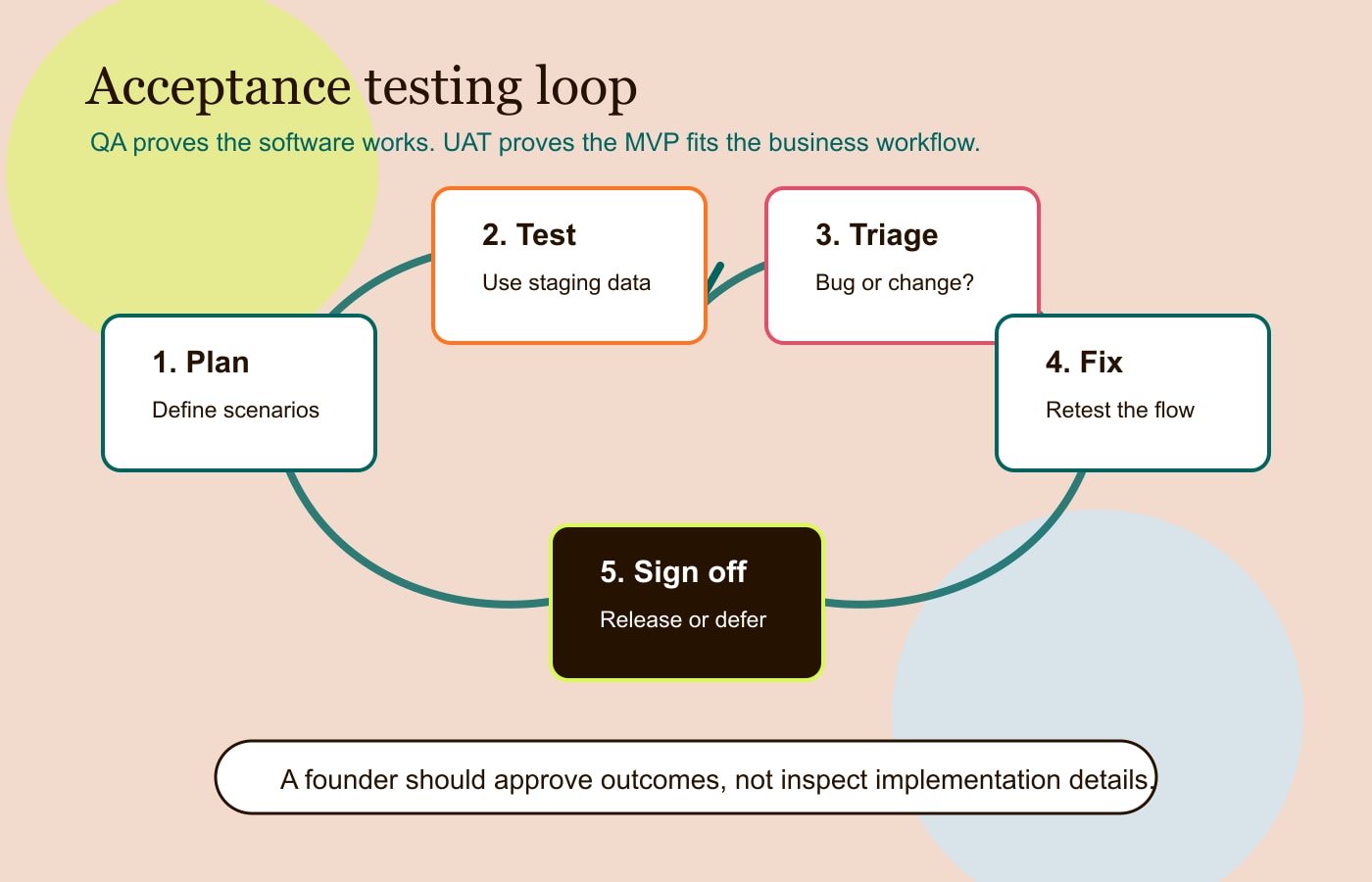
Quality assurance and user acceptance testing are related, but they answer different questions. QA asks whether the software works as engineered. UAT asks whether it works for the real business workflow.
TechTarget describes user acceptance testing as testing software in the real world by its intended audience before release. In an MVP build, that audience may be pilot users, internal operators, customer-facing staff, or the founder acting from a real customer scenario.
The technical partner should own QA depth:
- unit, integration, and end-to-end checks where appropriate;
- browser, device, and responsive testing;
- regression testing for critical flows;
- security and permission checks;
- error monitoring and release readiness;
- bug triage and retesting.
The founder should own UAT judgment:
- Do real users understand the workflow?
- Does the core action produce the promised value?
- Are the right business rules represented?
- Are the right edge cases handled for launch?
- Which issues block release, and which can wait?
- Does the MVP produce the metrics needed for the next decision?
Do not let QA become the founder’s unpaid job. Do not let UAT become the agency’s guess about the market. The handoff should be explicit: the partner prepares a stable staging build and test notes; the founder tests real scenarios and signs off on business readiness.
Use contracts and milestones to protect decisions
The contract should support the build process instead of pretending uncertainty does not exist. A fixed scope can work only when the scope is clear enough to price. If discovery is incomplete, the better first step may be a paid discovery phase, prototype, or technical spike.
Large IT projects are a different category from startup MVPs, but the risk pattern is worth respecting. In a report published in October 2012, McKinsey and the University of Oxford drew on a database of more than 5,400 IT projects and reported results for large projects with initial budgets above $15 million and found they ran 45% over budget and 7% over time on average, while delivering 56% less value than expected. Startups operate at smaller scale, but vague scope, weak stakeholder alignment, and late technical surprises create the same kind of waste.
For an outsourced MVP, the agreement should clarify:
- scope, exclusions, and assumptions;
- milestone deliverables and acceptance criteria;
- how change requests are priced and approved;
- who owns code, designs, environments, data, and credentials;
- access to the active repository and staging environment;
- QA responsibilities and UAT sign-off process;
- post-launch support, bug windows, and handoff.
Milestones should map to usable evidence, not just activity. “Database setup complete” may matter, but “pilot user can complete the booking workflow in staging” is easier for a founder to verify. Tie payment gates to deliverables a business stakeholder can inspect.
Know when you need technical leadership, not just developers
Some MVPs need a build team. Others need technical leadership before they need more code.
Bring in senior technical leadership when:
- you are comparing build partners and cannot evaluate their proposals;
- the MVP depends on complex integrations, AI, payments, permissions, or regulated data;
- estimates differ wildly and nobody can explain why;
- you already have developers, but architecture and delivery feel unclear;
- investors or enterprise buyers will ask technical diligence questions;
- you need someone to translate technical risk into founder-level tradeoffs.
This does not always mean hiring a full-time CTO. Fractional CTO services can cover architecture review, vendor oversight, technical discovery, roadmap risk, and delivery governance without adding a permanent executive role too early.
If the build is still unscoped, start with technical discovery. If the product is ready for version-one planning, use the MVP development checklist. If you need a partner to shape and build the first useful release, Hapy’s MVP Development engagement is built around that version-one clarity.
The founder’s weekly MVP management checklist
Use this checklist during active development:
- Did we see working product this week?
- Which user scenario did the latest work support?
- What decision is blocking the team?
- What scope was added, removed, or deferred?
- What technical risk changed?
- Which bugs block UAT?
- Which issues are really change requests?
- Are analytics and launch metrics being implemented?
- What must be true before the next milestone is accepted?
- What did we learn that changes version two?
This is the right level of involvement for most non-technical founders. You are not managing pull requests. You are managing the distance between customer reality, product scope, technical execution, and business evidence.
The best MVP build has clear ownership
MVP development for non-technical founders works when everyone knows what they own.
The founder owns the market, the scope boundary, the priority calls, the acceptance scenarios, and the business decision the MVP must support. The technical partner owns the architecture, delivery plan, implementation quality, risk communication, and release readiness.
That division keeps the founder out of the code while keeping them inside the decisions that matter. It also gives the technical partner enough authority to make responsible tradeoffs instead of merely translating a wishlist into tickets.
The best outcome is not “we shipped an app.” The best outcome is “we shipped the smallest credible product, real users tested the core workflow, the build held together, and we know what the next decision should be.”
That is how a non-technical founder manages an MVP build without pretending to be technical and without handing the product’s future to someone else.