To vet an MVP development company, do not start with the portfolio. Start with the decisions the company will make on your behalf: what to build first, what to cut, how to reduce technical risk, how to report progress, how to test quality, and who owns the code when the work is done.
The best MVP partner is not the one that promises the most features. It is the one that protects your runway from the wrong build.
That matters because an MVP is usually bought under pressure. A founder needs a demo for investors, a pilot for customers, or a first usable product before the window closes. That pressure can make a polished sales process feel like proof. It is not. A strong agency can explain the first two weeks in detail, challenge weak assumptions, show how estimates are formed, and put ownership terms in writing before the first invoice.
Use this checklist when you are comparing MVP development companies, choosing an MVP developer, or running MVP agency due diligence before a paid discovery or full build. A clear MVP agency brief gives each team the same assumptions, exclusions, integrations, budget, and success criteria to estimate. The MVP development red flags help identify oversold scope, vague ownership, weak QA, and sales pressure during that comparison. If you need to evaluate the broader team model, use the startup software development company guide. If you are still defining scope, Hapy’s MVP Development work is built around the same principle: shape the smallest useful product before committing engineering budget.
Before signing, use the MVP development contract checklist to review scope, change requests, ownership, milestones, acceptance, support, termination, confidentiality, and handoff terms with legal counsel.
The Short Version: What Good Looks Like
A good MVP development company should sound specific, not agreeable. They should ask about the user, the problem, the business model, the first proof point, and the constraint that would make the product fail. They should be able to describe how discovery becomes backlog, how backlog becomes releases, and how releases become learning.
Use this first-pass screen before going deep:
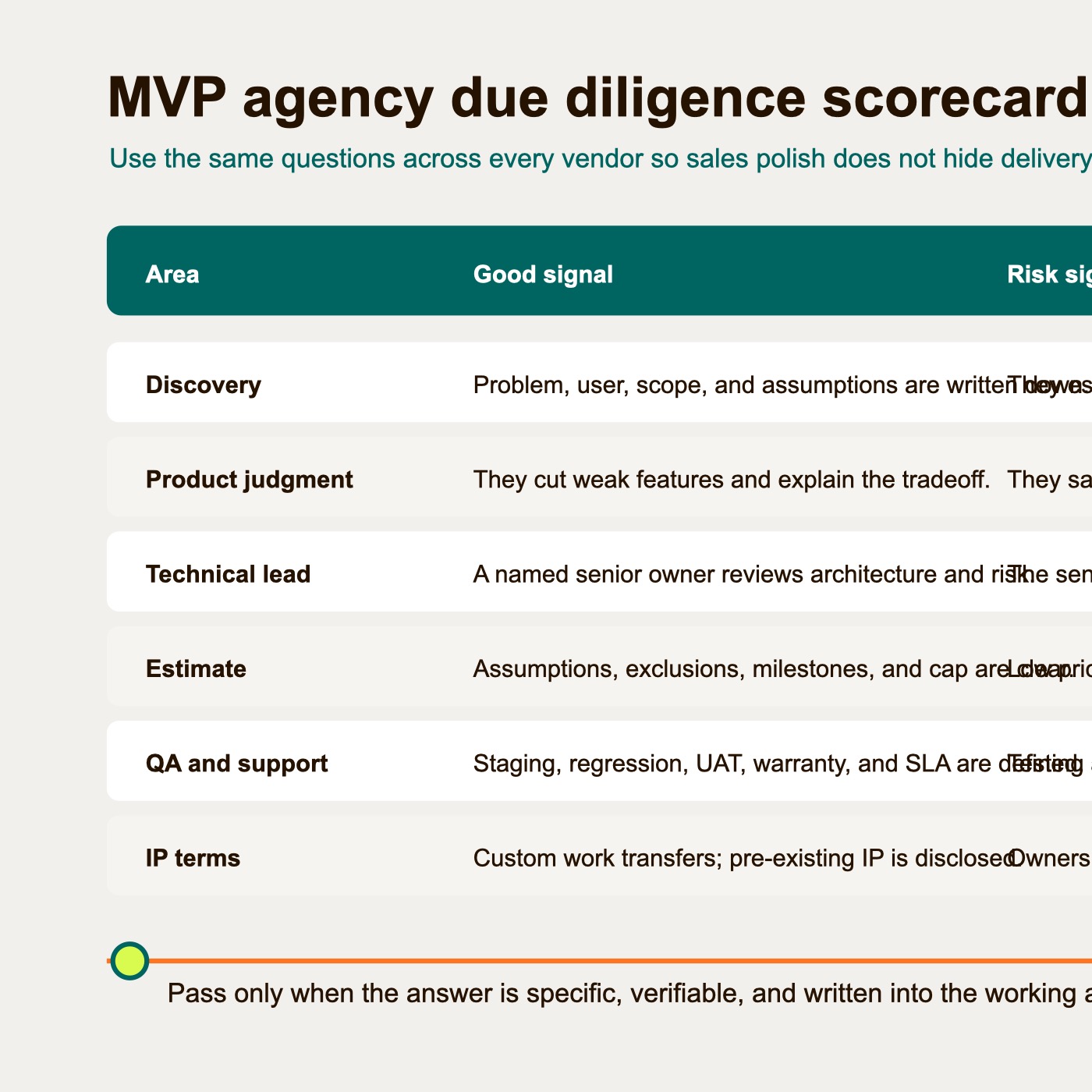
| Area | Good answer sounds like | Weak answer sounds like |
|---|---|---|
| Discovery | “We need to validate the user, core workflow, and first learning goal before estimating the build.” | “Send the feature list and we can start next week.” |
| Product judgment | “This feature may be a version-two item because it does not prove the riskiest assumption.” | “Yes, we can include that too.” |
| Technical leadership | “Here is the senior engineer or architect who will review scope, stack, security, and delivery risk.” | “Our team has many developers available.” |
| References | “You can speak with these two clients and test live products we built.” | “Everything is under NDA.” |
| Estimates | “The estimate is tied to assumptions, exclusions, milestones, and change-control rules.” | “We can do it for a flat price after one call.” |
| Communication | “You will get a weekly decision meeting, visible backlog, release notes, and one accountable lead.” | “We use Slack and move fast.” |
| QA | “QA is planned per sprint with test cases, staging, regression checks, and UAT.” | “Our developers test before launch.” |
| Support | “Bug warranty, response times, monitoring, and maintenance options are written into the agreement.” | “We can discuss support later.” |
| IP terms | “Custom code and design assets transfer to you, with disclosed pre-existing and open-source components.” | “You can use the product after payment.” |
If a vendor cannot answer these points clearly, do not treat the full build as the test. Run a narrow paid discovery, technical review, or prototype sprint first.
1. Discovery Process: Do They Start With the Problem?
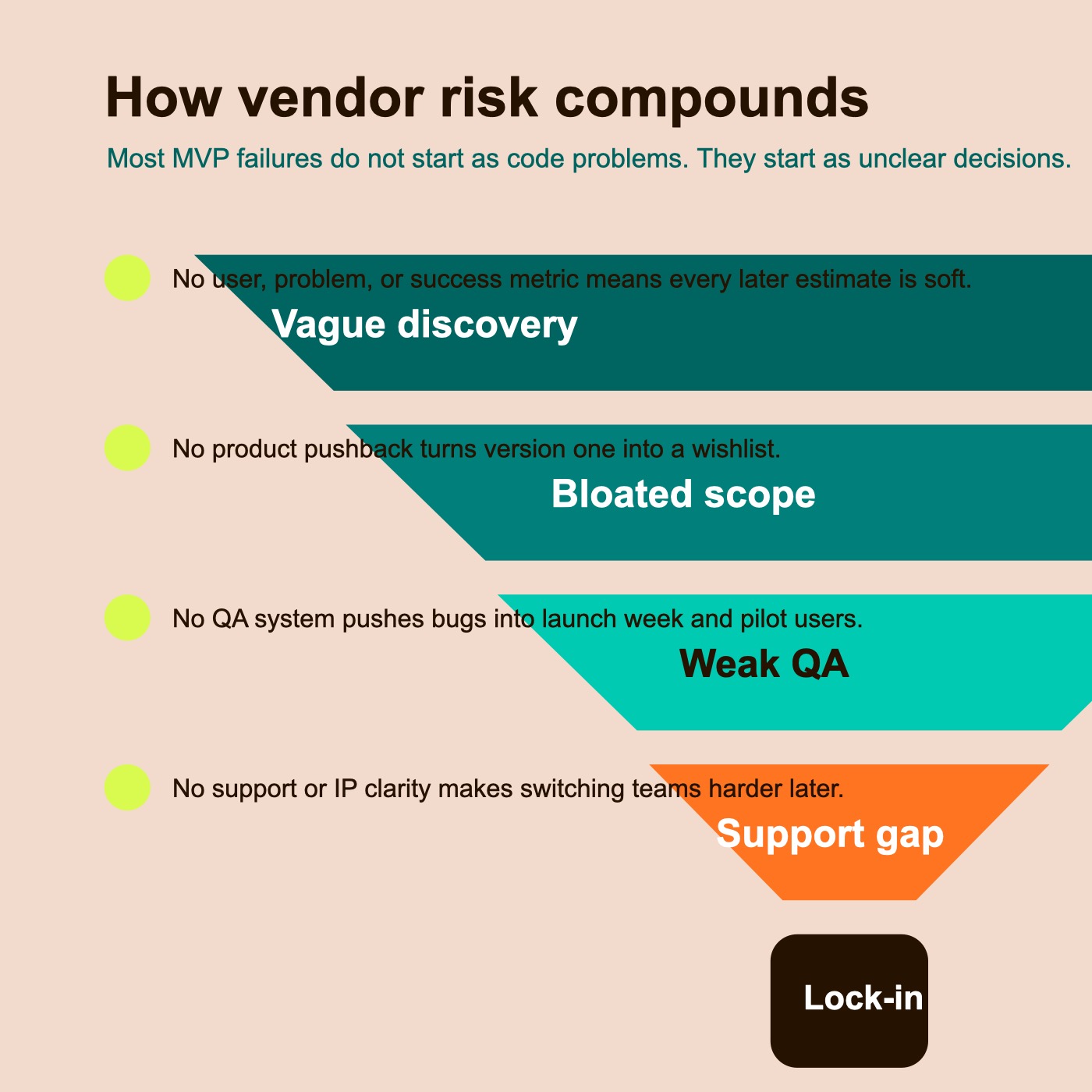
A serious MVP partner does not begin by accepting your feature list as the truth. They begin by turning the idea into a testable product decision.
The discovery process should clarify:
- Who the first user or buyer is.
- What painful workflow or job the product addresses.
- What the user does today instead.
- Which behavior would prove the MVP is worth extending.
- Which feature requests are outside the first learning goal.
- Which technical, compliance, data, or integration risks need early review.
Good discovery usually has a visible structure. The Design Council’s Double Diamond is one common model: teams expand the problem space, narrow the problem, explore possible solutions, then deliver the right version. Your vendor does not need to use that exact label, but they should be able to explain how they move from uncertainty to a buildable scope.
Good MVP development company questions:
- What happens in the first two weeks after we sign?
- What artifacts do we get from discovery?
- How do you decide what belongs in version one?
- How do you validate the user problem before building?
- What assumptions would make you recommend a prototype, concierge MVP, or smoke test instead of custom software?
Good answer sounds like:
“We start with a discovery sprint. We map the user, problem, current workaround, core workflow, success metric, and riskiest assumption. Then we turn that into a prioritized backlog, wireframes or prototype where useful, technical notes, and a scoped build plan. If the evidence is weak, we will recommend validation before code.”
Red flags:
- No discovery phase.
- A fixed price before scope is understood.
- No written assumptions.
- No backlog, acceptance criteria, or decision record.
- Treating every requested feature as equally important.
2. Product Judgment: Will They Push Back?
The fastest way to waste MVP budget is to hire a team that builds exactly what you ask for when what you asked for is too broad.
A good MVP agency should challenge scope respectfully. That does not mean being difficult. It means they understand that founders often bring a solution, while the market only pays for a solved problem. The partner should help you choose the smallest useful product, not the smallest pile of features.
Ask:
- Tell me about a project where you advised a client not to build a feature.
- What would you cut from this feature list?
- Which feature here is most likely to create technical debt?
- Which part of this product should we validate before building?
- What is the difference between a prototype, a POC, and an MVP in this case?
Good answer sounds like:
“For version one, I would cut the admin analytics dashboard, advanced roles, and secondary integrations. They may matter later, but they do not prove whether the core user will complete the primary workflow. I would build the first loop, instrument usage, and keep the data model ready for the next integration.”
That kind of answer shows product judgment. It connects scope to learning, not just effort.
If the product is still early, use Hapy’s guide to the product validation framework before a full MVP build. If the budget conversation is already active, compare your assumptions with the MVP development cost guide so you can separate real build cost from avoidable scope drag.
3. Technical Leadership: Who Is Actually Owning the Architecture?
When choosing an MVP developer, do not only ask whether the company can code. Ask who is making technical decisions.
Early-stage products need enough architecture to avoid a rebuild, but not so much architecture that the MVP becomes an enterprise platform. That balance requires senior technical judgment. The partner should be able to explain stack choices, data model tradeoffs, hosting, security basics, test strategy, integrations, and handoff plans in business language.
Ask:
- Who is the senior technical owner assigned to this project?
- How many hours per week will they actually spend on it?
- What architecture decisions will they personally review?
- How do you prevent senior people from disappearing after sales?
- How do you handle AI-assisted coding, code review, and license risk?
- What documentation will we receive if we switch teams later?
Good answer sounds like:
“The architect on the proposal is the person reviewing the first data model, integration plan, deployment approach, and key pull requests. We will not replace that person without your approval. If we use AI coding tools, every output still goes through normal review, tests, and dependency checks.”
Red flags:
- The sales call includes senior people, but the contract does not name the working team.
- The vendor claims deep expertise in every technology.
- The stack is chosen before the product constraints are known.
- There is no architecture note, deployment plan, or documentation commitment.
- The vendor cannot explain tradeoffs without jargon.
If you are non-technical or the build touches payments, sensitive data, AI workflows, regulated operations, or complex integrations, consider independent technical leadership. Hapy’s outsourced CTO guide explains when that kind of oversight is useful before and during vendor work.
4. References: Can You Verify Real Delivery?
References should confirm operational behavior, not just whether the vendor was pleasant.
As an illustrative diligence target, ask for two direct references from comparable projects; adjust the evidence needed to the engagement risk and legitimate confidentiality limits. Then ask questions that reveal how the agency behaved after the sale:
- Did discovery change the product scope?
- Were estimates realistic?
- Who actually worked on the project?
- How did the team handle bugs, delays, and change requests?
- Was the code easy to maintain after launch?
- Did the vendor transfer documentation and access cleanly?
- Would you hire them again for the same type of work?
Also test live products when possible. A portfolio screenshot does not tell you whether onboarding works, page speed is reasonable, errors are handled, or the product feels trustworthy.
Good answer sounds like:
“Here are two founders you can speak with. One project was a marketplace MVP and one was an internal workflow product. We can also walk you through public parts of the products and explain what we owned.”
Red flags:
- No references.
- Only anonymous testimonials.
- No live products.
- “Everything is under NDA” for every example.
- The vendor resists letting you speak to clients directly.
5. Estimates: Are Assumptions, Exclusions, and Change Rules Clear?
The estimate is where many MVP agency due diligence processes break down. A founder asks, “How much will this cost?” The agency answers with confidence. Everyone feels progress. Then discovery, UX, integrations, edge cases, QA, and support reveal the real scope.
A useful estimate should include:
- Workstreams.
- Assumptions.
- Exclusions.
- Roles and rates, if time-and-materials.
- Milestones or release checkpoints.
- Client responsibilities.
- Acceptance criteria.
- Change-control rules.
- A risk buffer or contingency.
- What happens if budget runs out before all features are done.
Fixed discovery followed by a flexible build plan with budget controls is one option for uncertain scope; compare it with other models against the actual risks. Pure fixed price can work for a narrow, stable scope, but it can become adversarial when the product changes. Time-and-materials can work when the team is transparent, but it needs a visible backlog and a not-to-exceed budget or decision gates.
Good answer sounds like:
“We can price discovery as a fixed sprint. After that, we will estimate the MVP by release, show assumptions, and define what happens when scope changes. If we use time-and-materials, you will see hours, backlog status, and forecasted burn weekly. We will not spend beyond the agreed cap without approval.”
Red flags:
- A dramatic low-ball estimate.
- 100 percent upfront payment.
- No written exclusions.
- No acceptance criteria.
- Change requests handled only after conflict appears.
- Calendar-based milestones with no working deliverable.
6. Communication: Is the Operating Rhythm Visible?
Communication problems usually show up before the contract. Slow follow-up, vague agendas, unclear owners, and inconsistent answers during sales rarely improve after payment.
Ask:
- Who is our day-to-day lead?
- How often do we meet?
- Where do we see backlog, priorities, risks, and decisions?
- What does a weekly update include?
- How are blockers escalated?
- How do you document tradeoffs and scope changes?
- Who has authority to approve changes?
Good answer sounds like:
“You will have one accountable lead. We run a weekly decision call, maintain a shared backlog, show current sprint priorities, flag risks early, and send release notes when working software is available. Scope changes are written down with cost, timeline, and product impact before approval.”
Red flags:
- No dedicated project lead.
- No shared backlog or project board.
- No written meeting notes.
- Decisions disappear into chat.
- The vendor cannot explain how scope changes are approved.
7. QA: Do They Test Like a Product Team?
QA should not be a last-week activity. It should be part of the delivery system.
At minimum, ask how the vendor handles:
- Staging environments.
- Manual QA.
- Regression testing.
- User acceptance testing.
- Error logging.
- Security checks.
- Browser and device coverage.
- Release notes.
- Bug severity levels.
For security, ask whether they use static and dynamic testing where appropriate. OWASP describes source code analysis as a way to inspect code for security issues without running it, while dynamic testing checks the running application from the outside. You do not need enterprise ceremony for every MVP, but you do need a partner that treats security and quality as design constraints, not launch-day polish.
Good answer sounds like:
“Each sprint includes QA. Developers write tests for critical logic, QA checks the user flow in staging, and the founder or pilot users complete UAT before release. We log defects by severity and run regression checks before launch. For sensitive products, we add security scans and a deployment review.”
Red flags:
- “Our developers test their own work” as the full QA plan.
- No staging environment.
- No bug tracker.
- No regression testing.
- No clear launch checklist.
- No plan for authentication, permissions, data handling, or secrets.
For usability testing, small focused rounds are better than waiting for a perfect sample. Nielsen Norman Group’s guidance on testing with five users is often cited because it pushes teams toward repeated rounds of observation instead of one late, oversized test. The practical lesson for MVPs is simple: test the core flow early enough to change it.
8. Support: What Happens After Launch?
An MVP launch is not the finish line. It is when real users start finding the gaps.
Before signing, clarify:
- Is there a bug warranty?
- How long does it last?
- What counts as a bug versus a change request?
- What support channels are available?
- What are response times for critical issues?
- Who monitors uptime, errors, and infrastructure cost?
- Who applies security and dependency updates?
- What happens if the agency is unavailable?
Good answer sounds like:
“We include a 30- to 90-day bug warranty for defects in delivered scope. Production incidents are classified by severity. Critical issues get a faster response than low-priority improvements. Maintenance, monitoring, and feature iteration can continue under a separate support plan.”
Red flags:
- “Support is not included” with no alternative.
- No warranty language.
- No severity levels.
- No access handoff.
- No infrastructure documentation.
- No plan for dependency updates.
The support conversation also reveals whether the vendor expects the product to live beyond launch. A team that cannot explain maintenance probably is not thinking about ownership.
9. IP Terms: Will You Own the Work?
IP terms are not a legal formality for startups. They affect fundraising, acquisition diligence, future hiring, and your ability to switch vendors.
Get legal counsel, but make sure the contract answers these business questions:
- Who owns custom source code, designs, documentation, database schema, and product assets?
- When does ownership transfer?
- What happens if an invoice is disputed?
- Which pre-existing vendor libraries or templates are being used?
- What license do you receive for those pre-existing components?
- Which open-source packages and third-party APIs are included?
- Are there copyleft license risks?
- Can the vendor reuse your product-specific code or data?
- What must be handed over on termination?
The U.S. Copyright Office explains work made for hire as a specific copyright category, and contractor work does not automatically fall into it just because a company paid for the work. The practical takeaway is not to rely on assumptions. Put assignment, licensing, and handoff terms in the agreement.
Good answer sounds like:
“All custom work product created for the project transfers to you upon payment. We disclose pre-existing components and grant a perpetual license to use them inside your product. We provide source code, documentation, credentials handoff, deployment notes, and dependency information at termination or launch.”
Red flags:
- Vague ownership language.
- The agency keeps ownership and only gives you a use license.
- No disclosure of pre-existing IP.
- No open-source dependency list.
- No handoff obligation if the agreement ends.
- The vendor resists standard NDA, confidentiality, or assignment terms.
Run a Paid Pilot Before the Full Build
If the agency looks promising but the decision still feels risky, run a paid pilot. This is not free spec work. It is a narrow, paid engagement designed to test how the vendor thinks and works before you commit the full MVP budget.
A useful pilot can include:
- Discovery and product scope.
- User flow map.
- Clickable prototype.
- Technical feasibility review.
- Architecture note.
- One narrow feature build.
- Code review of an existing codebase.
- QA plan and launch checklist.
The pilot should end with a decision: proceed, adjust scope, choose another partner, or validate the market before building.
Good answer sounds like:
“A two-week pilot can produce a scoped backlog, prototype, architecture note, estimate, and delivery plan. If either side decides not to continue, you keep the artifacts and can use them elsewhere.”
That is the right posture. A confident partner does not need to trap you. They should be willing to create portable value early.
A Practical MVP Agency Due Diligence Checklist
Use this checklist before signing.
| Check | Pass condition |
|---|---|
| Discovery | Vendor can explain the first two weeks, deliverables, and how assumptions become scope. |
| Product judgment | Vendor challenges unnecessary features and ties scope to learning. |
| Technical leadership | Named senior owner reviews architecture, security, stack, and delivery risk. |
| References | At least two direct references and live work are available for review. |
| Estimate | Assumptions, exclusions, milestones, change rules, and budget controls are written down. |
| Communication | One accountable lead, shared backlog, weekly decision rhythm, and documented changes. |
| QA | Staging, QA, regression, UAT, bug severity, and launch checklist are defined. |
| Support | Warranty, response times, monitoring, maintenance, and handoff terms are clear. |
| IP terms | Custom work ownership, pre-existing IP, open-source use, and termination handoff are explicit. |
Do not use a count of weak areas as a validated pass/fail rule. One unresolved essential security, ownership, or continuity issue can block the full build. Resolve material uncertainty with written evidence or a bounded evaluation before committing.
How to Choose an MVP Developer Without Overbuying
The right MVP partner depends on the risk you are trying to reduce.
Choose a focused builder when the problem is clear, the scope is narrow, and you mainly need execution.
Choose an MVP development company when you need product shaping, UX, engineering, QA, and launch support working together.
Add outsourced CTO or technical leadership when the founder cannot independently judge architecture, estimates, security, vendor quality, or technical hiring.
Do not buy a large team when the product still needs validation. Do not buy strategy when the work is already clear. Buy the smallest credible team that can own the real risk.
For a founder, the best way to vet MVP development company options is to watch how each vendor behaves before the contract. Do they slow down the right decisions? Do they challenge scope? Do they name assumptions? Do they make quality visible? Do they put ownership in writing?
That is the difference between hiring people to write code and hiring a partner to help you make version one worth building.
The sample answers, two-week pilot, and 30–90-day warranty above are negotiable examples, not universal standards or promises of Hapy delivery terms. Choose pilot outputs that fit available staff, access, and review time; a complete backlog, prototype, architecture, and estimate may require more than two weeks. Distinguish incident response from defect correction and specify both explicitly.
The work-made-for-hire discussion is U.S.-specific. Ask counsel to assess governing law, assignments, contractor rights, background-IP licenses, open-source obligations, and termination terms for the actual parties. Review observable artifacts and references rather than relying on the illustrative answers as proof of any provider’s performance.