MVP development expectations usually start with a clean story: define the core idea, build a small version, launch quickly, collect feedback, and decide what to do next. The reality is messier, but not necessarily worse. A useful MVP is not a tiny finished product. It is a controlled learning system.
The expectation gap appears when founders treat the MVP as proof that the whole company works. In practice, the first release only proves a narrower question: can a specific user complete a specific workflow, receive enough value to care, and give the team evidence worth acting on?
That shift changes the job. MVP development becomes less about compressing the full roadmap and more about protecting the first learning loop. Timelines move because requirements get clearer. Scope shrinks because the evidence path matters more than feature count. Bugs appear because real users do things staging never predicted. Feedback gets uncomfortable because polite approval is not the same as adoption. Pivots become possible because the team finally has contact with reality.
The calm version is this: expect the MVP to challenge your assumptions. That is the point.
If you are already past launch, use the post-MVP roadmap guide to turn early signal, bugs, feedback, and support themes into the next build cycle.
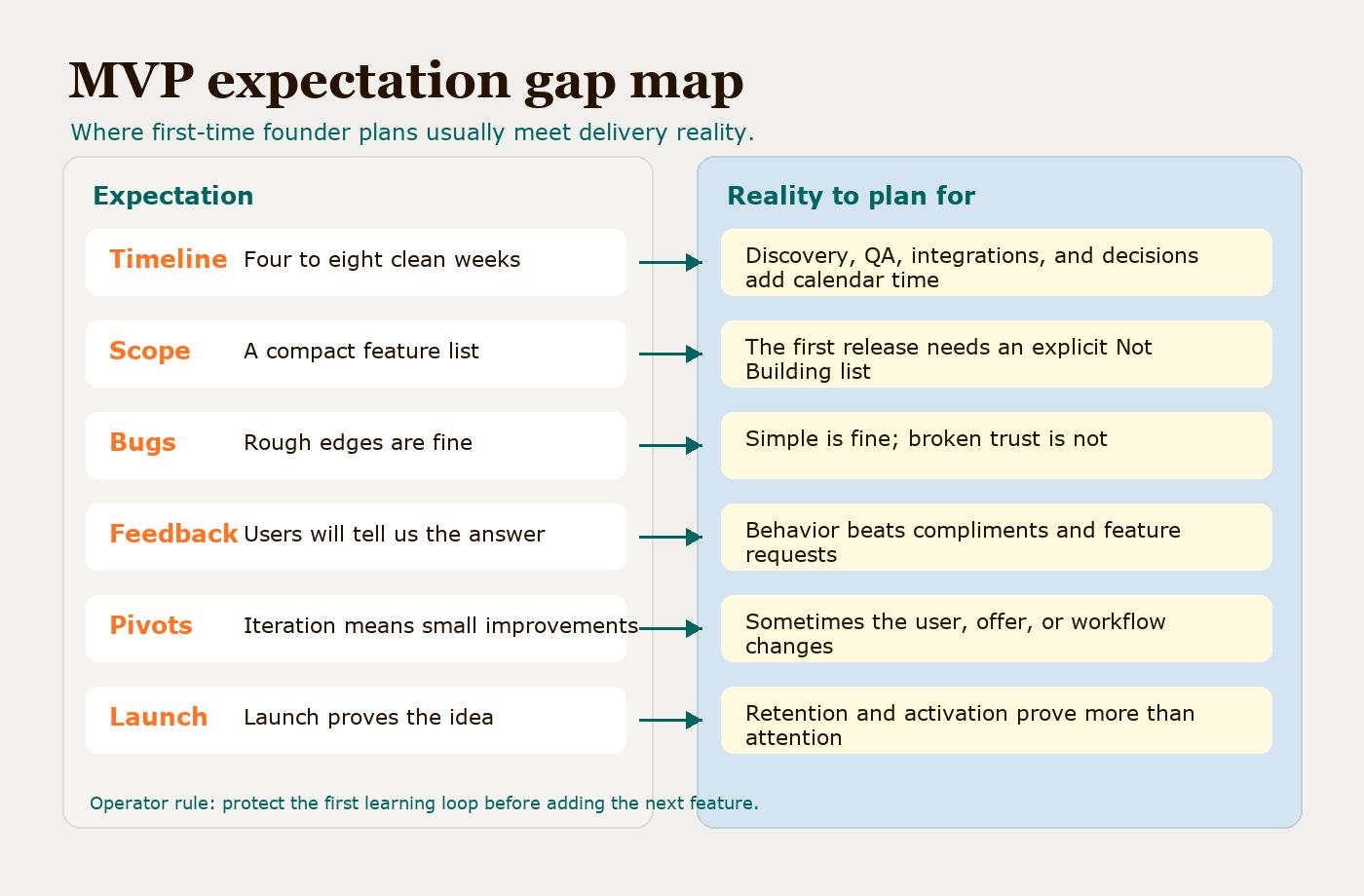
MVP development expectations vs reality
Most MVP development mistakes come from expecting version one to behave like a small version of the final platform. It will not. Version one is a first operating draft of the business, product, and technical system.
Here is the more useful expectation set:
| Area | Common expectation | What usually happens |
|---|---|---|
| Timeline | “A few weeks if we keep it simple.” | Discovery, design decisions, QA, integrations, and founder review add real time. |
| Scope | “We only need the obvious must-haves.” | The “must-have” list grows until someone actively cuts it. |
| Bugs | “Early users will tolerate rough edges.” | Users tolerate simple products better than broken workflows. |
| Feedback | “People will tell us what to build next.” | People give mixed requests; behavior and commitments matter more. |
| Pivots | “We will launch, learn, and improve.” | Sometimes the learning says the customer, offer, workflow, or business model needs to change. |
| Technical debt | “We can clean it up later.” | Some debt is fine; foundational debt slows every future change. |
| Launch | “Launch will tell us if the idea works.” | Launch gives attention. Retention, activation, and payment tell you more. |
This is why Hapy’s broader guide to MVP development challenges starts before code. Scope, analytics, QA, integrations, and maintenance decisions have to be shaped before the team is already halfway through the build.
Eric Ries defined the minimum viable product as the version that lets a team collect the most validated learning with the least effort, and he was explicit that the term is not about simply making a minimal product. It requires judgment, customer contact, and measurement. That point still gets missed because “minimum” is easier to sell than “validated learning.”
The timeline will include more than build time
The first timeline mistake is counting only development days. An MVP timeline also includes discovery, product decisions, design, technical setup, integration work, QA, launch preparation, feedback review, and the first post-launch iteration.
In an illustrative planning scenario, a four-week build-only estimate might become a ten- or twelve-week end-to-end plan. This is not an expected multiplier or delivery benchmark. The team may discover that the login flow needs different roles, the billing model affects onboarding, the first user segment is not the buyer, or the “simple” API has rate limits and webhooks that need careful handling.
For a normal software MVP, founders should separate the plan into five buckets:
| Bucket | What it includes | Founder risk if rushed |
|---|---|---|
| Discovery | user, pain, workflow, evidence question, constraints | building the wrong product cleanly |
| Scope | must-have path, not-building list, release boundary | turning version one into version five |
| Build | core frontend, backend, integrations, admin basics | fragile implementation and rework |
| QA and launch | staging, regression, mobile checks, analytics, support setup | losing trust before learning anything |
| Iteration | bug fixes, user interviews, funnel review, roadmap decision | treating launch traffic as validation |
If you need budget ranges as well as timing, use the MVP development cost guide before locking scope. Cost and timeline move together because each extra feature creates design, engineering, QA, analytics, support, and maintenance work.
The practical planning rule: estimate the build, then add time for decisions and proof. If founder review is slow, if integrations are unknown, or if the first release needs payment, permissions, sensitive data, or AI outputs, the calendar should not pretend those risks are free.
Scope will feel smaller than your vision
A strong MVP usually feels uncomfortably narrow. That is normal. The purpose is not to represent the full business vision. The purpose is to isolate the first proof point.
Founders often say they want a simple MVP, then list features for every future customer segment: onboarding, dashboards, user roles, notifications, reports, billing, admin tools, integrations, and settings. Each item sounds reasonable. Together, they create a broad product that is harder to test and slower to change.
The fix is not to ask, “What features do we need?” first. Ask:
- Who is the first user allowed to be?
- What painful workflow are we solving for that user?
- What action would prove the product created value?
- What has to work for that action to happen?
- What can be manual, delayed, or excluded without weakening the test?
This is where agile MVP development helps when it is used properly. The Agile Manifesto values working software, customer collaboration, and responding to change, but agile does not protect a founder from weak scope discipline by itself. Agile can also become a faster way to build too much.
Keep a written “Not Building” list beside the backlog. It should name the features the team is intentionally excluding from version one. This is not pessimism. It is how you protect runway and keep the first learning loop readable.
Bugs are not the problem; broken trust is
Founders sometimes hear “MVP” and assume early users will tolerate anything. That is only partly true. Early users may accept a plain interface, a manual workaround, or a limited feature set. They are much less forgiving when the product loses their data, blocks the core workflow, crashes during onboarding, sends the wrong email, or makes payment feel unsafe.
The quality bar should match the risk of the workflow. A reporting filter can be rough. Authentication, billing, permissions, data capture, notifications, and the core value path need more discipline because they shape trust.
Use this rule:
| Product area | MVP shortcut that can be acceptable | Shortcut that creates real risk |
|---|---|---|
| UI polish | standard components, limited animation, fewer layouts | confusing primary action or unreadable mobile flow |
| Admin work | manual internal tools, spreadsheets, low-volume operations | no audit trail for money, access, or customer support |
| Integrations | simple vendor setup for non-critical workflows | no fallback for payment, auth, or data-sync failures |
| Analytics | focused event tracking for the core funnel | no visibility into activation, drop-off, errors, or retention |
| Architecture | simple architecture around one workflow | messy foundations for identity, data ownership, or billing |
Technical debt belongs in the same conversation. Some debt is strategic because it lets the team learn faster. Unmanaged debt is different. Record each deliberate shortcut, its operational consequence, an owner, and the condition that triggers repayment. Include the expected cleanup work in later estimates rather than treating it as free.
For an MVP, the operator move is not “avoid all debt.” It is “choose where debt is allowed.” Take shortcuts in throwaway surfaces. Be careful with foundations that will become expensive to replace.
Feedback will be noisier than expected
A launch does not automatically produce clear feedback. It produces signals, requests, complaints, compliments, and silence. The founder’s job is to separate them.
Compliments are weak signal. Feature requests are useful but often local to one user’s habits. The best feedback is behavioral: users complete the workflow, return without being chased, invite a teammate, pay, introduce you to a buyer, or show you the workaround they were already using before your product existed.
Encouragement is not the same as validation. The dangerous sentence is “Everyone I showed it to loved it.” The useful follow-up is “What did they do after they saw it?”
Better discovery questions sound like this:
| Weak question | Better question |
|---|---|
| “Would you use this?” | “How do you solve this today?” |
| “Do you like the idea?” | “When did this last create a problem for you?” |
| “Would you pay for it?” | “What do you currently spend in time, money, or manual work?” |
| “What features should we add?” | “Where did the current workflow break or feel slow?” |
After launch, pair interviews with product telemetry. A product-dependence survey can ask how users would feel if they could no longer use the product. Survey people who have experienced the core value, state the eligibility and usage window, report response counts and response rate, and separate relevant user segments. A small or self-selected sample cannot establish product-market fit, and this guide does not use a universal percentage gate. For most MVPs, activation, retention, payment intent, and support themes will tell the story earlier.
Pivots are part of the work, not proof of failure
Founders often expect feedback to refine the product. Sometimes it does something harder: it changes the target customer, use case, pricing, positioning, or product shape.
That is a pivot. It should not be romanticized, but it should not be treated as shameful either. Repeated evidence may show that the first build targets the wrong person, the wrong pain, or an unworkable business model. Record which assumption failed and what alternative the next experiment will test.
The cheapest pivot is usually positioning. The most expensive pivot is a platform rewrite. Founders can protect themselves by designing the MVP around evidence rather than completeness:
| Pivot type | What changes | How to reduce cost |
|---|---|---|
| Positioning pivot | message, audience language, offer framing | keep landing pages and sales collateral easy to change |
| Segment pivot | first customer group or buyer | avoid hard-coding workflows around too many personas |
| Feature pivot | one feature becomes the product | instrument feature usage from the start |
| Business-model pivot | pricing, packaging, buyer, channel | test willingness to pay before broad buildout |
| Technical pivot | architecture, data model, platform | keep foundations clean where future scale depends on them |
The mistake is not pivoting. The mistake is waiting so long that the pivot consumes the remaining runway.
Launch outcomes are usually less dramatic than the story
Launch day is not the finish line. It is a test of the product’s ability to turn attention into usage.
Founders often expect a visible launch to produce market clarity. But upvotes, comments, waitlist signups, and launch traffic are attention metrics. They matter, but they do not prove retention. A quiet launch with ten serious users can be more valuable than a loud launch with hundreds of shallow visits.
The first two weeks after launch should be operated like a control room:
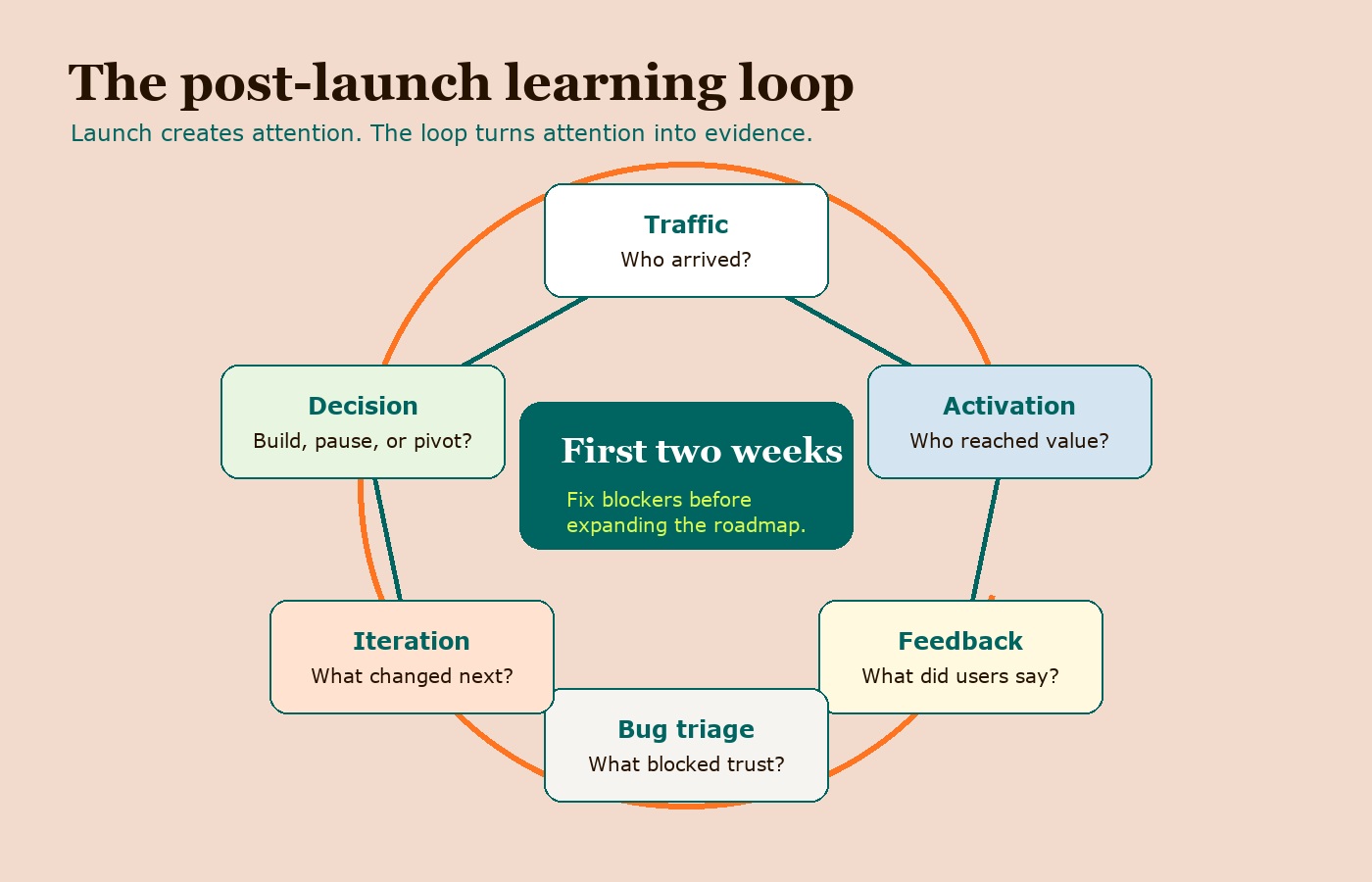
- Watch the activation funnel daily.
- Review failed sessions, support messages, and dropped workflows.
- Fix blocking bugs before adding new features.
- Interview the users who completed the core action.
- Interview the users who abandoned halfway.
- Decide what the next release is meant to prove.
This is where launch outcomes become useful. Not because they declare success or failure, but because they show what deserves the next week of work.
What founders should expect building an MVP
Founders should expect MVP development to be a series of tradeoffs, not a straight path from idea to launch. A realistic version one will usually be smaller than the founder’s vision, more dependent on decisions than the estimate suggests, and more revealing after launch than before it.
Use this operating checklist before you commit the build:
| Question | Good answer |
|---|---|
| What must version one prove? | One clear learning goal tied to user behavior or payment. |
| Who is the first user? | A narrow segment with a real pain and reachable access. |
| What is the core workflow? | One path from trigger to value, not a menu of features. |
| What will we not build? | A written exclusion list reviewed every sprint. |
| What quality cannot fail? | Auth, data, billing, permissions, core task, and analytics. |
| What feedback counts? | Behavior, retention, payment, introductions, and repeated use. |
| What happens after launch? | A two-week loop for bug triage, user learning, and roadmap decisions. |
The article on MVP development challenges can help you pressure-test the build risk. The MVP development cost guide can help you budget the work around evidence, not wishful feature volume. The agile MVP development guide can help keep iteration from becoming a faster build trap.
If you are still shaping version one, Hapy’s MVP Development work is built around the same discipline: narrow the first release, protect the learning loop, and build enough product to get honest market signal before the roadmap gets expensive.
FAQ
What is a realistic MVP development expectation?
A realistic MVP development expectation is that version one will be narrow, imperfect, and evidence-driven. It should prove one important user behavior before the team adds broader scope. The goal is not to impress every possible customer. It is to learn whether a specific product path deserves more investment.
Should an MVP have bugs?
An MVP can have rough edges, but it should not have bugs that break trust or block the core workflow. Users may tolerate limited functionality. They rarely tolerate broken onboarding, lost data, failed payments, confusing permissions, or a product that cannot explain what went wrong.
What should happen after an MVP launch?
After an MVP launch, the team should review activation, drop-offs, support issues, user interviews, retention, and payment signal. The first post-launch sprint should usually fix blockers and sharpen the core workflow before adding new features.
When should founders pivot after an MVP?
Founders should consider a pivot when the evidence consistently points away from the original user, pain point, offer, pricing, or workflow. A pivot should be based on behavior and customer evidence, not one loud opinion or one disappointing launch day.