A product validation framework should reduce the biggest uncertainty before a founder spends serious money on software. It should not collect vague praise, run a survey that asks people to imagine future behavior, or treat an MVP as the first time the market gets a vote.
The practical question is not, “Do people like the idea?” It is, “What evidence would make us confident enough to build the next smallest version?” For most startup founders, that evidence comes from a sequence of low-cost tests across demand, usability, feasibility, and willingness to pay. A focused product discovery sprint can turn those signals into a customer choice, risk map, validation step, and version-one boundary.
This guide is written for founders deciding whether to build an MVP, run a prototype test, recruit design partners, or stop before development. If you are already comparing validation steps, Hapy’s guide to POC vs prototype vs MVP explains where each format fits. If you are ready to define the build scope, use the MVP development checklist before moving into MVP development.
Once the product is live, the MVP investor metrics guide helps separate real activation, retention, conversion, and learning signals from signup or traffic numbers that cannot guide the next decision.
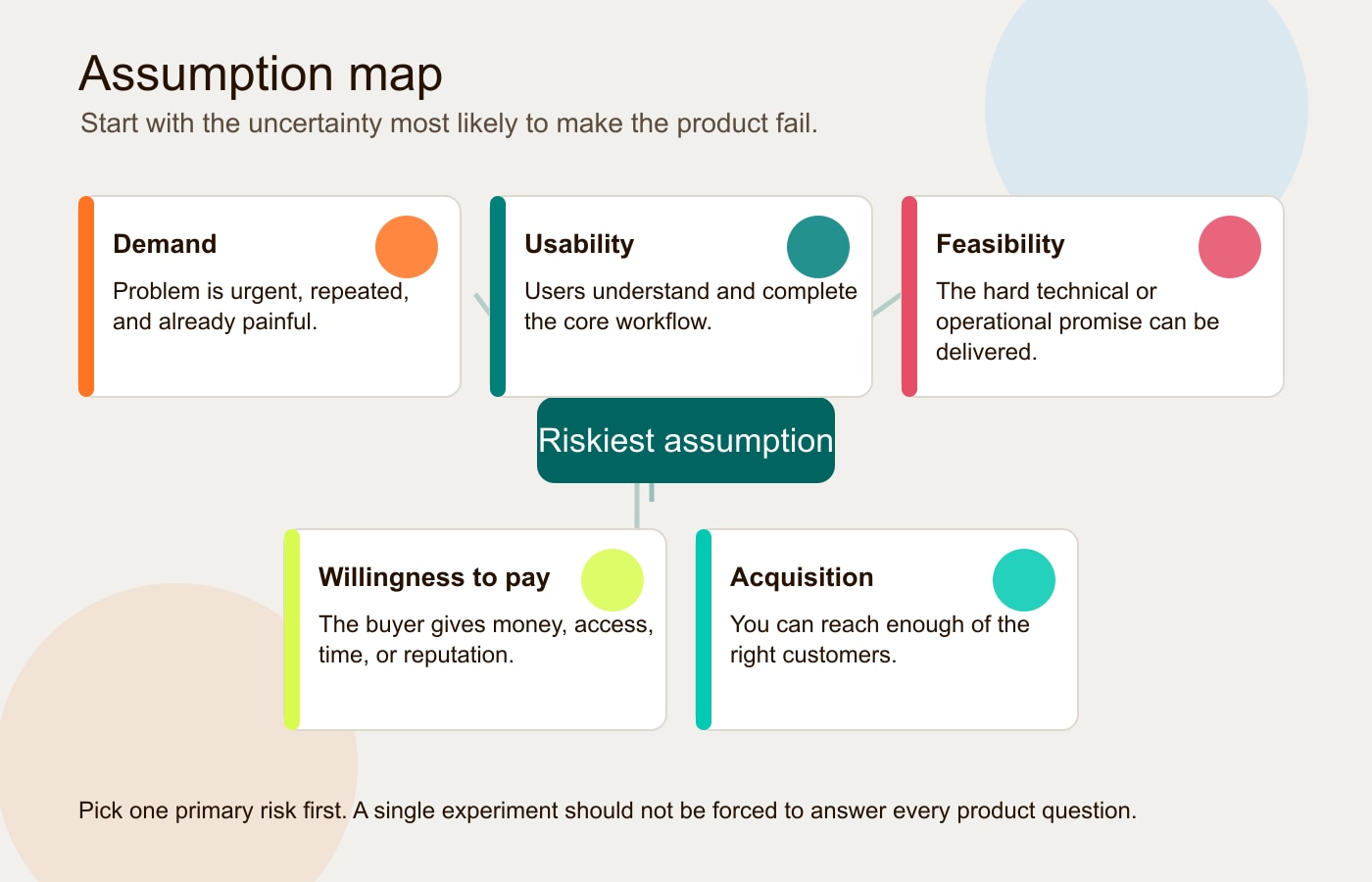
Start With the Riskiest Assumption
Product validation starts by naming the assumption that would make the product fail if it were false. That assumption is rarely “can we build it?” In early-stage software, the harder questions are usually whether the problem is urgent, whether the buyer will change behavior, whether the workflow is usable, and whether someone will pay enough to justify the product.
Harvard Innovation Labs frames demand validation around three questions: does the customer recognize the problem, are they actively seeking a solution, and do they have budget to solve it? That is a useful starting point because it moves the conversation away from founder conviction and toward customer priority.
An assumption map keeps the team honest:
| Assumption Type | What You Need to Know | Weak Evidence | Stronger Evidence |
|---|---|---|---|
| Demand | Does the target customer have an urgent problem? | “That sounds useful” | Repeated ICP interviews describe the same painful workflow without prompting |
| Usability | Can users understand and complete the core flow? | People like the mockup | Users complete the task in a clickable prototype with low confusion |
| Feasibility | Can the team deliver the promise with acceptable cost and risk? | Engineers think it is possible | A proof of concept confirms the hardest integration, data, AI, or workflow constraint |
| Willingness to pay | Will the buyer commit budget, time, or reputation? | Survey says they might pay | Deposit, paid pilot, signed LOI, pre-order, or design-partner agreement |
| Acquisition | Can you reach enough of the right people? | Big TAM slide | Repeatable channel produces qualified conversations or waitlist signups at tolerable cost |
The first validation experiment should test the assumption with the highest combination of uncertainty and consequence. If the product depends on a buyer changing budget, test payment intent before polishing UX. If the product depends on a new workflow, test behavior before pricing. If the product depends on a risky technical integration, run a POC before selling a delivery timeline.
Use Commitment, Not Compliments
The central trap in startup validation is mistaking encouragement for evidence. People are polite. They like helping founders. They may even believe they would use the product someday. None of that proves demand.
Alberto Savoia’s pretotyping work is useful here because it focuses on whether a specific market will take a specific action. In other words, a good validation hypothesis should name the segment, the observable behavior, and the threshold for a decision. “Founders need better product validation” is not testable. For a hypothetical test, “At least 8 of 40 seed-stage B2B founders will book a 30-minute validation review after seeing a landing page with a $500 offer” is testable.
That does not mean every test needs payment. It means every test needs a cost to the customer. The cost can be attention, time, data, reputation, internal access, or money.
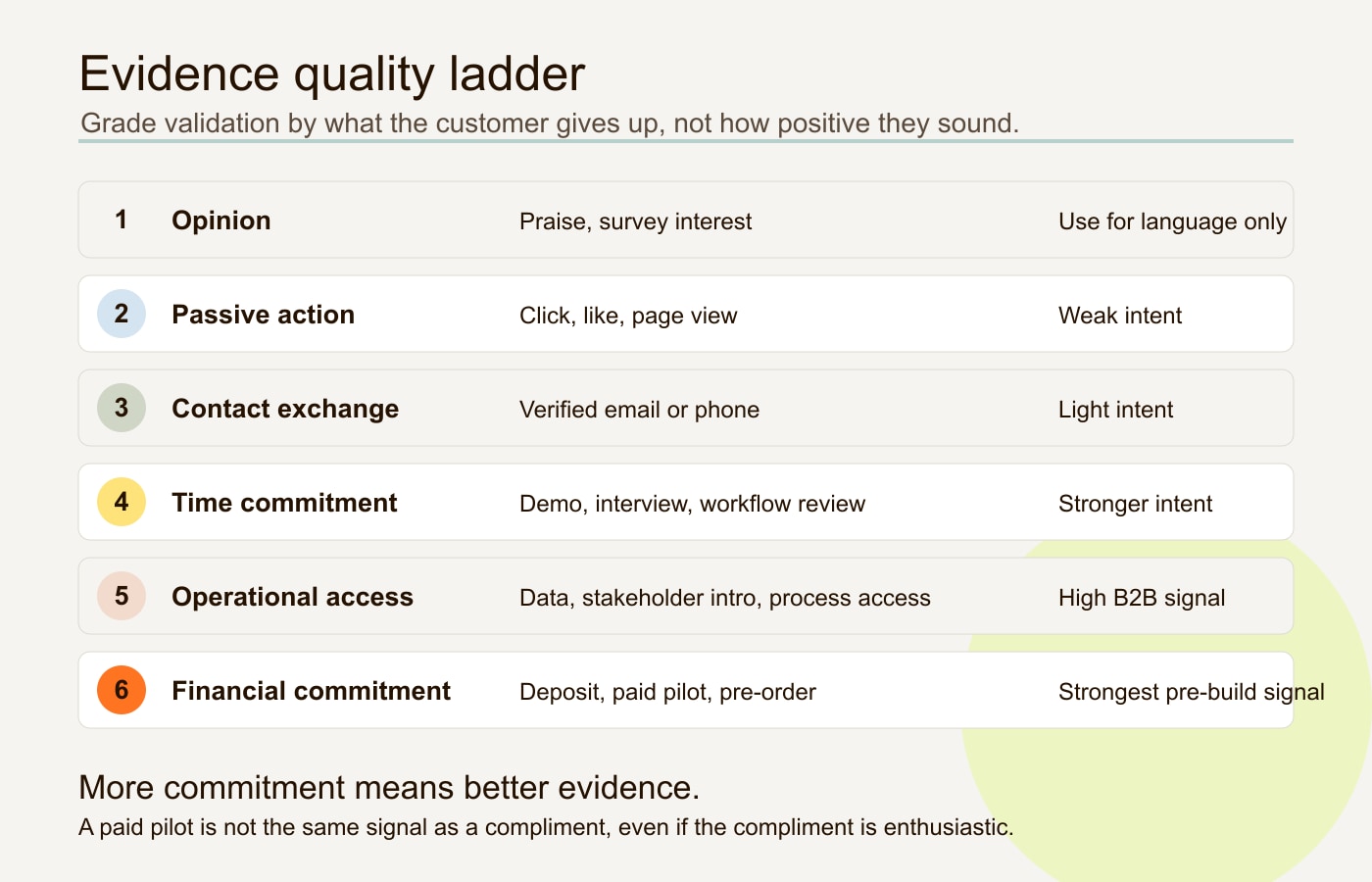
| Evidence Quality | Example Signal | How to Interpret It |
|---|---|---|
| Opinion | “Great idea, keep me posted” | Useful for language, not for demand |
| Passive action | Click, like, upvote, page view | Interest exists, but intent is weak |
| Contact exchange | Verified email or phone number | A light signal if the audience is qualified |
| Time commitment | Scheduled call, live demo, workflow walkthrough | Stronger because the prospect gives up calendar time |
| Operational access | Data sample, workflow access, internal stakeholder intro | Strong B2B signal because the customer accepts friction |
| Financial commitment | Deposit, paid pilot, pre-order, signed contract | Strongest demand signal before full product build |
Use the evidence quality ladder to avoid overreacting to weak signals. A landing page with a 10 percent email conversion rate may be encouraging, but if none of those people answer follow-up calls, the real signal is lower. A single paid pilot can be more informative than 500 anonymous survey responses if the buyer fits the ICP and the use case repeats.
Match the Method to the Risk
A product validation framework works only if the experiment matches the decision. Founders often pick the method they know how to run, then force the result to answer a different question. Customer interviews cannot prove conversion. A landing page cannot prove usability. A prototype cannot prove willingness to pay unless the test includes a real commitment.
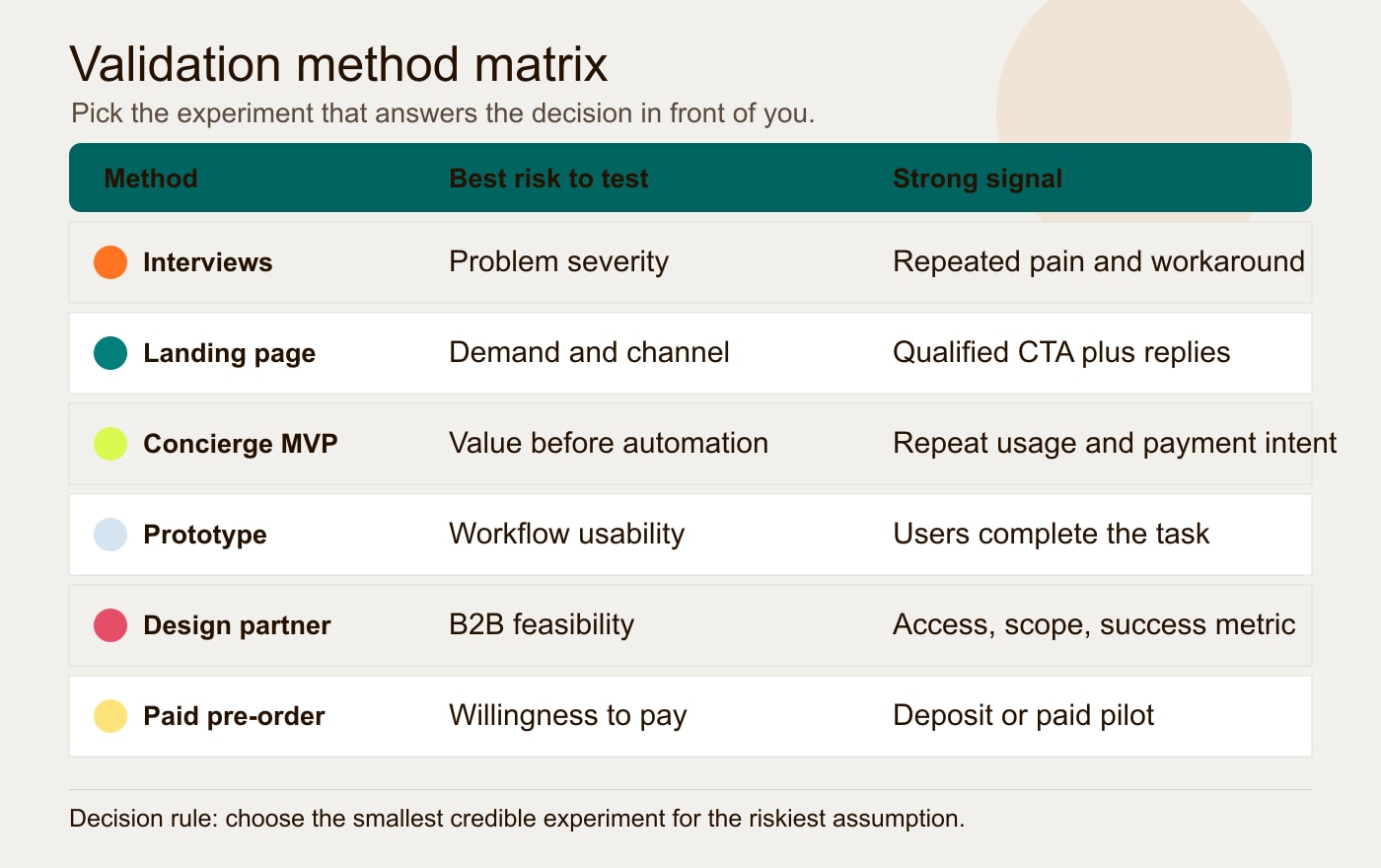
Use this validation method matrix to choose the smallest credible test:
| Validation Method | Best For | Primary Metric | Illustrative continuation signal | Stop or Pivot Signal |
|---|---|---|---|---|
| Problem interviews | Problem severity and current workarounds | Repeated pain pattern across ICP conversations | 8 to 12 qualified interviews reveal the same painful workflow, current workaround, and budget owner | Responses stay abstract, low-priority, or different across segments |
| Landing page test | Demand, positioning, and channel access | Qualified CTA conversion and follow-up response | 3 to 10 percent qualified CTA conversion, plus real replies or bookings from the right audience | Clicks arrive from the wrong audience, or leads ignore follow-up |
| Concierge MVP | Value delivery before automation | Repeat usage, manual effort, willingness to pay | 5 to 10 ICP users complete the manual workflow, request repeats, and identify what they would pay for | Every delivery is custom, value is unclear, or users will not repeat |
| Clickable prototype | Usability and workflow comprehension | Task completion, time on task, confusion points | 5 comparable users complete the core task and failures cluster around fixable UI issues | Users cannot understand the concept, not just the interface |
| Design-partner pilot | B2B feasibility, buying process, and integration risk | Active partner participation and success criteria | 3 to 5 partners agree on scope, success metrics, access, and commercial next step | Partners only want free consulting or endless feature influence |
| Paid pre-order | Willingness to pay and urgency | Deposit, pre-order, signed paid pilot | Buyers commit money before the product exists, with transparent delivery and refund terms | Interest disappears when price, timeline, or deposit appears |
The thresholds above are illustrative decision rules, not universal benchmarks or statistically validated pass marks. A regulated enterprise product may need fewer but much stronger signals. A consumer product may need larger numbers because lightweight clicks are cheap. The point is to define the threshold before the test starts so the team cannot move the goalposts after seeing mixed results.
Five Product Validation Experiments Founders Can Run
The best experiment is the one that makes the next build decision clearer. These five cover most pre-MVP situations.
Concierge MVP
A concierge MVP delivers the promised outcome manually to a small group of target users. It is useful when the founder needs to know whether the result is valuable before automating the workflow. Learning Loop’s concierge experiment play describes this as a way to validate the value proposition before a team invests in scalable automation.
Use it when the product promise is service-like, workflow-heavy, or AI-assisted. For example, instead of building an automated reporting platform, manually create weekly reports for 5 to 10 marketing agencies. Track what data they provide, what they question, what they reuse, how long delivery takes, and whether they ask for the next report.
Illustrative pilot thresholds to adapt before testing:
- At least 5 qualified users complete the workflow.
- At least 60 percent request the next cycle or introduce another user.
- Manual delivery reveals repeated steps that can be automated.
- At least 2 users agree to pay, prepay, or continue as a paid pilot.
Stop or pivot if every customer needs a different workflow, the manual service creates value only because of founder expertise, or users say it is useful but will not repeat it.
Landing Page Test
A landing page test checks whether a specific audience responds to a specific promise. It is most useful for demand, positioning, and channel testing. The page should include a clear value proposition, a concrete audience, a visible CTA, a realistic proof artifact, and a follow-up mechanism.
Do not judge the test by total traffic. Judge it by qualified behavior. A smaller audience of real buyers beats a large pool of curious visitors.
Illustrative pilot thresholds to adapt before testing:
- 200 to 500 targeted visitors when possible.
- 3 to 10 percent qualified CTA conversion depending on commitment level.
- At least 20 to 30 percent of high-intent leads respond to follow-up.
- Lead quality matches the ICP closely enough to support interviews or pilots.
For example, a founder testing “AI compliance summaries for fintech support teams” might run LinkedIn ads to compliance and support leaders, offer a sample review, and ask visitors to book a workflow audit. A high click rate with no bookings is a messaging signal, not demand validation.
Design-Partner Pilot
A design-partner pilot is useful for B2B products where the product has workflow, integration, procurement, or compliance complexity. The partner is not just a friendly feedback source. They should provide access, participate in testing, define success criteria, and agree what commercial conversion would look like.
Unusual Ventures describes a design-partner sales process with discovery, scope, validate, and negotiate/close stages. It also notes that companies may start with 10 to 15 design partners and convert a smaller subset into paying customers once real value is proven. a16z similarly treats design partners as a deliberate founder-led motion, not a casual beta list.
Illustrative pilot thresholds to adapt before testing:
- 3 to 5 active design partners match the target ICP.
- Each partner has a named champion, buyer, success metric, and timeline.
- The team receives real workflow access, data samples, or integration details.
- The agreement defines what happens if the pilot succeeds.
Stop or pivot if the partner will not share the real workflow, cannot name a buyer, asks for custom work unrelated to the target product, or refuses to define success.
Clickable Prototype Test
A clickable prototype validates usability and comprehension before code. It is useful when the risk is workflow clarity: onboarding, dashboard navigation, data entry, permissions, checkout, marketplace posting, booking, or admin operations.
Nielsen Norman Group’s classic guidance is to test with no more than 5 comparable users per round and run multiple small rounds. The same article notes that a first round with five participants can find about 85 percent of usability problems in the tested design, but the lesson is iteration, not magic sample size.
Illustrative pilot thresholds to adapt before testing:
- 5 comparable users attempt the core task without coaching.
- 4 of 5 complete the main task if the workflow is simple.
- Failures cluster around fixable labels, sequence, or missing feedback.
- Users can explain what the product does and why the task matters.
Do not use a prototype test to prove market demand. A user can complete the flow and still have no urgent need to buy the product.
Paid Pre-Order or Deposit
A paid pre-order is the strongest pre-build test when the product can be sold transparently before full delivery. It works best when the offer is specific, the delivery date is clear, and the buyer understands what exists today.
Use clear language. Do not imply the product is live if it is not. Do not charge cards without a delivery plan. Do not hide refund terms. A paid validation test should increase trust, not burn it.
Illustrative pilot thresholds to adapt before testing:
- 3 to 10 qualified buyers place a deposit or sign a paid pilot.
- The buyer matches the target segment, not a friendly edge case.
- Objections are about timing, scope, or price clarity rather than “why would I need this?”
- The deposit amount is meaningful enough to represent real intent.
Stop or pivot if conversion collapses when price appears, buyers ask for a totally different offer, or only personal friends and warm supporters pay.
Separate Demand, Usability, Feasibility, and Willingness to Pay
Founders often compress every validation question into one test. That creates muddy evidence. A good result in one dimension does not clear the others.
Demand validation asks whether the problem matters. Usability validation asks whether the proposed workflow makes sense. Feasibility validation asks whether the team can deliver the promise reliably. Willingness-to-pay validation asks whether the buyer will trade money or budget authority for the outcome.
For example:
| Situation | What It Means | Next Move |
|---|---|---|
| Strong interviews, weak landing page | The problem may be real, but the message or channel is wrong | Rewrite positioning and retest acquisition |
| Strong landing page, weak interviews | The promise attracts curiosity, but pain may be shallow | Interview converters before building |
| Strong prototype, weak payment intent | The workflow is usable, but value or urgency is unclear | Test pricing, package, and buyer segment |
| Strong paid pilot, weak feasibility | Demand exists, but delivery risk is high | Run a POC or narrow the first use case |
| Strong concierge usage, high manual drag | Value exists, but margins may fail | Identify repeated steps and automate only those |
This is also why a POC, prototype, and MVP are not interchangeable. A POC tests whether a difficult technical thing can work. A prototype tests whether people understand the product experience. An MVP tests whether a real user will use a minimal working product in the market. Treating all three as “just build something small” is how teams spend MVP budget on the wrong risk.
Define Decision Thresholds Before the Test
Validation gets political when founders decide after the fact what counts as success. Write the threshold before launching the experiment.
A useful threshold has four parts:
- Segment: who must take the action.
- Action: what behavior counts.
- Volume: how many people or accounts must do it.
- Time box: how quickly it must happen.
Weak threshold: “If people seem interested, we will build.”
Illustrative threshold, not a benchmark: “If 6 of 30 qualified operations leaders book a demo from the landing page and 3 agree to a paid concierge pilot within 21 days, we will build the first MVP workflow.”
Use three decision zones:
| Zone | Result | Decision |
|---|---|---|
| Build | The test meets the threshold with strong-fit customers and the same use case repeats | Define the smallest MVP scope and build only what the test proved |
| Iterate | The signal is real but uneven across audience, message, price, or workflow | Change one variable and rerun a smaller test |
| Stop | The target segment will not commit time, access, money, or repeat usage after a predeclared number of focused attempts appropriate to the learning budget | End the idea or choose a materially different customer/problem |
Do not keep testing forever. Validation is not a way to avoid judgment. It is a way to make judgment cheaper and better informed.
When to Build the MVP
Build the MVP when the riskiest assumption has enough behavioral evidence and the MVP has a clear learning purpose. The MVP should not include every feature customers mentioned. It should include the minimum workflow needed to test the next unresolved assumption in a real product setting.
Before development starts, founders should be able to answer:
- What is the one customer problem this MVP is designed to solve?
- Which segment showed the strongest behavioral signal?
- What evidence proves the problem is urgent enough?
- Which workflow must be built now, and which can stay manual?
- What metric will tell us whether the MVP is working?
- What will we stop doing if the metric fails?
After launch, the validation question changes. Pre-MVP validation asks, “Should we build this?” MVP validation asks, “Do users come back, expand, refer, pay, or depend on this enough to keep investing?” Rahul Vohra’s Superhuman product-market fit process uses Sean Ellis’s survey question - how users would feel if they could no longer use the product - and cites 40 percent “very disappointed” as a leading indicator. In the same First Round article, Hiten Shah’s Slack survey found 51 percent of 731 users would be very disappointed without Slack.
That benchmark belongs after users have experienced the product, not before. Pre-MVP validation should earn the right to build. Product-market validation should decide whether to scale.
A Practical Founder Workflow
Use this sequence when the product idea is promising but still unproven:
- Write the riskiest assumption in one sentence.
- Choose the smallest experiment that can test that assumption.
- Define the pass, iterate, and stop thresholds before launching.
- Run the test with the narrowest useful ICP.
- Grade evidence by commitment level, not enthusiasm.
- Build only if the evidence changes the risk profile.
For a B2B SaaS idea, that might look like this:
| Week | Experiment | Decision Output |
|---|---|---|
| 1 | 10 problem interviews with one narrow ICP | Confirm problem language, current workaround, buyer, and urgency |
| 2 | Landing page with one specific offer | Test positioning and channel access |
| 3 | Concierge workflow for 5 qualified users | Prove value and identify repeatable manual steps |
| 4 | Clickable prototype for the core workflow | Reduce usability risk before engineering |
| 5-6 | Paid pilot or design-partner scope | Confirm commercial path and MVP success criteria |
This product validation framework is intentionally strict because MVP development is still development. Once engineers start building, every unclear assumption becomes a roadmap debate, support burden, or sunk-cost argument. Test the demand first. Test the workflow next. Then build the smallest product that can learn what manual validation cannot.
Calibrate a threshold to economics and exposure
Suppose a hypothetical landing-page test costs $600 and produces three paying pilot customers: acquisition spend alone is $200 per paying pilot. If each pilot contributes only $100 after delivery costs and has no demonstrated renewal, the test has not shown attractive economics, even if its click target passed. Include founder sales time and delivery effort before scaling.
Choose the next investment the evidence is meant to authorize, then set thresholds around the loss you can tolerate, the workflow’s natural usage cycle, and the consequence of error. A financial or privacy failure can block release regardless of a conversion score. An LOI without budget authority is not equivalent to collected revenue.
Report counts as well as percentages, recruitment source, excluded participants, test dates, and results by relevant segment. Four successes out of five usability sessions can reveal problems and guide another small round; it is not a reliable estimate of population success. With mixed or small-sample evidence, state “inconclusive,” change one assumption, and retest with comparable users rather than moving the target after results arrive.