Last updated: September 8, 2026
MVP development cost in 2026 depends on the learning goal, release scope, team rates, and operating obligations. There is no defensible universal price for a “standard MVP.” Build an estimate from explicit work and reserve money for launch, support, and iteration. The worked example below is an illustrative USD planning model, not a market survey or a Hapy quote.
For founders, that distinction matters. A cheap MVP that cannot test the real business risk is not lean. It is just underbuilt. A polished build that uses all your runway before users respond is not strategic either. The goal is to spend enough to learn what deserves version two, while keeping enough capital for launch, iteration, and the inevitable scope correction after real users arrive.
This guide provides a practical budgeting model for founders, operators, and early teams deciding whether to build an MVP with no-code, hire freelancers, work with an MVP development company, or build with a more senior product and engineering partner.
After the estimate is approved, a transparent MVP development process keeps weekly demos, scope changes, budget burn, risks, and acceptance criteria tied to the remaining runway.
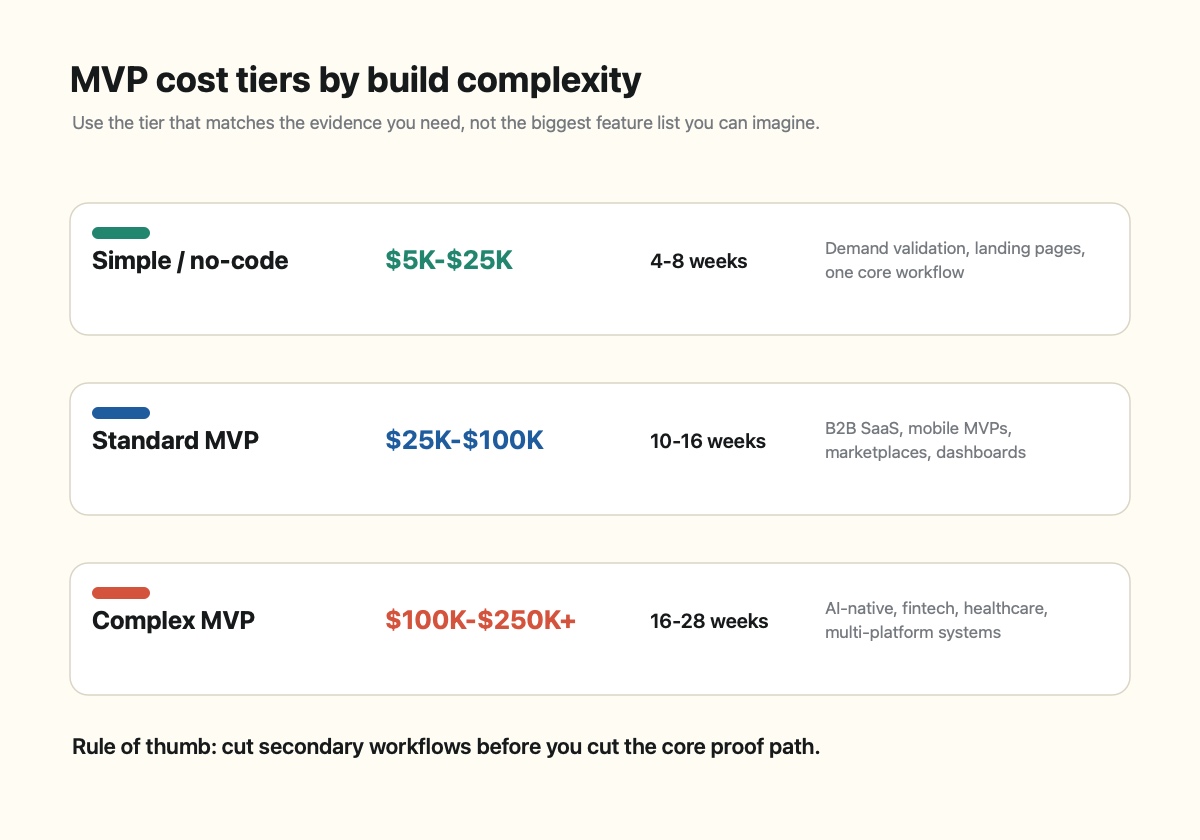
The retained cost-tier illustration is not a current price guide. Use the scoped calculation below; labels such as simple, standard, or complex do not establish a budget.
How much does MVP development cost in 2026?
Choose the validation artifact before pricing it. A landing page, concierge test, technical proof of concept, clickable prototype, and operational MVP answer different questions. Use POC vs prototype vs MVP to select the next step.
That separation is important. A prototype helps investors or stakeholders see the concept. A proof of concept tests whether a technical idea works. A functional MVP tests whether users will adopt, pay, or return. A Minimum Lovable Product raises the bar on UX and retention when the market is crowded and “it works” is not enough.
What actually drives MVP development cost?
MVP cost rises when the product needs deeper architecture, more user roles, more integrations, more testing, or more compliance. The visible feature list is only part of the price. The hidden cost sits in the logic behind those features.
For larger builds, compare this with the custom software development cost by risk model so MVP validation spend is not confused with enterprise reliability cost.
If the team is unsure which risks belong in version one, run technical discovery before the build estimate hardens. It can separate must-solve architecture, integration, AI, data, and security questions from features that can wait.
A one-role dashboard with a few forms is not the same as a multi-tenant SaaS product where every customer needs isolated data, billing rules, permission levels, and reporting. A marketplace is not one app; it is at least two user experiences plus admin operations, payments, trust, dispute handling, and liquidity problems. An AI product is not just a chatbot; it may need data ingestion, retrieval-augmented generation, model evaluation, prompt monitoring, and usage controls.
The main cost drivers
| Cost driver | Why it changes the budget |
|---|---|
| Scope depth | More workflows create more design, engineering, QA, and edge-case handling. |
| User roles | Admins, customers, vendors, operators, and internal teams each add permissions and flows. |
| Integrations | Stripe, Twilio, maps, analytics, CRMs, ERPs, and AI APIs add implementation and failure modes. |
| Data model | Multi-tenant SaaS, audit logs, analytics, and real-time sync all raise backend complexity. |
| Compliance | HIPAA, PCI-DSS, GDPR, KYC, AML, and security reviews add process and engineering overhead. |
| UX expectations | Consumer-facing products and investor demos often need more polish than internal tools. |
Compare team models on complete cost
| Team model | Budget explicitly | Main ownership risk |
|---|---|---|
| Solo freelancer | Specialist hours plus missing product, QA, design and release roles | Founder inherits coordination and review |
| Freelance team | Each role’s hours and the integration/management work between them | Gaps between individual contracts |
| Agency or build partner | Named team, deliverables, change process and support | Scope and incentives may diverge |
| In-house | Compensation, recruiting, equipment, management and ongoing capacity | Fixed commitments before demand is proven |
For a deeper model comparison, the MVP development agency vs in-house guide separates speed, ownership, founder load, and stage fit.
This is where many MVP budgets get distorted. Founders compare hourly rates and ignore coordination cost. If you hire a low-cost developer but spend 15 hours a week translating requirements, testing builds, chasing decisions, and rewriting tickets, that founder time belongs in the budget. A $12,000 MVP that consumes two months of executive attention may not be cheaper than a $35,000 build that moves with clearer ownership and a clear software development team structure.
For Hapy Co’s own MVP development work, the point is not to stuff version one with more people. It is to keep senior product, design, and engineering judgment close enough to the build that scope decisions happen before code gets expensive.
No-code, AI-assisted development, and when cheaper is smart
No-code and low-code tools have made early validation cheaper. For landing pages, internal tools, simple portals, proof-of-demand experiments, and wizard-of-oz workflows, they can be the right choice. They reduce the cost of asking, “Does anyone care?” before the team commits to custom architecture.
Platform popularity does not establish fit for your workflow, and adoption forecasts should not be presented as measured current results. Evaluate permissions, integrations, data export, recurring fees, and the cost of leaving before choosing no-code.
AI-assisted development changes the equation too, but it does not remove the need for technical judgment. Microsoft Research found that developers using GitHub Copilot completed a controlled programming task 55.8% faster than the control group. That is meaningful, especially for boilerplate and repetitive implementation. But AI assistance does not automatically solve architecture, product strategy, security, data modeling, or whether the product should exist.
Use no-code when the main risk is demand. Use AI-assisted custom development when the main risk is speed of execution around a well-understood scope. Use senior engineering when the main risk is architecture, data, compliance, security, or a product that must become the foundation for a real business.
The hidden costs founders forget
The launch budget is not the full MVP budget. Version one creates operational obligations: hosting, monitoring, bug fixes, usage-based tools, support, analytics, legal setup, security patches, and post-launch iteration.
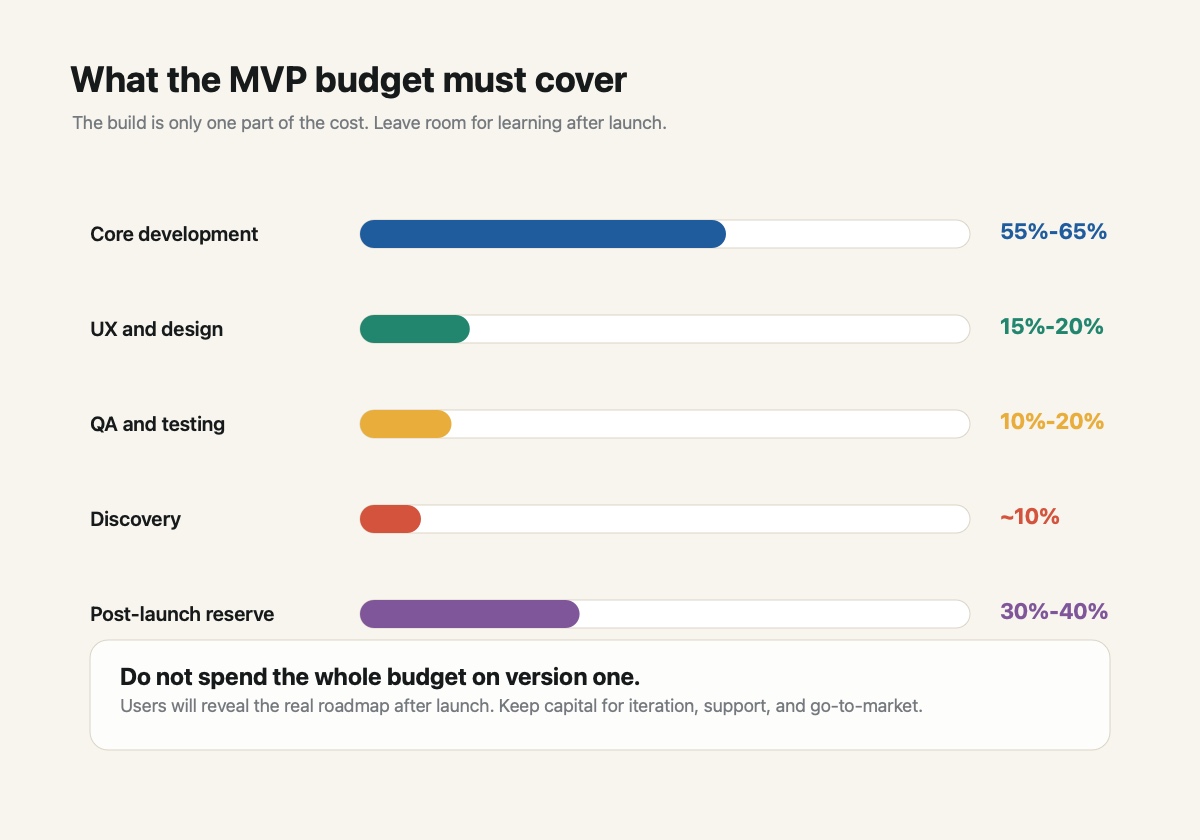
Worked first-year budget: a small booking pilot
Assume one web app for one service business: customer sign-in, available slots, booking/cancellation, staff administration, email confirmation, basic analytics, and deployment. Exclude native apps, online payments, marketplace payouts, AI, regulated health records, legacy migration, and multiple integrations. These exclusions are scope assumptions, not permission to omit necessary security or accessibility work.
All rates and hours below are invented USD supplier assumptions, with no implied geography or market average. Work is estimated by role rather than by a universal staffing ratio.
| Initial release work | Hours × rate | Cost |
|---|---|---|
| Product discovery and scope | 40 × $75 | $3,000 |
| UX/UI design | 60 × $60 | $3,600 |
| Engineering: app, admin, email, analytics | 320 × $75 | $24,000 |
| QA: workflows, permissions, devices, regression | 80 × $50 | $4,000 |
| Release setup and handoff | 24 × $75 | $1,800 |
| Initial release labor | 524 hours | $36,400 |
| Contingency for estimated release work | 20% × $36,400 | $7,280 |
| Release envelope | $43,680 |
The 20% contingency is a chosen scenario allowance, not a recommended universal percentage. It covers uncertainty within the agreed release scope; new workflows require repricing.
| Remaining first-year line | Assumption | Cost |
|---|---|---|
| Hosting, monitoring, email and other services | 12 × $150 | $1,800 |
| Maintenance and operational support | 12 months × 8 hours × $75 | $7,200 |
| Post-launch product iteration | 120 engineering hours × $75 | $9,000 |
| Post-launch validation of those changes | 30 QA hours × $50 | $1,500 |
| Pilot recruitment and launch materials | Fixed allowance | $2,000 |
| Remaining first-year envelope | $21,500 | |
| Total first-year cash envelope | $43,680 + $21,500 | $65,180 |
The recurring-service allowance covers 12 months from project start, including staging and production; it is not added twice after launch. Maintenance covers fixes, patches, and operations; iteration covers separately chosen product changes. Unspent contingency remains available cash, not a bill that must be paid.
Founder participation is excluded from that supplier cash total. If the founder contributes 5 hours per week over a hypothetical 12-week build, record 60 hours of internal effort separately. Taxes, legal review, founder salary, paid acquisition beyond the launch allowance, and growth above the assumed service usage are also excluded and need their own funding if applicable.
A 12-week schedule is a planning assumption, not the result of dividing 524 hours by one full-time person: roles overlap and dependencies constrain them. Confirm actual availability and milestones before approving a date.
For sensitivity, an extra 80 engineering hours at $75 plus 20 QA hours at $50 adds $7,000 before any revised contingency. That is why a second integration or payment workflow needs an explicit change estimate.
The post-launch reserve is the line item founders most often cut and most often regret. A healthy MVP budget leaves money for version 1.1. Users will expose confusing onboarding, missing edge cases, weak pricing, broken assumptions, and workflows that looked obvious in a Figma file but behave differently in real life.
What investors expect from an MVP now
Investor expectations have moved toward evidence. A deck can explain a market. A prototype can make the idea visible. But a functioning MVP with users, pilots, or revenue gives investors a stronger signal that the founder can turn capital into learning.
Use an investor’s actual mandate and stage criteria when planning the next evidence milestone. Customer validation, paid pilots, retention, and revenue answer different questions. A published accelerator benchmark is not a universal requirement or an implied development budget.
That does not mean every founder needs a six-figure MVP before fundraising. It means the MVP should be matched to the next milestone. If the next milestone is customer discovery, a no-code validation workflow may be enough. If the next milestone is paid pilots, the MVP needs enough reliability and UX clarity for real usage. If the next milestone is seed funding, the product needs to generate credible usage, retention, or revenue data.
That expectation fits the broader startup funding trends in 2026: capital is available, but investors are pushing founders to show sharper evidence before they raise.
A practical MVP budget framework
The best MVP budget is a learning budget. It should reserve money across four jobs: define the right version one, build it, launch it to real users, and improve it once the signal arrives.
| Founder situation | Recommended approach | Budget posture |
|---|---|---|
| Idea-stage, no user proof | Landing page, concierge MVP, clickable prototype, interviews | Keep spend low; buy signal before software |
| Validated problem, no product yet | Focused MVP around one core workflow | Spend enough to test behavior, payment, or retention |
| Pre-seed or pilot-ready | Production-grade MVP with analytics, QA, and support | Build for real customer conversations |
| Regulated or AI-native | Senior architecture, compliance, data, evaluation, security | Budget for risk, not just feature output |
| Seed-stage scaling | Strengthen architecture, reliability, onboarding, and data | Move from validation to repeatability |
Build the first-year budget from separate release, operating, iteration, and go-to-market lines. Do not apply allocation percentages from different denominators or assume the example above fits every product. An MVP without users does not produce evidence. It only produces software.
Where to cut scope without weakening the MVP
Founders should cut secondary workflows before cutting the core proof. The safest scope reductions usually come from admin polish, advanced reporting, edge-case automations, and future-state platform features. The riskiest cuts are the ones that remove the evidence path: onboarding, activation, payment, usage tracking, support, or the core job users came to complete.
Good MVP scope asks:
- What single user segment matters first?
- What one painful workflow are we solving?
- What action proves the user cares?
- What must be reliable enough for real usage?
- What can stay manual behind the scenes for version one?
- What data will tell us whether to invest more?
That is why a focused MVP often outperforms a broad one. A narrow product with a clear signal is easier to improve, pitch, fund, and sell. A broad product with weak evidence creates the illusion of progress while making every next decision harder.
When should you hire MVP development services?
You should consider MVP development services when the opportunity is real but the current team cannot turn it into a focused, testable release quickly enough. That usually happens when the work crosses product strategy, UX, technical architecture, and execution at the same time.
An MVP development company or product partner is useful when:
- You have a deck, rough scope, or strong thesis but need a version-one plan.
- You need something tangible for fundraising, pilots, or customer conversations.
- You cannot afford to hire product, design, engineering, QA, and technical leadership separately.
- You need someone to challenge scope before the budget disappears into features.
- You want a build that can produce evidence, not just a demo.
If that is where you are, book an MVP scoping call to decide whether the idea is ready to build, needs sharper scope, or should validate demand first.
FAQ
What is a realistic MVP development cost for startups?
Use a scoped estimate. The example here totals $65,180 for a first-year envelope around a small web booking pilot, under explicitly invented rates and exclusions. It is not a typical startup price or a quote.
Can I build an MVP for under $10,000?
A bounded experiment may fit that ceiling if the necessary work and operating costs fit the budget. Start with the question to test, price the work, and reduce scope or choose a prototype if a responsible operational release does not fit.
How long does MVP development take?
Estimate from dependencies, role availability, integrations, review time, and release requirements. The worked example assumes 12 weeks for planning; it does not establish a benchmark for other products.
How much does AI add to MVP cost?
Estimate data preparation, model integration, evaluation, safeguards, human review, and usage separately. Test representative volume and failure cases before assigning a recurring budget. There is no fixed “AI add-on” price.
Should I choose a freelancer, agency, or in-house team for an MVP?
Choose based on risk, not just hourly rate. Freelancers can work when scope is simple and the founder can manage the product. Agencies can move faster when the MVP needs design, engineering, QA, and delivery structure. In-house teams make more sense after product risk drops and the company needs long-term ownership.
What should I do before paying for MVP development?
Before paying for MVP development, define the user, the problem, the core workflow, the proof you need, and the budget left for launch and iteration. If those pieces are unclear, spend on discovery, interviews, or a prototype before paying for a full build.
The real answer: budget for evidence, not features
MVP development cost is not just a software estimate. It is a capital allocation decision. The founder’s job is to buy the strongest possible evidence with the least unnecessary drag.
Spend too little and the MVP cannot test the real risk. Spend too much and you reduce the runway needed to learn from users. The right budget sits between those extremes: focused enough to move fast, strong enough to earn trust, and flexible enough to change after the market responds.
If version one has one job, it is this: create enough evidence to make the next decision obvious.