An MVP agency brief is a short planning document that tells a development agency what you are trying to prove, who the product is for, which workflow matters first, what must be included, and what should stay out of version one. It should make the estimate more accurate by making assumptions visible.
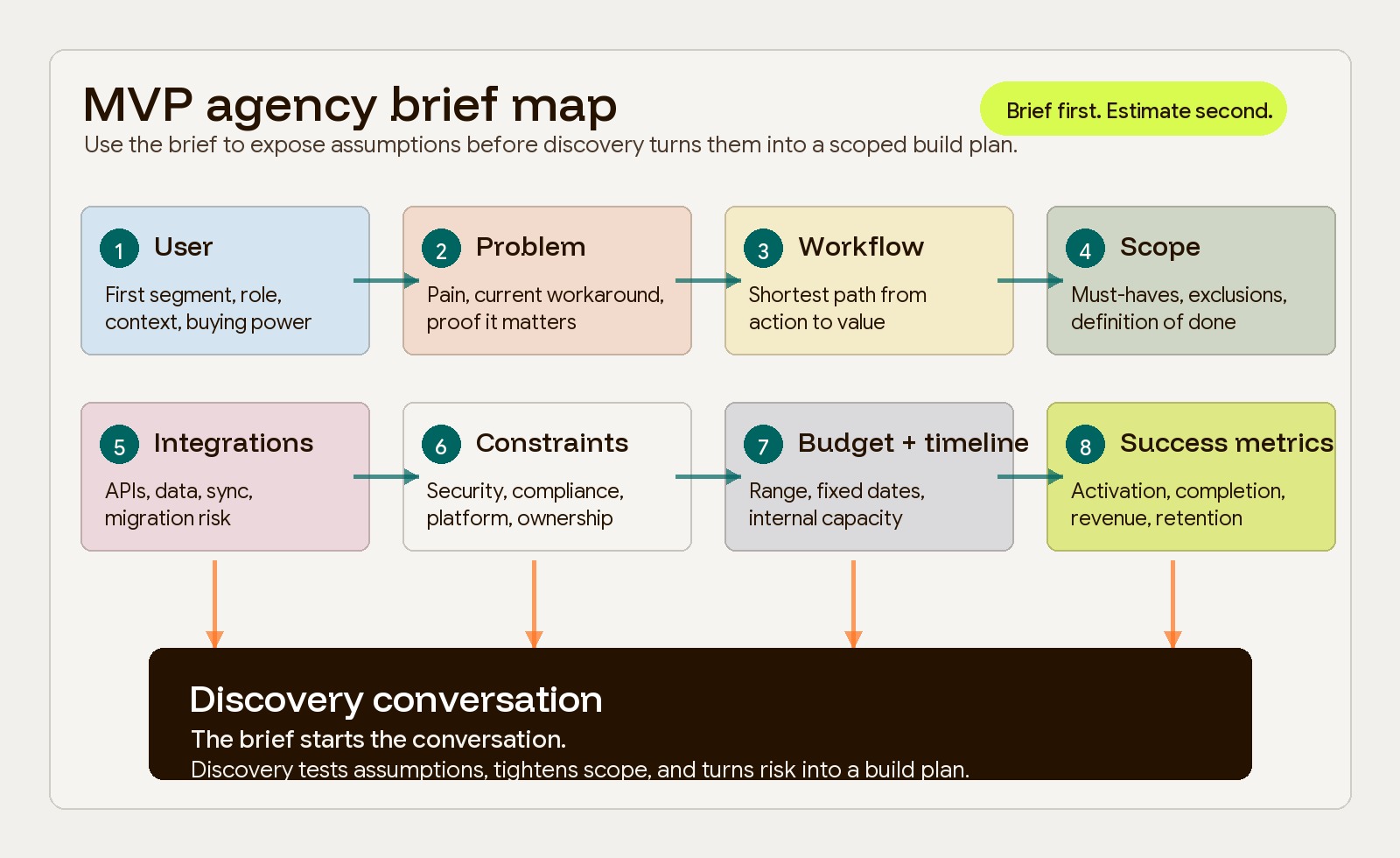
The brief is not a substitute for a product discovery sprint. Treat it as the beginning of a better discovery conversation. A good brief helps an agency see the shape of the work before it prices the build. Discovery then tests the assumptions, tightens the scope, and turns the brief into a delivery plan.
That distinction matters. Many founders ask for estimates with a feature list that sounds concrete but hides the real work. “Build a customer portal” could mean a public tracking page, a logged-in account area, a billing system, role-based admin tools, notifications, data migration, and analytics. Those are very different builds.
Use this guide before you request estimates, brief an MVP developer, or compare agency proposals. If you are earlier than this, Hapy’s MVP development checklist can help you validate whether the product is ready to scope at all. When proposals arrive, use the MVP development company vetting checklist and the practical MVP development red flags to examine the partner behind the estimate.
What an MVP Agency Brief Should Do
An MVP agency brief should give a development partner enough context to estimate the next responsible step. That may be a full build, but it may also be a paid discovery sprint, prototype, technical spike, or smaller validation test.
The practical goal is not to make the agency say yes quickly. It is to make the agency respond specifically.
A useful brief should help an agency answer:
- What problem is this product meant to solve?
- Who is the first user or buyer?
- What workflow creates the main value?
- Which features are required for the first useful release?
- Which features are explicitly excluded?
- What integrations, data, security, and compliance constraints affect the estimate?
- What budget and timeline boundaries are real?
- What success signal will decide whether the MVP worked?
If the agency cannot answer those questions from the brief, the estimate will usually become a guess. If the agency can answer them but does not challenge anything, that is also a concern. Good partners use a brief to find risk, not just to quote tasks.
Start With the User, Not the Feature List
MVP requirements for agency estimates should start with the first user segment. Not the whole market. Not every future persona. The first user whose behavior will tell you whether the product deserves more investment.
Write this section in plain business language:
| Brief section | What to include | Why it affects the estimate |
|---|---|---|
| First user | Role, context, company type, technical comfort, buying power | Shapes UX complexity, onboarding, copy, permissions, and support needs |
| Current workaround | Spreadsheet, manual process, existing tool, service workflow, or patched-together system | Shows the baseline the MVP must beat |
| Pain level | Time lost, money wasted, operational risk, customer frustration, or missed revenue | Helps separate must-have scope from nice-to-have scope |
| Adoption constraint | What would stop the user from trying or trusting version one | Reveals product, UX, and reliability requirements |
| Feedback access | Who can test the MVP and how quickly you can reach them | Determines whether the launch plan is realistic |
The strongest user descriptions sound operational. “Independent clinic managers who schedule recurring patient follow-ups in spreadsheets” is more useful than “healthcare users.” “Dispatch leads who reassign delivery routes by phone during peak hours” is more useful than “logistics teams.”
Specific users create specific systems. Vague users create padded estimates.
Define the Problem and the Current Workaround
A good MVP brief explains the business problem before it asks for software. Agencies need to know what pain the product should remove, what the user does today, and what result would make version one worth keeping.
Use a simple problem statement:
We believe [specific user] struggles with [painful workflow] because [current workaround or limitation]. We want the MVP to help them [measurable outcome] so we can learn whether [business hypothesis] is true.
This prevents the brief from becoming a wishlist. It also gives the agency room to suggest a cheaper or sharper implementation. If the real problem is “customers keep calling support for order status,” the first MVP may be a tracking page and notification flow, not a full CRM.
Include enough evidence to show the problem is real:
- Interview notes or sales-call patterns.
- Support-ticket themes.
- Manual hours spent per week.
- Lost revenue, delayed orders, or churn risk.
- Current tools and why they fail.
- Competitor gaps or buyer complaints.
The evidence does not need to be perfect. It does need to be honest. If you do not yet have user evidence, say that. The next step may be discovery or prototype testing before custom development.
Map the Workflow the MVP Must Support
A feature list is static. A workflow shows the product in motion.
Before you brief an MVP developer, map the shortest path from the user’s first action to the value moment. This is where many hidden requirements appear: account creation, empty states, permission checks, file uploads, payment redirects, notifications, admin overrides, error recovery, and status changes.
For example, “send invoice” may include:
- User creates an account.
- User adds client details.
- User creates line items.
- System calculates totals.
- User previews the invoice.
- User sends a secure payment link.
- Client pays through Stripe Checkout.
- System marks the invoice as paid.
- User and client receive confirmations.
That workflow is estimateable. “Invoice feature” is not.
Low-fidelity wireframes, screenshots of the current process, or a clickable prototype help here. They do not need to be beautiful. They need to show screens, inputs, states, and handoffs. For structured requirements, Hapy’s software requirements specification guide is the deeper reference.
Separate Must-Have Scope From Version-Two Ideas
The brief should make scope smaller, not larger. The more mature the brief, the more clearly it says what not to build.
Use a prioritization method that forces tradeoffs. The MoSCoW method is useful because it separates must-have, should-have, could-have, and won’t-have requirements. For an MVP estimate, the “won’t-have” list is often the most valuable part of the brief.
Format must-have scope as user stories with acceptance criteria. The Agile Alliance describes user stories as short descriptions of desired functionality from the user’s perspective. In an MVP brief, pair each story with a testable definition of done.
| User story | Must-have criteria | Explicit exclusions |
|---|---|---|
| As a customer, I want to view my order status without calling support. | Customer can enter an order ID and see current status, last update, and next expected step. | No logged-in customer account, live chat, or support analytics dashboard in version one. |
| As an admin, I want to update an order status manually. | Admin can search an order, change status, and trigger a customer notification. | No bulk edit, route optimization, or automated carrier sync in version one. |
| As a founder, I want to measure whether users complete the core workflow. | Product tracks visits, starts, completions, failures, and repeat usage. | No advanced cohort dashboards or warehouse sync before validation. |
This is how a brief protects the estimate. The agency can price the must-have path and call out the cost of later features separately.
List Integrations, Data, and Technical Constraints
Integrations are where simple estimates often break. “Connect to CRM” can mean reading a CSV once, pushing records through an API, syncing both ways in real time, handling duplicate records, retrying failed requests, and reconciling permissions.
Your MVP agency brief should list every system the product must touch:
| Integration or data source | Direction | What data moves | Risk to clarify |
|---|---|---|---|
| Stripe Checkout | Product to payment processor and webhook back to product | Invoice ID, amount, payment status, receipt | Whether hosted checkout is enough or custom payment flows are expected |
| CRM | Product to CRM, CRM to product, or one-way export | Contact, company, deal, status, owner | Field mapping, duplicate rules, OAuth access, API limits |
| Email or SMS | Product to notification provider | Recipient, template, status, attachment link | Deliverability, consent, retry rules, opt-out handling |
| Legacy spreadsheet or database | Import into product | Customers, orders, inventory, historical records | Dirty data, missing IDs, formatting, ownership, migration testing |
If payments are involved, do not ask an agency to invent payment handling casually. Hosted payment flows such as Stripe Checkout can reduce custom security scope compared with collecting card data directly. If performance matters, use measurable targets. Google’s Core Web Vitals are a useful reference for user-facing page experience metrics.
Also name constraints clearly:
- Target platforms: web, iOS, Android, internal admin, public portal.
- Browser or device support.
- Compliance needs: HIPAA, GDPR, PCI, SOC 2 expectations, audit logs, retention rules.
- Accessibility expectations.
- Hosting, cloud, or data residency requirements.
- Existing brand, design system, or repository constraints.
- Ownership requirements for code, data, design files, environments, and credentials.
Constraints are not bureaucracy. They are estimate drivers.
Share Budget and Timeline Boundaries
Many buyers avoid sharing budget because they worry the agency will price up to the number. The better reason to share a range is to see how the agency makes tradeoffs inside a constraint.
Give a real range and ask what the agency would change at each level:
| Constraint | What to tell the agency | Good response from the agency |
|---|---|---|
| Budget range | “We can invest $60k to $90k before the pilot.” | “Here is the scope that fits, the scope that does not, and the assumptions we need to test.” |
| Deadline | “We need a pilotable release by October 15.” | “Here is what can ship by then, what must be manual, and what should move to phase two.” |
| Internal capacity | “Our operations lead can test weekly, but we do not have an internal engineer.” | “We will include more documentation, admin training, support, and technical ownership in the plan.” |
| Procurement limits | “Legal review takes two weeks and security review is required.” | “We will schedule those gates before launch instead of discovering them at the end.” |
If your timeline is fixed, scope must be flexible. If scope is fixed, timeline and budget usually need room. The brief should state which constraint matters most.
Define Success Metrics Before Build Scope
An MVP is not successful because it launches. It is successful when it answers the business question that justified the build.
Include success metrics in the brief so the agency can instrument the product from the start:
- Activation: percentage of users who complete the first meaningful action.
- Completion: percentage of started workflows that finish successfully.
- Time saved: reduction in manual steps, support tickets, or processing time.
- Revenue signal: paid pilots, checkout completion, deposits, renewals, or qualified pipeline.
- Retention: repeat usage over a defined period.
- Reliability: error rate, uptime, failed transactions, or support escalations.
- Learning: decision rule for continue, change, pause, or expand.
Be specific about the decision. “We will continue if 10 pilot users complete the workflow twice in 30 days and at least 4 say they would pay for it” is more useful than “we want good engagement.”
Success metrics also stop overbuilding. If the MVP only needs to prove that customers will use self-service tracking, the first version may not need advanced analytics, AI recommendations, or a polished admin reporting suite.
Use the Brief to Start Discovery, Not Avoid It
The best MVP agency brief creates a better first conversation. It should help the agency come back with sharper questions:
- Which assumptions are validated and which are still guesses?
- Which workflow step carries the most risk?
- Which integrations need API access before estimation?
- Which features can stay manual during the pilot?
- Which compliance requirements are real for version one?
- Which metrics need to be tracked on day one?
- Which parts of the estimate depend on user testing?
That is why a brief should not pretend to be final. It is a working document. Discovery should improve it.
If the agency treats the brief as a fixed order form, you may get a quote quickly, but you have not reduced risk. A stronger partner will challenge scope, mark assumptions, propose discovery where needed, and show how the brief becomes backlog, wireframes, architecture, QA, launch, and support.
For teams still shaping the product, a discovery phase or product discovery sprint is often the most responsible first engagement. It gives both sides a lower-risk way to clarify user needs, scope, integrations, and technical unknowns before the larger build commitment.
MVP Agency Brief Template
Use this structure when you request estimates:
- Product summary: what the MVP is, who it is for, and why now.
- Target user: first user segment, pain, current workaround, and buying or adoption context.
- Problem evidence: interviews, support data, manual costs, sales feedback, or observed workflow friction.
- Core workflow: the shortest path from user action to product value.
- Must-have scope: user stories, acceptance criteria, and launch requirements.
- Exclusions: version-two features, manual workarounds, and features not needed for the first proof.
- Integrations and data: APIs, imports, sync rules, migration needs, credentials, and provider constraints.
- Technical constraints: platforms, security, compliance, performance, accessibility, hosting, and ownership.
- Budget and timeline: realistic range, fixed dates, internal availability, procurement gates, and support expectations.
- Success metrics: the data that will decide whether the MVP worked.
- Open questions: assumptions you want the agency to validate during discovery.
Keep the brief short enough to read and specific enough to price. Five to seven pages is usually better than a 40-page document full of uncertainty. Add links to wireframes, spreadsheets, workflows, or prototypes where useful.
What to Send With the Brief
Attach only what helps the agency understand scope:
| Attachment | Include when | Keep it practical |
|---|---|---|
| Workflow map | The product has multiple steps, roles, or states | Show entry, core action, success, error, and admin paths |
| Wireframes or prototype | UX assumptions affect scope | Low-fidelity is fine if states and inputs are clear |
| Data sample | Migration or reporting matters | Remove sensitive data and show field names, formats, and volume |
| Integration docs | External systems affect delivery | Include API docs, sandbox status, and who owns access |
| Brand or design system | The MVP must match an existing product | Link reusable components and constraints, not a full redesign brief |
| Compliance notes | Regulated data or procurement review is involved | List requirements, reviewers, and approval timing |
Do not bury the agency in every internal document. The brief should reduce ambiguity, not transfer the whole mess.
How to Judge the Estimate You Get Back
Once the brief goes out, evaluate the response by the quality of the assumptions, not only the price.
A serious estimate should include:
- Scope summary in the agency’s own words.
- Assumptions and exclusions.
- Recommended discovery or technical spike, if needed.
- Delivery phases and milestones.
- Team roles and seniority.
- UX, engineering, QA, DevOps, and project management coverage.
- Integration and data risks.
- Ownership and handoff terms.
- Change-control process.
- Post-launch support window.
A weak estimate will repeat your feature list, give one big number, and avoid the difficult parts. That may feel simpler in the moment, but it usually moves the uncertainty into the build.
The job of an MVP agency brief is to make the estimate honest. It should tell the agency enough to price the known work, name the unknown work, and recommend discovery where the risk is still too high. That is how you move from “How much will my app cost?” to a conversation about the smallest product worth building. Review Hapy’s MVP development work when you are ready to compare that brief with a delivery engagement.