A post-MVP roadmap is the plan that turns launch learning into product decisions. It should not be a backlog dump, a promise to build every requested feature, or a premature scale plan. The job is to decide what the MVP proved, what it failed to prove, and what must change before the product deserves more engineering, marketing, sales, and operational weight.
An MVP launch starts the feedback loop. It does not end the product strategy work. That is the tension founders often miss. Version one creates evidence, but evidence only helps if the team has a way to translate it into roadmap choices.
Hapy’s broader guide to MVP development frames the MVP as the smallest useful version that can teach the business something important. The post-MVP question is sharper: now that real users have touched the product, what should the company build, fix, charge for, or stop doing?
If you are still before launch, start with the MVP expectations vs reality guide so the first roadmap is built around learning instead of a compressed full-product wishlist.
What comes after MVP launch?
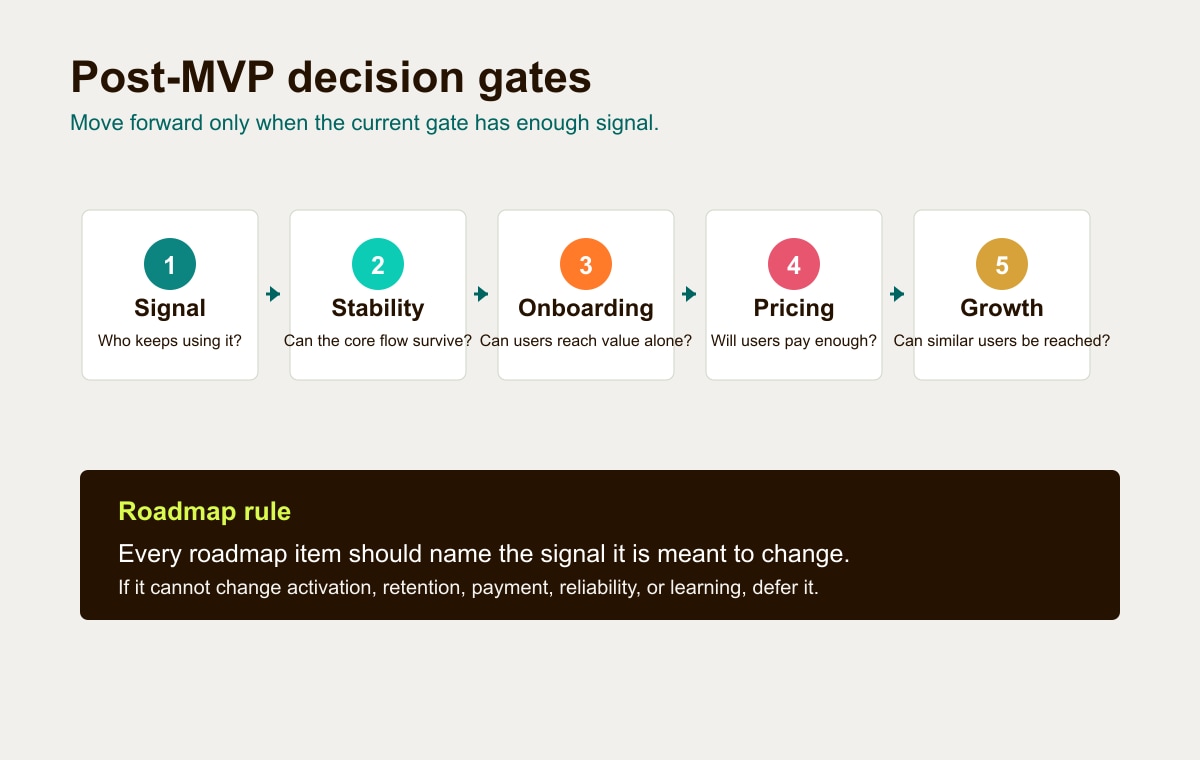
After MVP launch, the team should move through five decision gates: signal, stability, onboarding, monetization, and growth. Each gate answers a different business question. If a gate is weak, the roadmap should fix that weakness before adding more surface area.
Use the MVP investor metrics guide to turn activation, retention, conversion, engagement depth, feedback quality, and learning velocity into evidence for the next roadmap or funding decision.
| Gate | Question to answer | Roadmap implication |
|---|---|---|
| Signal | Who is using the product repeatedly, and why? | Narrow the roadmap around the strongest segment. |
| Stability | Can the core workflow survive real use? | Fix bugs, speed, data quality, and support risks. |
| Onboarding | Do users reach value without hand-holding? | Improve activation before adding advanced features. |
| Monetization | Will users pay enough for this to work? | Test pricing, packaging, and willingness to pay. |
| Growth | Can similar users be acquired repeatably? | Run contained channel and message experiments. |
That sequence matters. Growth before stability only creates a larger support problem. Pricing before value clarity creates false negatives. Feature expansion before segment clarity turns useful feedback into noise.
The best post-MVP roadmap is therefore not a bigger version of the pre-launch wishlist. It is a set of bets tied to the evidence version one produced.
Turn validated learning into roadmap decisions
Validated learning becomes useful only when it changes the roadmap. If the MVP shows that a specific customer segment completes the core workflow twice as often as everyone else, the next roadmap should serve that segment more intentionally. If signups are high but repeat usage is weak, the roadmap should focus on activation, onboarding, and retention before acquisition.
A simple post-launch review can separate signal from noise:
| Evidence | Good roadmap response | Weak roadmap response |
|---|---|---|
| One segment retains better than others | Build for that segment first | Average the feedback across all users |
| Users ask for the same adoption blocker | Remove the blocker | Add unrelated “nice to have” features |
| Users complete onboarding but do not return | Fix core value or habit loop | Spend more on acquisition |
| Buyers hesitate at pricing | Test packaging and value proof | Discount without learning why |
| Support tickets cluster around one workflow | Simplify or harden that workflow | Build a larger help center first |
This is where the product roadmap should become outcome-led. A roadmap after MVP should show what the team is trying to learn or improve, not only what it plans to ship.
One useful rule: every roadmap item should name the signal it is meant to change. “Add team invitations” is vague. “Improve activation for small agencies by letting the first user invite one teammate during setup” is a roadmap decision.
Measure dependency before you scale the MVP to a full product
To scale MVP to full product, first prove dependency. Dependency means the product has moved beyond curiosity. Users return, complete the key workflow, tolerate early imperfections, and describe the product in specific language.
The Sean Ellis product-market fit survey is a useful qualitative check because it asks users how they would feel if they could no longer use the product. In Rahul Vohra’s First Round Review essay on Superhuman’s product-market fit engine, the 40% “very disappointed” benchmark becomes a way to segment who truly depends on the product and what holds others back.
Do not use that number mechanically. Send the survey only to users who have experienced the core workflow. Segment the answers by role, use case, acquisition channel, company size, and usage depth. A blended 32% score can hide a 60% score inside one high-fit segment.
Behavior should carry equal weight. Hapy’s MVP development checklist names the launch metrics version one should have in place: activation, core task completion, retention, time-to-value, drop-off points, and support themes. Those metrics are the post-MVP operating system.
The practical signal stack looks like this:
- Activation: users reach the first meaningful outcome.
- Core task completion: users can finish the main workflow without founder rescue.
- Retention: a cohort comes back after novelty fades.
- Support quality: problems are concentrated enough to fix.
- Willingness to pay: users accept a real price, not only a free pilot.
- Segment pull: the strongest users look similar enough to target.
If the evidence is mixed, do not rush to scale. Keep the roadmap focused on the narrowest change that could clarify the decision.
Harden the product without freezing learning
Post-MVP hardening should protect the learning engine, not turn the product into a slow enterprise platform before the market is proven. The team should harden the core workflow, the data layer, the deployment process, and the user-facing reliability issues that could distort feedback.
Technical debt is not automatically bad after an MVP. Some shortcuts are the cost of learning quickly. The danger starts when the team scales on top of shortcuts that make every next decision slower, riskier, or more expensive. Hapy’s guide to technical debt cost explains how debt shows up as lost capacity, rework, QA drag, incidents, and delayed roadmap work.
The post-MVP hardening list should usually include:
- Event tracking that can be trusted.
- Error logging and support visibility.
- Performance fixes around the core workflow.
- Security basics for the data being handled.
- Regression tests for the paths users depend on.
- Documentation for architecture, setup, and release ownership.
- A short debt register ranked by business risk.
Avoid the opposite mistake: rewriting the product because the first version is imperfect. A broad rebuild is justified only when the architecture blocks the validated path forward. If a product has enough signal to continue but too much debt to scale safely, use an incremental migration pattern. Microsoft’s Azure Architecture Center describes the Strangler Fig pattern as replacing parts of a legacy system gradually instead of attempting a risky big-bang rewrite.
Feature flags also help teams keep learning while reducing release risk. Martin Fowler’s guide to feature toggles explains how teams can separate deployment from release, test with limited audiences, and avoid making every change visible to every user at once. For a post-MVP product, that means new capabilities can be rolled out to the right segment before they become permanent roadmap commitments.
Fix onboarding before adding feature depth
Onboarding is usually the first commercial bottleneck after MVP launch. The product may technically work, but users may not understand what to do first, why the setup matters, or how quickly they should expect value.
The roadmap should not treat onboarding as polish. Onboarding is part of the product’s proof. If users need a founder, salesperson, or support person to explain the value every time, the team has not yet built a repeatable product motion.
Post-MVP onboarding work should focus on:
- Reducing setup steps before the first useful outcome.
- Moving optional configuration out of the first session.
- Making empty states useful, not decorative.
- Showing progress through the core workflow.
- Replacing vague welcome copy with task-specific guidance.
- Capturing where users hesitate, abandon, or ask for help.
This is also where the team should decide what can stay manual. A manual concierge step may be acceptable if it teaches the team what automation should later do. A manual step is dangerous if it hides whether users can succeed without human intervention.
Price the product before growth hides the truth
Pricing is one of the most important MVP next steps after launch because it tests perceived value. A free MVP can prove interest, but it rarely proves a business model. Once users have completed the core workflow, the team should test a real price, package, or paid pilot.
For SaaS and subscription products, unit economics should become part of the roadmap conversation. David Skok’s SaaS metrics guide argues that SaaS leaders need to know whether they can make more from customers than it costs to acquire them, using LTV, CAC, payback, churn, and retention as operating measures. His guideline is that strong SaaS businesses often show LTV:CAC above 3 and recover CAC fast enough to keep growth capital-efficient.
Early teams should not pretend they have perfect LTV or CAC. They usually do not. But they can still ask practical questions:
- Which users would pay today?
- What value metric should pricing follow: seats, usage, transactions, locations, revenue, or workflow volume?
- Which features belong in the paid product because they prove value?
- Which requests are custom services rather than scalable product?
- Does the price support the support, infrastructure, and onboarding load?
The goal is not to optimize pricing forever. The goal is to stop treating monetization as a future problem while the product roadmap quietly expands.
What not to scale until there is signal
The most expensive post-MVP mistake is scaling the wrong thing. A weak product can make growth spend look like learning for a few weeks, but it usually creates muddy data, higher support costs, and a backlog shaped by low-fit users.
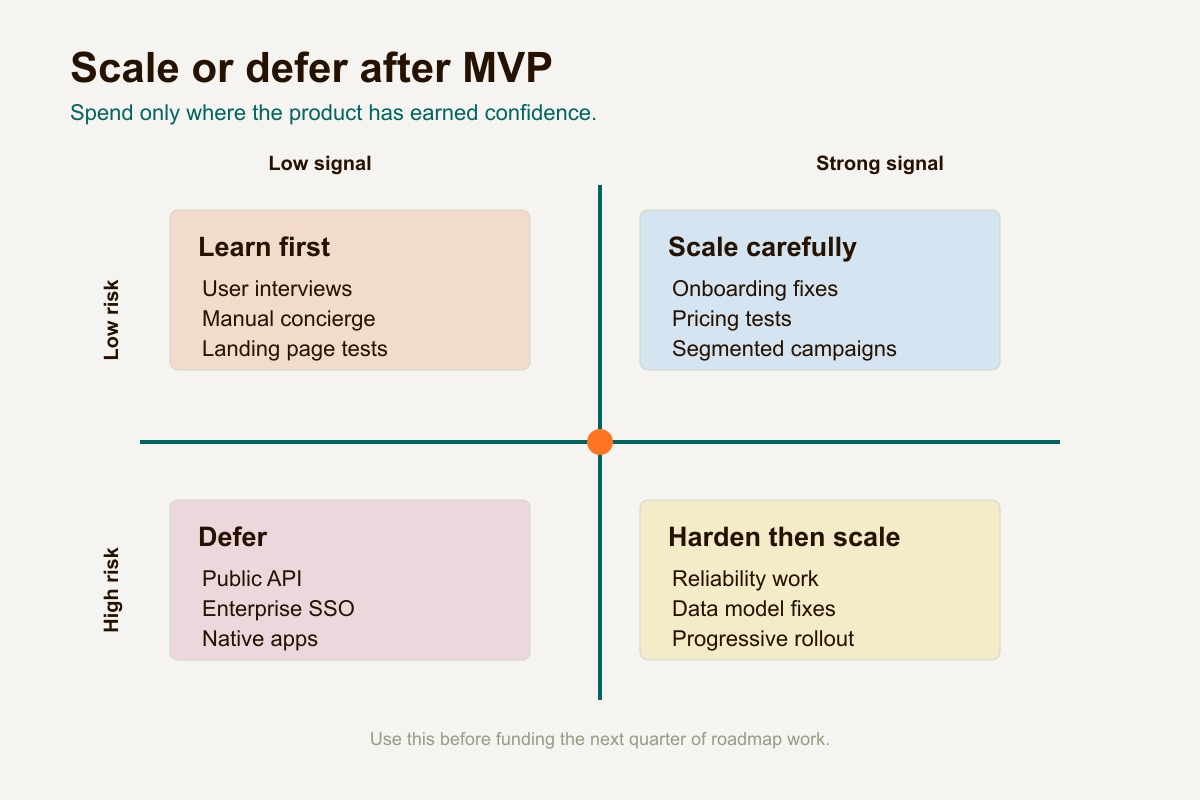
Do not scale these until the signal is strong:
| Do not scale yet | Wait for this signal |
|---|---|
| Paid acquisition | Retention and activation are improving in a clear segment. |
| Enterprise features | Buyers repeatedly ask for the same controls and will pay for them. |
| Public APIs | Integrations are blocking adoption for the core segment. |
| Native mobile apps | Mobile use is tied to retention or workflow completion. |
| Multi-language support | A specific market is already converting or retaining. |
| Advanced dashboards | Users rely on the product and need better decision visibility. |
| Referral programs | Users already recommend the product without incentives. |
| Large sales team | The founder-led sales motion is repeatable enough to teach. |
Some of these items may belong in the future roadmap. They just should not be funded by optimism. The post-MVP roadmap should protect the company from scaling areas where the product has not earned confidence yet.
Run growth experiments after the core loop works
Growth experiments become useful when the product has a core loop worth amplifying. Before that, growth tests can be misleading because channel performance gets mixed with product weakness.
A practical post-MVP growth experiment should define:
- Segment: who the test is for.
- Promise: what value message is being tested.
- Channel: where the audience will be reached.
- Activation event: what counts as real product entry.
- Retention or revenue check: what proves the users were worth acquiring.
- Stop rule: what result will end or change the test.
For example, a B2B workflow tool might test one founder-led outbound message to operations leaders in a narrow vertical, one landing page built around the workflow pain, and one onboarding path that gets users to the first completed task. The experiment is not successful because leads arrive. It is successful only if those leads activate, use the product again, and confirm that the price is plausible.
That is the commercial discipline. Growth should make a working product larger, not make an unclear product louder.
A 90-day post-MVP roadmap cadence
The first 90 days after launch should be deliberately boring. The team needs enough rhythm to learn without turning every new comment into a roadmap change.
Use this adaptable planning cadence. Triage critical security, data-integrity and reliability risks from day one and throughout the period; they override the calendar and may pause rollout. Weeks 9–10 are a deeper scheduled debt review, not the first time to assess technical risk.
| Timeframe | Focus | Output |
|---|---|---|
| Weeks 1-2 | Instrumentation, support and urgent-risk review | Clean event map, error log, critical-risk owners and top support themes |
| Weeks 3-4 | Activation and onboarding | First-session fixes, clearer setup, drop-off reduction |
| Weeks 5-6 | Segment and PMF survey | Strongest segment, blockers, language users repeat |
| Weeks 7-8 | Pricing and packaging test | Paid pilot, package hypothesis, buying objections |
| Weeks 9-10 | Technical debt review | Debt register, hardening priorities, release guardrails |
| Weeks 11-12 | Roadmap reset | Now/next/later plan tied to evidence |
This cadence is intentionally short. A 12-month roadmap after MVP is usually a fiction unless the team has strong evidence. A 90-day roadmap creates enough structure to act while keeping room for the product to learn.
The Hapy view
A post-MVP roadmap should be a capital allocation tool. It decides where engineering time, founder attention, sales effort, and growth spend should go next.
The strongest teams do three things well after version one. They protect the signal by narrowing the roadmap around the users who show real dependency. They protect the system by hardening the parts of the product that could break learning or trust. And they protect the business by testing pricing and growth only after the core value loop is visible.
That is what comes after MVP: not a rush to become a full product, but a tighter operating discipline. Scale what the market has proven. Fix what blocks the proof. Defer everything else until it earns its place on the roadmap.
Hapy’s MVP development engagement can help turn the next validated product assumption into a scoped release with explicit acceptance criteria.