MVP development challenges usually show up as engineering problems, but most of them start earlier. The expensive mistakes happen when a founder treats version one like a smaller final product instead of a focused risk test.
This guide focuses on software MVPs with a live customer workflow. The broader MVP concept also includes transparent concierge or manual services when they can test the relevant assumption. A clickable prototype can test usability, but a positive reaction to it does not establish paid demand or retention.
That distinction matters because version one has less margin for waste. A broad scope makes QA harder. A vague audience makes feedback noisy. Missing analytics turns launch into guesswork. Untested integrations create reliability problems. Compliance and maintenance choices that felt “later” become expensive when users, data, and revenue arrive.
The practical move is to manage MVP development challenges before code gets expensive. Founders should decide what the MVP must prove, what can stay manual, which risks need architecture now, and which features are only future-state ambition.
The MVP development checklist turns those decisions into a pre-build review founders can use before version one becomes an engineering commitment.
If the riskiest questions are technical rather than market-facing, technical discovery is the better pre-build step because it maps architecture, integrations, data, AI, security, and budget risk before development starts.
Prototype vs MVP: the first wrong turn
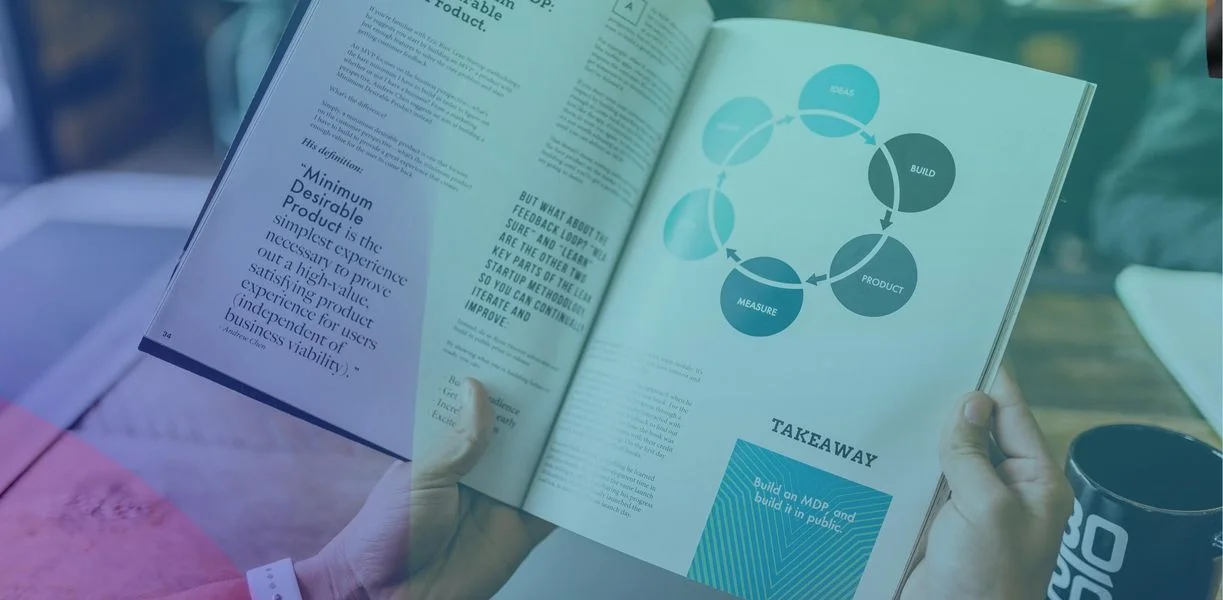
The first MVP development challenge is confusing the artifact you need. A prototype helps people understand the idea. An MVP tests whether the idea works under live conditions.
If the team is still choosing between a proof of concept, prototype, and MVP, use that validation-step decision framework before estimating version one.
That difference changes budget, timeline, team structure, and risk. A prototype can simulate a checkout flow. An MVP needs the checkout flow to work, fail gracefully, track drop-offs, and support a customer who paid. A prototype can impress a stakeholder. An MVP has to survive a real user.
| Decision | Prototype | MVP |
|---|---|---|
| Main job | Make the concept visible | Validate user behavior and business risk |
| Audience | Founders, stakeholders, early investors | Real users, pilot customers, paying customers |
| Functionality | Simulated flows and clickable screens | A real delivered outcome, using software or a disclosed manual service |
| Evidence produced | Qualitative feedback and alignment | Activation, retention, revenue, task completion, support signal |
| Common risk | Mistaking enthusiasm for demand | Building too much before the evidence is clear |
Recent 2026 MVP cost guides place startup MVPs across wide ranges because a “simple MVP” and a “complex MVP” are not the same product. Intigate’s 2026 guide frames MVP development cost around complexity, team model, integrations, QA, and maintenance rather than a single universal price. Hapy’s own MVP development cost guide makes the same practical point: budget for evidence, not feature volume.
The six MVP development challenges that create founder risk
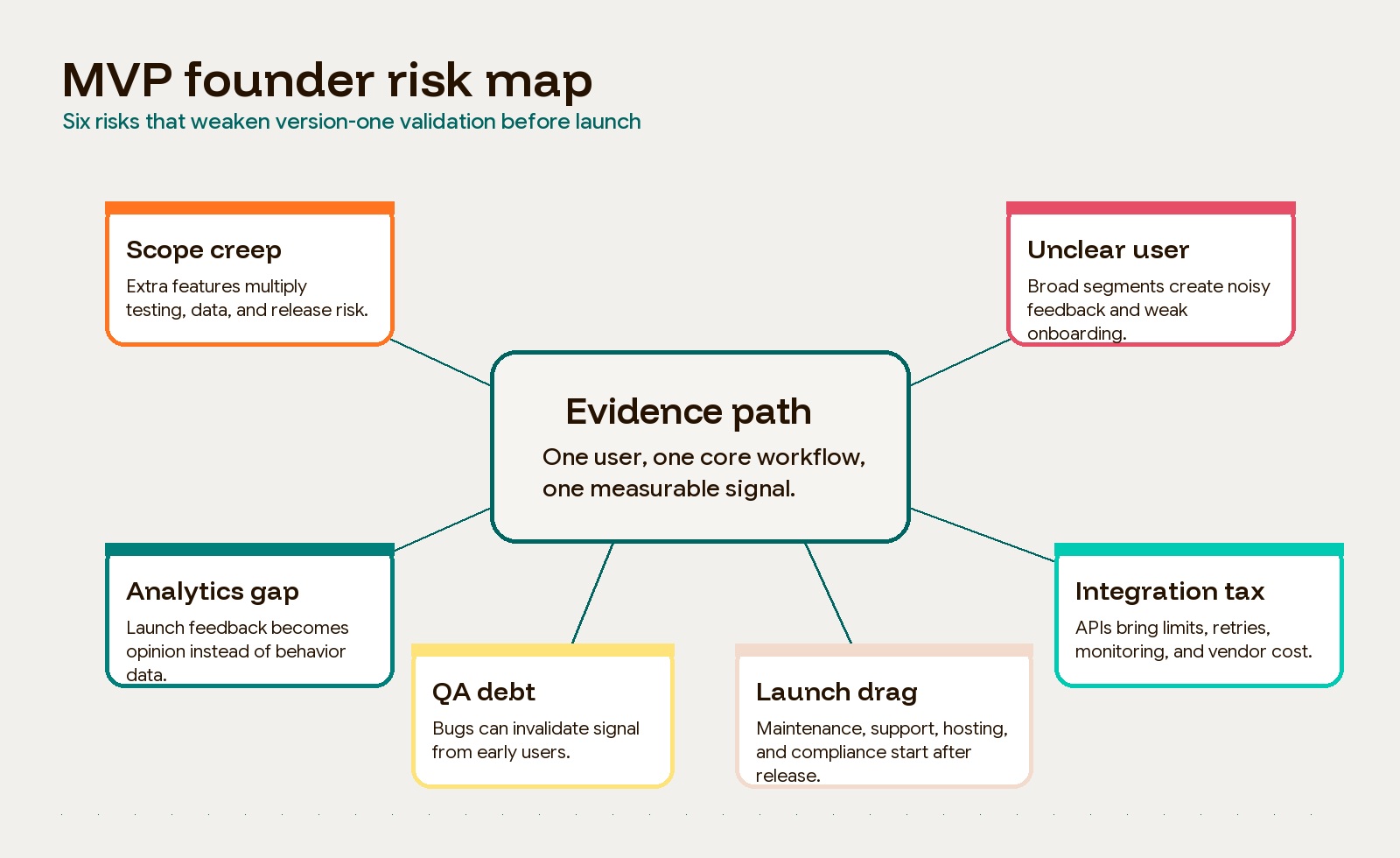
Most version-one failures do not come from one dramatic mistake. They come from small decisions that compound: one extra dashboard, one undefined user segment, one untracked onboarding flow, one “simple” integration, one skipped QA cycle, one maintenance assumption nobody priced.
1. Scope creep hides inside reasonable requests
Scope creep rarely sounds reckless in the moment. It sounds like, “Can we just add a filter?” or “Wouldn’t it be useful to include a small admin dashboard?” The problem is that software complexity behaves like a multiplier.
Every added feature can create new screens, permissions, database fields, error paths, analytics events, QA cases, and support obligations. A feature that looks small in a product conversation can be large in the system.
The founder-level fix is to define the evidence path before defining the feature list. What single user action proves the MVP matters? What must be true for that action to happen? What can be manual behind the scenes for now?
If the competitive bar is high, the first release may need a minimum lovable layer around the core flow, but only after the team understands the tradeoff between an MVP and a Minimum Lovable Product.
Prioritization models such as MoSCoW prioritization are useful only when the “Must Have” list is genuinely strict. If everything becomes mandatory, the model becomes theater.
2. A universal user makes every decision blurry
An MVP cannot validate a market if it is trying to serve everyone at once. Broad audience definitions create conflicting feedback, unclear onboarding, weak positioning, and a roadmap that changes every time a different user type speaks loudly.
Product strategy work should narrow the first user segment before the build begins. Roman Pichler describes product strategy as the link between vision and execution, while Contentsquare’s product strategy guide emphasizes audience, goals, and measurable direction. For an MVP, that translates into a simple operating question: who is version one allowed to disappoint?
That question feels uncomfortable, which is why it is useful. A founder building for solo creators, operations managers, healthcare administrators, and marketplace vendors at the same time is not creating a broader MVP. They are creating four products that will fight each other.
The narrower path is stronger:
- Define the first user segment.
- Name the painful workflow.
- Choose the trigger that brings the user into the product.
- Define the successful outcome.
- Ignore secondary segments until the first one produces signal.
3. Missing analytics turns launch into opinion
Many founders remember the visible product but forget the measurement system. They ship onboarding, dashboards, forms, payments, or workflows without enough telemetry to understand where users drop, stall, return, or abandon the product.
That creates a silent analytics gap. After launch, the team has anecdotes, support messages, founder intuition, and a handful of loud users. What it does not have is a clean view of behavior.
At minimum, a version-one product should track:
| Metric | What it tells you |
|---|---|
| Sign-up to activation rate | Whether users reach the first meaningful action |
| Core task completion | Whether the main workflow works in real conditions |
| Retention or return usage | Whether the product creates enough value to revisit |
| Session quality | Whether users are exploring, completing, or getting stuck |
| Drop-off points | Where design, copy, performance, or trust breaks down |
| Support themes | Which failures users cannot resolve on their own |
These do not need an enterprise analytics stack. They do need intentional event naming, funnel tracking, session review where appropriate, and a launch plan that says which numbers matter first.
4. Integrations are not plug-and-play once users depend on them
Third-party tools speed up MVP development. Stripe, Auth0, SendGrid, Twilio, analytics platforms, CRMs, AI APIs, and mapping tools let teams avoid building commodity infrastructure.
But integrations still create work. Each one brings authentication, setup, edge cases, retries, rate limits, webhooks, failure states, vendor pricing, and monitoring. Redwerk’s hidden-cost analysis calls out integrations, QA, maintenance, and post-launch costs as budget areas founders often underestimate.
The right question is not “Can this API do what we need?” It is “What happens when it fails, gets expensive, changes limits, sends duplicate events, or becomes business-critical?”
Before build, founders should map integrations across three adoption scenarios:
| Scenario | What to model |
|---|---|
| Low usage | Free-tier limits, setup cost, manual fallback |
| Expected usage | Monthly vendor cost, support workload, monitoring |
| Sudden growth | Rate limits, usage-based pricing, reliability, replacement options |
If a third-party system sits in the payment path, authentication path, core workflow, or data pipeline, it is part of the product architecture. Treat it that way.
5. QA looks optional until early users lose trust
Skipping QA is tempting because testing can look like a cost center before launch. In reality, QA protects the only thing version one exists to produce: credible evidence from real users.
If the checkout breaks, the onboarding crashes, permissions leak data, or a mobile view blocks the primary action, the founder does not learn whether the idea was weak. They learn that the product failed the user before the idea received a fair test.
For MVPs, quality assurance should focus on the core path first:
- Can a new user sign up and reach activation?
- Can the primary workflow be completed on target devices?
- Do payment, email, auth, and analytics events fire correctly?
- Do permission boundaries behave as expected?
- Do error states explain what happened and what to do next?
- Does a new release break anything that worked last week?
Estimate QA from the failure modes and required evidence, not a universal percentage of development spend. Budget named scenarios, test environments, representative data, permissions and integration checks, retesting, and a release decision. A payment or sensitive-data workflow may need substantially different assurance from a low-risk internal prototype.
6. Launch is the start of operating cost, not the end of development
The final MVP development challenge is assuming production launch closes the development loop. It does the opposite. Launch opens a new set of obligations: hosting, monitoring, bug fixes, security patches, dependency updates, vendor costs, customer support, analytics review, and first post-launch release decisions.
Maintenance is not only a technical line item. It is the cost of keeping the product trustworthy while the business learns.
Compliance can raise the stakes further. A healthtech MVP may need HIPAA-aware architecture from the beginning. A product serving EU users may need GDPR-conscious data collection, consent, retention, and deletion flows. Retrofitting those decisions later can be much harder than designing them into the first data model.
The mistake is not launching lean. The mistake is launching lean while pretending the product will not need care after the first users arrive.
How to turn founder risk into pre-build decisions
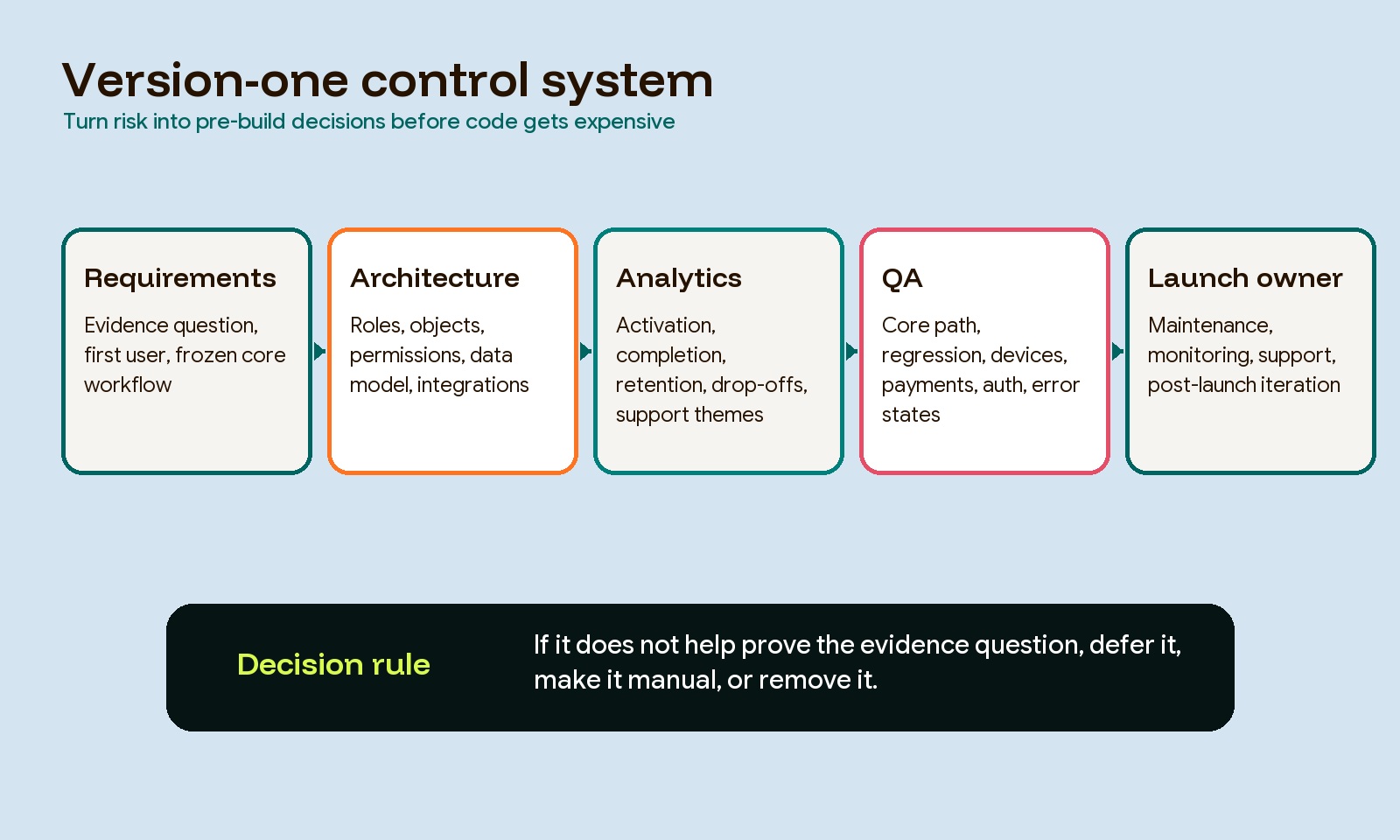
The best way to reduce MVP development challenges is to convert them into decisions before implementation starts. Version one needs a control system: requirements discipline, architecture choices, UX constraints, analytics, QA, and post-launch ownership.
For teams already building in agile cycles, Hapy’s agile MVP development guide shows how to keep sprint work tied to evidence instead of backlog volume.
Lock the evidence path
Start with the question the MVP must answer. Not the slogan. Not the roadmap. The question.
For example:
- Will operations managers invite their team after one successful workflow?
- Will a clinic pay for the product if intake time drops?
- Will vendors complete onboarding without sales help?
- Will users trust the AI output enough to reuse it next week?
Once the evidence question is clear, the scope gets easier. Anything that does not help answer it is either deferred, made manual, or removed.
Define the information architecture before UI polish
Founders often jump to screens because screens feel tangible. But information architecture is where many MVP risks are decided: user roles, objects, relationships, navigation, permissions, data states, and future extensibility.
If the product needs customers, teams, projects, invoices, vendors, admins, or patients, the relationships between those objects should be clear before front-end polish begins. A beautiful UI on top of a confused domain model becomes hard to change.
Use familiar UX patterns on purpose
Version one is not the best place to reinvent basic interaction patterns. Jakob’s Law, popularized by Nielsen Norman Group, says users spend most of their time on other sites and bring those expectations with them. Familiar patterns reduce learning cost, especially when the user is already evaluating whether the product is worth trusting.
That does not mean the product should look generic. It means the core workflow should feel legible: predictable navigation, clear hierarchy, obvious actions, and fewer surprises in high-stakes moments.
Budget the whole launch system
The build budget should not consume the whole product budget. A healthier plan reserves capital for:
| Budget area | Why it matters |
|---|---|
| Discovery and requirements | Prevents vague builds and late scope changes |
| UX and information architecture | Makes the core workflow understandable |
| Core engineering | Builds the live product and integration paths |
| QA and release testing | Protects early trust |
| Analytics and monitoring | Makes launch measurable |
| Post-launch iteration | Funds the changes real users expose |
| Maintenance | Keeps the product secure and functional |
If the MVP budget leaves no room for launch, support, and iteration, the team is not budgeting for an MVP. It is budgeting for a code drop.
Founder risk checklist before MVP development starts
Use this checklist before signing a development contract or starting a sprint. The goal is not to slow the build down. It is to stop preventable decisions from becoming expensive software behavior.
| Risk | Warning sign | Pre-build decision |
|---|---|---|
| Scope inflation | The backlog keeps expanding before the first user path is proven | Freeze the core workflow and defer secondary features |
| Unclear segment | The product is “for everyone who needs better software” | Name the first user, use case, and exclusion list |
| Analytics gap | Success is described only in qualitative terms | Define activation, retention, completion, and drop-off events |
| Integration tax | APIs are listed as simple line items | Map failure states, vendor cost, limits, and fallback paths |
| QA deprivation | Testing is treated as optional cleanup | Reserve QA time around the core path, permissions, devices, and regression |
| Compliance gap | Regulated data is mentioned but not designed into the architecture | Identify rules, jurisdictions, consent, audit, and deletion needs early |
| Maintenance overrun | Launch is treated as the end of spending | Reserve support, hosting, monitoring, patching, and post-launch iteration budget |
For Hapy Co, this is the practical reason to keep senior product and build judgment close to MVP execution. The goal of MVP development is not a bloated first release. It is a focused version one that can create market signal without burning the founder’s next move.
If the build question is whether to move with an outside team, internal hires, or a hybrid model, the MVP development agency vs in-house guide gives a stage-based comparison.
If the idea is still rough, book an MVP scoping call to decide whether the next step should be discovery, a prototype, a tighter version-one build, or more customer validation.
Common questions about MVP development challenges
What is the biggest MVP development challenge for founders?
Scope discipline is one important MVP development challenge; the highest risk depends on the product. Founders add features to make version one feel safer, but every addition increases cost, QA, complexity, and time before real user evidence arrives.
How is an MVP different from a prototype?
A prototype simulates the product experience so stakeholders or users can react to the idea. An MVP tests real behavior through a delivered outcome, which may use working software or a transparent manual service. For software releases, plan onboarding, workflow completion, analytics, support, and payment where relevant.
What should every MVP track from day one?
Every MVP should track activation, core task completion, retention or return usage, drop-off points, and support themes. The exact events depend on the product, but the founder should know whether users reach the first meaningful outcome.
How much QA does an MVP need?
An MVP needs enough QA to protect the core user path. That usually includes functional testing, integration checks, permissions, device/browser coverage, and regression testing around the flows that produce validation evidence.
Should founders build integrations into the first MVP?
Only when the integration is necessary for the evidence path. Payments, authentication, email, analytics, and core data integrations often belong in version one. Nice-to-have automations, complex reporting syncs, and future sales workflows can often wait.
The real job: make version one trustworthy enough to learn from
MVP development challenges are manageable when founders treat version one as a learning system. The product does not need every feature. It needs a clear user, a sharp workflow, reliable enough execution, and the measurement layer required to understand what happened.
That is the founder’s leverage point. Build too broadly and the product becomes slow before the market speaks. Build too thinly and the signal is unreliable. The right MVP sits between those mistakes: narrow enough to ship, strong enough to trust, and instrumented enough to make the next decision obvious.
Example of a predeclared launch decision
For a hypothetical weekly inventory pilot with six shops, a team could require five shops to complete the core count without help, four to repeat it in week three, and no unauthorized cross-shop data access. These illustrative gates support a small next investment, not a market-wide demand claim. Record the denominator, eligible shops, baseline process, errors, and manual support time. If repeat use is weak, interview both returning and non-returning shops and change one assumption before retesting; do not add dashboards to conceal a weak core workflow.