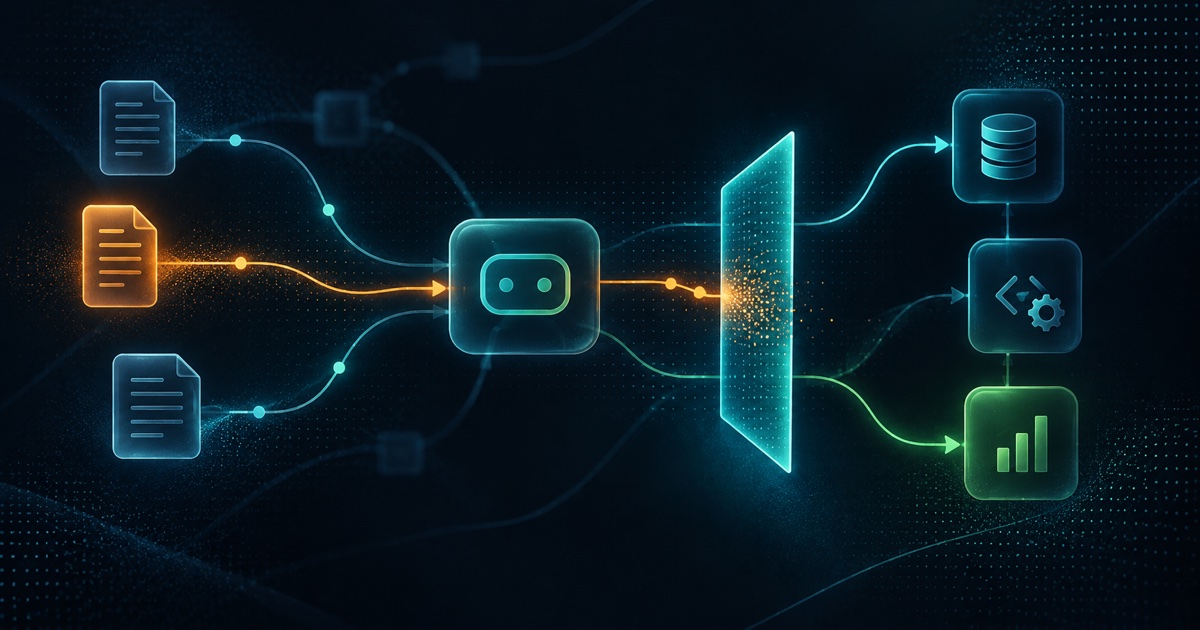
Choose the engagement by its scope and evidence. A focused automation engagement can suit repetitive work in existing tools; a broader engineering engagement can suit a custom product, complex architecture, or continuing operational responsibility. Either an agency or a tech partner may offer either model: the label alone says little about delivery quality.
That difference sounds simple. In practice, it is where many AI projects go wrong.
The market is moving fast because companies are no longer asking only, “Can AI do this?” They are asking, “Can this workflow run reliably inside our business?” IDC’s 2025 CEO research found that 66% of CEOs report measurable business benefits from generative AI initiatives, especially around operational efficiency and customer satisfaction. At the same time, AI has become a board-level risk topic. Fortune reported that the number of Fortune 500 companies citing AI as a risk factor rose to 281 in annual filings, a 473.5% increase.
That tension creates the real buyer problem. Businesses want the speed of AI workflow automation, but they also need the judgment, controls, and system design that keep automation from becoming another fragile layer of operations.
If the AI work is becoming part of the product itself rather than an internal workflow, use the AI product development strategy guide before treating an automation pilot as a production roadmap.
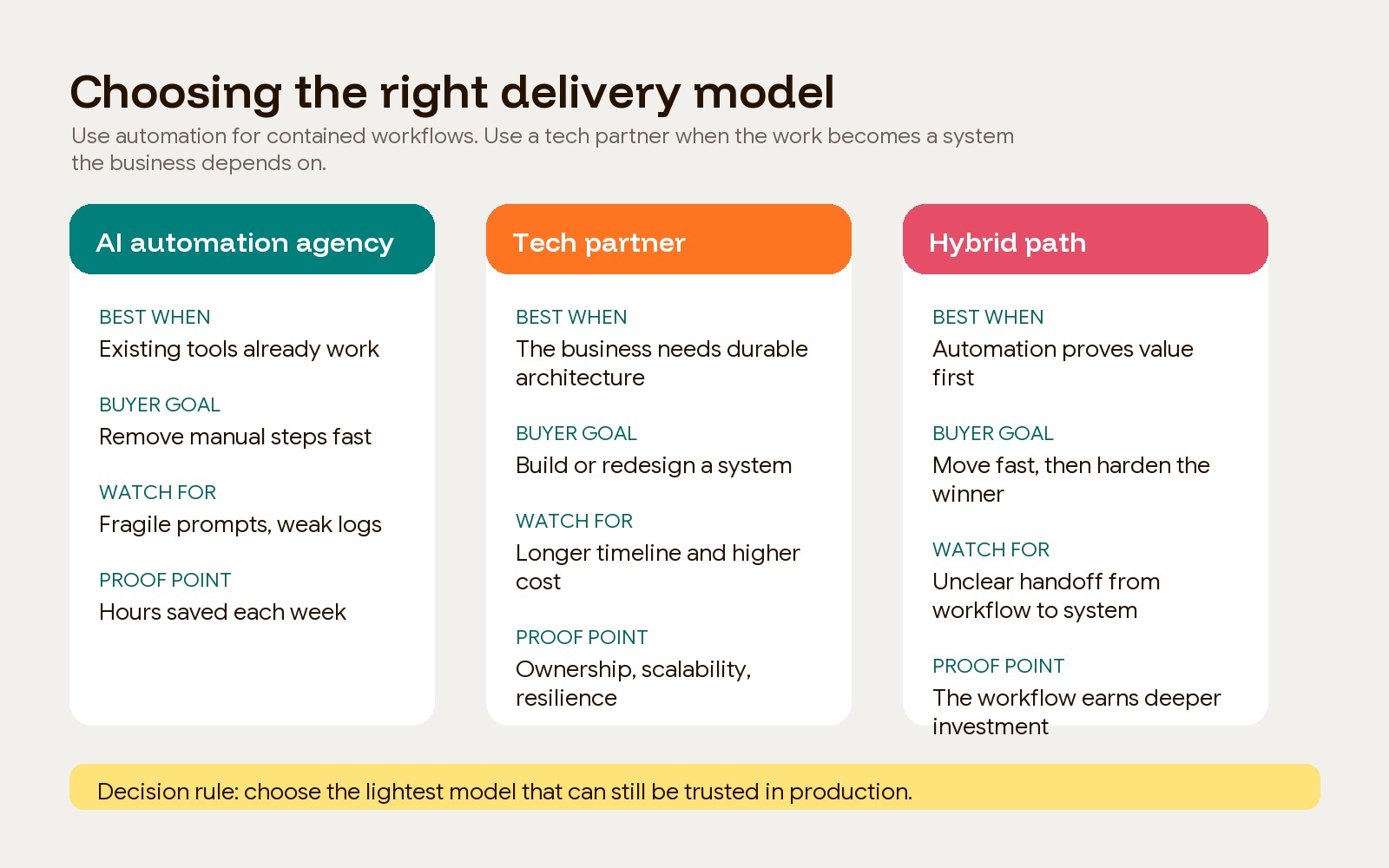
AI automation agency vs tech partner: the short answer
The comparison below describes two engagement patterns, not fixed provider categories. Ask each bidder to show its actual scope, delivery evidence, controls, and handoff commitments.
An AI automation agency usually owns a workflow outcome: qualify leads, route support tickets, extract invoice data, summarize sales calls, send follow-ups, sync CRM records, or create a reporting loop between tools. The work is typically built on existing platforms such as Zapier, Make, n8n, Voiceflow, GoHighLevel, or custom API connectors.
A tech partner owns a broader system outcome: build a product, redesign an operating model, create custom software, shape architecture, integrate data, manage technical risk, and make sure the system can evolve. The work may include AI automation, but AI is only one part of the delivery model.
Use these scope assumptions when reading the comparison; timelines, costs, and risk depend on the specific project:
| Decision area | AI automation agency | Tech partner |
|---|---|---|
| Best for | Repetitive workflows inside existing tools | Custom products, core systems, complex integrations |
| Typical timeline | Weeks for focused workflows | Months for larger builds or system redesigns |
| Cost pattern | Lower setup cost plus support or usage fees | Higher upfront cost plus product, engineering, and maintenance investment |
| Main value | Speed, labor reduction, faster response loops | Durable architecture, product quality, ownership, scalability |
| Risk profile | Fragile if the workflow depends on many tools, prompts, or unclear data | Slower and more expensive, but better suited to high-stakes systems |
| Ownership model | Often “glass box” workflow visibility if built in visual platforms | Can be transparent or opaque depending on code ownership and handoff |
| Buyer question | “Can we automate this without rebuilding the system?” | “Do we need a better system, not just a faster workflow?” |
The mistake is treating these models as rivals. They solve different levels of the same problem.
What an AI automation agency actually does
An AI automation agency designs, connects, and maintains AI-assisted workflows across the tools a business already uses. Instead of building a new app from scratch, the agency maps a process, identifies manual handoffs, and creates an automated workflow using APIs, prompts, triggers, document extraction, routing logic, and human approval steps.
That makes the model useful for sales, operations, finance, support, recruiting, and internal reporting. A good AI automation agency does not sell “AI” as the product. It sells fewer manual steps, faster cycle time, cleaner handoffs, and better operational visibility.
The strongest use cases share three traits:
- The workflow is already repeated often.
- The data inputs are reasonably structured.
- The cost of slow or manual execution is easy to calculate.
Examples include lead enrichment, CRM cleanup, invoice routing, customer support triage, appointment booking, proposal generation, inventory alerts, and document review workflows. If the work is mostly repetitive handoffs and rules, it may belong in a broader business process automation plan before it becomes a custom software project.
If you are already comparing vendors for that narrower workflow layer, use the AI automation agencies scorecard to test workflow fit, platform risk, governance, ownership, and support before funding a pilot.
This is why the AI automation agency market has grown quickly. Market estimates vary by methodology, but the direction is consistent: enterprise agentic AI and automation are expanding at a high-growth rate. Grand View Research, for example, projects the U.S. enterprise agentic AI market to grow at a 43.6% CAGR from 2025 to 2030. The demand is not only for AI models. It is for people who can turn those models into usable work.
Where AI automation agencies are a strong fit
An AI automation agency is a strong fit when the business already has the tools and mostly needs orchestration.
If your team is copying information between a form, CRM, spreadsheet, inbox, support tool, and reporting dashboard, you probably do not need a custom software platform first. You need a cleaner operating layer. That is exactly where AI workflow automation can create fast leverage. Hapy’s AI automation guide covers the guardrails that keep those workflows from turning into fragile shortcuts.
Good agency-fit work usually looks like this:
- A sales team needs faster lead qualification and follow-up.
- A clinic or service business needs intake, reminders, and appointment workflows.
- An operations team needs invoice, document, or inventory routing.
- A support team needs ticket triage, summary, response drafting, or escalation rules.
- A founder needs a lightweight internal tool before investing in full custom software.
The reason these projects work is that the workflow can be improved without changing the whole business architecture. The agency can connect existing tools, add AI where judgment or language processing helps, and leave a human in the loop where risk is higher.
For Hapy Co’s own positioning, this sits close to Business Systems & Automation: the goal is not to add another shiny tool. The goal is to make the business easier to see, run, and improve.
When broader engineering ownership is needed
A tech partner is the better fit when the business problem is not just a workflow problem.
If the project needs a custom user experience, proprietary product logic, deep data architecture, security design, regulated workflows, or long-term technical ownership, check whether the proposed automation stack can meet those requirements. It may still be useful for prototypes and internal workflows, but it should not become the hidden foundation of a critical system without engineering discipline around it. At that point, compare the work against practical custom software examples instead of treating it as another workflow tweak.
Choose a tech partner when the work involves:
- A customer-facing product or marketplace.
- A custom SaaS platform or internal operating system.
- Complex permissioning, audit trails, or compliance requirements.
- High-volume data processing where cost and latency matter.
- Integrations that require custom API design, not only prebuilt connectors.
- AI systems that can modify records, trigger payments, affect customers, or create legal exposure.
- A roadmap that will keep evolving beyond the first workflow.
This is where technical leadership matters. The hard part is not whether a model can summarize, classify, or draft. The hard part is deciding what should be automated, what should remain deterministic, what needs human approval, and what the business will own after launch.
When a hybrid model fits
The most practical answer is often hybrid: use automation to prove value quickly, then harden the parts that deserve to become real systems.
For example, a company might start with an AI automation agency to automate inbound lead routing, meeting summaries, and CRM updates. If that workflow starts influencing revenue forecasting, sales compensation, or customer segmentation, the business may need custom data modeling, role-based permissions, stronger observability, and tighter QA. At that point, the work has moved from automation into system design.
This is also how many good MVPs should be built. A narrow workflow can become the proof point before a team commits to a larger product. Hapy’s MVP development approach is built around the same idea: version one should answer the most important business question before the company overinvests in scope.
The hybrid path works best when everyone is honest about the transition point. If a workflow is only saving time, a lightweight automation may be enough. If it becomes part of how the company makes decisions, serves customers, or controls money, it needs stronger architecture.
Production reliability matters more than demo speed
The biggest risk in AI automation is that demos hide failure modes.
An AI agent can look impressive in a controlled recording and still fail on unfamiliar inputs or real integrations. There is no failure rate in this guide that can predict your workflow. Define success at the complete-task level, include retries and human corrections, and measure it on representative cases before relying on autonomous execution.
The common failure modes are not mysterious:
- The agent misunderstands context.
- A third-party API changes.
- A token expires.
- A prompt works for 20 examples and fails on the 21st.
- The workflow repeats a tool call and creates duplicate records.
- A model update changes output quality without warning.
- A multi-step chain compounds small errors into a large operational mistake.
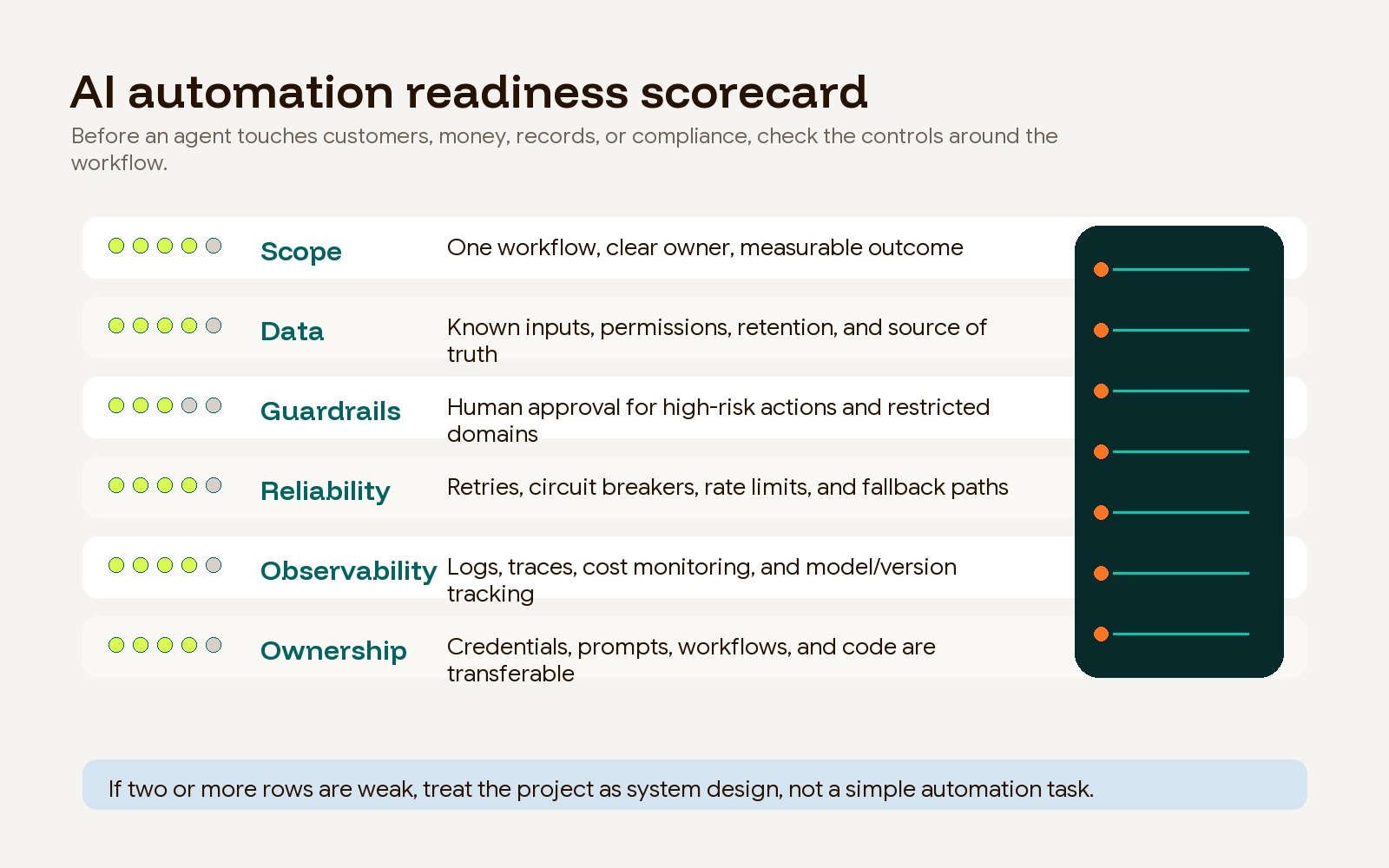
This is why production AI automation needs engineering controls, not just better prompts.
Strong implementations use event-driven workflow logic, clear failure states, rate limits, budget limits, human approval thresholds, regression tests, prompt/version tracking, and observability. The OpenTelemetry project has also been expanding guidance for GenAI observability, including visibility into LLM calls, tool execution, token usage, latency, and agent traces.
In plain business language: if an AI workflow can affect money, customers, records, compliance, or reputation, you need to know what happened, why it happened, and who can stop it.
Stack choice is a business decision, not a tooling debate
AI automation stacks tend to start with tools like Zapier, Make, and n8n. Each has a place.
Zapier is often strong for simple SaaS-to-SaaS workflows and non-technical teams. Make gives visual builders more room for branching logic and workflow complexity. n8n is often more attractive for technical teams because it is extensible and can be self-hosted. Its Sustainable Use License has usage restrictions, so review licensing before embedding or reselling it. Its documentation also includes advanced AI and LangChain workflow features, which matters when teams need more control than basic trigger-action automations.
The buyer should not ask, “Which tool is best?” The better question is:
- Where will our data pass through?
- Can we self-host if compliance requires it?
- What happens when the workflow volume increases?
- Who owns the credentials, API keys, and execution logs?
- Can we test changes before they affect live operations?
- How easy is it to move away from this stack later?
Vendor lock-in is also changing. The Open Responses specification is an attempt to standardize interoperable LLM interfaces across providers, reducing the cost of moving between models and routing work by cost, speed, or capability. That does not remove the need for architecture. It makes architecture more important because teams can design the system around portability instead of hardcoding every decision into one provider.
How pricing should be judged
AI automation agency pricing often looks cheaper than traditional software development because the scope is narrower. A focused automation may cost a few thousand dollars to set up, while a custom software platform can run tens or hundreds of thousands of dollars depending on scope.
That does not mean the cheaper option is always better. It means the buyer needs to price the right unit of value.
For an AI automation agency, judge cost against operational savings:
- Hours saved per week.
- Faster response time.
- Lower error rate.
- More qualified leads handled.
- Fewer support tickets escalated.
- Less manual reporting.
- Reduced dependency on one overloaded operator.
For a tech partner, judge cost against system value:
- Revenue enabled by a new product.
- Technical debt avoided.
- Lower future maintenance risk.
- Better data ownership.
- Faster product iteration.
- Stronger compliance and audit readiness.
- A durable platform the business can keep improving.
Value-based pricing can make sense for automation if the business case is clear. For example, if a support workflow reliably deflects a measurable share of tickets, the fee should be evaluated against the annual savings and the quality of the customer experience. But beware of pricing that assumes perfect automation. Real systems need monitoring, exception handling, and ongoing improvement.
For a more structured way to judge the savings case, Hapy’s AI automation ROI guide shows how to compare baseline work, operating cost, risk control, and production evidence before scaling.
If the work is closer to product engineering than workflow orchestration, the pricing conversation should also account for custom software development cost, not just setup fees and monthly support.
A practical due diligence checklist for buyers
Before choosing an AI automation agency or tech partner, run the same test: can they explain the work in operational terms?
A credible partner should be able to answer these questions clearly:
- What exact business process are we changing?
- What data enters the workflow, and where does it go?
- Which steps are deterministic, and which steps use AI judgment?
- What happens when the AI is uncertain?
- Who approves high-risk actions?
- How will we test the workflow before launch?
- What logs, traces, and alerts will exist after launch?
- Who owns the workflow, credentials, prompts, and source code?
- How are API usage, model costs, and rate limits controlled?
- What changes will require a support retainer, and what can the internal team adjust?
If the provider cannot answer these in plain language, be careful. Buzzwords are cheap. Production responsibility is not.
For larger companies, the bar should be higher. EU AI Act obligations are now moving through phased enforcement, with the European Commission noting that rules for general-purpose AI models entered application in 2025 and require more transparency, safety, and accountability. Even outside Europe, the direction is clear: AI systems that touch business operations need clearer governance.
The buyer decision framework
Use this simple rule:
Choose an AI automation agency when the workflow is clear, the data is accessible, the risk is contained, and the goal is speed.
Choose a tech partner when the business needs a system, not just a workflow. That includes custom product development, data architecture, technical leadership, security, compliance, or long-term ownership.
Choose a hybrid model when automation can prove the value first, but the winning workflow may need to become part of a durable product or operating system later.
The most important signal is not whether a provider calls itself an AI automation agency, AI consultancy, software development firm, or tech partner. The signal is whether they understand the level of responsibility the work carries.
Small workflow, low risk, clear ROI: automate it.
Core workflow, higher risk, unclear ownership: design the system properly.
Strategic product, customer-facing experience, regulated process, or high-volume operations: bring in a partner with product, engineering, and AI judgment in the same room. For enterprise AI deployments, that increasingly looks like a forward deployed engineer or a similarly embedded technical delivery model.
Final take
The AI automation agency vs tech partner decision is really a question of maturity.
A focused automation scope can shorten the path to a working workflow. A broader engineering scope can include architecture, product judgment, and operational resilience. Require evidence for those capabilities from either type of provider.
The best companies will use both patterns carefully. They will automate where speed matters, engineer where reliability matters, and avoid pretending that a clever workflow is the same thing as a durable system.
If your business is deciding between AI workflow automation and a deeper build, start with the workflow that is causing the most drag. Map the risk around it. Then choose the lightest model that can still be trusted in production.