Last updated: September 8, 2026
A forward deployed engineer is a customer-facing engineer who embeds inside a client environment to turn software capability into working business systems. The role sits between software engineering, solution architecture, technical consulting, and product strategy, but its center of gravity is execution: scope the real problem, write production code, integrate with messy systems, and stay close enough to the customer to see whether the work actually lands.
The reason the forward deployed engineer role is suddenly everywhere is simple: enterprise AI has a deployment problem. A chatbot demo can be built in a week. A reliable AI workflow inside a bank, healthcare provider, logistics network, or enterprise data stack is a different job. It needs access control, model evaluation, data plumbing, workflow redesign, and people who can explain tradeoffs to executives without losing the engineering detail.
That is the practical value of the FDE model. It puts senior technical judgment where most software projects break: the last mile between a promising product and the real operating environment.
What does a forward deployed engineer do?
A forward deployed engineer turns an abstract product promise into a working deployment for a specific customer. In practice, that means customer discovery, system design, integration work, data modeling, production coding, incident response, stakeholder communication, and feedback to the core product team.
The role was popularized by Palantir, which reframed client-facing integration work as a high-agency engineering discipline. A 2026 a16z analysis of forward-deployed job titles argues that the title worked because it gave status to work that was already critical: making complex software useful inside complex institutions.
That distinction matters. A traditional implementation team might configure software after the sale. A forward deployed engineer is expected to understand the business problem well enough to decide what should be built, then engineer the missing layer between the product and the customer’s reality.
Typical FDE work includes:
- Translating a vague operational complaint into a buildable technical plan.
- Connecting product APIs, customer databases, identity systems, data warehouses, and legacy software.
- Building prototypes that prove a workflow can work with real customer data.
- Writing production code for customer-specific services, data pipelines, dashboards, RAG systems, agents, or internal tools.
- Creating model evaluation and observability loops so AI systems can be trusted after launch.
- Explaining technical risk, implementation tradeoffs, and rollout plans to business leaders.
- Feeding patterns back to product teams so one-off work becomes reusable capability.
The best FDEs are not simply “engineers who talk to customers.” They are engineers who can stay useful when the requirements are incomplete, the data is imperfect, and the customer’s actual workflow contradicts the sales deck. That is why the role rewards the same mix of judgment, communication, and execution expected from a senior software engineer, but with more customer proximity.
Why forward deployed engineering matters for enterprise AI
Forward deployed engineering matters because enterprise AI value depends less on model access and more on deployment quality. The limiting factor is no longer whether a model can answer a prompt. It is whether the system can safely act inside a real workflow, with the right data, permissions, controls, and business context.
OpenAI made that point explicit when it launched the OpenAI Deployment Company on May 11, 2026. The company said its FDEs will work inside customer organizations to identify high-value workflows, connect OpenAI models to customer data and tools, and deploy systems that can be used reliably in daily operations. OpenAI also said the new company would launch with more than $4 billion in initial investment and acquire Tomoro, bringing about 150 forward deployed engineers and deployment specialists into the business.
This is one signal that some AI vendors expect more implementation support around enterprise deployments. It is not proof that every buyer needs an FDE or that self-service software is insufficient for every use case.
IBM is making a related argument from the consulting side. In May 2026, IBM introduced Forward Deployed Units, or FDUs: small senior pods that combine domain experts, architects, engineers, platforms, and AI agents. IBM’s position is that a single FDE can help, but systemic enterprise AI problems need an operating model that connects strategy, engineering, governance, and continuous improvement. IBM reports that a six-person FDU can do the work of a 30-person traditional team in the right conditions. That is a vendor-reported claim, not an independent benchmark; compare the scope, baseline, and outcome definition before using it in a business case.
The common thread is not a job title. It is a delivery model built around proximity to the work. For buyers comparing delivery options, the distinction is close to the choice between an AI automation agency and a tech partner: the more production risk the workflow carries, the more embedded engineering judgment matters.
Forward deployed engineer vs software engineer vs solutions architect
A forward deployed engineer differs from a software engineer and a solutions architect by where the work happens and what the role owns. A software engineer usually builds generalized product features. A solutions architect usually designs an approach and aligns stakeholders. A forward deployed engineer owns the messy middle: building production-grade systems inside a customer-specific environment. That role design should be reflected in the wider software development team structure, not hidden as informal hero work.
| Role | Primary setting | Owns production code? | Main success metric |
|---|---|---|---|
| Forward deployed engineer | Embedded with customer teams and operators | Yes, often inside the customer environment | Working deployment, adoption, renewal, measurable business value |
| Software engineer | Internal product or platform team | Yes, for generalized product features | Scalable product capability, reliability, feature adoption |
| Solutions architect | Pre-sale or strategic technical planning | Sometimes for demos or proofs of concept | Technical alignment, architecture fit, risk reduction |
| Technical consultant | Project or advisory engagement | Sometimes, depending on scope | Deliverables, recommendations, implementation milestones |
PostHog’s 2026 explainer puts the difference plainly: FDEs work much closer to one customer at a time, while software engineers typically optimize for reusable features across many customers. The same article notes that FDEs often travel or work directly inside customer systems, and that the role can vary from true implementation engineering to titles that are closer to technical consulting or sales engineering depending on the company. See PostHog’s forward deployed engineer breakdown.
That variation is why companies should define the role carefully before hiring for it. If the job is mostly pre-sales demos, call it sales engineering. If the job is mostly stakeholder workshops and architecture diagrams, call it solutions architecture. If the job requires production code, customer discovery, integration ownership, and post-launch accountability, FDE is the more honest title.
The FDE operating loop
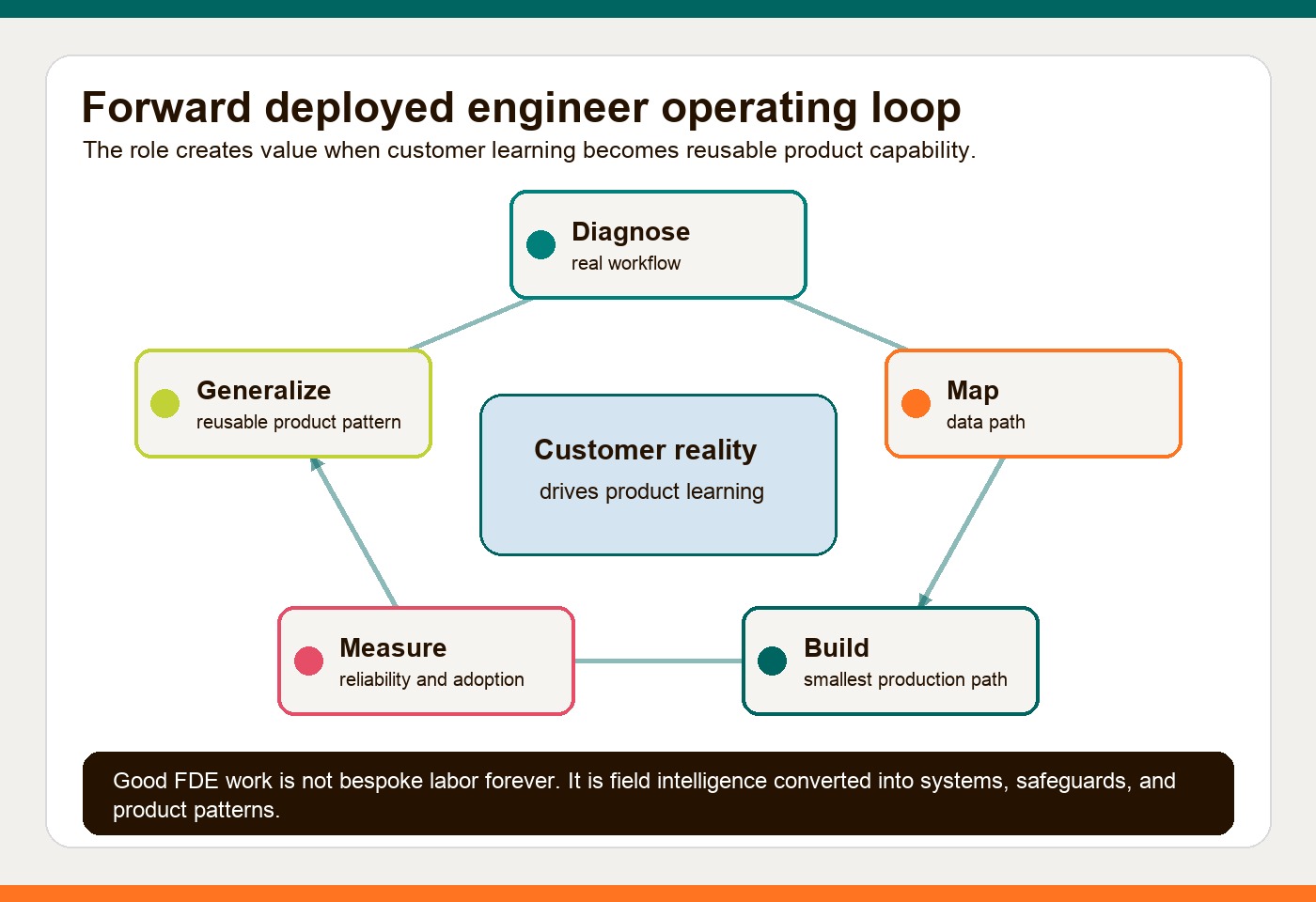
The forward deployed engineer model works when the loop between customer reality and product improvement is tight. The customer gets a working solution sooner. The product team gets field intelligence that would never appear in a clean roadmap document.
Use this loop as the operating model:
- Diagnose the real workflow. The FDE sits with operators, not just buyers, to understand where the process breaks today.
- Map the data path. The team identifies source systems, permissions, schemas, manual handoffs, security limits, and reliability constraints.
- Build the smallest production path. The first release should prove a real decision or workflow, not merely impress in a demo.
- Measure reliability and adoption. For AI systems, this means evals, human review, escalation paths, usage analytics, and failure analysis.
- Generalize what repeats. Patterns that show up across customers become product features, accelerators, templates, or internal playbooks.
Databricks describes a similar pattern in its OKR-centric pod delivery model, where embedded teams align delivery to customer outcomes and feed technical blockers back into product and engineering. Databricks reports that strategic cloud migrations under this model have unlocked 20-30% cost reductions for customers. Treat that as a Databricks case claim, not a general result; ask for the baseline, scope, time period, and customer evidence before applying it to another migration.
For Hapy Co, this is the same principle behind good business systems automation: build close enough to the operating reality that the system improves the way work actually happens, not the way a requirements document imagined it.
What skills does a forward deployed engineer need?
A strong forward deployed engineer needs production engineering depth, business fluency, and the emotional range to work inside customer pressure. The role is not a shortcut around engineering fundamentals. If anything, it raises the bar because technical decisions happen in front of the customer and under real constraints.
Core skills usually include:
- Backend and integration engineering: APIs, authentication, distributed systems, data pipelines, cloud services, observability, and deployment workflows.
- Data fundamentals: SQL, data modeling, warehouse patterns, ETL or ELT, vector databases, and quality checks.
- AI deployment: LLM application design, RAG, agents, prompt systems, model evaluation, guardrails, and human-in-the-loop controls.
- System design under constraints: SSO, SAML, IAM, VPCs, compliance reviews, data residency, and legacy ERP or CRM integration.
- Communication: discovery calls, executive updates, workshops, plain-English tradeoff explanations, and conflict navigation.
- Product judgment: knowing what to build first, what to defer, and when a custom solution should become a reusable product capability.
The job also rewards temperament. FDEs need high ownership without heroics. They need enough confidence to move through ambiguity and enough humility to learn from operators who understand the business better than they do.
Forward deployed engineer compensation and career path
There is no reliable universal FDE salary range. The title covers different mixes of production engineering, customer work, travel, implementation, solutions consulting, technical account management, and sales engineering. A useful benchmark must name the country, date, level, base-versus-variable or equity treatment, and whether the role owns production reliability.
For a real hiring decision, compare dated job postings or a named salary dataset with the same compensation definition. Do not combine a base-pay range with a total-compensation range or present an unnamed research article as a market benchmark.
Role design is a meaningful planning signal. Document whether the FDE will:
- Own production code and on-call or incident responsibilities.
- Travel or embed with strategic customers.
- Handle regulated or sensitive data.
- Build AI systems, integrations, evaluation, and observability.
- Lead executive workshops and post-launch adoption work.
For career growth, the path can lead to staff-level customer engineering, solutions architecture leadership, product management, technical account leadership, internal product engineering, or a founder role. Define technical leveling and code ownership so customer proximity does not become coordination work without engineering depth.
When should a company hire a forward deployed engineer?
A company should hire a forward deployed engineer when customer value depends on hands-on implementation, deep integration, and fast learning from real deployments. It is usually not the first hire for a simple SaaS product. It makes sense when the product touches complex workflows, regulated data, large enterprise accounts, or AI systems that need customer-specific context to work.
The FDE model fits best when:
- Contract values are high enough to justify senior engineering time close to the customer.
- The product needs deep integration with existing systems before value appears.
- Buyers are skeptical and need working evidence, not only a deck.
- The customer environment is regulated, fragmented, or operationally sensitive.
- The company is entering a new vertical and needs field learning quickly.
- AI reliability depends on customer-specific data, evaluation, governance, and workflows.
It fits poorly when:
- The product should work self-serve with minimal configuration.
- The business cannot afford customer-specific engineering work.
- Every deployment becomes bespoke and nothing returns to the core product.
- FDEs are used to compensate for weak onboarding, poor documentation, or product gaps that should be fixed centrally.
That last point is important. Forward deployed engineering can become a strategic moat, but it can also become a services trap. If every customer requires a custom build and none of that learning becomes reusable, the company is not scaling a product. It is selling expensive labor with a software label. The same pattern can create technical debt cost if teams keep shipping customer-specific work without a path back into the core system.
The risks of the FDE model
The main risk of forward deployed engineering is that it can hide product weakness behind talented people. A brilliant FDE can make a fragile system work for one customer. That does not mean the product is ready to scale.
Leaders should watch for four risks:
| Risk | What it looks like | How to control it |
|---|---|---|
| Bespoke sprawl | Every enterprise deployment becomes a one-off branch | Require field work to produce reusable patterns, components, or product issues |
| Burnout | FDEs own travel, politics, incidents, and delivery pressure | Cap active accounts, rotate coverage, and create clear escalation support |
| Product drift | Customer urgency overrides architecture discipline | Pair FDEs with product and platform owners who can decide what generalizes |
| Confused career paths | Engineers worry the role is not “real engineering” | Define technical leveling, code ownership, and promotion criteria explicitly |
There is also a buyer-side risk. Customers can become dependent on embedded vendor engineers if internal capability is never built. The best deployments avoid that dependency by pairing FDE execution with training, documentation, shared ownership, and a clear path for the client team to operate the system after launch.
The rise of the AI forward deployed engineer
The next version of the FDE role will be augmented by AI agents. Palantir’s AI FDE documentation describes an interactive agent inside Foundry that can translate natural language into platform operations, including data integration, Python transforms, ontology editing, governance checks, and application work.
That does not remove the human FDE. It changes the work mix. AI can help generate code, run checks, inspect systems, write documentation, and speed repetitive implementation. The human still has to decide what matters, what is safe, what the customer will actually use, and what should become product instead of project work.
The useful mental model is not “AI replaces the FDE.” It is “AI turns the best FDEs into higher-leverage operators.” They spend less time on repetitive plumbing and more time on architecture, trust, adoption, and business outcomes.
For companies building AI into real operations, that is where technical leadership matters. The hard work is rarely the first prototype. It is the system of decisions around data access, failure handling, product ownership, user adoption, and the feedback loop after launch. Hapy Co’s AI and technical capabilities are built around that same execution problem: using AI where it creates leverage, while keeping product judgment and engineering ownership close to the work.
The practical takeaway
The forward deployed engineer is not just a new label for consulting. At its best, the role is a response to a real delivery gap: companies can buy powerful software and still fail to turn it into operational value.
For AI especially, teams should judge the model by whether they can move from demo to production, from production to adoption, and from one customer’s pain to a reusable product pattern.
That is the strategic case for forward deployed engineering. It brings product, engineering, and customer reality into the same room. Used well, it helps companies learn faster, deploy more reliably, and build software that survives contact with the business.
FAQs about forward deployed engineers
What is a forward deployed engineer?
A forward deployed engineer is an engineer who embeds with a customer to build, integrate, and deploy production software in the customer’s real operating environment. The role combines software engineering, customer discovery, system integration, and product feedback.
Why are forward deployed engineers in demand?
Forward deployed engineers can be useful when AI and enterprise software need hands-on implementation before value appears. Demand varies by company and role definition. Do not treat an undated or unscoped job-posting growth figure as a general market measure; assess the customer work, production ownership, and hiring need in the role you are designing.
Is a forward deployed engineer a consultant?
An FDE can look like a consultant because the role is customer-facing, but the best FDEs own production implementation rather than only recommendations. If the person is not writing or owning technical delivery, the role is closer to solutions architecture or technical consulting.
What is the difference between an FDE and an AI engineer?
An AI engineer focuses on building AI systems, applications, agents, data pipelines, or model workflows. An FDE may do that work too, but inside a specific customer deployment with added responsibility for stakeholder alignment, integration, adoption, and post-launch reliability.