AI automation agencies help businesses turn manual workflows into AI-assisted systems that can classify, extract, summarize, route, draft, update records, and trigger follow-up work across existing tools. The right agency can remove expensive operational drag. The wrong one can leave you with brittle prompts, opaque integrations, and a workflow nobody trusts after the demo.
That distinction matters more now because AI use has moved faster than AI operating discipline. McKinsey’s 2025 global survey found that 88% of organizations use AI in at least one business function, but only 39% report any enterprise-level EBIT impact from AI. Gartner’s April 2026 survey of infrastructure and operations leaders found that only 28% of AI use cases fully succeed and meet ROI expectations, while 20% fail outright.
The lesson is blunt: buying AI automation is not the same as buying ROI. ROI comes when the agency understands the workflow, the data, the systems, the risk, and the human behavior around adoption.
What AI automation agencies actually do
AI automation agencies design and maintain workflows where AI models work alongside business rules, integrations, and human review. The work usually sits between operations consulting and software engineering: map a process, identify repeatable handoffs, connect tools, add AI where language or judgment is useful, and define what happens when the system is uncertain.
Common examples include:
- Lead qualification, enrichment, routing, and follow-up drafting.
- Sales call summaries and CRM updates.
- Invoice intake, purchase order matching, and finance exception routing.
- Customer support triage, response drafting, and escalation summaries.
- Document parsing for onboarding, compliance, insurance, legal, or healthcare workflows.
- Internal reporting loops that turn data into operating narratives.
- Knowledge-base assistants that cite internal policies or source documents.
A good agency does not sell “an AI agent” as the whole answer. It sells a measurable workflow improvement: faster cycle time, fewer manual steps, lower error rate, cleaner handoffs, better visibility, or more capacity without adding headcount.
For Hapy Co clients, this sits close to Business Systems & Automation: the point is not to add a clever layer on top of messy operations. The point is to make the business easier to run.
When an AI automation agency is the right fit
AI automation agencies are the right fit when the business has a repeated workflow, reasonably available data, and a clear definition of success. The best first project is usually painful, measurable, and narrow enough to test in weeks.
Strong agency-fit work often has four traits:
| Fit signal | What it means |
|---|---|
| Repetition | The process happens often enough that time savings compound. |
| Messy inputs | Emails, PDFs, transcripts, tickets, notes, invoices, or forms need interpretation. |
| Existing tools | The workflow can improve inside the current CRM, ERP, inbox, support desk, spreadsheet, or database. |
| Measurable outcome | The team can track hours saved, faster response, lower error rate, higher throughput, or fewer escalations. |
Weak candidates have the opposite profile. They have unclear ownership, inconsistent source data, low volume, high legal or financial consequence, or no baseline metric. If nobody can explain the current process in plain language, the workflow is not ready for an AI agency. Start with a business process automation strategy before automation.
The line between an agency and a broader tech partner also matters. If the work needs a customer-facing product, custom architecture, regulated data design, complex permissioning, or a system that will evolve for years, compare the project against a fuller AI automation agency vs tech partner decision instead of buying a narrow workflow build.
The three types of AI automation agencies
The following three categories are Hapy’s practical selection framework, not a market census or a scored agency study. An agency may span several groups; verify the assigned team’s experience against your workflow.
1. Workflow automation builders
These agencies move quickly inside existing tools. They often build with Zapier, Make, n8n, Airtable, HubSpot, Salesforce, Slack, Google Workspace, Microsoft 365, and lightweight AI tooling. They are useful when the workflow is obvious and the business needs fast relief from manual handoffs.
The advantage is speed. The risk is fragility. If the agency only wires tools together without data validation, monitoring, ownership, and exception handling, the workflow can become another hidden operating dependency.
2. Vertical specialists
Vertical specialists focus on industries such as manufacturing, logistics, finance, healthcare, real estate, professional services, or customer support. They are stronger when domain rules matter: invoice matching, inventory alerts, compliance screening, risk scoring, claims intake, appointment routing, or customer service escalation.
The advantage is pattern recognition. A specialist has probably seen the same bottleneck before. The risk is vendor lock-in if the agency relies on proprietary middleware, closed workflow logic, or ongoing licensing that prevents you from owning the system.
3. Engineering-led automation partners
Engineering-led agencies are closer to custom software teams. They still build automations, but they are more likely to use APIs, databases, queues, event logs, retrieval systems, evaluation sets, cloud infrastructure, and custom interfaces. They are useful when the workflow is important enough to require real architecture.
The advantage is durability. The risk is cost and scope creep if the business only needed a simple workflow improvement. This is where a practical AI automation ROI model helps: measure the value of the workflow before funding a larger system.
Stack choice is a business decision
The agency’s stack determines how the workflow behaves after launch. It affects cost, security, auditability, portability, maintenance, and who can safely change the system later.
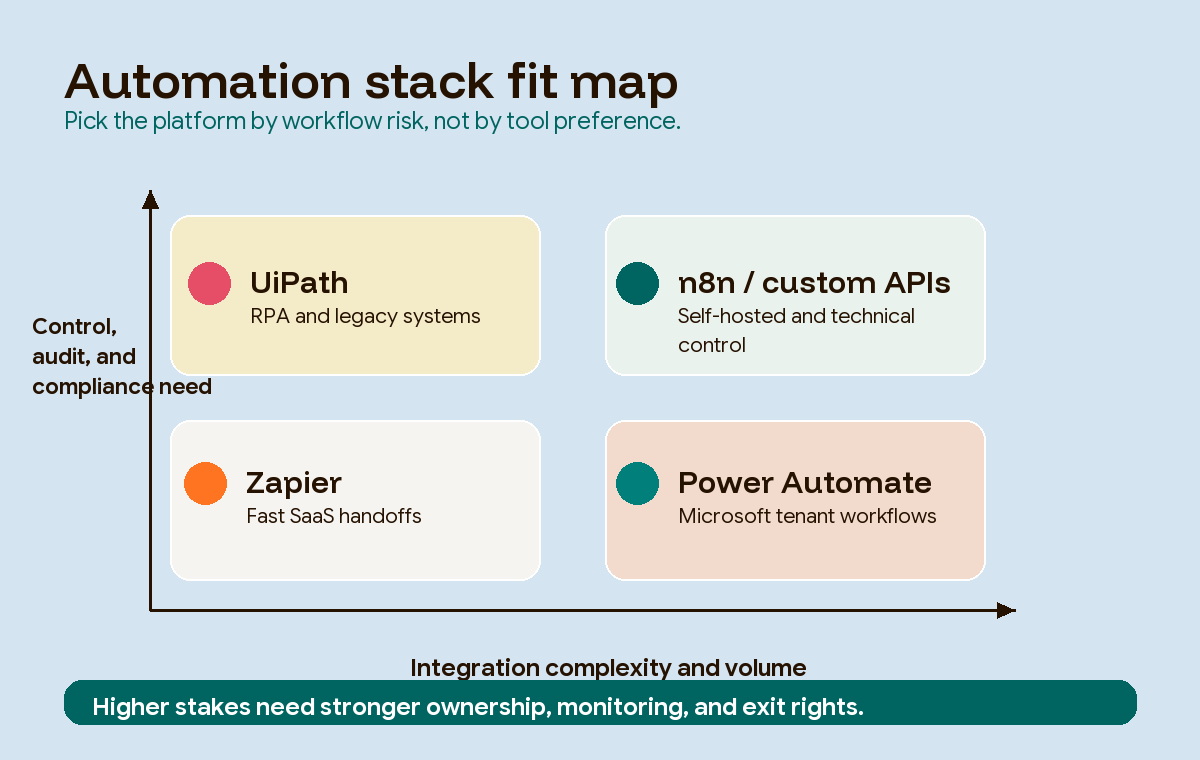
Zapier is often attractive for fast SaaS-to-SaaS workflows because it offers thousands of app connections and a low-code builder. That can be excellent for marketing ops, sales ops, support ops, and simple data movement. It can also become expensive or hard to govern if high-volume workflows expand across many steps and teams.
Microsoft Power Automate makes more sense when the company already lives inside Microsoft 365, Dynamics, Teams, SharePoint, and Azure. Microsoft publishes Power Automate pricing by plan, which helps buyers compare user-based and process-based cost before committing. The business question is whether the workflow should live inside the Microsoft tenant’s security and governance model.
n8n is often a better fit for technical teams that want more control, custom logic, and self-hosting options. Its documentation covers self-hosted deployment paths, which can matter when data residency, privacy, or integration depth is a serious requirement. The tradeoff is that self-hosting creates operational responsibility: patching, secrets management, monitoring, backups, and access control.
UiPath is better known for enterprise robotic process automation and agentic automation. It can be appropriate when the work involves legacy systems, desktop workflows, attended or unattended bots, and process auditing. UiPath describes its platform as combining AI agents, robots, and people, which is powerful for complex operations but usually heavier than what a small workflow project needs.
Do not let an agency choose the platform only because it is their favorite tool. Ask:
- Where will customer, employee, financial, or operational data pass through?
- Can the system run inside our existing security model?
- What happens when workflow volume doubles?
- Who owns the API keys, credentials, prompts, logs, and outputs?
- Can changes be tested before they affect live operations?
- Can we move the workflow away from this vendor later?
Pricing should include the full operating cost
AI automation agency pricing often looks simple: discovery fee, setup fee, monthly support, and sometimes a platform or usage charge. That is only the visible cost.
The full cost includes workflow discovery, data cleanup, integration work, model usage, vendor fees, human review, monitoring, QA, staff training, security review, and ongoing maintenance. A low monthly fee can become expensive if the workflow creates exception work, duplicate records, manual checking, or compliance exposure.
Use this cost model before approving a proposal:
| Cost layer | What to ask |
|---|---|
| Discovery | What process map, data audit, and success baseline will we get before build starts? |
| Build | Which integrations, prompts, rules, databases, queues, and interfaces are included? |
| Platform | What are the workflow platform, model, storage, hosting, and app subscription costs? |
| Review | How much human checking remains, and who is responsible for it? |
| Monitoring | What logs, dashboards, alerts, and failure states will exist after launch? |
| Maintenance | Who fixes API changes, model drift, broken credentials, and edge cases? |
| Exit | What do we own if we stop paying the agency? |
The simplest ROI test is not “will AI save time?” It is “will this workflow produce enough measurable value after full cost and risk are included?” If the answer is not clear, fund a smaller pilot.
Governance is not optional for production AI automation
Production AI automation needs governance because agents can read data, make recommendations, trigger actions, and update business systems. Deloitte’s 2026 State of AI press release says close to three-quarters of companies plan to deploy agentic AI within two years, but only 21% report a mature model for agent governance.
That gap is exactly where agency selection should get sharper. A vendor that can build a polished demo may still be weak at production control.
Use the NIST AI Risk Management Framework as a plain-language checklist, even if you do not need formal compliance. The useful questions are practical:
- What can the AI access?
- What can it do automatically?
- What requires human approval?
- What happens when confidence is low?
- What logs prove what happened?
- Who owns incidents, corrections, and changes?
For lower-risk workflows, governance can be lightweight: role-based access, approval steps, error alerts, and a named owner. For higher-risk workflows that affect customers, money, compliance, contracts, employment, or production systems, governance should include audit logs, test cases, rollback paths, security review, and clear human accountability.
This is not bureaucracy. It is what makes automation safe enough to scale.
The due diligence scorecard
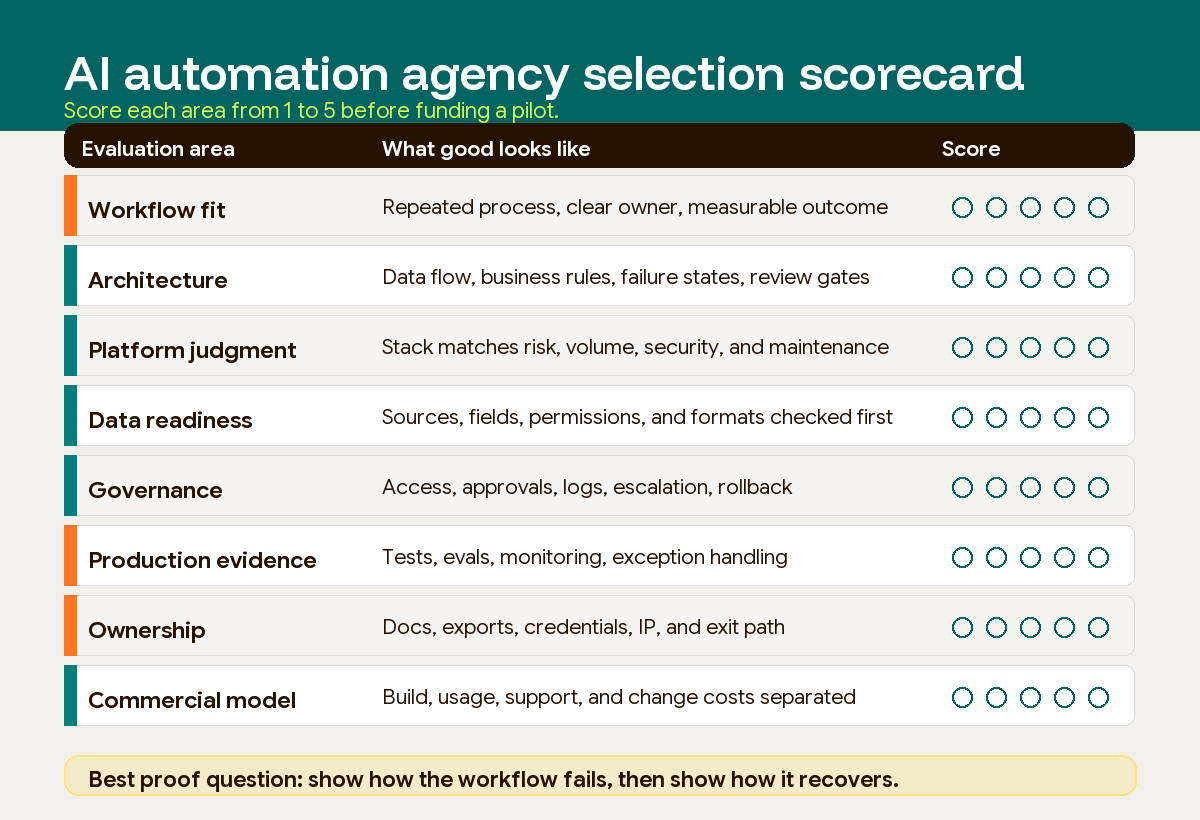
Use the following scorecard before selecting an AI automation agency. Give each area a 1–5 evidence score: 1 means no usable evidence; 2 means an assertion or generic example; 3 means a relevant artifact with unresolved gaps; 4 means a walkthrough by the proposed delivery team; 5 means a relevant artifact plus a reference or pilot that corroborates it. Record unknowns separately rather than guessing. These are discussion anchors, not validated predictors of success. Treat required access, ownership, and recovery controls as pass/fail gates before comparing totals. A vendor with a lower total score can still be the right choice if the workflow is low risk. A vendor with a high score in sales but weak ownership, monitoring, or governance is a risk.
| Evaluation area | What good looks like |
|---|---|
| Workflow fit | The agency can explain the process, bottleneck, baseline metric, and target outcome without hiding behind AI language. |
| Technical architecture | The proposal shows systems, data flow, model use, business rules, failure states, and human review points. |
| Platform judgment | The stack matches the workflow’s risk, volume, data sensitivity, and maintenance needs. |
| Data readiness | The agency checks source quality, permissions, field consistency, document formats, and integration limits before build. |
| Governance | Access, approvals, logs, escalation paths, and rollback rules are defined before launch. |
| Production evidence | The agency can show test plans, evals, monitoring, exception handling, and post-launch support. |
| Ownership | You receive workflow documentation, credentials handoff, source code or configuration exports, and clear IP terms. |
| Commercial model | Pricing separates build, platform, usage, support, change requests, and exit costs. |
Ask for proof, not only credentials. Certifications can help, but they do not prove the team assigned to your project can design a reliable workflow. Case studies can help, but they should include the starting baseline, implementation scope, measurable outcome, and what happened after launch.
The strongest question is simple: “Show us how this workflow fails.”
If an agency can explain bad inputs, model mistakes, API limits, duplicate records, permission errors, cost spikes, user overrides, and recovery paths, you are probably talking to a serious operator. If it only shows the happy path, keep looking.
A practical selection process
Do not start by asking for the best AI automation agency. Start by defining the workflow.
- Pick one painful process.
- Write the current steps, systems, owner, volume, cycle time, error rate, and business cost.
- Decide which actions can be automated, assisted, or left human-led.
- Shortlist agencies by workflow fit, not generic AI claims.
- Ask each agency for a technical design, not only a pitch deck.
- Run a contained pilot with real examples and clear success metrics.
- Scale only after production evidence shows the workflow is reliable.
This is where Hapy’s technical leadership lens matters. The hard part is not whether an AI model can summarize, classify, or draft. The hard part is deciding what the system should be allowed to do, what humans still own, and how the business will know when the workflow is working.
The bottom line on AI automation agencies
AI automation agencies are useful when they remove real operating friction from a measurable workflow. They are risky when they sell autonomy before the business has process clarity, clean data, governance, and ownership.
The right agency will talk about workflow baselines, stack tradeoffs, exception handling, human review, monitoring, and total cost before promising transformation. That is the difference between a demo that impresses a meeting and an automation layer the business can actually run.
If your team is evaluating AI automation agencies, choose the one that can make the work visible, testable, and owned. The best partner is not the one with the flashiest agent demo. It is the one that can help you decide what should be automated, what should be redesigned, and what should stay human.