The top custom software development companies in the USA are not interchangeable. Some are built for enterprise modernization, some for regulated healthcare or financial systems, some for nearshore engineering scale, and some for founder-led product discovery.
That is the useful way to read this list. “Best” depends on the job. A Fortune 100 platform modernization, a HIPAA-heavy workflow, a SaaS MVP, and an internal operations system need different agency shapes.
Custom software is also a large enough investment that the wrong fit gets expensive quickly. Grand View Research estimated the global custom software development market at USD 43.16 billion in 2024, with projected growth to USD 146.18 billion by 2030. CISQ’s 2022 report estimated poor software quality cost the U.S. at least USD 2.41 trillion, with technical debt at roughly USD 1.52 trillion.
The practical takeaway: choose a custom software development agency by risk fit, not by brand size or hourly rate alone.
If you are still deciding whether custom is the right path, start with Hapy’s guide to customised software. If the build path is clear and budget is the main question, use the custom software development cost guide before asking agencies for final estimates.
How this list is organized
Editorial scope reviewed September 8, 2026. This is a qualitative directory of ten firms, not a measured ranking, exhaustive U.S. market survey, or comparative delivery test. Hapy sells software services and is a commercial participant in this market. The article’s existing record describes the list as unpaid; it does not document a complete relationship or referral-fee audit for every listed firm, so this guide does not assert that all such relationships have been independently ruled out.
The inclusion criteria are publicly described custom-software services relevant to U.S. buyers, a discernible delivery model, and coverage of at least one buying path below. Product-only software vendors and individual freelancers fall outside this directory’s scope. Capabilities are primarily provider-described; “fit” notes are editorial hypotheses to test with the proposed team, not verified service quality or availability. Reproduce the comparison by recording the provider page, retrieval date, relevant service statement, proposed staffing, and reference evidence against the five buyer questions.
The firms represent these buying paths:
- Enterprise engineering and digital transformation firms.
- Nearshore and distributed development partners.
- Regulated-industry software consultancies.
- Onshore boutique product and engineering studios.
- Agencies with explicit maintenance, modernization, or support capabilities.
The comparison focuses on five buyer questions:
| Evaluation area | Why it matters |
|---|---|
| Industry fit | The agency should understand the workflows, compliance needs, users, and failure modes of your market. |
| Discovery process | Good discovery reduces rework by clarifying users, scope, architecture, risks, and ownership before build. |
| Technical depth | The team should be able to handle architecture, integrations, QA, DevOps, security, data, and maintainability. |
| Delivery model | Onshore, nearshore, dedicated team, staff augmentation, and full outsourcing models create different management loads. |
| Maintenance support | The agency should explain what happens after launch: bug fixes, monitoring, documentation, handover, and iteration. |
Top custom software development companies in the USA
Use this table to build a shortlist, then validate each agency with a project-specific discovery call, technical walkthrough, references, and contract review.
| Agency | Best industry fit | Discovery process | Technical depth | Delivery model | Maintenance support |
|---|---|---|---|---|---|
| EPAM | Large enterprises, software platforms, financial services, healthcare, retail, industrial, and global modernization programs | Best when the buyer already has executive sponsorship, complex architecture, and formal governance | Deep engineering, cloud, DevOps, quality engineering, API/integration, modernization, data, AI, and cybersecurity capabilities | Global delivery with consulting, engineering, and platform teams | Strong fit for long-running enterprise programs; likely too much structure for small tactical builds |
| Itransition | Mid-market and enterprise work across healthcare, finance, manufacturing, retail, insurance, software, and professional services | Useful when discovery must connect business process analysis with enterprise workflow design | Software engineering, application services, managed IT, DevOps, QA, ERP, CRM, ecommerce, BI, AI, RPA, cloud, and cybersecurity | End-to-end engineering, dedicated teams, IT consulting, and managed services | Explicit maintenance, support, application integration, and managed IT services make it suitable for ongoing systems |
| Vention | Startups, scaleups, SaaS, fintech, proptech, automotive, ecommerce, healthtech, edtech, games, and AI companies | Discovery and analysis are part of its stated process before UX/UI, development, testing, release, and refinement | Web, mobile, QA, cloud development, UI/UX, DevOps, cybersecurity, AI, big data, blockchain, and major cloud platforms | Staff augmentation, dedicated teams, project outsourcing, AI-enabled teams, and startup/enterprise models | Good fit when the same engineering group needs to stay available after release for refinement and iteration |
| BairesDev | U.S. teams that need timezone-aligned engineering capacity across many industries and technologies | Starts with an exploration call covering team structure, success criteria, timeline, budget, and required skills | Custom software, QA, AI, data science, mobile, UX/UI, DevOps, security, cloud, and 100+ technologies | Nearshore staff augmentation, dedicated teams, software outsourcing, and AI transformation | Better as a capacity and scaling partner than a boutique product strategy firm; confirm who owns support after launch |
| ScienceSoft | Regulated or operations-heavy work in healthcare, finance, insurance, logistics, manufacturing, energy, telecom, retail, and professional services | Strong fit when the project needs consulting, requirements analysis, architecture, and measurable business value before build | Custom software, web, mobile, desktop, database, cloud, SaaS, API integration, modernization, analytics, AI, IoT, and cybersecurity | Consulting, development, outsourcing, dedicated teams, staff augmentation, nearshore/offshore models | Strong maintenance profile: software maintenance, app support, modernization, code review, security assessment, compliance assessment, and application management |
| Saritasa | Companies needing custom software, AI/ML, web apps, mobile apps, IoT, VR/AR, project takeovers, and technical scale-up | Strategy-led approach that starts with business challenges before design, development, maintenance, and scaling | Custom software, AI/ML, VR/AR, mobile, web, IoT, infrastructure as code, CI/CD, DevOps, and software architecture | Strategy, design, development, maintain, and scale model with dedicated teams available | Strong post-launch fit because maintenance, cloud infrastructure management, software support, and dedicated teams are explicit services |
| Intellectsoft | Enterprise and mid-market work in fintech, healthcare, construction, logistics, automotive, travel, edtech, insurance, and retail/ecommerce | Good fit when architecture due diligence, process consulting, and knowledge transfer matter | Full-stack apps, UX/UI, machine learning, AI model production, process consulting, and legacy re-engineering | Custom software, mobile, web, dedicated development team, IT consulting, and team extension | Ask for a concrete maintenance and staffing plan, especially if the project needs continuity beyond launch |
| Atomic Object | Product-led organizations building, enhancing, or modernizing web, mobile, IoT, desktop, cloud, AI, healthcare, financial services, education, or insurance products | Strong fit for collaborative product discovery, user experience, technical tradeoff discussions, and long-term product thinking | New product development, product enhancement, modernization, AI software development, web, mobile, IoT, desktop, and cloud | Onshore design-and-development consultancy with long-term client relationships | Strong fit when you want a durable product partner, but budgets and timelines should match an onshore consulting model |
| Designli | Non-technical founders, SaaS founders, web apps, mobile apps, custom platforms, and product rescues | Explicitly focused on product strategy, roadmap clarity, UX, user testing, and hypothesis-driven development | UX/UI, mobile, web apps, cross-platform development, custom software, clean architecture, modular systems, and AI-assisted engineering | Dedicated full-time product teams with product owner, designer, engineers, and QA | Good for founder-stage continuity because its model emphasizes full-time single-client teams and biweekly demos |
| Orases | U.S. organizations needing enterprise applications, APIs, legacy modernization, case management, ERP, CRM, web portals, HIPAA-compliant apps, logistics, and grant systems | Strong fit when the project needs requirements definition, UX research, system integration planning, and a repeatable process | Advanced web apps, API development, modernization, re-engineering, cloud apps, CRM, ecommerce, ERP, HIPAA apps, inventory, SaaS, system integration, and warehouse systems | U.S.-based strategy, consulting, development, management, optimization, and support model | Good for long-lived operational systems because support is part of the stated service model |
Add customer evidence before using the shortlist
Provider pages show what a firm offers, not how it performed for a comparable buyer. Third-party-hosted customer reviews, such as Atomic Object’s Clutch profile and Designli’s Clutch profile, provide another evidence route. Check the reviewer identity, project date, scope, budget context, and whether the proposed team participated. Review-platform verification and positive ratings do not substitute for your own reference conversation or code/delivery review.
The directory does not score every firm’s customer outcomes consistently, so no comparative ranking should be inferred from inclusion or order. Before shortlisting, gather the same evidence for each candidate and record gaps as unknowns.
Agency notes and best-fit scenarios
EPAM
EPAM is best suited for large organizations that need serious engineering depth across platforms, cloud, quality engineering, modernization, and cybersecurity. It is the kind of partner to consider when the project has multiple business units, legacy systems, compliance pressure, and a need for mature program governance.
The tradeoff is size. EPAM can bring scale and technical bench strength, but smaller teams may find the enterprise operating model heavier than they need.
Itransition
Itransition is a practical fit for mid-market and enterprise buyers that need software engineering plus systems work: ERP, CRM, ecommerce, BI, application support, managed IT, QA, DevOps, and cybersecurity. It is strongest when the project is not only a new app, but a business workflow that must connect to the rest of the company.
Shortlist Itransition when maintenance and managed services are part of the buying decision from the beginning.
Vention
Vention is a strong option for startups, scaleups, and product companies that need to add engineering capacity without building every role internally. Its model is useful for SaaS, fintech, healthtech, ecommerce, AI, big data, mobile, web, cloud, and cybersecurity work.
The key diligence question is how much product ownership you want the agency to carry. Vention can supply teams and delivery capacity, but the buyer still needs clear product leadership, roadmap decisions, and acceptance criteria.
BairesDev
BairesDev is a nearshore-heavy option for U.S. companies that need timezone overlap and faster access to engineers. It is useful when the architecture direction is mostly clear and the business needs dedicated teams, staff augmentation, software outsourcing, QA, AI, data, mobile, cloud, or DevOps support.
The main diligence point is support ownership. Confirm who handles post-launch bugs, production incidents, documentation, and roadmap continuity after the first release.
ScienceSoft
ScienceSoft is a good fit for regulated, complex, or operations-heavy projects where consulting, requirements analysis, architecture, compliance, security, modernization, and support matter. Healthcare, finance, insurance, logistics, manufacturing, energy, telecom, and retail buyers should consider it when the software needs more than feature delivery.
ScienceSoft is especially relevant when maintenance, code review, security assessment, or application management needs to be part of the same engagement.
Saritasa
Saritasa is useful for companies that need custom software plus technical depth in AI/ML, web, mobile, IoT, VR/AR, infrastructure, CI/CD, and DevOps. Its strategy-design-development-maintain-scale model makes it more than a build-only vendor.
Shortlist Saritasa when you need an agency that can take over an existing project, modernize a system, or stay involved after launch.
Intellectsoft
Intellectsoft is a fit for enterprise and mid-market buyers in fintech, healthcare, construction, logistics, automotive, travel, edtech, insurance, and retail/ecommerce. Its service mix points toward custom software, mobile, web, dedicated development teams, IT consulting, and team extension.
It is worth considering when architecture, process consulting, and knowledge transfer matter. During diligence, ask how developer allocation, maintenance, and post-launch support are staffed.
Atomic Object
Atomic Object is best for product-led organizations that want a senior onshore product and engineering partner. It is a fit for web, mobile, IoT, desktop, cloud, AI, modernization, healthcare, financial services, education, and insurance work.
Choose Atomic Object when the expensive part of the project is not just writing code, but making good product and architecture decisions early.
Designli
Designli is a strong fit for non-technical founders, SaaS founders, and teams moving from idea to product. Its model emphasizes product strategy, UX, user testing, roadmap clarity, and dedicated full-time product teams.
It is especially useful when the buyer needs a product partner, not only engineering capacity. The tradeoff is that deep enterprise modernization or large global rollouts may require a different agency shape.
Orases
Orases is a fit for organizations that need advanced web applications, APIs, legacy modernization, CRM, ERP, HIPAA-compliant apps, inventory systems, SaaS platforms, system integrations, portals, and operational software.
Shortlist Orases when the work is a long-lived business system that must integrate with existing tools and remain supportable after launch.
When a nearshore or boutique agency may be better than a large firm
A large firm is often the right choice when the project is politically complex, highly regulated, global in scope, or tied to a multi-year platform transformation. Large firms can bring governance, scale, and specialized practice depth. The tradeoff is cost, procurement overhead, and sometimes slower decision loops.
A nearshore agency may be better when your team already has product leadership and needs reliable engineering capacity with U.S. timezone overlap. This works well for roadmap acceleration, QA coverage, mobile/web delivery, data engineering, and DevOps where the architecture direction is already clear. The buyer still needs strong internal ownership: product decisions, acceptance criteria, code review expectations, and release priorities should not be outsourced by accident.
A boutique agency may be better when the hard part is not headcount but judgment. Choose a boutique studio when you need founder-friendly discovery, UX direction, prototype discipline, technical rescue, or senior people close to the business problem. Boutiques can be faster and more direct than large firms, but they may not be the best fit for 24/7 support, global rollouts, deep bench staffing, or procurement-heavy enterprise programs.
The simple rule: choose nearshore for leverage, boutique for judgment, and large firms for scale. If you need two of those at once, design the engagement deliberately instead of hoping one vendor can behave like all three.
How to shortlist custom software development agencies
Do not ask every agency for the same vague proposal. Give them enough context to show how they think.
For a deeper diligence pass after the shortlist, use the custom software development partner guide to test ownership, delivery process, security, references, and commercial clarity.
Ask each shortlisted agency for:
- A discovery plan for the first two to four weeks.
- The proposed team structure and who will lead the work day to day.
- Relevant examples in your industry or workflow type.
- Architecture assumptions and known risks.
- QA, deployment, monitoring, and rollback process.
- Security practices and access-control expectations.
- Maintenance, support, and handover plan.
- Ownership terms for code, designs, data models, documentation, and reusable components.
For security-sensitive projects, ask how the agency’s process maps to a secure development framework. NIST’s Secure Software Development Framework gives buyers and vendors a shared vocabulary for secure software development and supplier communication.
A practical scorecard for comparing agencies
Use a simple 1-5 score for each category, then multiply by weight. The weights are editorial starting points, not a validated ranking model. Anchor 1 to missing or weak evidence, 3 to adequate relevant evidence, and 5 to strong evidence verified for the proposed team. Treat mandatory security, ownership, and availability requirements as pass/fail gates that a high total cannot offset. The point is not to pretend the decision is perfectly mathematical. The point is to keep price from drowning out risk.
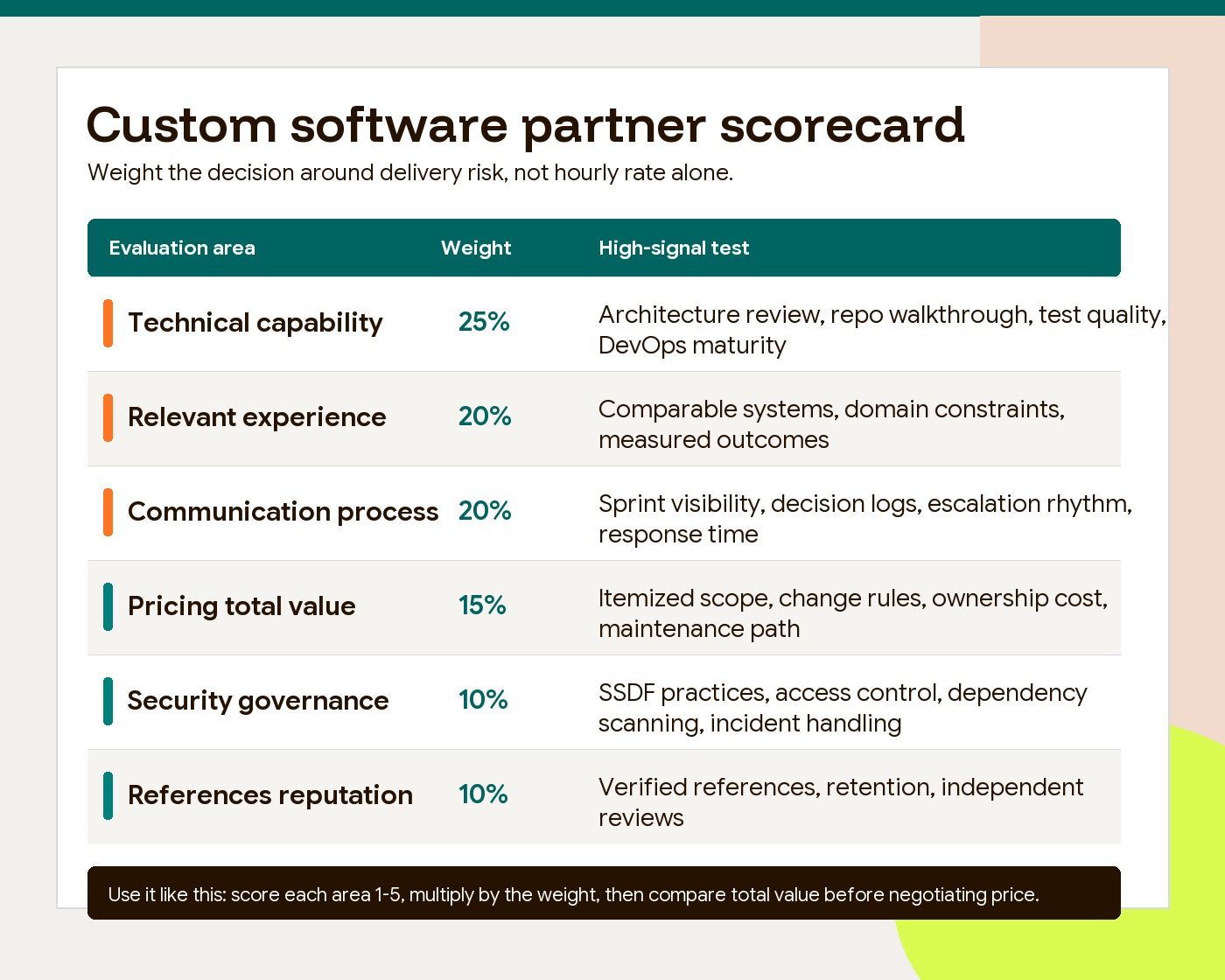
| Evaluation area | Weight | What to test |
|---|---|---|
| Industry and workflow fit | 20% | Similar users, workflows, compliance needs, integrations, and business constraints |
| Discovery process | 20% | Requirements quality, UX research, technical spikes, risk mapping, and decision logs |
| Technical depth | 25% | Architecture, code quality, testing, DevOps, security, data, cloud, and integration maturity |
| Delivery model | 15% | Access to senior leads, timezone overlap, sprint visibility, staffing continuity, and escalation paths |
| Maintenance support | 10% | Bug handling, monitoring, documentation, roadmap iteration, handover, and support SLAs |
| Commercial clarity | 10% | Estimate structure, change rules, ownership terms, and total cost of ownership |
If an agency is cheaper but scores lower on discovery, architecture, QA, or support, estimate the internal management load you will need to add. If an agency is more expensive but lowers rework and ownership risk, the premium may be rational.
Red flags to watch for
Several red flags are easy to miss during a polished sales process:
- They quote a complex system after one short call.
- They cannot explain technical tradeoffs in plain language.
- They avoid showing who will actually lead the work.
- They promise senior talent but staff the work mostly with junior execution.
- They have no clear testing, release, monitoring, or support process.
- They treat security as a final checklist.
- They resist repository access, documentation, or handover planning.
- They push a fixed price for work that is obviously uncertain.
- They cannot explain how AI-assisted development is reviewed.
One red flag may be manageable. Several together usually point to a delivery model that will get expensive later.
FAQ
What is the best custom software development company in the USA?
There is no single best agency for every project. EPAM may be a better fit for enterprise modernization, BairesDev for nearshore engineering scale, ScienceSoft for regulated or operations-heavy systems, Atomic Object for onshore product engineering, and Designli for founder-led product discovery. Choose by project risk, not by list position.
How much do custom software development agencies cost?
Cost depends on scope, complexity, team seniority, integrations, security requirements, design depth, QA needs, and post-launch support. A small internal tool is not priced like a multi-tenant SaaS platform or enterprise integration layer. Use Hapy’s custom software development cost guide to separate build cost from year-one operating cost.
Should I choose a U.S. agency or a nearshore agency?
Choose a U.S. onshore agency when discovery, product judgment, compliance, or executive collaboration needs close senior involvement. Choose a nearshore agency when the architecture direction is clear and you need timezone-aligned engineering leverage. Many teams use a hybrid model: onshore product and architecture leadership with nearshore execution.
What should I ask before hiring a software development agency?
Ask about discovery, team structure, technical leadership, architecture assumptions, QA, DevOps, security, maintenance, ownership, and handover. A good agency should explain risks and tradeoffs before it tries to close the contract.
The bottom line
The best custom software development agency in the USA is the one that matches your risk profile. Enterprise transformations need scale. Regulated systems need governance and security depth. SaaS and mobile products need product judgment and release discipline. Roadmap acceleration may need nearshore capacity. Technical rescues need senior engineers who can tell the truth quickly.
Start with the outcome, then choose the agency model. That is how a top custom software development agency becomes a useful extension of the business instead of another vendor to manage.
If Hapy is on your shortlist, compare its engagement options with the same scope, evidence, and ownership criteria you apply to other providers.