The Netherlands startup ecosystem is a strong launchpad for globally oriented B2B products, especially when founders match the right Dutch hub to a real buyer problem. It is not a market where a thin local MVP can coast for long.
The country has dense technical talent, strong universities, serious public capital, Amsterdam’s commercial pull, Delft’s research depth, Eindhoven’s hardware and photonics base, and Rotterdam’s logistics testbed. It also has a harder truth: early-stage funding needs separate investigation from headline totals, late-stage growth funding often depends on international investors, and the best Dutch opportunities usually need cross-border product thinking from the start.
For European founders, the practical question is not whether the Netherlands is “good for startups.” It is. The better question is whether your product benefits from what the Netherlands does unusually well: regulated fintech infrastructure, vertical B2B SaaS, deep tech commercialization, climate and energy systems, maritime logistics, AI for complex workflows, and products that can sell beyond a small home market.
For a Nordic comparison, use the Denmark startup ecosystem, Sweden startup ecosystem, and Finland startup ecosystem guides alongside this Dutch market view.
Netherlands startup ecosystem in 2026: the useful read
The Netherlands is a mature European tech market with a selective funding environment. Techleap’s 2026 report, produced with TNO and Invest-NL, frames the country as an innovation hub with real growth and real structural gaps: deep tech strength, high AI talent density, more scaleups, but weaker conversion from startup to scaleup than the United States.
Dealroom’s live Netherlands profile shows the headline capital picture. Dutch startups raised $3.2 billion in 2025, and with $1.6 billion raised in the first five months of 2026, the annualized path pointed to $3.9 billion. That sounds healthy, but Dealroom also shows the concentration: in the trailing four quarters through Q1 2026, 41% of Dutch startup capital went into $100 million-plus scaleup rounds, 39% into $15 million to $100 million breakout rounds, and only 20% into rounds below $15 million.
The below-$15-million category is a round-size bucket, not a direct measure of seed availability. Large rounds can change funding shares without changing the number of seed investors or their willingness to invest. Compare stage-specific deal counts and terms over like periods, and interview funds currently investing at your stage. The annualized figure is arithmetic based on a partial year, not a forecast.
The 2026 Techleap data also explains why deep tech gets so much attention. The State of Dutch Tech 2026 page says deep tech represents 12% of active tech firms but produces 41% of scaleups and attracts 41% of Dutch venture capital. It also points to the AI paradox: the Netherlands has Europe’s highest AI talent density at 10.9 AI professionals per 10,000 inhabitants, but Dutch AI startups convert to scaleup status at 21.2%, far below the U.S. comparison cited by Techleap.
The lesson is blunt: the Netherlands has enough talent to build hard products. The challenge is turning that talent into companies that scale.
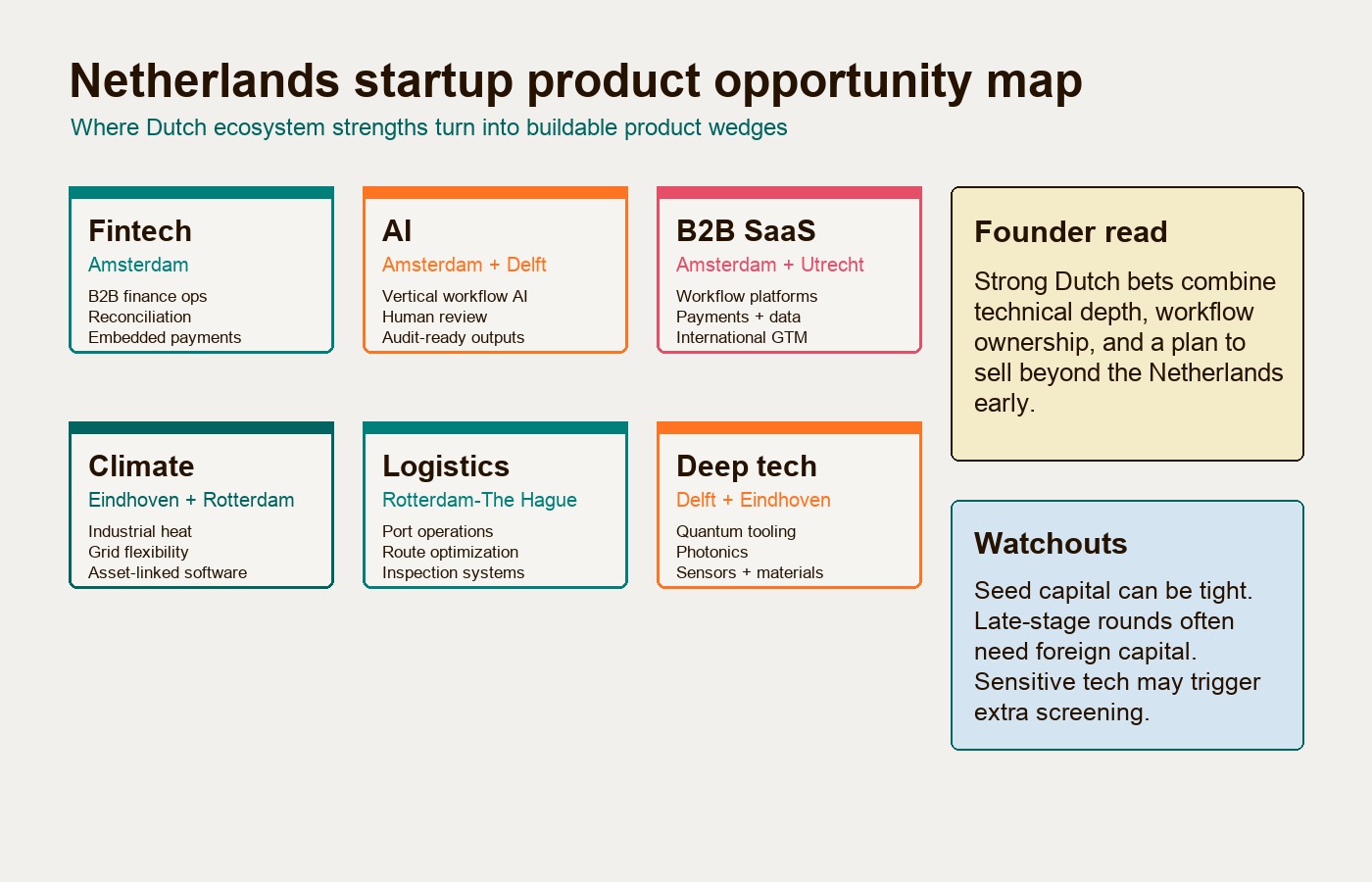
Amsterdam, Delft, Eindhoven, and Rotterdam-The Hague
The Dutch startup map is compact, but the hubs are not interchangeable. Founders should choose a base around customers, technical proof, labs, capital, and partner access rather than defaulting to the biggest logo on the map.
Amsterdam: fintech, AI, SaaS, capital, and commercial density
Amsterdam is the natural entry point for many software and fintech founders. It has the biggest capital concentration, international talent, startup infrastructure, enterprise buyers, fintech history, and a brand that travels. Dealroom lists Amsterdam as the leading Dutch metro for venture funding, with $2.0 billion raised over the last twelve months to Q1 2026.
Amsterdam is also becoming more credible in deep tech. A June 2026 I amsterdam report valued the Amsterdam deep tech ecosystem at $8.8 billion, more than double its value five years earlier. The report groups the city’s strength into AI infrastructure and quantum algorithms, biotech and medtech, and green chemistry and advanced materials. It also notes that Amsterdam’s research organizations, including UvA, Amsterdam UMC, VU Amsterdam, NKI, and AMS Institute, account for 27% of deep tech ecosystem value.
For founders, Amsterdam is strongest when the product needs customers, capital, GTM hiring, payments or financial infrastructure knowledge, AI talent, international sales, or a credible European HQ story. It is weaker as a default home for lab-heavy hardware unless the company also needs Amsterdam’s commercial layer.
Delft: quantum, engineering, aerospace, and spinouts
Delft is the Netherlands’ research-heavy engineering hub. TU Delft, YES!Delft, Delft Enterprises, QuTech, TNO links, and the wider Rotterdam-The Hague region make it relevant for quantum, aerospace, robotics, advanced engineering, medtech, energy systems, and deep tech spinouts.
TU Delft’s spinout position is a real signal. Science|Business reported that TU Delft ranked 15th in the European University Spinout Report 2025 and was the highest-ranked Dutch university, while Delft Enterprises emphasized the need for structural valorization funding. That is the Delft tradeoff in one sentence: strong technical creation, but commercialization support must be intentional.
For software founders, Delft matters when the product needs hard science credibility, research partnerships, engineering validation, or access to technical founders. For AI teams, it is useful when AI is part of a scientific, industrial, or high-assurance system rather than a generic interface.
Eindhoven: semiconductors, photonics, hardware, and industrial systems
Eindhoven and the Brainport region are where the Dutch ecosystem gets most hardware-real. ASML, Eindhoven University of Technology, High Tech Campus Eindhoven, PhotonDelta, advanced manufacturing suppliers, and energy-transition ventures create a different startup environment from Amsterdam.
This is a strong fit for founders working on semiconductors, integrated photonics, sensors, industrial IoT, manufacturing software, circular energy, and products that need industrial validation. The tradeoff is capital intensity. Hardware, infrastructure, and industrial energy products do not scale like pure SaaS, so the funding plan has to include grants, strategic partners, public capital, venture debt, and patient institutional investors.
RIFT is a useful example. In March 2026, the Eindhoven scaleup secured EUR 113.8 million in financing, including an EUR 83.1 million Series B led by PGGM with Invest-NL and Oost NL participation, plus an EUR 30.7 million EU Innovation Fund project. The product is not a dashboard. It is iron fuel technology for industrial heat, with a commercial project expected to deliver about 340 GWh of heat per year and avoid more than one million tonnes of CO2 over 15 years.
That is the Eindhoven pattern: hard problems, physical validation, serious partners, and longer timelines.
Rotterdam-The Hague: logistics, maritime, govtech, and regulated operations
Rotterdam-The Hague is most useful when the product touches logistics, maritime operations, port infrastructure, public-sector-adjacent workflows, cybersecurity, legal-regulatory environments, or industrial decarbonization.
The Port of Rotterdam describes itself as a place where it field-tests innovations and links established firms with emerging players in areas like AI, drones, blockchain, autonomous shipping, and IoT. PortXL adds the accelerator layer. Its 2025 cohort announcement said 132 startups had joined PortXL over ten years, with an 83% survival rate and more than EUR 191 million raised by alumni.
For founders, Rotterdam is not just a logistics story. It is a proof environment. If a product can work in port operations, cross-company data exchange, safety-critical inspection, customs-adjacent workflows, hydrogen logistics, or emissions-reduction infrastructure, Rotterdam can create evidence that travels.
Funding and support: strong, but uneven by stage
Dutch startup support is serious, but founders should understand the shape of the money. The market is better at backing credible technical and scale-stage companies than funding every early idea.
Invest-NL is one of the most important public-capital actors. Its fund investment criteria focus on funds investing in agrifood, bio-based and circular economy, deep tech, energy, and life sciences and health. Invest-NL says it participates in funds with intended total size of at least EUR 50 million, with tickets between EUR 5 million and EUR 25 million, and expects recipient funds to invest at least twice Invest-NL’s investment into Dutch companies.
Techleap is the ecosystem coordination layer. Its LEAPs initiative turns the 2026 State of Dutch Tech agenda into working groups. The three primary priorities listed on Techleap’s LEAPs page are Spin-off Factory, European Growth Strategy, and Future Builders Education. That tells founders where the country’s own operators see friction: university commercialization, cross-border European scaling, and future talent.
Support options also include university incubators, YES!Delft, HighTechXL, Rockstart, Startupbootcamp, Antler, regional development agencies, Invest International, TNO, PhotonDelta, Quantum Delta NL, PortXL, and sector-specific venture funds. The right support path depends on the product:
| Product type | Better-fit support path | Why it matters |
|---|---|---|
| Vertical SaaS | Amsterdam investors, sector design partners, Techleap founder networks | Sales proof, workflow depth, and cross-border GTM matter more than lab access |
| Fintech infrastructure | Amsterdam fintech network, banking partners, compliance advisors, payment ecosystem | Trust, licensing, and integration shape the roadmap early |
| Deep tech spinout | TU Delft, TU/e, TNO, YES!Delft, Delft Enterprises, PhotonDelta, Quantum Delta NL | IP, lab access, grants, and technical validation are part of company formation |
| Climate or energy hardware | Eindhoven/Brainport, Invest-NL, Oost NL, EU funding, industrial partners | Capital stack and deployment sites matter as much as seed VC |
| Maritime/logistics tech | Port of Rotterdam, PortXL, corporate pilots, municipality and infrastructure partners | Real-world pilots produce evidence that logistics buyers respect |
Sectors where Dutch startups have a real edge
The best Dutch opportunities are not random. They appear where local strengths, buyer pain, regulation, and technical talent overlap.
Fintech remains core, but the stronger 2026 wedge is B2B financial infrastructure rather than another consumer wallet. Amsterdam already has payments, banking, compliance, and fintech talent. Product opportunities include invoice reconciliation, cross-border treasury, SME finance operations, embedded finance, fraud controls, stablecoin-to-fiat workflows, compliance automation, and financial data infrastructure.
AI is attractive because talent density is high, but generic AI products are not enough. The strongest Dutch AI startup opportunities sit inside complex workflows: legal operations, healthcare diagnostics, maritime planning, procurement, scientific research, industrial monitoring, customer operations, and compliance-heavy document review. The product needs to show measurable cycle-time reduction, fewer errors, human oversight, and clean integration with existing systems.
B2B SaaS is especially relevant when it is vertical. Mews, Framer, Mambu, Mollie, FINOM, and other Dutch-linked software companies show that international SaaS can be built from the Netherlands, but the winning pattern is not “SaaS for everyone.” It is a focused workflow with payments, automation, data, or collaboration depth.
Climate tech is credible when it moves beyond reporting into operational change: industrial heat, grid flexibility, port decarbonization, building energy systems, material circularity, carbon-aware logistics, and measurement tools that connect to physical assets. RIFT is the clearest example, but the broader opportunity is in software and systems that make infrastructure transitions easier to deploy.
Deep tech, photonics, quantum, semiconductors, and sensors are structurally important because Dutch universities and industry anchors give founders something few markets can replicate. The hard part is commercialization: finding the first application where a technical advantage becomes an urgent buyer problem.
Product opportunity matrix for founders
Use this matrix as a set of product hypotheses to investigate, not demonstrated demand or a ranking of sectors. The goal is not to chase every hot sector. It is to match the product’s workflow, buyer, and proof requirement with the hub that can make the company stronger.
| Sector | Proposed Dutch wedge | Leading hubs | Buildable product opportunities | Proof buyers will expect |
|---|---|---|---|---|
| Fintech | B2B infrastructure over consumer apps | Amsterdam, Utrecht | Reconciliation, treasury, lending workflows, embedded finance, compliance controls, payment operations | Security, compliance, integrations, audit trails, clear ROI |
| AI | Vertical workflow systems | Amsterdam, Delft, Eindhoven, Rotterdam | Legal AI, maritime planning, support ops, scientific AI, procurement review, clinical workflow assistance | Human oversight, accuracy evidence, permissions, workflow fit |
| B2B SaaS | Workflow depth with international GTM | Amsterdam, Utrecht, Rotterdam | Hospitality ops, field service, finance ops, logistics SaaS, revenue operations, collaboration tools | Product-market fit signals, retention, integration depth, low-friction onboarding |
| Climate tech | Industrial and infrastructure transition | Eindhoven, Rotterdam, Delft, Wageningen | Grid flexibility, industrial heat, emissions operations, port decarbonization, circular materials software | Physical validation, deployment partners, payback model, funding stack |
| Logistics and maritime | Port and cross-border operating systems | Rotterdam-The Hague, Amsterdam | Autonomous shipping support, customs workflows, route optimization, asset inspection, emissions tracking | Reliability, safety, partner data access, real-world pilots |
| Deep tech | Science-led products with commercial wedge | Delft, Eindhoven, Amsterdam, Leiden | Quantum tooling, photonics packaging, sensors, medtech hardware, advanced materials, lab automation | IP clarity, lab validation, customer use case, patient capital |
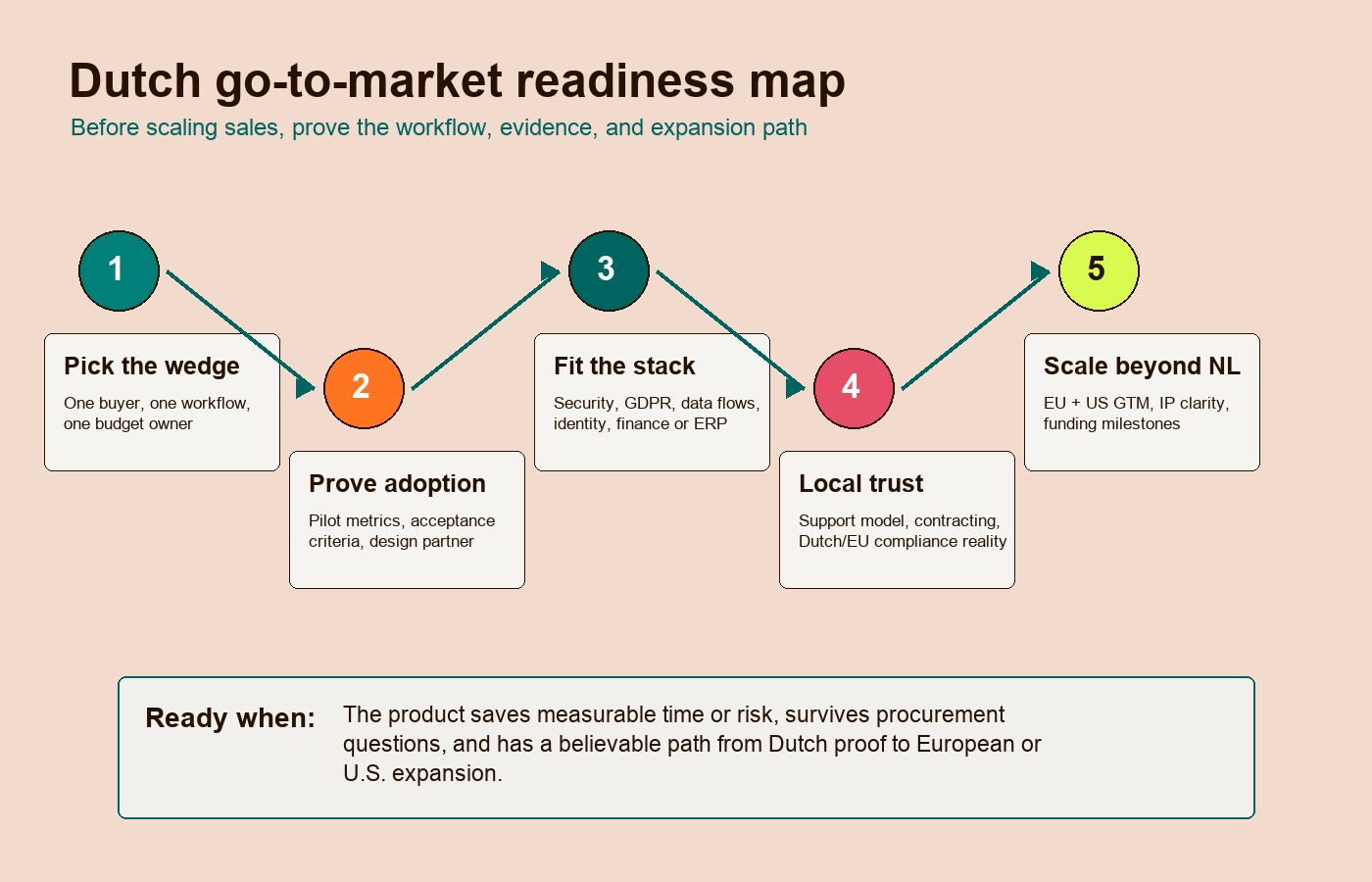
Netherlands go-to-market checklist
The Netherlands is open, international, and English-friendly, but that does not mean go-to-market is effortless. Dutch buyers can be pragmatic and direct. They will often test whether the product saves time, reduces risk, integrates cleanly, and has a reason to exist beyond a polished demo.
Use this checklist before treating the Netherlands as an active market:
| Area | Minimum readiness standard |
|---|---|
| ICP | One specific buyer, workflow, and budget holder, not a broad “Dutch startups” or “European SMEs” target |
| International story | Clear reason the product can scale beyond the Netherlands after validation |
| Product workflow | Mapped current process, exception cases, handoffs, permissions, and success criteria |
| Compliance | GDPR baseline, sector-specific regulatory review, data-processing terms, retention, subprocessors, and security evidence |
| Integrations | CRM, finance, ERP, identity, data warehouse, logistics, or payment integrations that match the buyer’s stack |
| Proof | Pilot plan with before/after metrics, referenceable design partners, and documented acceptance criteria |
| Localization | English may work, but Dutch legal, finance, support, and public-sector-adjacent materials may still matter |
| Funding plan | Milestones that fit current capital appetite: traction for SaaS, technical validation for deep tech, deployment partners for climate |
| Talent | Hiring plan for local technical, commercial, or regulatory roles only where proximity creates advantage |
| Expansion | EU and U.S. sales assumptions, entity/IP structure, and partner strategy considered before late-stage fundraising |
If most of those rows are still vague, slow down. A Dutch launch should usually start with a narrow workflow and credible design partners, not a broad country campaign.
For SaaS founders, these buyer requirements should shape the first release. Use them to assess Hapy’s MVP development service or another proposed build partner. Hapy’s guide to SaaS product-market fit signals is useful before scaling sales pressure. If the opportunity is still broad, the product strategy roadmap guide can help translate market insight into sequencing. For teams building custom workflow products, the custom software development services buyer guide is a useful way to think through ownership, scope, and delivery risk.
Founder challenges to plan around
The Netherlands has founder advantages, but the friction is real.
The first challenge is establishing funding fit. A smaller share of total dollars in small rounds does not by itself show that seed availability weakened. Founders should design milestones carefully: not “we built version one,” but “we proved a painful workflow with a buyer who can expand.”
The second challenge is late-stage capital. Dutch deep tech and SaaS companies often need international investors for breakout rounds. That is not automatically bad. It does mean founders should build clean IP ownership, clear subsidiary structure, and a credible international commercial story before the next financing round forces the issue.
The third challenge is investment and sector regulation. Deep tech founders should have Dutch counsel check whether a proposed financing, acquisition, or transfer requires investment screening and whether the activity falls within current sensitive-technology rules. Do not use a general market guide to determine a filing threshold or completion date. Include the legal review and any required clearance in the financing schedule.
The fourth challenge is talent compensation. The official Netherlands Enterprise Agency page on startup share options describes a proposed change and explicitly says parliamentary consideration may change it. Check enacted law, effective date, qualifying company and employee conditions, and cross-border tax treatment with an adviser before promising a tax benefit. A proposed scheme is not an existing employee entitlement.
The fifth challenge is academic commercialization. Delft, Eindhoven, Amsterdam, Leiden, Wageningen, and Utrecht produce strong research. Turning that research into companies still needs better repeatable support: founder training, standard deal terms, patient capital, lab access, and operators who can translate science into buyer language.
What European founders should build first
Founders entering the Netherlands should build the proof layer before the expansion layer.
For fintech, build compliance, reconciliation, permissions, audit logs, and bank-grade integration into the first serious product scope. The market is too mature for a demo that cannot survive operational review.
For AI, choose a narrow workflow where the model is part of a controlled system. The buyer should know what the AI reads, what it changes, what a human approves, how errors are caught, and how performance improves over time.
For B2B SaaS, validate retention and workflow ownership before chasing a wider European rollout. A Dutch design partner is useful only if the product can become part of a repeatable buyer category.
For climate and logistics, build around deployment proof. A clean dashboard is rarely enough. Buyers need to know the product can work with assets, facilities, ports, energy constraints, safety requirements, and partner data.
For deep tech, pick the first commercial wedge aggressively. The technical platform may have ten future applications, but the company needs one buyer problem that can fund the next phase.
The founder takeaway
The Netherlands startup ecosystem is best understood as a launchpad for serious, internationally minded products, not a protected local market. Amsterdam brings capital and commercial density. Delft brings scientific and engineering depth. Eindhoven brings hardware, photonics, semiconductors, and industrial validation. Rotterdam-The Hague brings maritime, logistics, government, cybersecurity, and infrastructure proof.
The opportunity is strongest for founders who connect those strengths to buildable product opportunities: fintech infrastructure, vertical AI, workflow-heavy SaaS, industrial climate tech, logistics software, quantum and photonics tooling, and deep tech spinouts with a clear customer path.
Build for international product-market fit early. In the Netherlands, that is not premature ambition. It is how the market works.
Check the route into a support program
Use the linked Invest-NL criteria to distinguish investments into funds from direct startup financing. For incubators or corporate pilots, confirm the current application window, geographic and entity requirements, sector, stage, equity or fee terms, and access actually offered. A named organization in this guide is a research lead, not confirmation that your company qualifies or that applications are open.