A product strategy roadmap is the planning layer that turns product strategy into sequenced decisions. It should connect the product vision, target customer, business outcomes, discovery work, delivery capacity, and success metrics. It should not become a feature calendar that quietly promises every idea on a date.
That distinction is where many roadmaps fail. A team writes a strategy, keeps a backlog, and then asks the roadmap to do both jobs at once. Leadership wants confidence. Sales wants dates. Engineering wants specificity. Product wants room to learn. The roadmap gets stretched until it becomes a brittle contract no one fully trusts.
The better version is a living planning system. It gives the company enough direction to coordinate, but enough flexibility to adjust when discovery, delivery, or market evidence changes the plan.

What a product strategy roadmap should do
A product strategy roadmap should translate strategy into visible choices: what the product is trying to achieve, which customer problems matter next, what the team is learning, where capacity is going, and what evidence will change the plan.
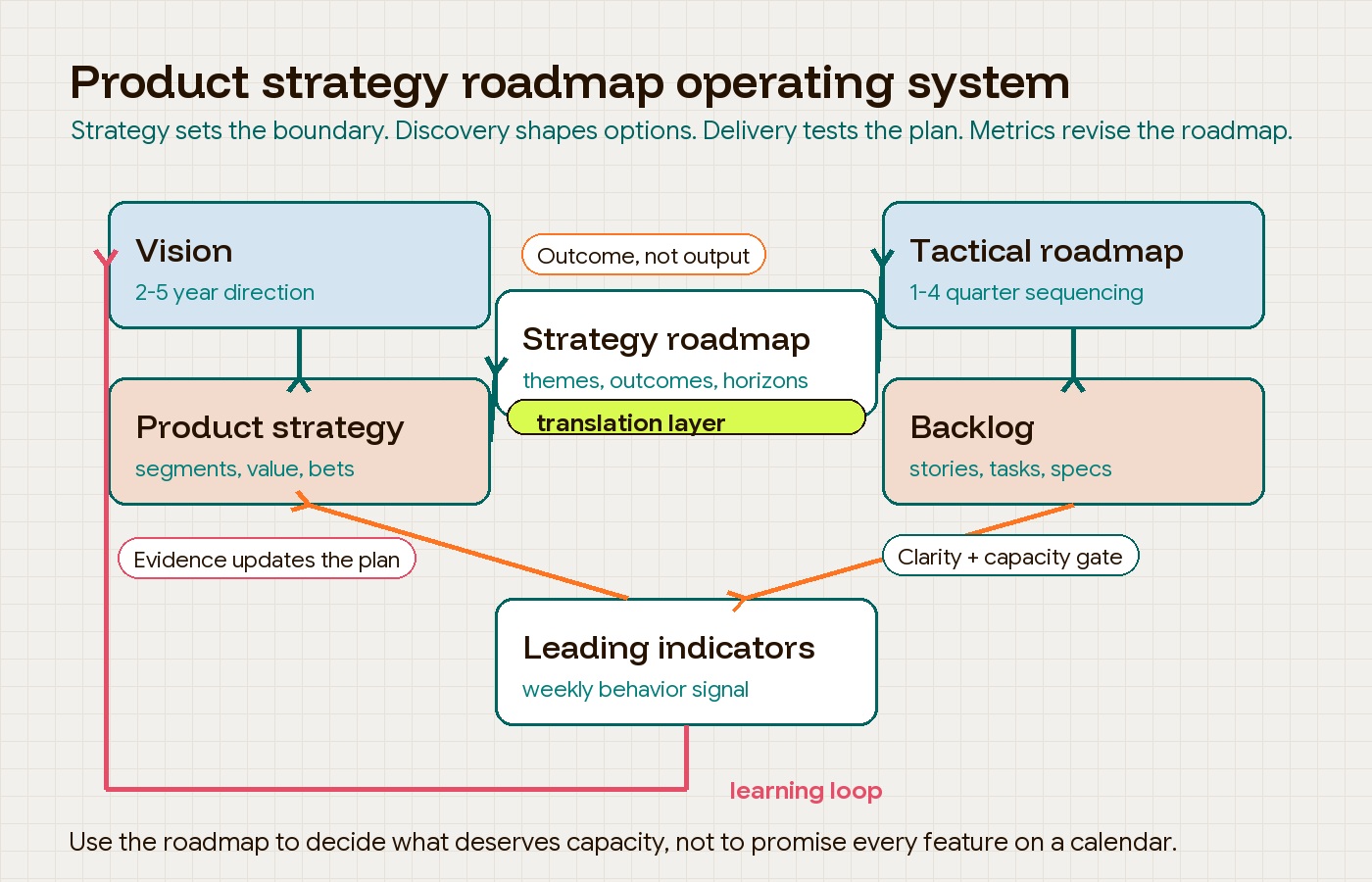
The roadmap sits between strategy and execution. Above it are vision and product strategy. Below it are the tactical roadmap, release plan, and backlog. If those layers blur, the team either becomes too abstract to ship or too tactical to make strategic tradeoffs.
| Planning layer | Best use | Typical horizon | What belongs there |
|---|---|---|---|
| Vision | Direction and ambition | 2-5 years | The future the company is trying to create |
| Product strategy | Market and product choices | 12+ months | Segments, value proposition, differentiators, bets |
| Product strategy roadmap | Translation into priorities | 6-18 months | Themes, outcomes, horizons, discovery areas |
| Tactical roadmap | Near-term sequencing | 1-4 quarters | Delivery order, capacity, dependencies, launch windows |
| Backlog | Execution detail | 1-4 weeks | Stories, bugs, technical tasks, acceptance criteria |
The roadmap is most useful when it protects both alignment and adaptation. It should help senior leaders see the product direction, help go-to-market teams understand what is likely coming, and help delivery teams know which outcomes deserve capacity.
It should also make it easier to say no. Roman Pichler’s list of common product roadmapping mistakes is useful because the errors are not cosmetic. Feature-based goals, stakeholder-driven wish lists, speculative plans, and roadmaps disconnected from the backlog all push teams toward fragmented products.
Roadmap vs backlog vs release plan
The simplest diagnostic is this: if the item needs exact implementation detail, it belongs in the backlog. If it needs launch coordination, it belongs in a release plan. If it needs strategic judgment, it belongs in the product strategy roadmap.
Confusing these tools creates planning debt.
| Tool | Good question | Bad use |
|---|---|---|
| Product strategy roadmap | Which outcomes and themes deserve attention next? | Tracking sprint-level work |
| Tactical roadmap | What should the team sequence over the next few quarters? | Pretending uncertain bets are committed dates |
| Release plan | What is shipping, when, and who needs to prepare? | Replacing product strategy with launch logistics |
| Backlog | What does the team need to build, fix, test, or specify? | Becoming an unfiltered dumping ground for stakeholder ideas |
A roadmap can include timing, but timing should match certainty. “Now” work may have a target release window because it is scoped and underway. “Next” work should usually describe problems or opportunities under discovery. “Later” work should stay closer to outcomes and strategic bets.
That is why the Now-Next-Later roadmap model works well for uncertain products. It acknowledges that confidence decreases as the team looks further out. The mistake is filling all three columns with features. That keeps the format flexible on the surface while preserving the same old feature-commitment problem underneath.
Use horizons to show uncertainty honestly
A strong product strategy roadmap changes the type of information it shows across horizons.
In the “Now” horizon, specificity is healthy. The team should know the problem, first solution, delivery path, owner, and success signal. In “Next,” the team should be clearer about the customer opportunity than the final feature. In “Later,” the roadmap should stay anchored to outcomes, not imagined implementation.
| Horizon | Roadmap content | What it communicates |
|---|---|---|
| Now | Validated solutions in active delivery | The team has clarity and capacity |
| Next | Customer opportunities in discovery | The problem matters, but the solution is still open |
| Later | Strategic outcomes or capability bets | The direction matters, but commitment would be premature |
This is where an Opportunity Solution Tree is a useful companion. Teresa Torres’s roadmapping guidance argues for separating outcomes, opportunities, and solutions so teams can keep multiple paths visible instead of prematurely locking onto one feature path. In practice, that means the roadmap can show a target outcome without pretending the first solution idea is already the answer.
The operating rule is plain: the farther out the roadmap looks, the less it should behave like a feature list.
Build the roadmap around outcomes, not outputs
An outcome roadmap organizes work around measurable customer or business results. It asks, “What should change because we build this?” rather than “What will we ship?”
That shift matters because output is easy to fake. A team can ship a dashboard, integration, or onboarding flow and still fail to improve activation, retention, conversion, support load, or operational speed. Outcome-based planning forces the team to name the behavior or business metric the work is meant to move.
Itamar Gilad’s writing on outcome roadmaps is useful here because it includes a practical missing piece: effect delay. A feature can launch this week, but the business result may take weeks or months to appear. A roadmap that ignores that delay will overreact to early noise or declare success before the metric has had time to move.
For a B2B SaaS team, a roadmap theme might look like this:
| Weak roadmap item | Stronger outcome-based version |
|---|---|
| Build new onboarding dashboard | Increase first-week setup completion from trial accounts |
| Add advanced reporting | Reduce the number of manual status requests from customer teams |
| Ship AI support assistant | Reduce repetitive support triage while preserving answer quality |
| Add enterprise permissions | Shorten security review for larger accounts |
The stronger version does not remove the feature. It gives the feature a job. It also makes a better prioritization conversation possible because the team can compare expected outcomes rather than debating whose request sounds more urgent.
Prioritize with the right method at the right stage
Product prioritization frameworks are useful only when they match the decision. A scoring method cannot repair a vague strategy, and a release-scoping method cannot tell a team which customer problem matters most.
Use different frameworks for different moments:
| Planning moment | Better method | Why it fits |
|---|---|---|
| Early discovery | Opportunity scoring or Kano-style analysis | Helps separate painful needs from interesting ideas |
| Comparing known initiatives | RICE or weighted scoring | Makes reach, impact, confidence, and effort visible |
| Drawing a release boundary | MoSCoW | Forces Must, Should, Could, and Won’t-have tradeoffs |
| Managing mature product value | Kano | Finds where basic needs, performance gains, and delighters differ |
Intercom’s RICE framework is helpful when the team has enough evidence to estimate reach, impact, confidence, and effort. It turns a messy comparison into a transparent score. But RICE can be misleading when the inputs are mostly guesses, dependencies are ignored, or teams score ideas inconsistently.
MoSCoW prioritization is better when a team needs a release boundary. The value of MoSCoW is not the four labels. It is the discipline of making “Won’t-have for now” explicit, especially when stakeholders keep adding small requests that collectively break the scope.
The practical sequence is:
- Use discovery to understand the customer problem.
- Use opportunity or Kano thinking to judge the nature of user value.
- Use RICE or weighted scoring when there is enough evidence to compare options.
- Use MoSCoW when the team needs to protect a release or MVP boundary.
- Review the roadmap when real usage data changes the confidence level.
That last step is often skipped. The roadmap should remember confidence. If a high-impact idea is based mostly on anecdote, it should not receive the same treatment as a high-impact idea backed by usage, interviews, conversion data, or paid demand.
Make stakeholder alignment part of the system
A roadmap built in isolation is usually a negotiation deferred. The product manager may feel productive while drafting it, but the real argument happens later when sales, leadership, customer success, engineering, or support sees their priorities translated into tradeoffs.
Better roadmapping starts before the formal review.
Pre-wire the roadmap with key stakeholders. Ask what customer problem they believe is most urgent, what evidence would change their mind, which dependencies they see, and which commitments they think the business has already made. This keeps the review meeting from becoming a surprise approval session.
Then keep a visible concern log:
| Concern | Owner | Evidence needed | Decision |
|---|---|---|---|
| Sales needs enterprise permissions for active deals | Sales lead | Deal list, contract value, blockers, timeline | Decide whether this enters Now or Next |
| Engineering sees data model risk | Tech lead | Dependency map and rough effort range | Add discovery spike before commitment |
| Support reports onboarding confusion | Support lead | Ticket themes and affected account segments | Compare against activation data |
| Leadership wants a marketable AI feature | Product lead | Use case, buyer value, risk, prototype evidence | Keep as opportunity until validated |
This is not bureaucracy. It is a way to keep objections from becoming hallway politics. It also helps the team decline non-aligned requests without dismissing the person making them.
Tie every roadmap theme to leading indicators
A product strategy roadmap should not wait for lagging metrics to declare whether the plan worked. Revenue, churn, retention, and NPS matter, but they often move too slowly to guide weekly roadmap decisions.
Leading indicators connect product work to earlier user behaviors. ProductPlan’s overview of product management metrics is a good reminder that roadmap health depends on more than shipped work. Teams need metrics that show whether customers are adopting, returning, converting, and getting value.
For roadmap planning, the most useful metric chain usually looks like this:
| Outcome | Mid-term signal | Weekly leading indicator | Roadmap use |
|---|---|---|---|
| Improve retention | More activated accounts reach habit | Day 7 return rate or key workflow completion | Decide whether onboarding work is working |
| Increase paid conversion | Trials experience core value faster | Time to first meaningful action | Prioritize activation friction |
| Reduce support load | Fewer repetitive support themes | Self-serve task completion rate | Decide whether workflow or help content needs work |
| Grow expansion revenue | More teams adopt advanced workflows | Feature adoption by qualified accounts | Sequence enablement, permissions, and reporting |
The key is not to add a metric to every line for show. The key is to define what the team expects to change and when the signal should appear. If the roadmap theme has no measurable behavior attached to it, the team is probably planning activity rather than product progress.
Where AI belongs in roadmapping
AI can make product roadmapping better when it improves sensing, synthesis, and simulation. It makes roadmapping worse when it turns weak strategy into faster documentation.
The useful AI use cases are practical:
- Summarizing support tickets, sales calls, reviews, and interview notes into recurring opportunity themes.
- Indexing research so product managers can find evidence behind a roadmap bet.
- Clustering feedback by segment, account value, workflow, or churn risk.
- Drafting first-pass specs or test plans after the strategic decision has already been made.
- Running scenario analysis on historical usage or experiment data when the dataset is strong enough.
Productboard’s guide to AI in product discovery frames AI as a discovery aid, not a replacement for product judgment. That is the right posture. AI can help a team see more signals, but humans still need to decide which market, customer, constraint, and strategic tradeoff matters.
The roadmap should not become “AI says these features are popular.” Popularity is not strategy. A high-volume request from the wrong segment can still pull the product away from its strongest position.
A practical product strategy roadmap checklist
Before using a roadmap to guide capacity, check whether it can answer these questions:
- What business outcome or customer outcome does each theme support?
- Which customer segment is the roadmap primarily serving?
- Which items are committed, which are in discovery, and which are directional?
- Where are the biggest assumptions, dependencies, and technical risks?
- What leading indicator should move before lagging metrics change?
- What evidence would move an item from Next to Now?
- What is explicitly not being built in this cycle?
- Who has been consulted before the formal roadmap review?
- How often will the roadmap be reviewed, and what kind of evidence can change it?
If the roadmap cannot answer those questions, it may still be a useful note. It is not yet a planning system.
The takeaway
A product strategy roadmap is useful when it makes better decisions easier. It should connect vision to product strategy, product strategy to roadmap themes, roadmap themes to delivery capacity, and delivery capacity to evidence.
For early products, that often means fewer dates, more discovery, sharper release boundaries, and a clear Not Building list. For growing products, it means outcome-based themes, prioritization discipline, stakeholder alignment, and leading indicators that show whether the plan is working before lagging metrics arrive.
The product strategy roadmap should not promise every feature on a calendar. It should show what deserves capacity, why it matters, what is still uncertain, and what evidence will change the plan.
For founders shaping version one, Hapy’s MVP development checklist is a useful companion before the roadmap turns into build scope. For teams that need senior product, design, and engineering support around the next product decision, Hapy’s MVP development work is built around focused validation, scope discipline, and execution that produces signal.