Last updated: September 8, 2026
SaaS product-market fit is the point where a defined customer segment depends on your product enough to keep using it, pay for it, expand usage, and pull it through the market without heroic founder effort. It is not a launch milestone, a funding event, or a month of strong sign-ups. It is a pattern across retention, customer language, sales efficiency, and repeatable demand.
That distinction matters because the cost of being wrong is high. In its 2026 analysis of more than 400 recent startup failures, CB Insights found that poor product-market fit appeared in 43% of identifiable failure cases. The older shorthand was “no market need.” The sharper diagnosis is this: the company did not prove that the right market urgently needed the product before it tried to scale.
For SaaS founders, product-market fit should be treated as a system of evidence. One metric will not prove it. A healthy month of new ARR will not prove it. A loud set of early adopters will not prove it. The goal is to find convergence across who needs the product, why they keep using it, whether they pay efficiently, and whether growth becomes easier as the product gets sharper.
That evidence matters even more in the current startup funding trends, where investors are concentrating capital around companies that can show durable demand, efficient growth, or defensible AI leverage.
Before a SaaS team expands scope, it should know whether packaging and willingness to pay are improving. Use the SaaS pricing validation guide to test price signals before treating feature volume as growth.
If the product category is still being shaped, start by clarifying the SaaS business model and the types of SaaS you are actually competing in.
Once the evidence is strong enough to fund a reliable first release, use the SaaS product development roadmap to connect scope, architecture, billing, team design, and validation to the next business milestone.
What SaaS Product-Market Fit Actually Means
Marc Andreessen popularized product-market fit as being in a good market with a product that can satisfy that market. The key word is market. As a16z notes in its classic essay on product-market fit, the market can pull a product forward with surprising force when demand is real.
In SaaS, that pull has practical signs:
| Signal | What It Means |
|---|---|
| Retention stabilizes | A real cohort keeps using the product after novelty fades. |
| Customers use specific language | They describe an urgent workflow, not a generic benefit. |
| Sales cycles compress | Buyers understand the value faster over time. |
| Referrals appear without prompting | Customers tell peers because the product solves a painful problem. |
| Expansion starts showing up | Existing customers add seats, usage, teams, or modules. |
The mistake is treating product-market fit as binary. A company usually moves through stages: problem validation, MVP learning, early traction, validated repeat usage, and then broader market pull. At each stage, the question changes. Early on, the question is “Does this solve a painful problem for anyone?” Later, it becomes “Can we find many similar customers and acquire them efficiently?”
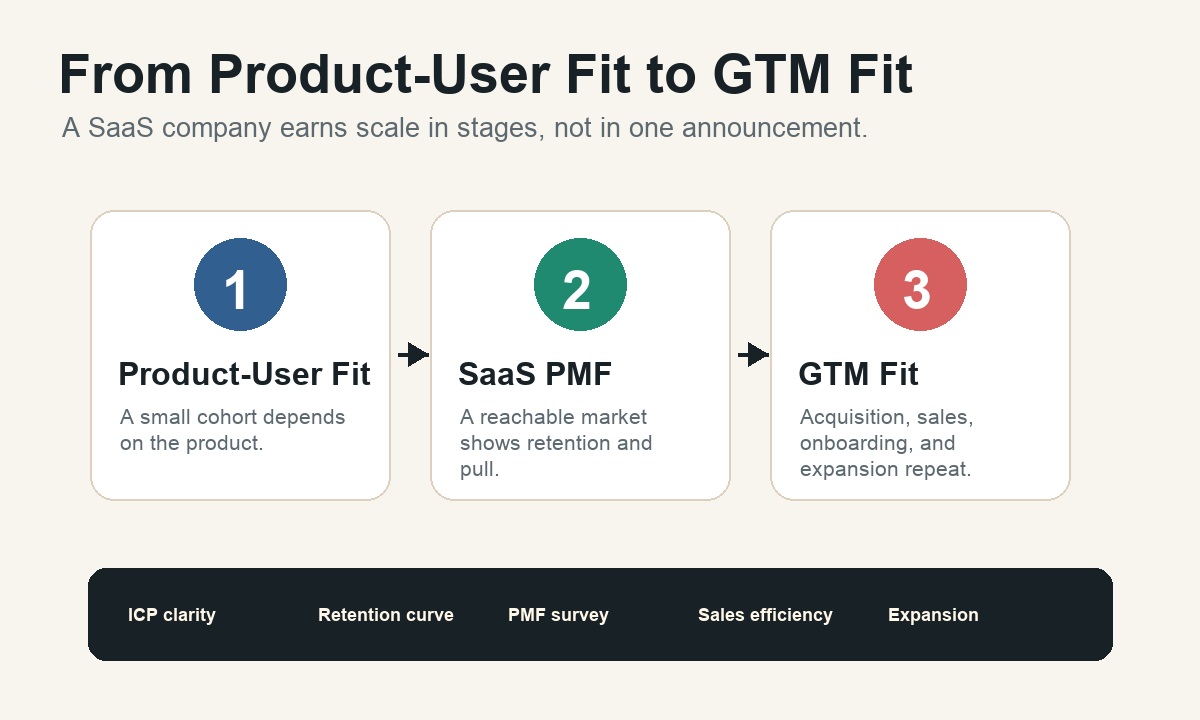
Product-User Fit Comes Before Product-Market Fit
Many SaaS teams first find a small group of people who love the product. That is useful, but it is not always product-market fit. a16z calls this product-user fit: the product works for a specific user type, but the team has not yet proven that the market is large, reachable, and ready to pay.
This is where founders often overread the signal. A tight group of power users can make the product feel inevitable. But if those users are hard to find, too niche, unwilling to pay, or unlike the broader market, scaling spend will only expose the weakness faster.
A practical test is to separate three questions. This is especially important when deciding between vertical SaaS vs horizontal SaaS, because a small high-fit segment can be more valuable than a broad but shallow market.
| Question | Fit Type |
|---|---|
| Do some users love this product? | Product-user fit |
| Are there enough similar users with the same urgent problem? | Market validation |
| Can we reach, sell, retain, and expand them predictably? | Product-market fit moving into go-to-market fit |
The path is not to broaden too early. The path is to understand the high-expectation customer first, then decide whether that segment can become a real market.
The PMF Survey: Measure Dependency, Not Politeness
The best-known qualitative diagnostic is the Sean Ellis product-market fit survey: “How would you feel if you could no longer use this product?” The useful answer is not “satisfied” or “likely to recommend.” It is “very disappointed.”
Rahul Vohra’s First Round Review essay on how Superhuman built a product-market fit engine made the method operational. Superhuman started with 22% of surveyed users saying they would be very disappointed without the product, then used segmentation and roadmap prioritization to raise that score to 58%.
The 40% threshold is helpful, but it should not be used blindly. The survey works only when it is sent to users who have experienced the core product. Survey eligibility should require experience of the core product. A target such as 40 responses is a practical recruiting heuristic, not a statistical guarantee. Report invitations, eligible respondents, response rate, segment sizes, and the observation period. For example, 16 of 40 respondents is 40%, and one different answer moves the result by 2.5 percentage points. A self-selected segment may be biased regardless of sample size; triangulate with observed retention and interviews.
The better insight is often in the segments, not the average:
| Survey Segment | What To Learn |
|---|---|
| Very disappointed | Who is your strongest beachhead, and what do they love? |
| Somewhat disappointed | What blocker prevents them from becoming dependent? |
| Not disappointed | Who should you stop building for right now? |
If one segment scores 60% and the full user base scores 28%, investigate the segment before changing the roadmap. A 3-of-5 result and a 60-of-100 result have the same percentage but very different stability. Check whether the segment was chosen after seeing the answers and whether independent cohorts show the same behavior.
Retention Is the Hardest PMF Evidence to Fake
Retention is the cleanest SaaS product-market fit signal because it measures behavior after the sales promise is over. A product without fit usually shows a retention curve that keeps falling toward zero. A product with fit shows a curve that flattens because a meaningful cohort has made the product part of its workflow.
For early-stage SaaS, look at cohorts by signup month, segment, use case, and acquisition channel. Blended retention can hide the truth. Paid acquisition may bring weak-fit users. Referrals may bring strong-fit users. Enterprise customers may retain differently from self-serve customers. The job is to identify which cohort flattens and why.
Useful retention questions include:
| Question | Why It Matters |
|---|---|
| Does the Month 3 or Month 6 cohort flatten? | Shows lasting value beyond activation. |
| Which segment retains best? | Reveals the real ICP. |
| Which feature predicts retention? | Points to the core value moment. |
| Does retention improve in newer cohorts? | Shows the product is learning from the market. |
| Does expansion offset contraction? | Signals durable account-level value. |
Net revenue retention is especially important for B2B SaaS. ChartMogul defines net revenue retention as starting recurring revenue plus expansion, minus contraction and churn, divided by starting recurring revenue. A product with NRR above 100% is growing inside its existing customer base before new-logo sales are counted.
That does not mean every pre-PMF company needs world-class NRR immediately. It means the retention conversation should start early. If customers leave before they form a habit, the problem is not a bigger sales team. It is a product, onboarding, ICP, or value-delivery problem.
The Metrics That Matter Before Scaling
Once retention and survey signals point in the same direction, SaaS teams can use financial metrics to test whether the business can scale without leaking cash. This is where an early MVP development motion has to evolve from learning to repeatable revenue.
| Metric | Healthy Direction | Why It Matters |
|---|---|---|
| PMF survey score | 40%+ “very disappointed” in the right segment | Measures dependency. |
| Retention curve | Flattens in a defined cohort | Measures durable product value. |
| Activation rate | Rising for the target ICP | Measures time-to-value. |
| Net revenue retention | Moving toward or above 100% | Measures expansion and account durability. |
| CAC payback | Shortening or within a tolerable range for the motion | Measures capital efficiency. |
| LTV:CAC | 3:1 or better as the model matures | Measures whether acquisition creates value. |
| SaaS Magic Number | 0.75+ before aggressive scaling | Measures sales and marketing efficiency. |
The SaaS Magic Number is a useful scale-readiness check because it connects sales and marketing spend to incremental revenue. Wall Street Prep defines the SaaS Magic Number as the annualized increase in quarterly revenue divided by prior-quarter sales and marketing spend. As a rule of thumb, below three quarters suggests weak efficiency, three quarters to one suggests the motion is becoming workable, and above one indicates a much stronger growth engine.
Use these benchmarks as guardrails, not theater for a board deck. Benchmarkit defines CAC payback, CLTV:CAC, Magic Number, gross revenue retention, net revenue retention, and Rule of 40 in its 2025 B2B SaaS performance benchmarks. The definitions matter because teams often make metrics look healthier by excluding salaries, commissions, discounts, churn, or gross margin.
For a founder, the operating question is simple: if we spend another dollar on acquisition, do we get a customer who activates, retains, expands, and pays back the investment in a reasonable time?
Product-Market Fit Is Not Go-to-Market Fit
Product-market fit answers: “Does a target customer strongly need this product?”
Go-to-market fit answers: “Can we acquire, sell, onboard, retain, and expand those customers predictably?”
That second question matters because many SaaS companies reach a promising product signal, then stall when founder-led selling stops working. The founder can often close early deals through conviction, context, and personal credibility. A repeatable business needs messaging, channels, qualification, pricing, handoff, onboarding, and customer success to work without constant founder intervention.
Before hiring a large sales team, document what already works:
| GTM Component | Evidence To Capture |
|---|---|
| ICP | Which segment retains, expands, and closes fastest? |
| Messaging | Which pain statement makes buyers lean forward? |
| Qualification | Which disqualifiers predict churn or stalled deals? |
| Sales process | Which steps move a deal from curiosity to commitment? |
| Pricing | Which packaging maps to value, not just features? |
| Onboarding | Which activation moment predicts retention? |
SaaStr’s guidance on the early sales transition is blunt: the founder should close the first batch of customers, then hire two reps rather than one, and only bring in a sales leader after reps have proven they can hit quota. Jason Lemkin places that sales-leadership moment around $1M-$2M in ARR for many SaaS companies.
The point is not the exact ARR number. The point is sequencing. A VP of Sales should accelerate a working motion, not discover product-market fit from scratch.
False Product-Market Fit Signals To Avoid
False fit feels exciting because it gives the team permission to move faster. The problem is that the market has not actually given that permission.
Watch for these traps:
| False Signal | What To Check Instead |
|---|---|
| Many sign-ups | Do activated cohorts retain? |
| Strong demo feedback | Do buyers change behavior and pay? |
| Investor interest | Do customers renew without founder pressure? |
| Loud early adopters | Is there a larger reachable ICP behind them? |
| High NPS | Would users be very disappointed if the product disappeared? |
| Paid growth | Does CAC pay back after gross margin and churn? |
The most dangerous version is the “leaky bucket”: acquisition is working, but retention is weak. Marketing can temporarily hide the leak by pouring in more leads. Finance eventually finds it in CAC payback, burn multiple, churn, and weak expansion.
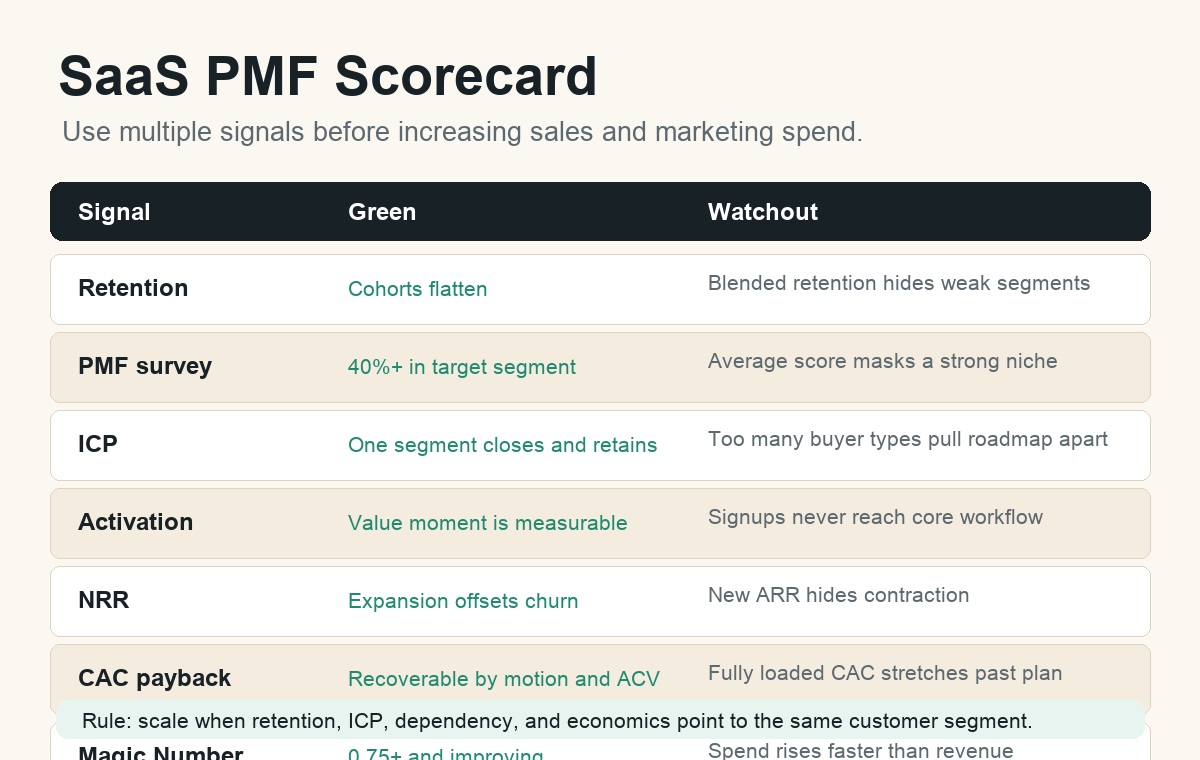
A Practical SaaS PMF Scorecard
Founders do not need a perfect model to make a better decision. They need a disciplined scorecard that prevents one exciting metric from overpowering the rest.
Use this as a Hapy discussion framework. The color thresholds are heuristics, not a validated predictive score or universal PMF test:
| Area | Green Signal | Yellow Signal | Red Signal |
|---|---|---|---|
| Customer segment | Clear ICP with repeatable pain | Several promising segments | No segment stands out |
| PMF survey | 40%+ very disappointed in target segment | 25-39% with strong segment clues | Low score and vague responses |
| Retention | Cohorts flatten by segment | Retention improving but unstable | Cohorts trend toward zero |
| Activation | Core value moment is measurable | Activation varies by channel | Users sign up but do not reach value |
| Acquisition | One or two channels repeat | Founder/network driven only | Growth depends on one-off pushes |
| Unit economics | CAC payback and Magic Number improving | Mixed by segment or channel | More spend creates more loss |
| Expansion | Early upsell, seats, usage, or referrals | Some account growth | Churn offsets growth |
Do not approve scaling by counting green cells. Regardless of the total, require a defined ICP, credible activation and retention evidence across sufficiently observed cohorts, affordable acquisition economics, and the operational capacity to serve more users. Unresolved security or reliability blockers also stop expansion. When evidence is thin or contradictory, run a bounded learning experiment with a spend cap and stopping rule before adding fixed headcount.
How To Move From Pre-PMF To Post-PMF
Pre-PMF work should feel narrow and empirical. The team is not trying to impress the whole market. It is trying to find the users who pull the product forward.
- Define the painful workflow in the customer’s words.
- Identify the smallest segment where the pain is urgent and frequent.
- Ship the minimum version that reaches the core value moment.
- Measure activation, retention, and “very disappointed” responses.
- Segment the strongest users and study why they depend on the product.
- Split the roadmap between deepening what they love and removing blockers for adjacent users.
- Scale only the channels that bring retained customers, not just cheap leads.
This matches the spirit of the Lean Startup method: the point is validated learning, not simply building more software. Hapy’s guide to lean software development covers the delivery mindset behind that loop. The official Lean Startup principles describe the fundamental activity as turning ideas into products, measuring how customers respond, and learning whether to pivot or persevere through the build-measure-learn feedback loop.
The best SaaS teams keep this loop alive after they find traction. Product-market fit is not permanently owned. Customer expectations change, AI compresses feature advantages, competitors copy faster, and new segments behave differently from early adopters. A company can have fit in one segment and lose it when it moves upmarket, downmarket, or into a new workflow.
Frequently Asked Questions
What is SaaS product-market fit?
SaaS product-market fit is the point where a specific customer segment repeatedly uses, pays for, and depends on a software product because it solves an urgent problem better than available alternatives. In practice, it shows up through retention, customer pull, clear ICP, efficient acquisition, and expansion inside existing accounts.
What is the best metric for product-market fit?
Retention is usually the hardest signal to fake, but no single metric is enough. Pair cohort retention with the Sean Ellis PMF survey, activation rate, customer interviews, NRR, CAC payback, and sales-cycle data. The strongest evidence appears when qualitative dependency and quantitative behavior point to the same customer segment.
Is 40% “very disappointed” enough to prove product-market fit?
No. It is a useful benchmark, not a complete diagnosis. A 40% score from poorly selected users can mislead the team, while a lower overall score may hide a strong segment. Survey activated users, segment the results, and use the answers to identify the high-expectation customer.
When should a SaaS company scale sales and marketing?
Scale after retention stabilizes in the target ICP, the sales motion becomes repeatable, CAC payback is tolerable for the business model, and sales efficiency is improving. If growth still depends on founder charisma or one-off referrals, document the playbook and run controlled channel tests before adding a large team.
What is the difference between product-market fit and go-to-market fit?
Product-market fit proves that customers need the product. Go-to-market fit proves that the company can acquire and serve those customers predictably. A SaaS company usually needs both before it can scale efficiently.
The Bottom Line
SaaS product-market fit is not a feeling of momentum. It is evidence that a clear customer segment depends on the product and that the business can reach more of those customers without destroying its economics.
The safest rule is simple: do not scale until the market is pulling, retention is flattening, the ICP is clear, and the GTM motion is repeatable enough for someone other than the founder to run. Growth should amplify fit, not compensate for its absence.
If the evidence points to an unresolved core workflow, scope a focused MVP development engagement before funding a broader feature roadmap.