Custom software development services should not mean “a team that writes code after you hand over a feature list.” A serious service should help the buyer clarify the business problem, reduce delivery risk, design the product, make architecture tradeoffs, build and test the system, launch it safely, and define who owns the software after release.
That distinction matters because custom software is not a normal purchase. The buyer is not buying a finished product with a fixed shelf label. They are funding a decision process that turns messy workflows, customer needs, data, integrations, and constraints into working software. If the service misses discovery, UX, architecture, QA, maintenance, or ownership, the cost usually appears later as rework, delays, technical debt, or vendor dependency.
The practical buyer question is simple: what should the vendor be responsible for before, during, and after development?
This guide is written for founders, operators, product leads, and procurement teams comparing custom software development services. It is not a service-page checklist. It is a buying framework for deciding whether a vendor can own enough of the work to reduce risk instead of just adding developers.
What custom software development services should include
Custom software development services should include the full path from problem definition to post-launch ownership. The exact scope depends on the project, but buyers should expect coverage across discovery, requirements, UX, architecture, development, integrations, QA, launch, maintenance, documentation, and ownership.
Use this as the baseline:
| Service area | What buyers should expect | Why it matters |
|---|---|---|
| Discovery | Business goals, users, workflows, constraints, risks, and success metrics | Prevents the team from building the wrong thing well |
| Requirements | Functional needs, non-functional needs, assumptions, exclusions, and acceptance criteria | Makes scope testable instead of conversational |
| UX and product design | User journeys, wireframes, prototypes, content states, and usability decisions | Reduces rework before engineering commits to the flow |
| Architecture | Stack, data model, permissions, hosting, integrations, scalability, security, and technical tradeoffs | Determines maintainability and future cost |
| Development | Iterative implementation with code reviews, demos, issue tracking, and delivery visibility | Turns the plan into working software without hiding progress |
| Integrations | API planning, data mapping, error handling, sync rules, and third-party constraints | Prevents brittle handoffs between systems |
| QA and security | Test plans, regression coverage, edge cases, accessibility, performance, and security review | Keeps quality from becoming a launch-week surprise |
| Launch | Deployment plan, environment setup, rollback path, analytics, training, and support window | Reduces production risk |
| Maintenance | Bug fixes, monitoring, patching, backups, dependency updates, and roadmap iteration | Keeps the software useful after release |
| Ownership | Code, data, designs, documentation, credentials, repositories, and handover terms | Protects the buyer from lock-in |
If a vendor excludes one of these areas, that may be fine. It just needs to be explicit. A buyer with a strong internal product and engineering team may only need delivery capacity. A non-technical founder or operations team usually needs more complete ownership from the partner.
Discovery should define the business problem before scope
Discovery is where a custom software project should become smaller, clearer, and more honest. The vendor should not begin by asking for every desired feature. They should first understand the workflow, the users, the business outcome, the constraints, and the risk.
Good discovery answers questions like:
- What business result should improve if the software works?
- Which users, roles, permissions, and handoffs matter?
- Which current tools, spreadsheets, or manual processes will the software replace or connect?
- Which assumptions are still unproven?
- Which requirements are must-have, and which can wait?
- What could make the build more expensive than it looks?
This is where custom work differs from buying SaaS. If the workflow is common, SaaS may be enough. If the workflow is specific, valuable, or hard to support with generic tools, custom software may be justified. Hapy’s guide to custom software development cost is useful once the team knows what risk sits behind the feature list.
Discovery should produce artifacts a buyer can actually inspect: workflow maps, user stories, acceptance criteria, risks, assumptions, and a first delivery plan. If the output is only a prettier proposal, the buyer has not learned enough.
Requirements should be useful, not ceremonial
Requirements do not need to become a hundred-page document, but they do need to be clear enough that the team can build, test, and make tradeoffs. A lightweight software requirements specification can help when the project has multiple stakeholders, compliance needs, integrations, or ambiguous workflows.
Useful requirements define:
- Functional requirements: what the system must do.
- Non-functional requirements: performance, security, uptime, accessibility, scalability, and compliance expectations.
- Acceptance criteria: how the buyer and vendor will know a feature is done.
- Out-of-scope items: what the team will not build in this phase.
- Assumptions: what the estimate depends on.
- Open questions: what still needs discovery or a technical spike.
This is also where buyers should separate MVP scope from long-term platform scope. An MVP can tolerate some temporary decisions if the goal is learning. A system that will run daily operations needs stronger architecture, testing, and support from the start. Hapy’s broader custom software process guide explains why even small software projects need a lightweight lifecycle around scope, design, quality, launch, and ownership.
UX should clarify behavior before development
UX is not decoration at the end of a custom software build. It is where the team decides how people will actually use the system. That includes user journeys, permissions, empty states, errors, notifications, onboarding, dashboards, mobile behavior, and the moments where a user needs help or confirmation.
A good custom software partner should use UX work to reduce ambiguity before engineering starts. Wireframes and prototypes expose workflow problems faster than code. They also help non-technical stakeholders react to something concrete.
For buyer-side review, ask:
- Does the prototype show the main user roles?
- Are error states, empty states, and edge cases included?
- Does the design account for admin work, not only the customer-facing flow?
- Are dashboards and reports tied to real decisions?
- Has the team tested whether users understand the workflow?
The goal is not to overdesign every screen. The goal is to prevent developers from becoming the hidden product designers because no one made the interaction decisions earlier.
Architecture should expose tradeoffs, not hide them
Architecture is where buyers should expect plain-language tradeoff discussions. The vendor should explain the stack, data model, hosting approach, permissions, integrations, security posture, and maintainability plan in terms the business can understand.
IBM describes the software development lifecycle as a structured way to plan, build, test, deploy, and maintain software. For buyers, the lesson is not to memorize SDLC terminology. The lesson is to avoid vendors that rush from sales call to code without showing how the system will hold together.
Architecture questions should include:
- What will be easy to change later, and what will be expensive?
- Which parts of the system are custom, and which use existing services?
- How will roles, permissions, and audit trails work?
- What happens when an integration fails?
- How will the system be monitored after launch?
- What technical debt is acceptable in this phase, and what is dangerous?
That last question is important. Technical debt is not always bad. Some shortcuts are reasonable for a validation build. But accidental debt from weak architecture can become a business tax. Hapy’s guide to technical debt cost explains how poor software quality shows up as slower releases, higher QA spend, incidents, rework, and rebuild pressure.
Development should be visible while work is happening
Development is where the plan turns into working software, but buyers should not treat it as a black box. A strong vendor gives the buyer enough visibility to make decisions without forcing them to micromanage the team.
Expect a working rhythm:
- A shared backlog with priorities and acceptance criteria.
- Regular demos of working software.
- Clear issue tracking and decision logs.
- Code reviews before changes are merged.
- Staging environments for review before production.
- Sprint or milestone reporting that explains risk, not only status.
Velocity should be used for planning, not pressure. If a vendor turns every update into a performance theater, the team may optimize for looking busy instead of making good decisions. Better signals include shipped usable increments, defect trends, unresolved blockers, scope changes, and whether the riskiest assumptions are being resolved early.
Integrations need more attention than buyers expect
Integrations are often where custom software estimates become fragile. A vendor may quote a CRM, payment, ERP, warehouse, support, or analytics integration as if it is a standard task. Sometimes it is. Often, the hard work is data mapping, permissions, sync timing, error handling, rate limits, retries, duplicates, and reconciliation.
Before approving an integration-heavy build, ask the vendor to classify each integration:
| Integration type | Buyer risk | What to ask for |
|---|---|---|
| Standard API | Usually low risk if docs and sandbox are available | Auth method, endpoints, limits, and test environment |
| SaaS workflow sync | Medium risk because business rules often live between tools | Field mapping, conflict rules, retries, and ownership |
| Legacy system | High risk if docs, access, or data quality are weak | Technical spike, data audit, fallback plan, and contingency |
| Real-time or bidirectional sync | High risk because failure states multiply | Queueing, monitoring, replay logic, and reconciliation |
If the project is mostly about dashboards, workflows, internal tools, and system connections, it may overlap with Hapy’s Business Systems & Automation work. If the question is whether to build a narrow internal tool or a larger operating system, compare custom ERP development vs internal tools before choosing the heavier path.
QA, security, and launch should be part of the service
Quality should not appear only at the end. Buyers should expect QA and security to be built into the delivery process: requirements review, test planning, automated checks where useful, manual exploratory testing, regression testing, accessibility review, and release validation.
For security-sensitive work, NIST’s Secure Software Development Framework gives buyers and vendors a shared way to discuss secure development practices. You do not need to turn every project into a compliance program. You do need to know whether the vendor has a real process for access control, dependency review, secrets management, vulnerability handling, and secure deployment.
Launch planning should include:
- Production environment setup.
- Data migration or import process.
- Rollback plan.
- Monitoring and alerting.
- Analytics and event tracking.
- User training or handover.
- Hypercare window for post-launch issues.
If launch is treated as “we pushed the code,” the buyer is carrying operational risk the proposal probably did not price.
Maintenance and ownership are where vendor risk becomes visible
Many custom software projects are sold around the launch, but the real buying decision includes what happens afterward. Maintenance should cover bug fixes, dependency updates, security patches, monitoring, backups, performance tuning, minor improvements, documentation updates, and support expectations.
Ownership should be even more explicit. The buyer should know who owns:
- Source code and repositories.
- Product designs, prototypes, and design systems.
- Database schemas and data models.
- Documentation, runbooks, and architecture notes.
- Cloud accounts, credentials, domains, and deployment pipelines.
- Third-party licenses and reusable vendor components.
- Analytics and production data.
For mission-critical systems, buyers should also discuss handover, continuity, and exit planning. A good vendor should not make the software impossible to maintain without them. They can still be the best long-term partner, but that relationship should be chosen, not forced by lock-in.
Buyer checklist for evaluating custom software vendors
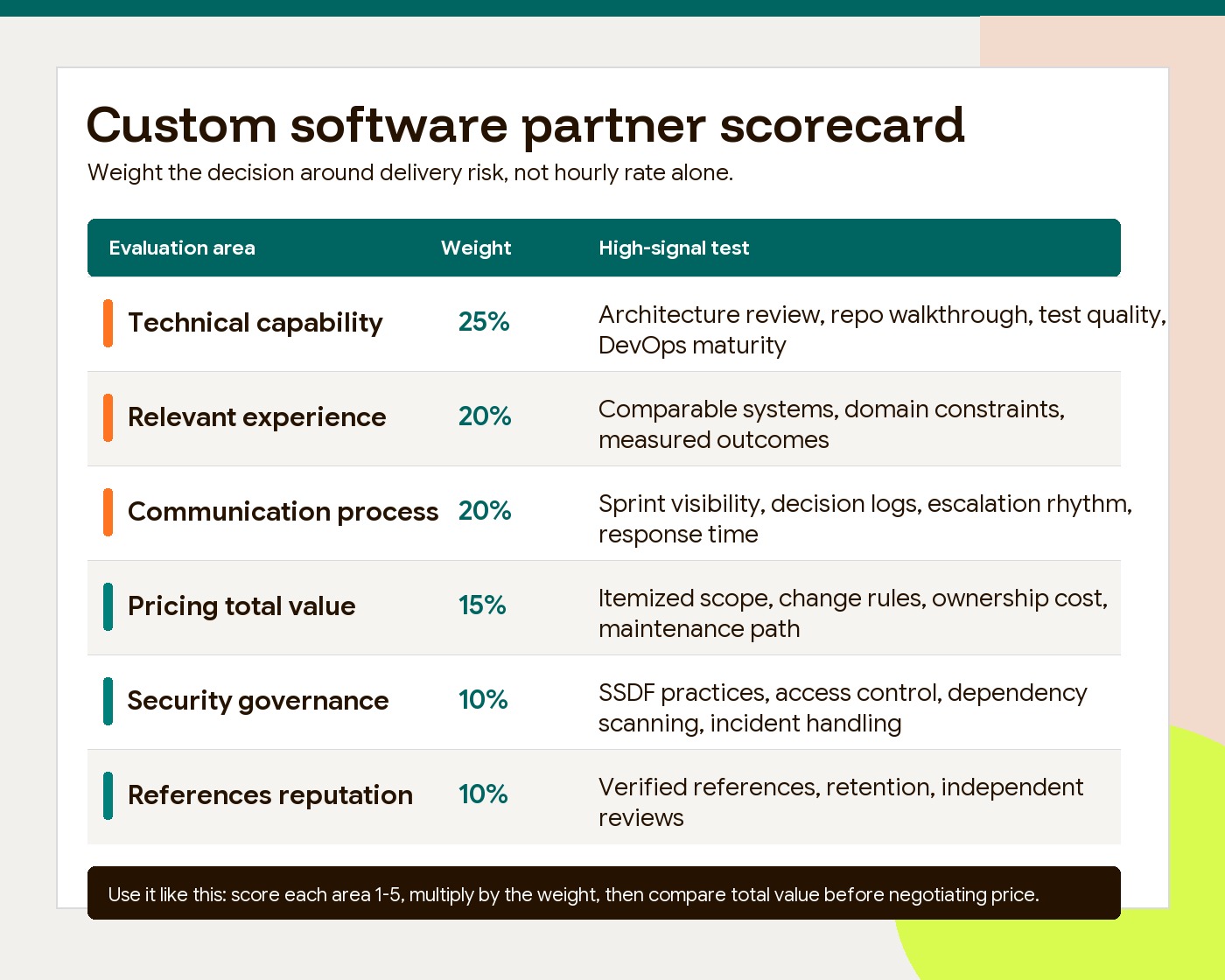
Use this checklist before signing a proposal. Use evidence anchors: 1 = missing, 2 = a claim only, 3 = a relevant artifact, 4 = a walkthrough by the assigned team, 5 = corroboration through a reference or scoped pilot. Mark unknowns explicitly. These scores organize discussion; they are not a validated ranking. Agree project-specific weights before reviewing vendors and test whether a small weight change reverses the result. Required ownership, access, recovery, and contractual terms are gates, not points that a high total can offset.
| Evaluation area | What a strong answer sounds like |
|---|---|
| Business understanding | “Here is the workflow, the user, the business outcome, and the risk we are solving first.” |
| Discovery process | “We will produce requirements, assumptions, risks, architecture notes, and a phased plan before full build.” |
| UX capability | “We will prototype the key workflows and edge cases before engineering commits to them.” |
| Architecture judgment | “Here are the tradeoffs, future constraints, integration risks, and maintenance implications.” |
| Engineering practice | “We use code review, staging, testing, version control, and deployment discipline.” |
| Integration planning | “We have mapped each system, API, data owner, sync rule, and failure path.” |
| QA and security | “Testing and security checks are part of the build, not a final pass.” |
| Communication | “You will see working software, open risks, decisions, and blockers on a regular cadence.” |
| Maintenance | “Here is what happens after launch, including support levels and ownership.” |
| Commercial clarity | “The proposal explains what is included, excluded, uncertain, and change-controlled.” |
| Ownership terms | “The contract defines code, data, design, documentation, credentials, and handover.” |
| References | “You can speak with clients about estimate accuracy, support, delivery style, and crisis ownership.” |
Red flags are usually visible before the project starts:
- The vendor quotes a complex system after one short call.
- The proposal lists features but not assumptions.
- UX, QA, DevOps, security, or maintenance are vague.
- Integrations are described as simple without reviewing the systems.
- The team cannot explain who will lead the work day to day.
- The contract does not define ownership and handover.
- The vendor avoids discussing what could go wrong.
One red flag may be manageable. Several together usually mean the buyer will pay later in rework, management load, or technical debt.
The best engagement model depends on uncertainty
There is no universal best contract model for custom software development services. The right model depends on how much scope certainty, technical risk, and product learning remains.
| Model | Best fit | Buyer caution |
|---|---|---|
| Fixed price | Stable, well-defined work with clear acceptance criteria | Can create change-order fights if discovery is weak |
| Time and materials | Evolving product work, technical discovery, and agile delivery | Needs active governance or budget can drift |
| Dedicated team | Long-running product roadmap or continuous delivery | Buyer needs product ownership and prioritization discipline |
| Hybrid | Serious custom software with unknowns | Works well when fixed discovery narrows risk before build |
For many buyers, the cleanest path is fixed discovery followed by a build model that matches the remaining risk. Discovery can clarify scope, UX, architecture, data, integrations, and cost assumptions. Then the buyer can decide whether fixed price, time and materials, a dedicated team, or a phased model is actually appropriate.
A sample RFP request
The following is an illustrative procurement prompt, not contract language or a client case:
Describe the proposed team and allocation, discovery outputs, assumptions, exclusions, milestones, and acceptance evidence for [workflow]. Price build, third-party services, migration, maintenance, and exit work separately. Show how [integration failure] and [unauthorized action] will be tested. Identify ownership of each repository, cloud account, dataset, design file, and reusable component. State license restrictions, handover deliverables, support coverage, response targets, and the change-request process.
For example, a fictional approval tool might require a rejected request to retain its history, notify the submitter once, and remain inaccessible to another department. Ask every vendor to demonstrate that same case. Have appropriate counsel turn negotiated ownership and license terms into an agreement for the relevant jurisdiction; a procurement checklist does not transfer IP by itself.
How Hapy thinks about custom software services
At Hapy, the main question is not “Can this be built?” Most things can be built. The better question is “Should this be built this way, now, with this scope, and under this ownership model?”
That is why custom software development services should be judged by the decisions they help the buyer make. A useful partner will sometimes reduce scope, recommend SaaS, start with an internal tool, validate with an MVP, or push for stronger architecture before writing too much code.
Custom software is strongest when it changes how the business works: a workflow becomes clearer, a customer experience becomes easier, data becomes more trustworthy, or a team stops stitching operations together by hand. The vendor should help the buyer reach that outcome with less uncertainty, not just more tickets.
Bottom line
Custom software development services should give buyers a path from uncertainty to ownership. The work should cover discovery, UX, architecture, development, integrations, QA, launch, maintenance, and the commercial terms that decide who controls the software afterward.
If a vendor can explain those areas clearly, show the risks, and make the tradeoffs visible, the buyer is comparing a real partner. If the vendor can only promise speed, low rates, or a long feature list, the buyer may still be carrying the hardest parts of the project alone.