The Denmark startup ecosystem is attractive for founders building serious B2B products, but it does not reward vague expansion plans.
Denmark is small, digital, high-trust, regulated, and unusually connected to public systems. Copenhagen gives founders the strongest commercial base. Healthtech benefits from national health data infrastructure and clinical collaboration. Climate tech benefits from energy, water, food, agriculture, and data-center decarbonization pressure. Danish SaaS startups benefit from a market where the public and private sectors already expect digital workflows.
The practical lesson for European founders is simple: Denmark is not an investment-tourism market. It is a product-readiness market. A startup that can show evidence, integration discipline, security, compliance, and a narrow buyer workflow has a better chance than one selling a broad “Nordic opportunity” story.
That is the useful angle for 2026: build for trust first, then scale the product.
If you are comparing Nordic wedges, read this alongside the Sweden startup ecosystem and Finland startup ecosystem guides. Sweden is often more useful for fintech, climate, and product-led SaaS density, while Finland is stronger when deep tech, gaming, AI, or technical commercialization shape the product bet.
Denmark startup ecosystem in 2026: the useful read
Copenhagen is the center of gravity for Danish startups. Use Dealroom’s Copenhagen profile to investigate ecosystem companies and categories. Its live totals depend on coverage, valuation dates, and geographic definitions; this guide does not treat an undated total as a current funding or buyer-demand measure.
That concentration matters, but founders should read it carefully. Denmark has credible startup density, but the home market is still small. The advantage is not that founders can sell only to Denmark. The advantage is that Danish design partners, public institutions, regulated buyers, and Nordic operators can help prove a product that later travels.
The sectors with the strongest practical fit share three traits:
- The buyer already has a digitized workflow.
- Trust, privacy, safety, or operational reliability matter.
- The product can reduce complexity for a serious institution, not just create a nicer interface.
That is why Denmark is especially relevant for healthtech, climate tech, public-sector digitization, B2B SaaS, fintech infrastructure, robotics, and industrial workflow software. It is less compelling for founders who need a very large domestic consumer market or a loose regulatory environment.
Copenhagen startup ecosystem: density with a trust premium
The Copenhagen startup ecosystem is useful because it puts founders close to capital, public buyers, corporates, universities, health institutions, and experienced software operators. It also sits inside a business culture that prizes clarity and reliability. That can be a gift for disciplined founders and a headache for teams still selling possibility instead of proof.
For a European founder, Copenhagen is strongest when the product needs one of these advantages:
| Copenhagen advantage | What it helps founders do | What still has to be proven |
|---|---|---|
| Public and enterprise digital demand | Test serious workflow software with buyers who already use digital systems | Procurement path, security evidence, support model, and integration readiness |
| Health and life-science networks | Validate clinical, patient, data, or operational health products | Privacy, clinical workflow fit, data governance, evidence, and buyer trust |
| Climate and energy credibility | Build around decarbonization, energy efficiency, water, agriculture, and green infrastructure | Deployment proof, payback logic, regulatory fit, and partner access |
| Nordic software talent | Build B2B SaaS with strong usability and technical execution | Narrow ICP, retention signal, onboarding, pricing, and expansion motion |
| International accessibility | Use Denmark as a Nordic or EU proof market | Clear reason the product can travel beyond Denmark |
The trap is treating Copenhagen like a badge. A Copenhagen presence helps only if it improves the product’s evidence base: a better pilot, a better partner, a more credible dataset, a regulatory review, or a buyer workflow the team could not learn from elsewhere.
Startup Denmark: useful, but not a shortcut
Startup Denmark is the official route for non-EU/EEA founders who want to establish and run an innovative growth company in Denmark. The official Start-up Denmark page says the business idea must be approved by a panel appointed by the Danish Business Authority before the founder can apply to SIRI for a residence and work permit. It also says the scheme is for innovative companies that can contribute to economic growth and job creation, not ordinary local-service businesses.
The official SIRI page for Start-up Denmark, checked September 8, 2026, lists a normal processing time of two months and a DKK 3,060 processing fee; it says processing can take up to four months if further information is needed. These are not guaranteed timelines. Check current eligibility, self-support requirements, fees, application steps, and permit conditions directly with SIRI before applying.
Founders should not read Startup Denmark as a light relocation form. It is closer to a business-readiness test. The application is more credible when the company can explain:
- why the product is innovative in a Danish or European context;
- which buyer or public problem it addresses;
- why Denmark is the right operating base;
- how the founder will actively run the company;
- what evidence supports growth potential;
- whether the product fits Danish strengths such as healthtech, climate tech, B2B software, life sciences, fintech, or digitized public services.
If the business plan cannot name the buyer, the problem, the proof, and the Denmark-specific reason for being there, the visa path is not the real blocker. The product strategy is.
Healthtech: Denmark is a strong testbed, not a soft market
Denmark healthtech is attractive because the healthcare system is highly digital, data-rich, and collaborative. Invest in Denmark describes the country as one of Europe’s leading health technology hubs, with a strong digital healthcare infrastructure, public-private collaboration, and a population comfortable with digital services.
The most important product signal is health data. Invest in Denmark says Danish public healthcare has comprehensive administrative and medical registries collected for more than half a century, and that health data will be accessible through one national entry with the establishment of Digital Health Denmark in 2026. It also says Danish health data covers the whole healthcare sector, spans the population from cradle to grave, and can be linked through the CPR number.
That is powerful, but it raises the bar. A healthtech product in Denmark cannot rely on “we have AI” or “we improve patient experience” as the main claim. The product needs to prove how it handles consent, privacy, interoperability, clinical context, data minimization, auditability, and workflow adoption.
The best openings are practical:
- remote monitoring that reduces avoidable in-person care;
- clinical operations tools that reduce staff burden;
- patient communication and care coordination software;
- decision-support products with clear human oversight;
- Software as a Medical Device and digital therapeutics with evidence discipline;
- data governance tools that help institutions use health data responsibly.
The founder mistake is building for a theoretical patient while ignoring the nurse, clinician, administrator, region, municipality, payer, or procurement owner who must make the product work. Healthtech in Denmark is not only about data access. It is about operational fit.
Climate tech: build around deployment, not slogans
Denmark climate tech benefits from a serious national green transition agenda. Innovation Centre Denmark describes Denmark as a green-technology frontrunner and notes that the government published its first national strategy for investments in green research, technology, and innovation in 2020, followed by a long-term global climate action strategy. Its green transition overview also emphasizes testing new green technology in an advanced energy system with a high share of renewable energy.
For founders, that means Denmark is useful when the product touches a real operating system: energy, water, food, agriculture, industrial efficiency, buildings, district heating, grid flexibility, or data-center infrastructure. It is weaker when the product is only a carbon dashboard with weak data quality and no pathway to operational change.
The data-center opportunity shows the pattern. The U.S. International Trade Administration says Denmark’s data center market was estimated to reach 267.9 MW in capacity in 2025, with green IT focused on combining data center operations with reuse of excess heat for district heating networks. The Net Zero Start-Up Hub in Fredericia is built for companies developing sustainable digital infrastructure technologies and gives selected teams access to data center operators, experts, mentoring, and validation pathways.
The 2026-2027 Net Zero Start-Up Hub call is especially instructive because it names focus areas founders can build around: low-carbon power systems, grid integration, long-duration energy storage, heat reuse, district energy, AI-enabled optimization, intelligent controls, digital twins, and automation.
Those are not “green brand” ideas. They are systems problems. The product has to work with assets, meters, operators, facilities, utilities, municipalities, and procurement constraints.
A concrete climate-tech first-contact route
For a heat-reuse or data-center controls product, use the Net Zero Start-Up Hub’s 2026–2027 call as a program entry point. Check its current application window and eligibility before preparing an application; a published call is not a promise of acceptance, funding, or a customer contract.
Prepare a one-page brief naming the operator, equipment or data needed, integration boundary, and the operational decision the product improves. Ask the program contact whether an operator can validate the problem and what a pilot would require. Propose a baseline, success measure, safety boundary, data-access agreement, support owner, and end-of-pilot buying decision. Do not build the full integration until an actual operator confirms the need and access path.
B2B SaaS and public-sector digitization
Danish SaaS startups have an unusually good local context when the product makes work clearer, safer, faster, or easier to govern. Denmark’s digital infrastructure suggests possible software opportunities; it does not by itself prove that buyers need or will pay for a new product.
The International Trade Administration’s 2026 Denmark digital services guide values the country’s ICT sector at approximately $30.8 billion in 2025, with the public sector accounting for more than 25% of total IT spending. It also identifies public-sector digitalization, healthcare IT, AI, quantum, cloud, cybersecurity, and data centers as major opportunity areas.
The public-sector point is important. Denmark’s Agency for Digital Government says the Joint Government Digital Strategy runs from 2026 to 2029 and is designed to support joint public investments in complex areas with dependencies across authorities, sectors, and levels of government. Hapy’s inference is that this could create opportunities for software across institutions. An announced strategy does not establish an available procurement budget, an accessible contract, or demand for a particular product.
For B2B founders, these are hypotheses to validate with buyers:
- workflow software for municipal, regional, and national service delivery;
- cybersecurity and cloud governance tools;
- e-health infrastructure and patient operations;
- finance, billing, procurement, and compliance automation;
- vertical SaaS for SMEs that must interact digitally with public systems;
- AI workflow tools with audit logs, permissions, and human review.
The SaaS bar is not just feature quality. Danish buyers will expect reliability, privacy, integration, support, and a clear reason to change an existing process. If the product cannot explain the workflow it owns after onboarding, it is not ready for a mature B2B market.
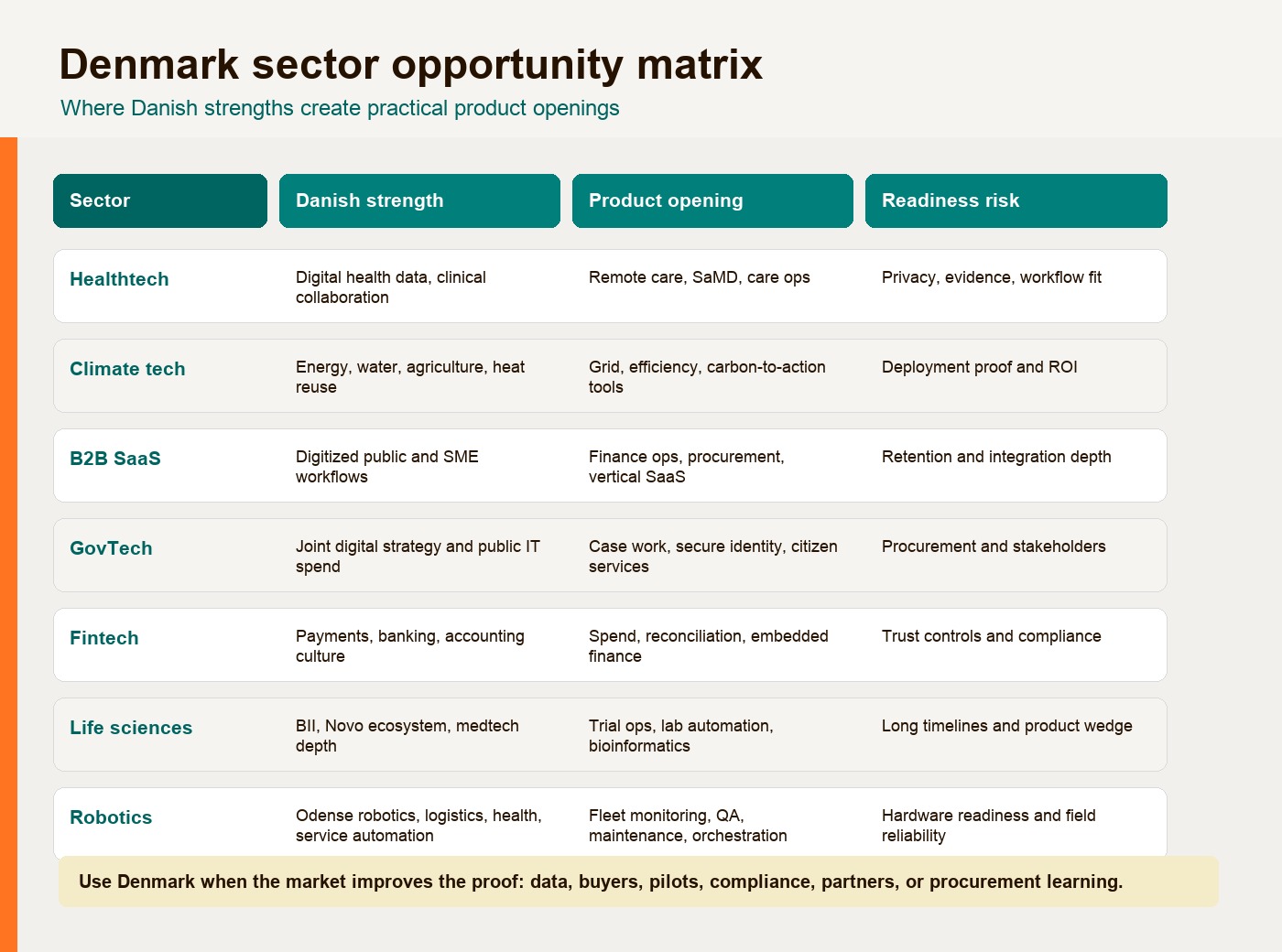
Denmark sector matrix: where product opportunity is strongest
Use Denmark when the market can make the product more credible. Avoid it when the team only wants a Nordic logo.
| Sector | Danish strength | Product opportunity | Main founder risk |
|---|---|---|---|
| Healthtech | Digital healthcare, registries, clinical collaboration, public-private partnerships | Remote care, clinical workflow tools, SaMD, patient operations, data governance | Underestimating privacy, evidence, procurement, and clinical adoption |
| Climate tech | Renewable energy, water, agriculture, district heating, data-center decarbonization | Energy optimization, heat reuse, grid flexibility, industrial efficiency, carbon data tied to operations | Selling sustainability claims without deployment proof or buyer ROI |
| B2B SaaS | Digitized public and private workflows, high software adoption, SME demand | Finance ops, procurement, compliance, vertical SaaS, workflow automation | Building generic tools without a narrow buyer and retention signal |
| Public-sector digitization | Long-running government digital strategy and public IT demand | GovTech, case management, secure identity workflows, citizen service tools, data interoperability | Slow procurement, security review, stakeholder complexity |
| Fintech and SME software | Digital payments, accounting, banking, cards, expense management | Spend management, reconciliation, embedded finance, tax/reporting automation | Weak trust controls, unclear regulatory path, poor integration with finance systems |
| Life sciences and biotech | Novo Nordisk Foundation ecosystem, BII, medtech and research depth | Translational research tools, clinical trial operations, lab automation, bioinformatics | Long timelines, capital intensity, unclear commercialization wedge |
| Robotics and industrial software | Odense Robotics, manufacturing, logistics, health and service robotics | Robotics operations software, fleet monitoring, QA, maintenance, workflow orchestration | Hardware readiness, field reliability, service burden |
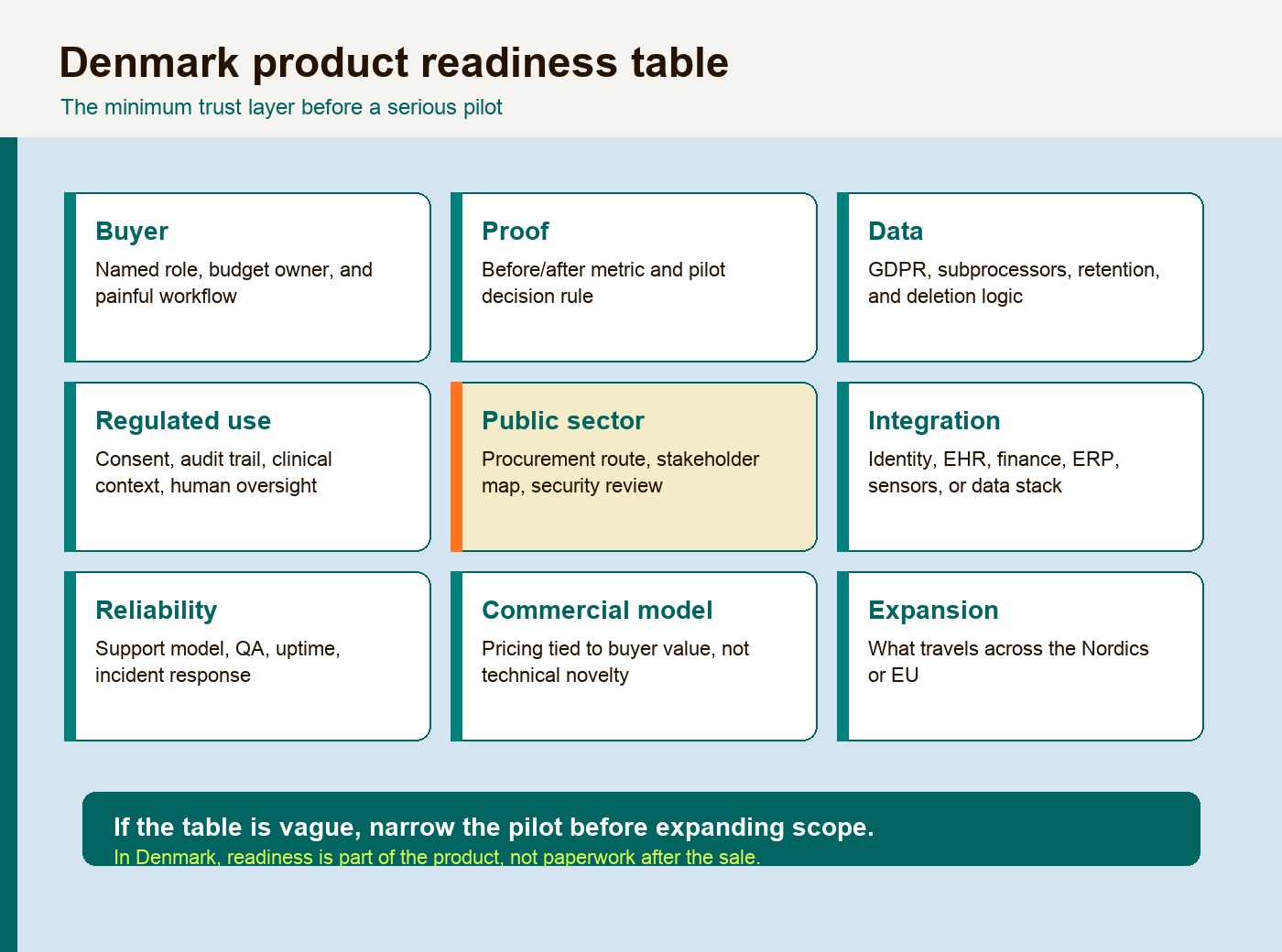
Compliance and product-readiness table
Denmark rewards founders who treat compliance as part of the product. That is especially true in health, climate infrastructure, public services, finance, and AI.
| Readiness area | Planning questions to resolve before a Danish pilot |
|---|---|
| Buyer | One named buyer role, budget owner, and painful workflow |
| Proof | Pilot success criteria, before-and-after metric, and decision rule |
| Data | Have a qualified reviewer determine applicable data-protection obligations, lawful processing basis, processing terms, subprocessors, retention, and deletion |
| Health or regulated data | Consent model, audit trail, clinical context, security, and human oversight where needed |
| Public-sector path | Procurement route, stakeholder map, documentation, accessibility, and security review |
| Integration | Fit with identity, EHR, finance, CRM, ERP, sensors, data warehouse, or public systems |
| Reliability | Support model, uptime expectation, incident response, QA, and failure handling |
| Commercial model | Pricing tied to buyer value, not only technical novelty |
| Localization | English may work for many startup contexts, but legal, public, healthcare, and support materials may need Danish expectations |
| Expansion | Clear view of whether the product travels to Sweden, Norway, Finland, Germany, the Netherlands, or the broader EU |
If several rows are weak, the right next step is not a bigger launch. It is a narrower product test. Hapy’s MVP development checklist is useful before a team commits to version one, and the guide to software development risks is worth using when integrations, data handling, procurement, or QA could change the scope.
Founder challenges to plan around
The first challenge is sales-cycle discipline. Denmark’s strongest buyers can be attractive, but they may move slowly because the decision involves procurement, security, legal, operations, and integration review. A founder should design pilots with explicit acceptance criteria rather than hoping a friendly conversation turns into a contract.
The second challenge is trust. High digital maturity does not mean low scrutiny. In Denmark, trust is an asset, and products that touch health data, financial operations, public systems, or energy infrastructure need to earn it through documentation, governance, and behavior.
The third challenge is market size. Denmark can be an excellent proof market, but most venture-scale companies need a Nordic, European, or global plan. Founders should decide early what must stay Denmark-specific and what should be built for cross-border reuse.
The fourth challenge is competition from capable local and international firms. The ITA guide notes that new entrants face competition from established local, international, and U.S. firms in Danish digital services. A foreign founder needs a sharper wedge than “better software.” The wedge might be a neglected workflow, a data advantage, a partner channel, a regulated use case, or a product experience that removes real operational friction.
The fifth challenge is talent. Denmark has strong technical and life-science capability, but specialized senior talent is still competitive. Founders using Startup Denmark or hiring internationally should plan immigration, compensation, equity, payroll, and local employment advice early enough that hiring does not become a launch blocker.
What European founders should build first
Founders entering Denmark should build the trust layer before the expansion layer.
For healthtech, start with one clinical or operational workflow and the evidence a real institution would trust. Do not build a broad platform before the product proves data handling, user adoption, and care-context fit.
For climate tech, connect the product to a physical or operational decision. The strongest products help operators reduce energy waste, reuse heat, manage grid constraints, improve industrial efficiency, or turn climate reporting into action.
For B2B SaaS, avoid generic horizontal features. Build around finance operations, public-sector workflows, compliance, procurement, identity, customer operations, security, or another narrow job where Danish buyers already feel friction.
For AI products, design governance into the product surface. Show what the system reads, what it changes, what a human approves, how errors are handled, and how the model or workflow is evaluated over time.
For public-sector or GovTech products, map procurement before building too much. Denmark’s digitized public sector is a serious opportunity, but it is not a shortcut around stakeholder complexity.
For SaaS founders specifically, Hapy’s guide to SaaS product-market fit signals can help separate promising usage from real readiness to scale.
The founder takeaway
The Denmark startup ecosystem is strongest for founders who build practical products for trust-heavy markets. Copenhagen gives access to capital, operators, health and life-science networks, public-sector technology demand, B2B SaaS talent, and Nordic credibility. Startup Denmark gives innovative non-EU/EEA founders a formal pathway, but it is not a substitute for a sharp business case.
These sector opportunities are Hapy’s interpretation of the linked ecosystem sources, not confirmed customer demand. The common thread is not hype. It is product readiness.
Build the smallest serious product Denmark can validate: narrow enough to pilot, strong enough to earn trust, documented enough for compliance review, and useful enough that a cautious buyer can see the workflow changing.
That is how Danish market credibility turns into European product momentum.
For a defined buyer and workflow, Hapy’s MVP development engagement can turn a pilot hypothesis into a reviewable delivery scope.