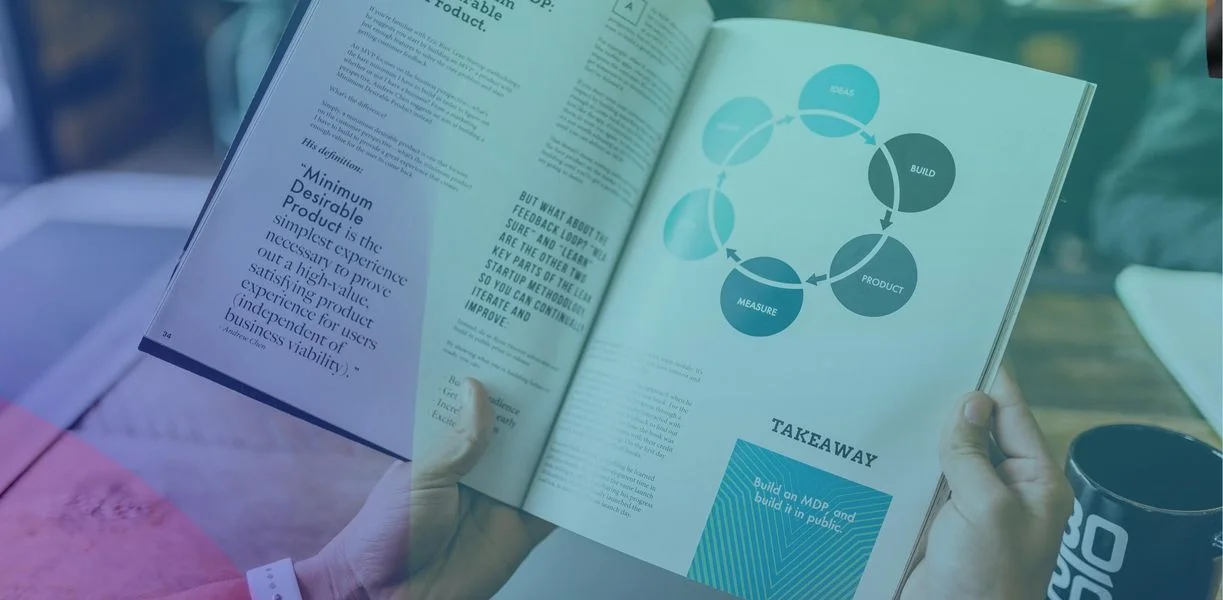
Build an MVP around a decision you need to make. Identify one user group, one important problem, and the assumption that could make the product fail. Then release the smallest usable workflow that produces evidence about that assumption.
An MVP does not guarantee feedback, funding, referrals, or product-market fit. It helps reduce uncertainty when the experiment, recruitment, measurement, and next decision are explicit.
What an MVP is meant to test
A minimum viable product is a first usable release focused on a core value proposition. A prototype can test whether someone understands a flow; a landing page can test a message; an operating MVP can test whether people actually complete and repeat the work. Choose the cheapest credible experiment for the question.
A smaller feature list alone is not enough. Users must still be able to complete the central task, understand limitations, and recover from expected errors. The release needs proportionate quality, privacy, and operating support.
A worked MVP experiment
Consider a hypothetical booking tool for independent tutors who currently schedule recurring lessons through chat. This is an invented planning example, not a Hapy customer result.
| Experiment element | Decision |
|---|---|
| First user | Independent tutors with recurring students and scheduling changes each week |
| Risky assumption | Tutors and students will use a shared booking flow instead of returning to chat for every change |
| Core workflow | Tutor publishes available slots; student requests one; tutor confirms; both receive the result |
| Excluded scope | Marketplace discovery, video lessons, complex billing, referrals, and advanced reporting |
| Recruitment | Invite tutors who can show their current scheduling process; include people outside the founder’s friends |
| Observation | Four weeks of ordinary scheduling, with support and corrections logged |
| Main metric | Confirmed bookings completed through the tool, divided by eligible booking attempts |
| Secondary evidence | Repeat use, time spent coordinating, cancellations, support effort, and reasons for reverting to chat |
Before launch, agree a local decision rule. For illustration, recruit ten tutors and require at least seven to complete the workflow without live guidance in the first week and at least five to use it again during later weeks. Also require that confirmations do not create unresolved double bookings. These are hypothetical learning gates, not industry benchmarks or proof of market fit.
If onboarding blocks completion, fix and retest that flow. If tutors complete it but do not return, interview them about urgency, current alternatives, and missing value. If use continues only through founder reminders, treat that as weak evidence. If the cohort repeats the workflow with acceptable support cost, test a larger independent cohort and willingness to pay before broad expansion.
Ten participants can reveal practical problems; they cannot establish population-level demand. Report counts, recruitment method, assistance, and dropouts alongside percentages.
Six steps from assumption to usable release
1. Research the current problem
Ask prospective users to show the last time the problem occurred. Record the steps, time, workarounds, and consequences. Compare current tools, including doing nothing. Surveys can help explore patterns, but an expression of interest is weaker evidence than repeated behavior or a real commitment.
Write the hypothesis before creating a feature list. For the tutor example: “Tutors who coordinate recurring lessons in chat will complete and repeat a shared booking workflow because it reduces scheduling back-and-forth.”
2. Define the value and measurement
Choose the user outcome, denominator, observation window, and decision rule together. Track failed attempts and manual assistance. If the product involves money, decide how to test willingness to pay honestly without charging for something you cannot deliver.
Do not confuse registrations with value. A signup might show interest; a completed booking, repeated task, or retained paid account answers a different question.
3. Map the complete core flow
Include entry, the key action, confirmation, and recovery. For booking, test unavailable slots, changed plans, duplicate requests, and failed notifications. A polished happy-path screen does not show whether the workflow can be trusted.
Use a prototype to test comprehension before implementation. Observe users attempting the task without telling them which button to click.
4. Prioritize only what the experiment needs
Classify work as necessary for the core task, necessary for safe operation, necessary for measurement, or deferred. Keep a written “not building” list. Use MoSCoW prioritization when it helps the team explain exclusions.
Standard components and existing services can reduce custom work, but their costs, permissions, and failure behavior still need review. Avoid creating a large platform before one workflow has evidence.
5. Build, test, and release to a bounded cohort
Build in reviewable increments. Test normal behavior, errors, data handling, and the measurements needed for the experiment. Agree a support owner and a way to pause or recover the release.
Recruitment is part of the plan, not something to start after development ends. Explain that the release is a pilot, what it can do, what it cannot do, and how participants can leave or report a problem.
6. Measure, learn, and make a decision
Compare results with the rule written before launch. Combine event data with interviews and support notes. Separate a product problem from a broken measurement, poor recruitment, or an unusable flow.
Choose one next action: continue the same test, fix a specific obstacle, change the hypothesis, expand cautiously, or stop. Do not treat every request as a feature commitment. Preserve the evidence so the next roadmap discussion does not start from memory.
What an MVP can make easier
A narrow release can focus the team, expose misunderstood user needs, and reduce the amount of work committed before learning. It may help conversations with customers and investors because the product can be demonstrated. Those benefits depend on the experiment and the response; they are not guaranteed outcomes.
Estimate cost and timeline from scope
There is no reliable price or duration for “an MVP” without specifying what it does. Estimate discovery, UX, engineering, integration, QA, launch, recruitment, and observation separately. Include hosting, third-party services, support, and post-pilot changes.
Compare quotes for the same workflow and acceptance criteria. A concierge test and a native mobile product with billing and integrations have different costs and risks. An MVP can evolve into the product; it does not always require a separate team to build a “final version” from scratch.
Use the MVP development cost guide to structure a budget, and state what would widen the estimate before committing.
App, SaaS, and AI MVPs need different evidence
| Product type | What to validate beyond a demo |
|---|---|
| Mobile or web app | Task completion on supported devices, error recovery, and repeat use |
| SaaS | Activation, repeated workflow value, willingness to pay, onboarding effort, and support cost |
| AI product | Output quality on representative cases, human review, cost per useful result, and safe failure behavior |
The common rule is to test the outcome, not the amount of functionality. An AI feature that needs extensive correction may be useful as an assistant while failing the case for automatic action.
Mistakes that weaken the evidence
- Unclear audience: feedback from unrelated users cannot answer one specific market question.
- Feature overload: too many changes make it hard to know what created the result.
- Overengineering: infrastructure work can consume the budget before demand is tested.
- Oversized staffing: more people create coordination costs when the work is not ready to parallelize.
- Unfiltered feedback: requests need context, frequency, and connection to the hypothesis.
- An incomplete core flow: users cannot evaluate value when the central task does not work.
- Rushed interpretation: a fast release does not replace an adequate observation window.
Keep the release focused, but include what users need to complete the task honestly. Use the result to decide what deserves further investment. That is the purpose of a scoped MVP development engagement.