A custom software development partner is an external engineering team that helps you design, build, improve, and operate software around a business outcome. The important word is partner. A vendor takes a ticket and ships a feature. A partner helps you make better technical decisions before the feature becomes expensive.
That distinction matters because custom software is getting more strategic. Grand View Research estimated the global custom software development market at USD 43.16 billion in 2024, with a projected USD 146.18 billion by 2030. At the same time, the cost of weak software decisions keeps rising. CISQ’s 2022 report estimated that poor software quality cost the U.S. at least USD 2.41 trillion, with technical debt at roughly USD 1.52 trillion.
The practical takeaway is simple: do not choose a custom software development partner by hourly rate alone. Choose the team that can reduce delivery risk, explain tradeoffs, protect ownership, and keep the system useful after launch.
This guide is for founders, operators, procurement leads, and technical leaders who need to evaluate a custom software development company without turning the process into a slow, performative RFP. Founders choosing a version-one team can use the more focused startup software development company guide to match the partner model to product uncertainty and runway.
Before comparing quotes, use the custom software development cost by risk guide to separate visible scope from integration, compliance, data, UX, and team risk.
If you are building the first vendor shortlist, our comparison of top custom software development companies in the USA gives a market-level view before you run deeper diligence.
If you need to understand the work before vendor selection, use the custom software development process playbook to check discovery, requirements, architecture, QA, launch, and maintenance.
For a broader view of what the engagement should include, use the custom software development services buyer guide before narrowing vendors.
What makes a custom software development partner different from a vendor?
A software vendor is usually measured by output: tickets completed, hours billed, features shipped, or a fixed scope delivered. A custom software development partner is measured by business and technical progress: clearer scope, better architecture, fewer delivery surprises, stronger product decisions, and a cleaner path to ownership.
The difference shows up in how the team behaves before the contract is signed.
| Vendor behavior | Partner behavior |
|---|---|
| Quotes from a thin brief | Asks about users, workflow, constraints, risks, and decision owners |
| Optimizes for hourly rate | Explains total cost, delivery risk, and maintenance cost |
| Promises broad capability | Shows comparable work and tradeoffs from similar systems |
| Treats scope as static | Builds a change process around learning and priority shifts |
| Disappears after launch | Plans support, monitoring, documentation, and handover |
Deloitte’s 2024 Global Outsourcing Survey describes this broader shift in sourcing: organizations are moving toward extended workforces, value-based relationships, AI-enabled service delivery, and models such as Build, Operate, Transform, and Transfer. The report also notes that 83% of surveyed executives are already leveraging AI as part of outsourced services, which makes governance and partner discipline more important, not less.
For Hapy’s work, that is the real test. If a team can only add capacity, it may be useful for execution. If it can also improve the way decisions get made, it is closer to a partner.
When should you hire a custom software development partner?
Hire a custom software development partner when the software is important enough that architecture, product judgment, integration quality, security, and long-term ownership matter.
Good triggers include:
- You have a business workflow that off-the-shelf software cannot handle cleanly.
- You need a version-one product or MVP, but the scope is technical enough to need senior judgment.
- Your internal team lacks capacity in a specific area, such as cloud architecture, AI automation, mobile, payments, data modeling, or DevOps.
- Your current product is slowed down by technical debt, reliability problems, or weak delivery process.
- You are replacing scattered tools, spreadsheets, and manual handoffs with a more coherent operating system.
Do not hire a custom team just because “custom” sounds more powerful. If the problem is standard, a SaaS tool, no-code setup, or workflow platform may be the better first move. Hapy’s guide to no-code vs custom software vs AI code tools is useful when the build decision is still open.
If you are validating a new product, start narrower. A focused MVP development engagement should answer the riskiest product question before you fund a broad platform build.
If the shortlist is specifically for a first-version startup product, use the MVP development company vetting checklist to test discovery quality, estimate discipline, QA, support, and IP terms before hiring.
The hidden cost of bargain outsourcing
Low hourly rates can be real. Low total cost is not guaranteed.
Public rate guides vary by source and skill level, but recent outsourcing guides commonly show a wide spread: U.S. and Canada rates near the top, Eastern Europe and Latin America in the middle, and India or Southeast Asia lower on base hourly cost. One 2026 software outsourcing guide lists US/Canada at USD 100-200 per hour, Western Europe at USD 70-110, Eastern Europe at USD 40-70, Latin America at USD 35-65, and India/Southeast Asia at USD 25-50.
Those numbers are useful for budgeting, but they do not tell you what the system will cost to finish, stabilize, and own.
The expensive part of bargain outsourcing usually appears later:
| Hidden cost | What it looks like in practice |
|---|---|
| Rework | Features technically ship but do not match the workflow, edge cases, or user behavior |
| Management overhead | Your internal team spends more time explaining, reviewing, and correcting than expected |
| Architecture drag | Early shortcuts make integrations, reporting, security, or scaling harder |
| Quality gaps | Weak testing creates bugs that move into production and damage trust |
| Knowledge loss | Context lives with the vendor, not in your repo, docs, backlog, or team |
| Contract friction | Ownership, open-source use, support, and change requests are unclear |
This is why rate shopping is dangerous for complex work. A cheaper team with weak process can create more internal load than a higher-cost team with stronger discovery, architecture, QA, and communication. A partner should be able to explain how it handles manual testing and automation, not just how many developers are available.
If cost is the main concern, separate the project into risk bands. Hapy’s custom software development cost guide covers the budget side, while the software development risks guide is better for identifying where a cheap build becomes expensive later.
Use a scorecard before you ask for a final price
The best way to evaluate a custom software development partner is to score the decision before negotiation becomes emotional. Price should matter, but it should not dominate the decision before you understand risk.
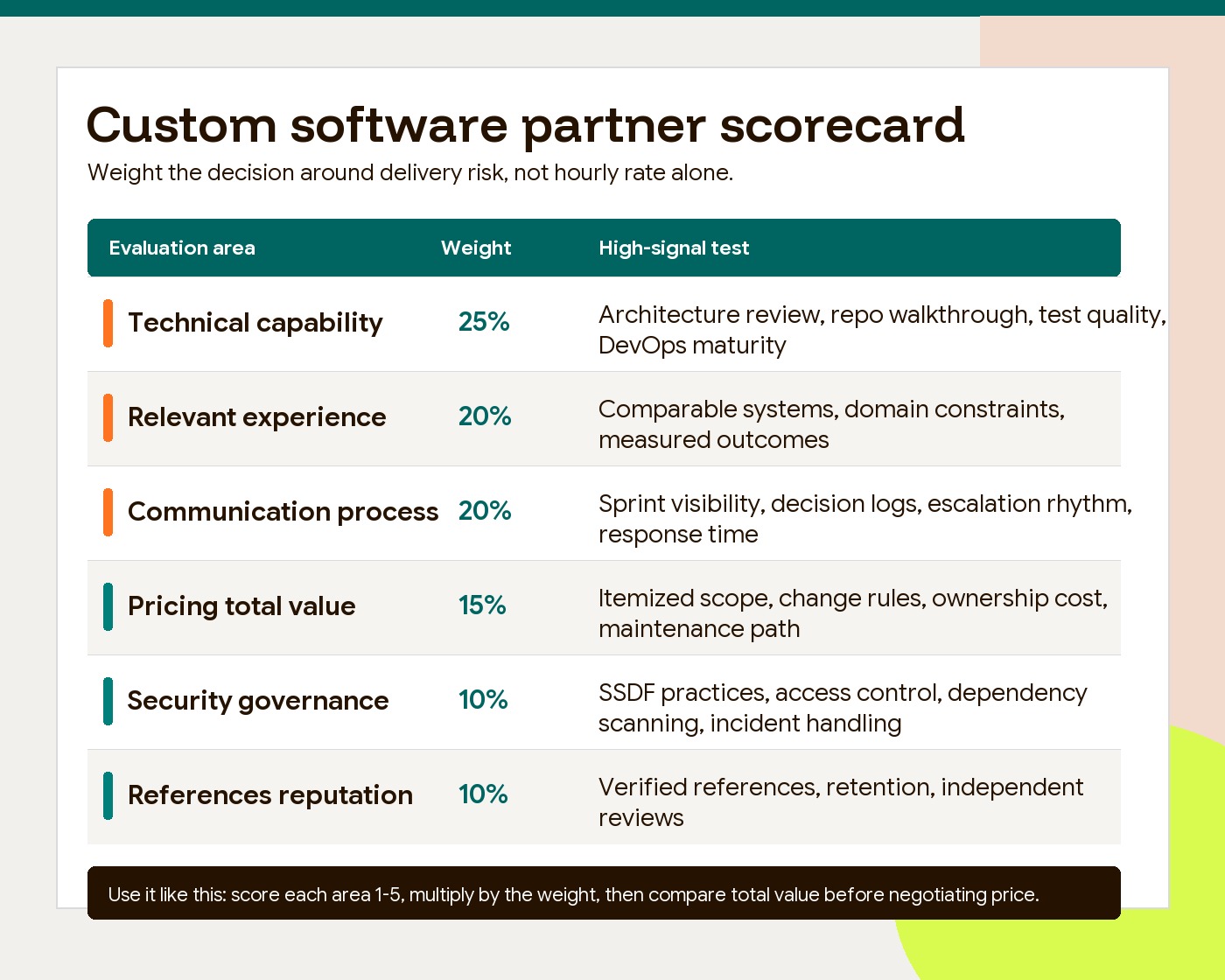
Use a simple 1-5 score for each category, then multiply by weight. A practical scorecard might look like this:
| Evaluation area | Weight | What to test |
|---|---|---|
| Technical capability | 25% | Architecture thinking, code quality, testing, DevOps, cloud maturity |
| Relevant experience | 20% | Similar workflows, domain constraints, integration history, measurable outcomes |
| Communication process | 20% | Sprint visibility, decision logs, risk escalation, response time, access to leads |
| Pricing and total value | 15% | Itemized estimate, change rules, maintenance path, ownership cost |
| Security and governance | 10% | Access controls, dependency scanning, secure SDLC, incident process |
| References and reputation | 10% | Named references, retention, independent reviews, proof of long-term support |
The scorecard is not there to make the decision look scientific. It is there to force the hard conversation early. If one team is cheaper but scores lower on technical capability, ask what internal oversight you will need to compensate. If another team is more expensive but stronger on architecture and process, ask whether that premium lowers the total cost of ownership.
How to vet technical capability without relying on resumes
Resumes and slide decks are low-signal. A good custom software development partner should be willing to show how they think.
Use three practical tests.
1. Ask for an architecture walkthrough
Do not ask only “What tech stack do you use?” Ask why.
A strong partner can explain:
- Which parts of the system should be custom and which should use existing tools.
- Whether the product needs a modular monolith, microservices, serverless functions, or a simpler architecture.
- How data will move between systems.
- Where failure is most likely to happen.
- What should be deferred until usage justifies it.
The best answer is rarely “we can build anything.” It is a clear view of tradeoffs.
2. Review real delivery process
Ask how the team runs discovery, sprint planning, QA, deployment, and release review. For security-sensitive work, ask how their process maps to a secure development framework. NIST’s Secure Software Development Framework is useful here because it gives purchasers and producers a shared vocabulary for secure software development and supplier communication. For a broader delivery view, map that process against the project life cycle.
Look for specifics:
- Pull request and code review rules.
- Unit, integration, and end-to-end testing expectations.
- Dependency and vulnerability scanning.
- Staging, rollback, and deployment process.
- Monitoring and incident response after launch.
- Documentation standards for handover.
If the answer is mostly “our developers are experienced,” keep digging.
3. Run a small work simulation
For high-stakes work, a short paid discovery sprint or technical simulation can be more useful than another sales call.
Good simulation tasks include:
- Walk through an existing codebase and identify risk.
- Design an integration plan for a third-party API.
- Refactor a small legacy flow.
- Define a test plan for a critical workflow.
- Map a manual business process into system requirements.
This exposes collaboration, judgment, communication, and follow-through. It also shows whether the partner can work with ambiguity without turning every unknown into a change order.
Choose the right pricing model for the risk
There is no universally best software development pricing model. The right model depends on how much uncertainty the project carries.
| Pricing model | Best fit | Main risk |
|---|---|---|
| Fixed price | Clear scope, low ambiguity, known acceptance criteria | Vendor protects margin by reducing flexibility |
| Time and materials | Discovery-heavy work, evolving products, uncertain integrations | Buyer carries more budget risk without strong governance |
| Dedicated team | Ongoing roadmap, long-term product ownership, flexible priorities | Can become expensive if goals and team shape are not managed |
| Milestone-based | Medium uncertainty with defined checkpoints | Weak milestones can reward output instead of outcomes |
| Outcome-based or shared-risk | Optimization projects with measurable baselines | Hard to structure if KPIs are vague or not under vendor influence |
Outcome-based pricing sounds attractive because it ties compensation to results. It can work, but only when the metric is clear. “Improve UX” is not a pricing metric. “Reduce support ticket volume for this workflow by 20% within 90 days after launch, excluding third-party outage cases” is closer.
If the work is exploratory, avoid pretending it is fixed. Use a discovery phase, define the first valuable release, and then price the next stage with better information.
Contract terms that protect long-term ownership
This is not legal advice, but it is a practical procurement warning: the contract should make ownership and operating responsibility boringly clear.
At minimum, review these areas with counsel:
| Contract area | What to clarify |
|---|---|
| Intellectual property | Who owns custom code, designs, documentation, data models, prompts, workflows, and AI agent configurations |
| Pre-existing IP | Which vendor libraries, frameworks, templates, or tools are reused, and what license you receive |
| Open-source software | Disclosure, license compliance, security scanning, and responsibility for remediation |
| Data and access | Environment access, credential handling, audit logs, data retention, and offboarding |
| Confidentiality and security | Security obligations, incident notice, privacy requirements, and subcontractor controls |
| Support and maintenance | Warranty period, bug handling, uptime expectations, patching, and response times |
| Termination and handover | Repo access, documentation, infrastructure credentials, design files, and knowledge transfer |
The “work made for hire” phrase deserves care. The U.S. Copyright Office explains that a work made for hire is either prepared by an employee within the scope of employment or specially commissioned for certain uses with a written agreement signed by both parties. Its guidance on work made for hire is a reminder not to rely on assumptions. For custom software, contracts often need explicit assignment language in addition to any work-for-hire language, especially when contractors, subcontractors, reusable components, and third-party libraries are involved.
The practical test: if the relationship ended tomorrow, could your team access, understand, run, and extend the software?
If the answer is no, the contract and operating model are not done.
Plan for AI-assisted development without outsourcing judgment
AI coding tools are now part of software delivery. The question is not whether a partner uses them. The question is how they govern them.
Microsoft Research’s GitHub Copilot study found that developers with access to the tool completed a controlled JavaScript task 55.8% faster than the control group. That is a useful signal, but it is not a promise that every product roadmap gets 55.8% cheaper. The study was a specific task in a controlled setting.
Ask a potential partner:
- Which AI tools are approved for coding, testing, documentation, and analysis?
- What code, customer data, or proprietary information is prohibited from AI tools?
- How is AI-generated code reviewed?
- Are tests written against behavior, or are they generated from the implementation without independent thought?
- How are security scans, dependency checks, and code reviews enforced?
- Who is accountable when AI-assisted work fails?
AI can help a mature team move faster. It can also help an immature team produce more unreviewed code. The difference is process.
For business workflows that involve AI agents, automation, dashboards, or internal tools, Hapy’s Business Systems & Automation work starts with operating logic before tooling. That is the same discipline you should expect from a software partner.
Decide how ownership will evolve
Some companies want a partner to build and maintain a system indefinitely. Others want the partner to help them create an internal capability over time. Be explicit about which one you need.
For long-term engineering capacity, some enterprises use build-operate-transfer style models. Deloitte’s 2024 outsourcing survey notes renewed interest in Global In-house Centers and models such as Build, Operate, Transform, and Transfer. The idea is straightforward: the partner helps build and operate capability, then the client gains more control when the team, process, or entity is mature enough to transfer.
Most companies do not need a formal legal vehicle for this. They do need an ownership plan.
That plan should cover:
- Repository and infrastructure access from day one.
- Documentation written for future maintainers, not just the current vendor.
- Decision records explaining major architecture choices.
- Hiring or internal training milestones if the team will transfer knowledge.
- A support model after the initial release.
- A clean exit path if the relationship ends.
The goal is not to distrust the partner. It is to prevent dependency from becoming lock-in.
A practical selection process
Use a phased process that creates evidence quickly.
Round 1: Qualification
Filter for basic fit:
- Relevant project type and technical stack.
- Similar business workflows or product category.
- Security and compliance expectations.
- Team size and seniority.
- Availability and timezone overlap.
- Budget range.
Do not overinvest here. The goal is to remove obvious mismatches.
Round 2: Technical and process evaluation
Ask shortlisted teams for a structured response:
- Proposed approach.
- Key risks and assumptions.
- Architecture direction.
- Delivery plan.
- Team composition.
- QA and deployment process.
- Security practices.
- Pricing model and estimate.
Score the response with your weighted matrix. Require technical leads to participate, not only sales.
Round 3: Working session or paid discovery
Before signing a large build, run a small working session. Give the partner a real slice of the problem and watch how they reason. You are looking for clarity, ownership, and judgment.
Good partners will say what they do not know yet. Weak partners will turn every concern into reassurance.
Red flags when choosing a software development partner
Watch for these signals:
- They quote a complex system after one short call.
- They cannot explain tradeoffs in plain language.
- They avoid showing who will actually lead the work.
- They promise senior talent but staff the project with mostly junior execution.
- They have no clear testing or release process.
- They treat security as a final checklist.
- They resist code access, documentation, or handover planning.
- They frame every change as client fault instead of shared discovery.
- They push a fixed price for work that is obviously uncertain.
- They cannot explain how AI-assisted development is reviewed.
One red flag may be manageable. Several together usually point to a delivery model that will get expensive later.
What Hapy would look for before starting
Before Hapy would recommend a custom build, we would want enough clarity on five questions:
- What business workflow or product outcome does this software need to improve?
- What is the smallest useful release that proves the direction?
- Which risks are product risks, technical risks, security risks, or operational risks?
- What should be bought, configured, automated, or custom-built?
- Who needs to own the system after launch?
That last question is often the most neglected. The best custom software development partner does not just help you get to launch. It helps you avoid becoming dependent on a system nobody inside the business understands.
FAQ
What is a custom software development partner?
A custom software development partner is an external team that helps plan, build, improve, and maintain software around a business outcome. A good partner contributes technical judgment, delivery process, architecture thinking, QA, security discipline, and ownership planning, not just coding capacity.
How do you choose a custom software development partner?
Choose a custom software development partner by scoring technical capability, relevant experience, communication process, pricing and total value, security governance, and references. Use a small working session or discovery sprint to test how the team thinks before signing a large build contract.
What is the difference between a software vendor and a software partner?
A software vendor usually delivers against a defined task or scope. A software partner helps shape the scope, identify risks, make technical tradeoffs, manage delivery, and support long-term ownership. The difference becomes visible when requirements change or the system needs to operate after launch.
Should I choose the lowest-cost software development company?
Not if the project is complex or strategically important. Low hourly rates can help, but weak discovery, poor architecture, poor QA, unclear ownership, and high management overhead can make a cheap team more expensive over the full lifecycle.
What should be included in a software development contract?
A software development contract should clarify IP ownership, pre-existing IP, open-source use, data access, confidentiality, security obligations, support, maintenance, termination, and handover. For legal terms such as work made for hire and assignment, review the contract with qualified counsel.
The bottom line
The right custom software development partner is the team that lowers uncertainty. It helps you define the right system, build it with discipline, protect ownership, and keep improving it after launch.
The wrong partner may still write code. The problem is that the code becomes only one line item in a larger bill: rework, delay, technical debt, unclear ownership, and internal management drag.
If you are evaluating a custom build, start with the decision framework before the estimate. Score the partner, test the working relationship, make ownership explicit, and price the work around risk. That is how a custom software development partner becomes a useful extension of the business instead of another vendor to manage.