Custom software development cost is not driven by feature count alone. Two products can both have authentication, dashboards, user roles, reports, and notifications, yet land in completely different budget ranges because one is a low-risk validation MVP and the other is a regulated enterprise workflow tied to legacy systems and messy historical data.
The more useful pricing question is: what risk sits behind the feature list? Integration complexity, workflow ambiguity, compliance, data migration, UX complexity, and team maturity can all change the real engineering effort. They also change how much discovery, testing, architecture, documentation, and post-launch support the buyer should fund.
For historical context, a 2012 McKinsey and University of Oxford publication described a study of more than 5,400 IT projects and found that large IT efforts ran 45% over budget and 7% over time on average, while delivering 56% less value than predicted. The large-project sample is not a current forecast for small custom builds or MVPs. For a smaller build, identify the specific uncertainties in the estimate rather than applying those percentages.
For a broader baseline on budget ranges, start with Hapy’s guide to custom software development cost. If you are pricing version one specifically, pair this with the MVP development cost guide so you do not confuse validation spend with enterprise platform investment.
If the team is not ready to price scope yet, map the custom software development process first so discovery, requirements, architecture, QA, launch, and maintenance are visible before estimates harden.
If the scope is still being framed, the custom software development services buyer guide can help define which responsibilities belong in the vendor engagement before pricing starts.
Quick answer: estimate custom software development cost by risk
Custom software development cost should be estimated as baseline scope plus risk adjustment, not as a flat price per screen or feature. The baseline scope covers the visible product: workflows, platforms, screens, roles, data model, and integrations. The risk adjustment covers the uncertainty that can multiply effort after the proposal is signed.
Use this simple model:
| Estimate layer | What it means | Buyer question |
|---|---|---|
| Baseline scope | The visible product size: features, roles, platforms, workflows, and admin needs | What are we actually building? |
| Risk factors | Integration, workflow, compliance, data, UX, team, schedule, and quality uncertainty | What could make the same scope harder than it looks? |
| Contingency | Budget reserved for known unknowns after discovery | Which assumptions still need validation? |
| Lifecycle cost | Hosting, monitoring, support, security, maintenance, and future changes | What will this system cost to own after launch? |
This does not create a perfect number. It creates a more honest conversation. A vendor that can explain its risk assumptions is usually giving you a more useful estimate than one that gives a precise price without showing the logic behind it.
Why feature-count software estimates create false precision
Feature-count estimates are attractive because they feel concrete. A buyer can list screens, modules, and user roles. A vendor can attach hours. The problem is that the hardest parts of custom software often sit below the visible interface.
Construx’s Cone of Uncertainty explains why early estimates can be far wider than buyers expect. At the initial concept stage, skilled estimates can be off by a factor of 4 on the high side or one-quarter on the low side. The range narrows only when the project definition becomes clearer: requirements, architecture, user interface, detailed design, team plan, and technical constraints.
That is why fixed-price custom software contracts can break down when they are signed too early. The vendor has two practical choices:
- Add a large risk buffer, which can make the first quote look inflated.
- Underbid to win the work, then recover margin through change orders, scope cuts, shortcuts, or weaker quality.
Neither path is ideal for the buyer. A defensible estimate should separate what is known from what still needs discovery.
The cost-risk matrix buyers should use before comparing quotes
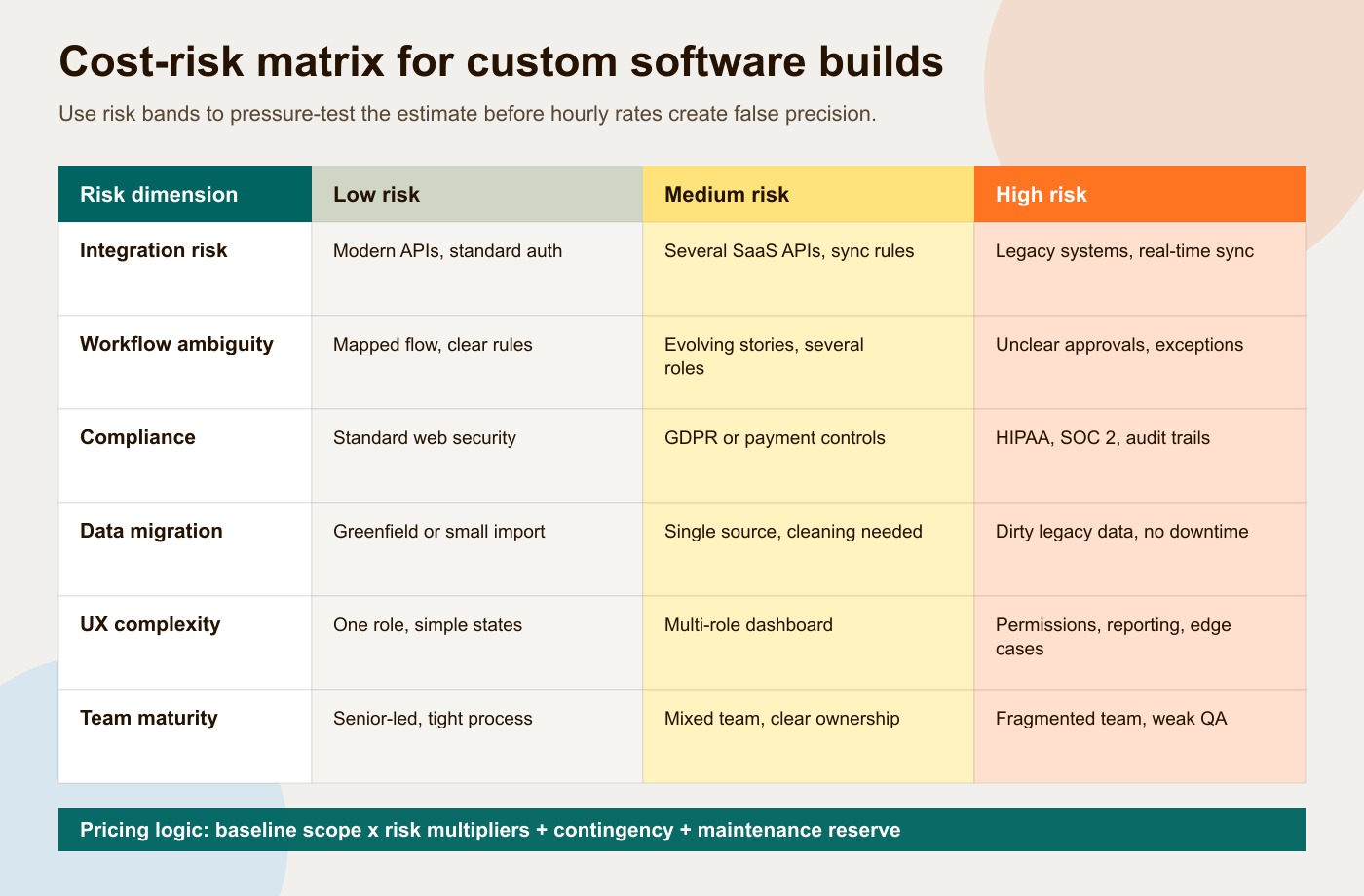
The best custom software estimates price risk explicitly. A practical matrix does not pretend every project fits the same range. The classifications below are illustrative prompts, not a validated estimator. A regulation’s name does not determine effort: applicability, data, jurisdiction, existing controls, and required evidence do. Legal obligations, contractual requirements, and assurance reports such as SOC 2 are distinct and need separate scope decisions.
| Risk dimension | Low risk | Medium risk | High risk | Cost effect |
|---|---|---|---|---|
| Integration risk | Modern APIs, standard auth, clear docs | Several SaaS APIs, CRM sync, webhooks | Legacy systems, real-time sync, proprietary protocols | More architecture, retry logic, QA, and failure handling |
| Workflow ambiguity | Mapped flow, clear acceptance criteria | Evolving stories, several roles | Unclear approvals, exceptions, cross-department rules | More discovery, rework, and change control |
| Security and assurance scope | Defined data, controls, and responsible owners | Unresolved access, retention, vendor, or evidence needs | Critical obligations or assurance scope not yet established | Scope review, engineering, evidence, and independent validation where required |
| Data migration | Greenfield or small import | One source with cleaning | Dirty legacy data, high volume, no downtime | More extraction, transformation, reconciliation, and support |
| UX complexity | One role, simple states | Multi-role dashboard | Complex permissions, reporting, responsive states, edge cases | More design states, testing, onboarding, and support work |
| Team maturity | Senior-led, tight process | Mixed team with clear ownership | Fragmented team, weak QA, unclear governance | More defects, slower decisions, higher technical debt |
CMU Software Engineering Institute explains the same logic in cost-estimation terms: size is only one input; cost drivers such as product, process, personnel, and environment explain real variance. COCOMO II formalizes that idea with effort multipliers and scale factors, which is why the same functional scope can require very different effort in different delivery environments.
For business teams, you do not need to run a full parametric model to use the lesson. Ask each vendor to classify the six risk dimensions before they price the build. As a planning heuristic, several high-risk dimensions suggest funding discovery before fixing the build price. A single unresolved critical security or legal obligation can also block release regardless of the other scores.
Six risks that change custom software development pricing
1. Integration risk
Integration risk rises when custom software must connect to systems the team does not fully control. A standard Stripe, HubSpot, Auth0, or email integration is one thing. A legacy ERP, proprietary database, undocumented vendor API, or real-time bidirectional sync is another.
Low-risk integrations have current documentation, sandbox access, predictable payloads, stable authentication, and clear error codes. High-risk integrations need custom middleware, data mapping, retry queues, conflict resolution, rate-limit handling, mock environments, and deeper integration testing.
The hidden cost is not the first successful API call. It is what happens when the external system is slow, unavailable, inconsistent, or changes behavior after launch.
2. Workflow ambiguity
Workflow ambiguity happens when the business has not agreed how the work should actually happen. Developers then make assumptions about approvals, exceptions, user permissions, edge cases, handoffs, and business rules. When those assumptions change late, the cost spreads across the data model, API layer, interface, tests, analytics, and support documentation.
NASA’s software engineering guidance treats requirements volatility as a project stability risk. Its thresholds call out 40% volatility at Critical Design Review, 20% at Software Integration Review, and 10% at Test Readiness Review, and it notes that late requirement changes can cost 10 to 100 times more than early changes.
Most commercial projects are not safety-critical NASA programs. The principle still applies: late workflow change is expensive because it invalidates decisions already built into the system.
3. Compliance and security
Compliance is not a feature to bolt on at the end. It changes architecture from the start. A healthcare platform, payment workflow, financial tool, or enterprise customer portal may need access control, encryption, audit logging, incident response, retention rules, vendor review, and documented evidence for security or customer review.
For example, the HHS summary of the HIPAA Security Rule requires regulated entities to use administrative, physical, and technical safeguards for electronic protected health information. The PCI Security Standards Council describes PCI DSS as technical and operational requirements for protecting payment account data. The European Commission’s GDPR overview explains that EU data protection law protects personal data and applies across the European Economic Area.
The pricing point is simple: regulated data changes the work. It usually means more senior engineering, more documentation, more testing, more review, and more operational discipline after launch.
4. Data migration
Data migration sounds like a transfer task. In real projects it is a quality problem. Legacy systems often contain duplicate records, missing relationships, orphaned data, inconsistent naming, undocumented fields, and business logic hidden in old workflows.
A realistic migration budget should include:
| Migration phase | What happens |
|---|---|
| Assessment | Source audits, schema mapping, field definitions, data ownership |
| Cleaning | Deduplication, normalization, enrichment, missing-value decisions |
| Migration | Extraction, transformation, loading, automation, rollback planning |
| Validation | Reconciliation, referential integrity checks, parallel runs |
| Hypercare | Monitoring, fixes, user support, performance tuning after go-live |
The risk jumps when the business needs zero downtime, parallel systems, millions of records, or high-confidence reconciliation. In those cases, migration can become one of the largest parts of the project even when the visible product looks straightforward.
5. UX complexity
UX complexity is not just visual polish. It affects how many states, roles, permissions, errors, and support paths the team must design and test.
A simple internal tool may need one role and a few screens. A B2B SaaS platform may need owners, admins, managers, operators, clients, billing users, and support staff. Each role can change navigation, permissions, onboarding, reporting, notifications, empty states, loading states, and error states.
One “dashboard” can easily become dozens of design and QA states once the team accounts for roles, data availability, mobile behavior, edge cases, and permission boundaries. When UX is underdefined, developers make product decisions in code, which is a slow and expensive place to discover disagreement.
6. Team maturity
Hourly rates are a weak proxy for total custom software development cost. A low hourly rate can still become expensive if the team lacks senior architecture, QA discipline, delivery rhythm, or clear ownership.
Junior-heavy or fragmented teams often create hidden costs: brittle schemas, missing tests, inconsistent patterns, unclear documentation, security gaps, and rework. Senior-led teams can cost more per hour but reduce risk by making better architecture, scope, and quality decisions earlier.
This is where technical debt enters the estimate. A cheap build can become expensive if every future feature has to fight the system underneath it. Hapy’s guide to technical debt cost explains how that debt shows up as slower delivery, higher QA spend, incidents, rework, and rebuild pressure.
Low-, medium-, and high-risk build examples
These examples are planning bands, not quotes. The point is to show how similar feature labels can hide very different risk profiles.
| Build type | Example | Typical risk profile | Budget posture |
|---|---|---|---|
| Low-risk build | Validation MVP, internal workflow tool, single-role portal | Clear workflow, modern stack, limited data, one or two standard integrations | Keep scope lean; use fixed discovery plus a contained build budget |
| Medium-risk build | B2B SaaS platform, client portal, operations dashboard | Multiple roles, billing or CRM sync, analytics, moderate UX states, some migration | Use discovery, phased delivery, and a contingency reserve |
| High-risk build | Enterprise ERP extension, clinical portal, financial workflow, legacy modernization | Legacy integrations, regulated data, migration, audit trails, complex permissions, high uptime expectations | Fund architecture, technical spikes, security review, migration planning, and post-launch support |
A validation MVP and an enterprise system may both include dashboards, reports, authentication, and notifications. The enterprise version costs more because the risk around the features is heavier.
MVP cost should buy evidence; enterprise cost should buy reliability
An MVP is not a cheaper version of the final product. It is a learning instrument. Some shortcuts are acceptable when the goal is to validate demand, workflow fit, pricing, or user behavior before committing to a larger build.
That changes the budget logic:
- MVP development cost should buy evidence.
- Custom software development cost should buy a maintainable system.
- Enterprise software development cost should buy reliability, governance, security, data integrity, and operational continuity.
The mistake is treating MVP architecture as if it is automatically ready for scale. If a prototype or MVP starts to become core business infrastructure, the team should address testing, security, observability, data quality, and architecture before the debt compounds.
Contract model should match the risk profile
The right pricing model depends on how much uncertainty remains.
| Pricing model | Best fit | Risk tradeoff |
|---|---|---|
| Fixed price | Stable, low-risk scope with clear acceptance criteria | Vendor carries risk, so the quote usually includes a buffer |
| Time and materials | Agile builds, R&D, evolving requirements | Client carries more budget risk unless governance is strong |
| Dedicated team | Long-term SaaS scaling and continuous delivery | Predictable monthly capacity, but roadmap ownership matters |
| Hybrid | Complex custom software with unknowns | Fixed discovery narrows risk, then the build model adapts |
For many serious custom software projects, the hybrid model is the most defensible. Pay a fixed price for discovery, workflow mapping, data review, integration analysis, and architecture. Then choose the build model after the major risks are visible.
This is also how buyers should evaluate a custom software development company. A mature partner should be willing to explain risk assumptions, show what is included and excluded, and identify which parts of the estimate are still uncertain.
How to create a defensible custom software estimate
Use this sequence before approving a budget:
- Map the real workflow, including approvals, exceptions, and user roles.
- List every integration and classify it as standard, custom, legacy, or unknown.
- Audit source data before promising migration timelines.
- Define security, compliance, audit, and access-control requirements early.
- Separate MVP validation needs from enterprise reliability needs.
- Estimate UX states, not only visible screens.
- Evaluate team maturity, not only hourly rates.
- Add risk-based contingency reserves instead of flat padding.
- Budget post-launch maintenance, support, monitoring, and security updates.
- Re-estimate after discovery, architecture, and technical spikes.
For implementation support, compare the scope and operating costs with Hapy’s business systems automation service. If the work is connected to operational efficiency or internal systems, Hapy’s business process automation guide can help clarify which workflows should be standardized before they are automated. If you are comparing delivery options, the guide on outsourcing software development covers vendor risk, communication, and team models.
A worked risk reserve
Illustrative planning example: a $50,000 baseline excludes the following uncertainty. These figures are assumed USD inputs, not Hapy quotes or measured probabilities.
| Risk | Discovery action and cost | Residual additional cost after discovery | Planning probability | Expected reserve |
|---|---|---|---|---|
| Legacy export format differs from sample | $1,000 extraction spike | $2,000–$6,000; use $4,000 midpoint | 50% | $2,000 |
| Approval rules change after review | $500 operator workshop | $1,000–$3,000; use $2,000 midpoint | 30% | $600 |
The base plus discovery is $51,500. The illustrative expected reserve is $2,600, producing a working budget of $54,100. A stress case in which both risks occur at the high estimate adds $9,000, producing $60,500. Expected value is not a confidence interval or a spending cap; risks can be correlated and a small project may experience the full loss. Record an owner, trigger, and mitigation for each row, update the assumptions after discovery, and agree which reserve level the sponsor can fund. Mandatory controls belong in baseline scope, not a probability-weighted optional reserve.
What to ask before hiring a custom software development company
- Which assumptions drive the largest uncertainty range?
- Which discovery outputs change the estimate?
- Which controls and integration failure paths are included?
- What migration, UX, QA, deployment, and support work is excluded?
- Who can release contingency and approve scope changes?
- Which costs continue after launch?
Custom software development cost becomes easier to defend when the estimate shows its logic. The goal is not to make pricing look certain before the work is understood. The goal is to identify the risks that deserve discovery, senior judgment, contingency, and a better contract structure before the expensive part of the build begins.