A startup software development company should help a founder reduce uncertainty before it turns into wasted runway. That is the difference between a build partner and a dev shop.
At the founder stage, the hard question is rarely “Can someone code this?” Most products can be coded. The harder question is whether the team can help you decide what should be built first, what should be tested before code, what quality bar matters for launch, and how the product will survive after the first release.
That is why choosing a software development company for startups is a partner-selection decision, not a vendor-shopping exercise. You are choosing who will translate messy customer insight, investor pressure, design tradeoffs, technical constraints, budget limits, and launch risk into a working product.
Use this guide when you are comparing a startup app development company, a custom software development partner, a startup development agency, or a product studio for version one. The right partner should make the next decision clearer at every stage. Use the MVP development red flags to pressure-test what happens when a sales process promises too much too early.
Start with the uncertainty, not the vendor list
The best partner model depends on what is still uncertain. If your scope is stable, fixed-scope delivery may work. If user needs are still moving, a dedicated product team may fit better. If you already have a strong CTO and only need narrow engineering capacity, staff augmentation can work.
The mistake is choosing a model because it sounds cheaper or safer. A rigid fixed-scope contract can become expensive when the founder learns something important mid-build. Staff augmentation can look flexible but fail when nobody inside the startup has time to manage architecture, backlog quality, code review, and delivery.
Before contacting vendors, write down:
- The first customer segment version one must serve.
- The core workflow the product must prove.
- The assumptions that are still untested.
- The budget range you can protect without betting the company.
- The internal owner who can make product decisions each week.
- The launch signal that will tell you whether to continue, pause, or change direction.
That short brief will improve every sales call. It also helps you spot partners who ask better questions than you expected. Those questions are often more revealing than the proposal.
Match the team model to the founder stage
Startup product development can become fragile when the commercial model assumes more certainty than the founder actually has. Use the model below as a first filter, then validate it with discovery or a small pilot.
| Team model | Best fit | Founder risk |
|---|---|---|
| Fixed-scope project | Stable requirements, clear acceptance criteria, limited learning expected | Change requests can turn new user insight into budget conflict |
| Staff augmentation | Strong internal CTO, product owner, backlog, and engineering process already exist | Founder buys capacity but still owns product, management, and quality risk |
| Dedicated product team | Evolving roadmap, founder-led product direction, need for design and engineering continuity | Without a decisive product owner, the team can drift into expensive motion |
| Fixed discovery, then build | High uncertainty, non-technical founder, early MVP, unclear integrations | Requires patience upfront, but usually reduces rework later |
A separately scoped discovery phase is one option when uncertainty is material; it is not a proven safest model for every startup. Discovery should narrow the product, expose technical risk, and produce enough artifacts to choose fixed scope, dedicated team, or a hybrid model with less guesswork.
If your first release is mostly about validation, Hapy’s MVP Development work is built around the same principle: scope less, ship the right first version, and learn before the roadmap gets heavier.
What discovery should prove before development
Discovery is not a paid proposal. It is the first risk-reduction phase of the build.
A useful discovery phase should answer four questions:
- What are we proving? Define the business assumption, user behavior, or workflow change that version one must validate.
- Who is version one for? Name the first user segment and exclude the audiences that can wait.
- What must be built now? Separate the core workflow from nice-to-have features, future admin tools, and investor-demo polish.
- What could make this expensive? Identify integrations, permissions, data migration, AI risk, security needs, compliance, performance, and operational support.
Eric Ries describes the minimum viable product as a way to maximize validated learning with the least effort. For founders, that idea matters because every extra feature should earn its place by helping you make a better decision.
Good discovery outputs include:
- A short product brief.
- User journeys or workflow maps.
- Must-have, should-have, could-have, and not-building lists.
- Wireframes or a clickable prototype for the riskiest flows.
- Technical assumptions and open questions.
- Integration notes and data dependencies.
- A launch plan with analytics, support, and success metrics.
- A revised estimate with assumptions and exclusions.
Weak discovery outputs are easy to spot. They look like a nicer pitch deck, a feature inventory, or a generic “phase two roadmap” that avoids the hard tradeoffs.
Product design should reduce usability risk
Product design is not the skin on top of the app. It is where the team decides how the product behaves.
For a startup, product design should clarify onboarding, the core workflow, edge cases, empty states, error states, admin work, notifications, dashboards, and handoffs between users. It should also make the product small enough to ship while still useful enough to test.
Clickable prototypes are valuable because they let users react before engineering commits to the wrong flow. Nielsen Norman Group’s usability guidance argues for running smaller iterative tests with about five users per round rather than waiting for one large study. The startup lesson is practical: do not spend months debating flows internally when a focused prototype test can reveal confusion faster.
Ask each partner:
- How do you turn founder notes into user flows?
- Which parts of the product should be prototyped before development?
- How do you decide when default UI patterns are enough?
- What design decisions will affect engineering cost?
- How do you document states, permissions, and edge cases for developers?
- What user feedback would change the build plan?
A strong startup app development company will not push custom UI everywhere. If the visual interface is not the competitive advantage, good defaults and clean product behavior often matter more than expensive originality.
Engineering should be visible before launch week
Startup founders do not need to micromanage engineering. They do need visibility into whether the build is healthy.
A good custom software development partner should show working software early and often. The founder should see the backlog, acceptance criteria, demos, risks, blockers, test coverage on important paths, and open decisions. If the first real demo appears near the end of the engagement, the partner has turned risk into surprise.
Engineering discipline should include:
- Code review before changes are merged.
- A staging environment for founder review.
- Automated checks where they protect critical paths.
- Clear environments for development, staging, and production.
- Basic monitoring, logging, and rollback planning.
- A documented definition of done.
- Known technical debt tracked openly.
Security should also be part of the build, not a final checklist. NIST’s Secure Software Development Framework gives teams a common vocabulary for secure software practices across the lifecycle. A startup does not need enterprise process on day one, but it does need sensible controls around credentials, dependencies, access, deployment, and vulnerability response.
This matters even more now that AI coding assistants are common. AI-assisted output can speed up implementation, but it still needs human review, tests, static analysis, and security checks. A partner who treats AI-generated code as automatically production-ready is adding hidden risk.
Launch and post-launch support belong in the proposal
Launch is not just “push to production.” It is the handoff from build work to real users, real data, real support tickets, and real business risk.
Before signing, ask how the partner handles:
| Launch area | What to expect |
|---|---|
| Deployment | Production setup, environment variables, rollback plan, release checklist |
| Data | Imports, migrations, backups, privacy rules, admin access |
| Analytics | Events tied to activation, workflow completion, retention, and support themes |
| Support | First-response owner, escalation path, bug severity rules, hotfix process |
| Training | Founder/admin walkthroughs, runbooks, recorded handoff, documentation |
| Maintenance | Dependency updates, monitoring, security patches, minor improvements |
Post-launch support is especially important for startup software because the first real users will expose what the build team could not fully simulate. A founder should know who owns urgent bugs, how quickly critical issues are handled, which improvements are included, and when new work becomes a separate engagement.
If the partner cannot explain launch support clearly, you are not buying a complete build. You are buying development and inheriting the operational risk.
Ownership terms protect the company
Code ownership should be explicit before work starts. Paying an invoice does not always mean the startup owns everything it needs to own.
For U.S. copyright transfers, 17 U.S. Code Section 204 requires a written, signed instrument for a transfer of copyright ownership to be valid. Founders should not treat legal language as a formality here. The product may become part of fundraising diligence, acquisition diligence, or an internal team transition later.
Ask legal counsel to review at least these areas:
- Foreground IP: custom code, designs, documentation, database structures, and project-specific assets created for you.
- Background IP: pre-existing frameworks, libraries, templates, accelerators, and tools the partner brings into the project.
- Open-source use: especially licenses that could create disclosure obligations.
- Repository access: when you get access, who controls it, and what happens if the relationship ends.
- Data ownership: customer data, analytics data, backups, credentials, and admin accounts.
- Handover: documentation, runbooks, architecture notes, deployment access, and transition support.
- Infringement protection: warranties and responsibility if a third party challenges the delivered work.
The practical goal is simple: you should be able to keep operating, modifying, and scaling the product with or without the original partner.
Cost and timeline bands founders can use
Cost depends on scope, team model, geography, complexity, integrations, quality bar, and launch support. Use these as illustrative planning bands, not observed project benchmarks or quotes. For a lean MVP, assume two full-time engineers, part-time design and QA, one workflow, documented integrations, prepared content/data, and a founder who resolves decisions within two working days. Design and testing overlap implementation; regulatory approval, procurement, and major migration are outside those assumptions.
| Build stage | Typical founder need | Planning band |
|---|---|---|
| Product discovery | Clarify scope, risks, user flows, architecture, and estimate basis | 1 to 3 weeks |
| Clickable prototype | Test the core flow with users, investors, or design partners | 2 to 6 weeks |
| Lean MVP | Build one useful workflow with basic admin, analytics, QA, and launch support | 8 to 16 weeks |
| Integrated MVP | Add payments, third-party APIs, roles, data model complexity, or AI workflows | 12 to 24+ weeks |
| Dedicated product pod | Continuous product design, engineering, QA, and iteration | Monthly retainer or rolling capacity |
| Post-launch support | Bug fixes, monitoring, minor improvements, dependency updates, advisory | Monthly support or defined SLA |
Hapy’s custom software development cost guide is the better next read if you need a deeper cost model. The key point for this article is that the cheapest proposal is not always the lowest-risk path. A low estimate that excludes discovery, UX, QA, launch, maintenance, or ownership can become expensive after users arrive.
A practical partner scorecard
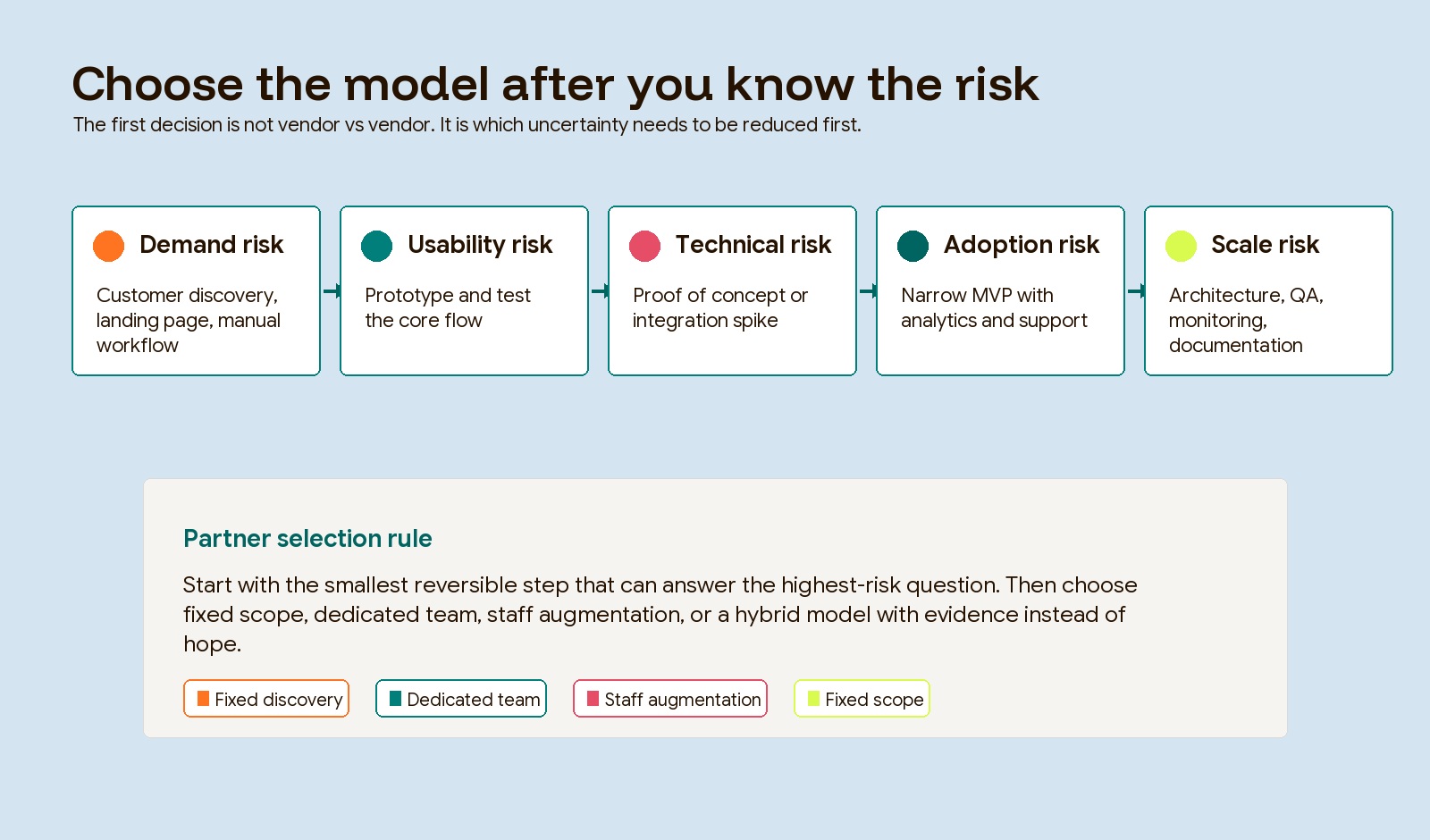
Use a weighted scorecard after you have a short list. Do not score sales polish. Score evidence.
| Evaluation area | Weight | What good looks like |
|---|---|---|
| Discovery and product judgment | 20% | They challenge scope, define assumptions, and tie features to founder decisions |
| Relevant technical competence | 20% | They can explain architecture, integrations, security, testing, and similar work in plain language |
| Product design quality | 15% | They prototype risky flows, account for edge cases, and avoid unnecessary custom UI |
| Delivery process | 15% | They show working software, decision logs, backlog quality, demos, and transparent risk reporting |
| Launch and support | 10% | They include deployment, monitoring, rollback, documentation, and post-launch ownership |
| Ownership and contract clarity | 10% | They define IP, background code, repositories, data, credentials, and handover |
| Founder fit | 10% | They communicate directly, handle uncertainty well, and make decisions easier |
These weights and the 1–5 scale are editorial heuristics, not a validated predictor of delivery success. Use 1 for no relevant evidence, 2 for verbal claims with important gaps, 3 for a relevant artifact explained by the assigned team, 4 for consistent artifacts plus corroborating references, and 5 for that evidence plus a successful comparable bounded evaluation. Multiply by the decimal weights and sum for a score out of 5. Record the evidence and reviewer disagreement alongside the number. Any unresolved essential ownership, security, or operational requirement blocks a full commitment regardless of the total.
Warning signs before you sign
Some partner risks can be investigated before signing.
Watch for these warning signs:
- The vendor gives a confident fixed price after one short call.
- The proposal lists features but not assumptions, exclusions, or acceptance criteria.
- Senior people sell the work, but you cannot meet the actual delivery team.
- UX is treated as decoration after engineering starts.
- QA, DevOps, security, or post-launch support are vague.
- The team avoids discussing what could go wrong.
- The contract does not define code, data, design, documentation, and credential ownership.
- The partner pushes a large build before validating the riskiest workflow.
- Communication is polished in sales but slow when you ask specific delivery questions.
One warning sign may be fixable. Several together usually mean the founder will carry more management, rework, or legal risk than the proposal admits.
Questions to ask a startup development agency
Use questions that force the partner to explain how they work under real uncertainty.
Product and discovery
- What would you need to learn before estimating the full build?
- Which features would you challenge or cut from this first version?
- What should we test before writing production code?
- What would make you recommend a prototype, no-code test, or concierge workflow instead of custom software?
Design and UX
- Which flows need a clickable prototype?
- How do you test usability with the first target users?
- How do you document empty states, errors, permissions, and admin workflows?
Engineering
- Who will write code on this project, and can we meet them?
- How do you review code and manage technical debt?
- What parts of the system are highest risk?
- What testing will exist before launch?
- How do you govern AI-assisted coding, if your team uses it?
Launch and support
- What is included in launch readiness?
- What happens during the first 30 days after release?
- Who owns urgent production issues?
- What monitoring and rollback process will be in place?
Ownership and handover
- When do we get repository access?
- Which IP is ours, and which background IP is licensed?
- What documentation will exist if we hire an internal team later?
- What does a clean exit look like?
If the partner answers with vague reassurance, keep digging. Good teams can explain tradeoffs without burying a founder in technical theater.
How to choose a startup software development company without overbuying
The right startup software development company should make the product smaller, sharper, and easier to learn from. That may sound counterintuitive if you are under pressure to move fast, impress investors, or match a competitor’s feature list. But a partner who protects focus is usually more valuable than one who agrees to build everything.
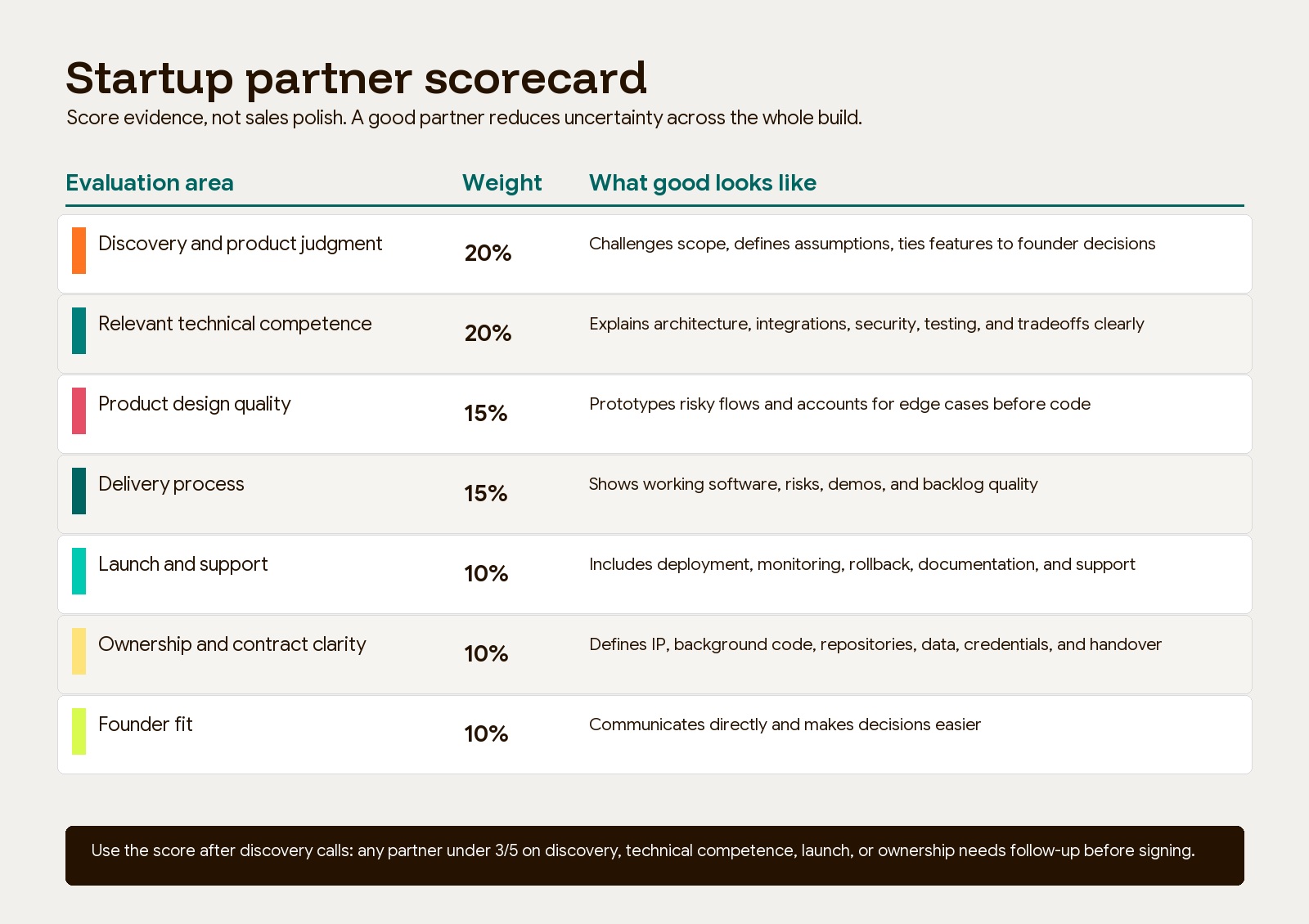
Use this simple decision path:
- If the core risk is demand, start with customer discovery, a landing page, a prototype, or a manual service workflow.
- If the core risk is usability, prototype and test the main workflow before engineering.
- If the core risk is technical feasibility, run a proof of concept or technical spike.
- If the core risk is product adoption, build a narrow MVP with analytics and support close to the founder.
- If the core risk is scale, security, or operations, invest earlier in architecture, QA, monitoring, and documentation.
For a broader view of what custom work should include, read Hapy’s custom software development services buyer guide. If you are still comparing outsourcing models, the guide on how to outsource software development gives more context on working with external teams.
Bottom line
Choosing a startup software development company is not about finding the most impressive portfolio or the lowest estimate. It is about finding a partner who can reduce uncertainty across discovery, product design, engineering, launch, ownership, and post-launch learning.
A good partner will help you build less before you build more. They will make assumptions visible, turn scope into decisions, show working software early, protect ownership, and keep launch support inside the plan.
That is the build partner founders should be looking for: not more hands, but sharper judgment when version one still has to earn its future.