The strongest reason to use a relational database is trust. When a product handles accounts, payments, orders, bookings, inventory, permissions, or invoices, each record must stay connected to the right customer and workflow.
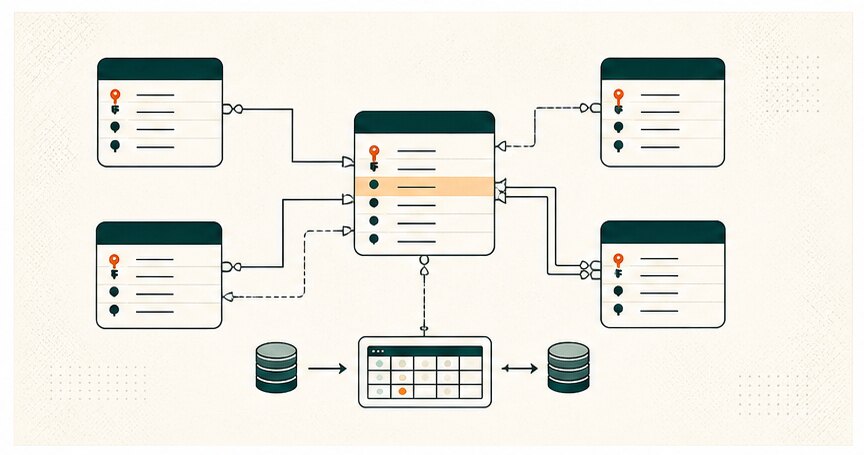
Relational databases make those connections explicit. They store data in tables, link records with keys, validate changes with constraints, and let several changes succeed or fail as one transaction. That combination is why SQL databases remain a dependable default for business software.
NoSQL databases solve different problems. They can be useful when documents have varied shapes, event volume is very high, or data naturally forms a graph. A team does not need to force every workload into one database. It can keep transactional records in SQL and add search, analytics, cache, or event storage where those tools fit better.
What is a relational database?
A relational database stores data in tables made of rows and columns. Each table represents one kind of thing, such as customers, orders, products, or invoices. A primary key identifies each record. A foreign key links it to a record in another table.
Consider a booking system:
- A customer can have many bookings.
- Each booking belongs to one customer.
- A booking can include one or more services.
- A service can appear in many bookings.
Those rules become part of the data model instead of living only in application code. The database can reject a booking that refers to a customer who does not exist or prevent two records from using the same unique reference.
The common relationship types are:
| Relationship | Example |
|---|---|
| One-to-one | One employee has one payroll profile |
| One-to-many | One customer has many orders |
| Many-to-many | Many employees work on many projects through an assignment table |
SQL, or Structured Query Language, gives applications and analysts a standard way to create, read, update, join, group, and report on that data.
The practical advantages of relational databases
Data integrity is enforced close to the data
Application validation is useful, but it is not enough on its own. Imports, admin tools, background jobs, and integrations can all write to the same database. Constraints provide a final line of protection.
A relational database can enforce:
- Required fields.
- Unique email addresses or order references.
- Valid links between tables.
- Approved values for a status.
- Numeric and date rules.
- Deletion behavior for related records.
This matters most when a bad record can cause a financial error, expose the wrong account, oversell inventory, or distort a report.
Transactions keep multi-step changes consistent
A transaction groups related operations. Either every operation succeeds or none of them does.
In an illustrative order workflow, a transaction creates an invoice and reserves inventory in the same database. If the reservation fails, those database writes can roll back together. An external payment is a separate operation: a database rollback cannot undo a card charge. Track payment attempts with unique identifiers, reconcile provider responses, and define compensation for failed orders.
This is the useful meaning behind ACID transactions:
- Atomicity: All related changes succeed or fail together.
- Consistency: A transaction cannot leave the database in an invalid state.
- Isolation: Concurrent transactions do not corrupt one another.
- Durability: Committed changes survive a restart or failure.
Relationships support useful reporting
Business questions usually cross several kinds of data:
- Which customers bought a product twice in the last quarter?
- Which invoices are overdue, and who owns each account?
- Which campaign produced customers with the highest retention?
- Which locations are losing inventory faster than they sell it?
SQL joins let a team answer these questions without copying every field into one large record. A well-designed relational model also gives business intelligence tools a clear structure to query.
The schema documents how the business works
A schema names the entities, fields, and relationships in a system. It makes assumptions visible. An engineer can inspect the model and see that an approval belongs to a request, a request belongs to an account, and only certain statuses are valid.
That structure helps when the original developers leave, a new integration arrives, or the company needs an audit. The schema is not complete documentation, but it is much better than business rules scattered across unrelated JSON documents and application functions.
Permissions can be precise
Access features vary by engine and version. For example, PostgreSQL 18 row security policies can restrict rows by role, but table owners and privileged roles can bypass them. Test with the actual application role, including attempts to read another tenant’s records. Views and grants also need deliberate configuration; do not assume a database choice provides tenant isolation automatically.
Security still depends on correct application design, encryption, backups, and operational controls. Tables alone do not make a system secure. The advantage is that the database offers mature tools for enforcing access boundaries.
The ecosystem is mature
Established relational engines have documented operating procedures and tooling, but features and support differ. Check migration, backup, replication, monitoring, connection-pooling, and recovery support for the selected version and hosting service.
That maturity reduces architecture risk. A growing company usually benefits more from predictable operations than from choosing a novel database before the workload requires it.
Relational database examples
| Database | Common fit |
|---|---|
| PostgreSQL | SaaS products, custom business systems, geospatial work, and complex queries |
| MySQL | Web applications, content platforms, and teams with an established MySQL stack |
| MariaDB | MySQL-compatible environments that prefer its open-source ecosystem |
| SQL Server | Microsoft-heavy organizations, enterprise reporting, and .NET systems |
| Oracle Database | Large enterprises with demanding operational and governance requirements |
| SQLite | Mobile apps, desktop apps, embedded products, prototypes, and local storage |
The product name matters less than the operating fit. Look at your team’s experience, hosting environment, availability needs, backup process, expected query patterns, and licensing constraints.
Where relational databases become harder
Relational databases have tradeoffs.
Schema changes need discipline
A schema protects the data, but changing it takes care. Production migrations must account for existing records, old application versions, locks, and rollback. Teams need a migration process rather than editing tables by hand.
Poor models create expensive queries
SQL is powerful, but it cannot rescue a careless data model forever. Missing indexes, unbounded queries, unnecessary joins, and duplicated concepts can slow a system as it grows. Performance work requires real query evidence, not blanket denormalization.
Horizontal scale can be more involved
Relational systems can handle substantial workloads, but capacity depends on the query mix, hardware, indexes, and operating model. Benchmark representative reads and writes before assuming a replica or cache will solve a bottleneck. At very high write volume, distributing data across many nodes can become operationally complex. Some NoSQL databases make that distribution a core part of their design.
Not every record fits a stable table
Content blocks, telemetry events, raw third-party payloads, and rapidly changing experimental attributes may not deserve a rigid relational shape. PostgreSQL includes JSON support for mixed models, but storing everything as JSON removes many of the constraints that made SQL valuable in the first place.
Relational database vs NoSQL
| Question | Relational database | NoSQL database |
|---|---|---|
| Is the data highly structured? | Strong fit | Possible, but may add little value |
| Do transactions cross several records? | Strong fit | Depends on the database and model |
| Will teams run joined reports? | Strong fit | Often requires denormalization or another analytics layer |
| Does each document have a different shape? | Possible with JSON, but less natural | Often a strong fit |
| Is the workload a cache or massive event stream? | Possible, but a specialist store may fit better | Often a strong fit |
| Do relationships form a graph? | Works for many cases | A graph database may be clearer for deep traversal |
Read our NoSQL advantages guide for the other side of the decision.
A database decision checklist
Before choosing a database, write down the answers to these questions:
- Which records would cause the most harm if they became inconsistent?
- Which changes must happen together in one transaction?
- What reports will operators and managers need?
- Which relationships are stable, and which attributes are still changing?
- How many reads and writes do you expect now, not in an imagined global future?
- What recovery time and acceptable data loss does the business require?
- Who will monitor, back up, migrate, and restore the database?
- Does the team already know how to run the proposed technology safely?
If the database supports an internal workflow, Hapy’s business systems automation service provides a place to discuss the workflow, ownership, and recovery requirements together.
For many custom software systems and enterprise applications, a relational database remains the clearest starting point. Add another data store when a measured workload calls for it, not because a mixed stack looks more advanced.