An MVP development contract should protect the founder’s ability to learn, launch, own the work, and change direction without turning every discovery into a dispute. Before signing, review the contract as a business operating document with legal counsel, not just as a vendor formality.
This is not legal advice. The point is to give founders a practical review map before they ask a lawyer, advisor, or technical lead to inspect the final language. A good MVP development agreement should make scope, change requests, IP ownership, payment milestones, acceptance criteria, support, termination, confidentiality, and handoff materials clear enough that both sides know what happens when the build gets messy.
That clarity matters because an MVP is supposed to reduce risk. If the contract rewards vague delivery, blocks access to the code, hides ownership terms, or treats acceptance as automatic, the agreement can create the exact risk the founder hired the team to reduce.
If you are still choosing the team, pair this with Hapy’s guide to choosing a custom software development partner and the checklist of MVP development red flags. The partner’s behavior during contract review is often the first real test of how the build will feel.
The MVP build management guide explains which decisions should remain with the founder, while transparent MVP development shows what the reporting, demo, budget, risk, and acceptance rhythm should make visible after signing.
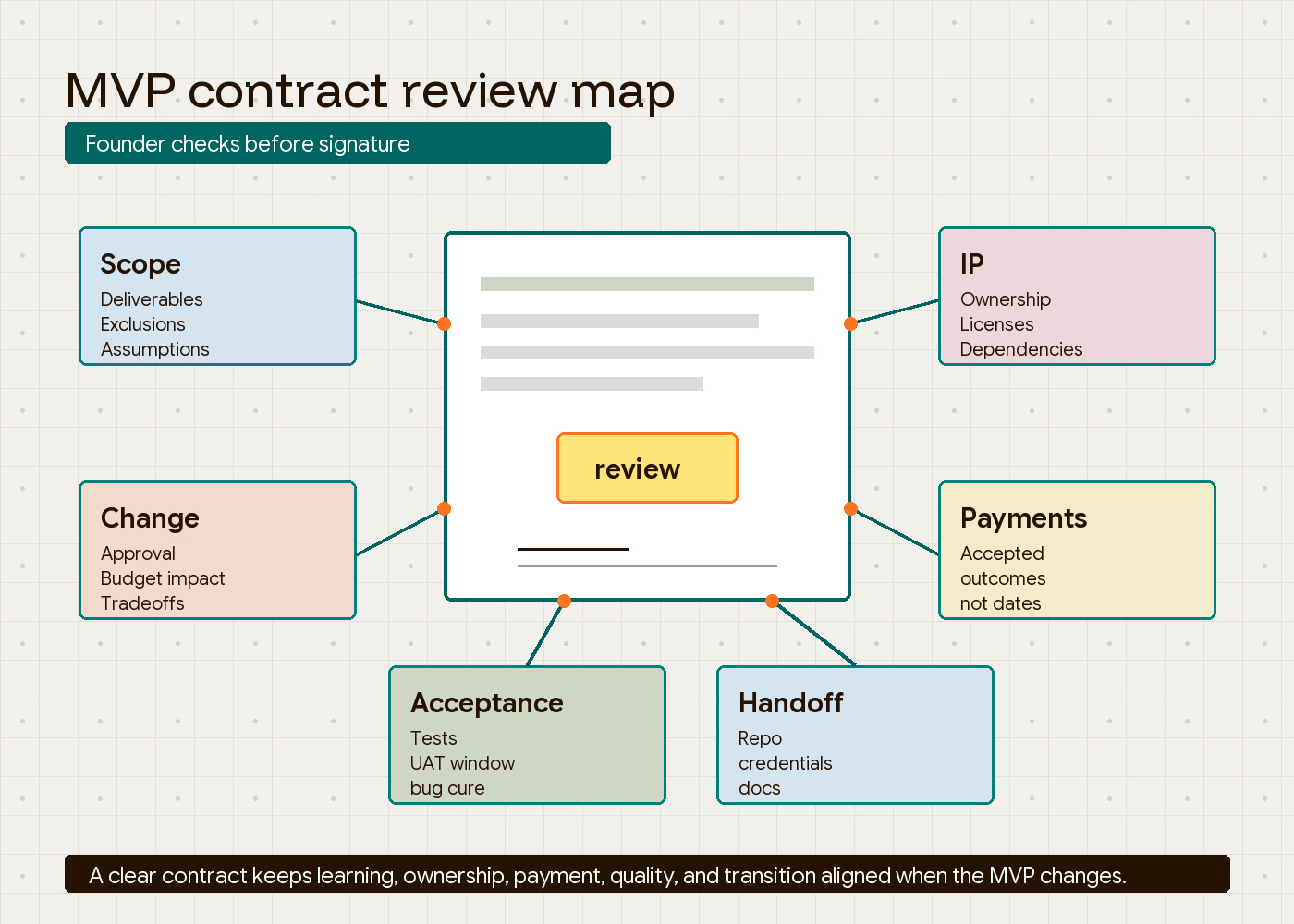
What an MVP development contract should make clear
An MVP development contract should make nine business areas clear before work starts: scope, change requests, IP ownership, payment milestones, acceptance criteria, support, termination, confidentiality, and handoff materials.
Use this table as a first-pass screen before counsel reviews the exact language.
| Contract area | What to check before signing | Founder risk if vague |
|---|---|---|
| Scope | Deliverables, exclusions, assumptions, roles, integrations, environments, and launch responsibilities | The team treats every missing detail as extra work later |
| Change requests | Who can request changes, how they are priced, and how they affect timeline | Learning from users becomes a change-order fight |
| IP ownership | What you own, what the vendor keeps, and what third-party components are included | You pay for work you cannot fully use, transfer, or continue |
| Payment milestones | What must be delivered and accepted before each payment | Cash leaves before business value or technical access arrives |
| Acceptance criteria | How each milestone is tested, rejected, repaired, and accepted | Broken or incomplete work is treated as done |
| Support | Warranty period, bug severity, response times, maintenance, and launch monitoring | The product launches with no clear owner for defects |
| Termination | Exit rights, notice periods, fees, work-in-progress access, and transition help | You cannot switch teams cleanly when performance breaks down |
| Confidentiality | Product plans, customer data, investor materials, credentials, and business information | Sensitive information moves without clear controls |
| Handoff materials | Repositories, credentials, documentation, design files, tests, deployment notes, and data export | The next team has to reverse-engineer the product |
The question is not whether the contract is long. The question is whether the important terms are specific enough to guide real decisions.
Start with scope before arguing over price
Scope should describe the version-one product in buildable terms. A software development contract for MVP work should name the user roles, core workflow, must-have screens, integrations, admin needs, data model assumptions, launch environment, and explicit exclusions.
The exclusion list is just as important as the feature list. If analytics, billing, AI workflows, multilingual support, app store submission, migration, reporting, or production monitoring are not included, the agreement should say so. That protects both sides. The founder avoids surprise gaps, and the agency avoids being held to assumptions it never priced.
For MVPs, scope should stay tied to the learning goal. A contract that treats version one as a miniature final platform can drain runway before the founder learns whether the product deserves version two. A stronger agreement explains what the MVP must prove and what deliberately waits.
Ask before signing:
- What is included in version one?
- What is explicitly excluded?
- Which assumptions would change the estimate?
- Which features are required for launch, and which are only useful after evidence?
- What business question should the MVP answer?
If the scope cannot answer those questions, the contract is probably not ready for a full build commitment.
Make change requests a learning system, not a punishment
Change requests are normal in MVP development. The risky contract is the one that pretends scope will not change, then turns every discovery into delay, friction, or surprise cost.
The change process should define who can request a change, what information the request must include, who estimates it, how quickly the vendor responds, and how the founder approves budget or timeline movement. It should also separate true changes from defects. If a feature fails agreed acceptance criteria, fixing it should not be billed as new scope.
For fixed-price MVP agency contract terms, change control is especially important because the vendor has an incentive to protect margin. For time-and-materials work, the founder needs a budget guardrail: weekly reporting, a not-to-exceed cap, or approval before the team crosses a spending threshold.
A practical change request should include:
- The requested change or decision.
- The reason it matters for the MVP goal.
- The estimated impact on budget, timeline, quality, or scope.
- The tradeoff: what gets deferred, simplified, or removed.
- Written approval before work begins.
That does not make the process bureaucratic. It makes learning visible.
Treat IP ownership as a business continuity issue
IP ownership is one of the first terms founders should review with counsel. Do not assume payment alone gives the company full ownership of custom code, designs, documentation, data schemas, prompts, model workflows, or product assets.
The U.S. Copyright Office explains that work made for hire has specific legal requirements. The founder-friendly lesson is simple: get explicit written terms for ownership, assignment, licenses, and rights to modify the work in the jurisdictions that matter to your company.
An MVP contract should separate three buckets:
| IP bucket | What it means | What founders should review |
|---|---|---|
| Foreground IP | New code, product logic, designs, workflows, documents, and data structures created specifically for the MVP | Whether ownership transfers clearly to the company |
| Background IP | The agency’s pre-existing libraries, templates, internal tools, starter kits, or reusable components | Whether the company receives a broad enough license to use and modify embedded parts |
| Third-party IP | Open-source packages, paid APIs, fonts, templates, SDKs, and external services | Whether licenses, costs, restrictions, and security obligations are disclosed |
For AI-assisted development, add one more review point: what happens to prompts, generated code, model configuration, evaluation sets, synthetic data, and agent workflows created during the engagement. Even if those items are not the whole product, they may be part of how the product works.
Founders should also ask for software supply-chain transparency. A simple dependency list, license inventory, or software bill of materials can make future diligence easier. Standards such as SPDX and CycloneDX exist to describe software components and licenses in a structured way. Your MVP may not need enterprise-grade compliance on day one, but it should not hide its dependencies.
Connect payment milestones to accepted outcomes
Payment milestones should reward verifiable progress, not vague activity. A deposit may be reasonable, but later payments should connect to accepted deliverables: discovery artifacts, approved designs, working feature sets, tested workflows, staging release, production launch, repository access, or handoff completion.
Avoid milestone language that says payment is due only because a date passed. A calendar milestone can be useful for planning, but it does not prove the product is usable.
A stronger milestone structure looks like this:
| Milestone | Payment trigger | Evidence to request |
|---|---|---|
| Discovery complete | Scope, assumptions, architecture notes, backlog, and release plan are delivered | Requirements, wireframes, risk log, estimate update |
| Design accepted | Core workflow screens and user states are approved | Prototype, design files, responsive states, edge cases |
| Feature set accepted | Agreed workflows work in staging | Demo, test results, bug list, repository commits |
| Launch ready | Critical paths pass testing and deployment is prepared | Release checklist, rollback plan, environment notes |
| Handoff complete | Founder has access and materials needed to continue | Repositories, credentials, docs, exports, vendor transition notes |
The contract should also explain what happens if a milestone is rejected. The usual business pattern is a written rejection notice, a cure period, retesting, and then acceptance or further escalation. Counsel can help decide the exact mechanism.
Define acceptance criteria before the first sprint
Acceptance criteria turn “done” into something testable. Without them, the founder and the agency may both believe they are being reasonable while measuring different outcomes.
For each important feature, define the user, condition, action, expected result, error case, permission behavior, and data effect. Hapy’s glossary entry on acceptance criteria is a useful plain-language reference if the team needs a shared definition.
Acceptance should also include non-functional expectations when they matter: performance, accessibility, security, browser support, data retention, admin controls, uptime assumptions, and logging. For accessibility, the WCAG 2.2 recommendation gives teams a recognized standard to reference when user experience needs to meet an agreed bar. For security-sensitive software, NIST’s Secure Software Development Framework gives buyers and vendors a shared vocabulary for secure development practices.
Watch for automatic acceptance clauses. Some agreements say a milestone is accepted if the client does not respond within a short window. That may be commercially convenient, but it can be risky for non-technical founders who need time to test the product properly. Review the timeline, rejection process, and cure rights before signing.
Ask:
- How long do we have to test each milestone?
- Does acceptance require written approval?
- What happens if critical bugs remain?
- Who decides whether a defect is a bug or new scope?
- Are security, accessibility, performance, and data issues part of acceptance where relevant?
Acceptance is not about being difficult. It is the control that keeps payment, quality, and scope aligned.
Support terms should cover launch reality
The contract should explain what happens after launch. MVPs are allowed to be lean, but they are not allowed to leave founders guessing when users find defects.
Review the warranty period, what counts as a defect, severity levels, response times, fix times, support channels, monitoring responsibilities, and what moves into paid maintenance. The support section should also say what is excluded: founder-requested feature changes, third-party outages, new browser or operating system behavior, customer modifications, or unsupported integrations.
For a practical MVP, support terms usually need at least:
- A short post-launch warranty for defects against accepted scope.
- Severity definitions for critical, major, and minor bugs.
- Named support channel and response expectations.
- Production monitoring owner.
- Maintenance or retainer option after warranty.
- Process for prioritizing post-launch iteration.
This is where MVP contracts often reveal the vendor’s real operating model. If launch support is vague, the agency may see delivery as the end of the relationship. If support is concrete, the team is more likely to think about reliability before production.
Termination should preserve your ability to continue
Termination terms are not only about ending the relationship. They are about whether the founder can continue the product without losing access, knowledge, or momentum.
Review termination for convenience, termination for cause, notice periods, cure periods, unpaid fees, work-in-progress rights, repository access, refund rules, and transition obligations. If the agency underperforms, disappears, or no longer fits the roadmap, the company should know what it receives and what it owes.
The cleanest exit terms are practical:
- The founder retains access to company-owned repositories and environments.
- Completed and paid-for work is available for continuation.
- Work in progress is delivered in its current state where the contract allows.
- Documentation, credentials, and design files are handed over.
- The vendor provides a short transition period if needed.
- Confidential information remains protected after termination.
The goal is not to make termination easy in a casual sense. The goal is to prevent a business interruption from becoming a product hostage situation.
Confidentiality should include product, data, and credentials
Confidentiality language should cover more than the startup idea. It should include customer lists, usage data, analytics, investor materials, roadmap decisions, financial information, credentials, API keys, product strategy, unreleased features, data exports, and technical architecture.
For MVPs, credential handling deserves explicit attention. Developers may need access to GitHub, cloud hosting, analytics, payment processors, AI services, CRM sandboxes, app store accounts, and design files. The contract or project plan should make account ownership clear: company-controlled accounts first, vendor access second.
Ask:
- Which systems will the vendor access?
- Which accounts must be owned by the company?
- How will credentials be shared, rotated, and revoked?
- Can the vendor use subcontractors, and do they have matching confidentiality obligations?
- Can the vendor show the work publicly, and only after what approval?
If the MVP uses real customer data, ask counsel and the technical team whether a data processing agreement, privacy addendum, security controls, or regional compliance review is needed.
Handoff materials are part of the deliverable
Handoff should not be treated as a courtesy after final payment. It is part of what the founder is buying.
At minimum, the MVP development agreement should identify the materials needed for another qualified team to run, fix, and extend the product:
| Handoff material | Why it matters |
|---|---|
| Source repository | Lets the company inspect history, continue development, and switch teams |
| Deployment notes | Explains how staging and production are built, released, and rolled back |
| Environment variables | Prevents hidden dependency on one developer’s machine |
| Credentials inventory | Shows which accounts exist, who owns them, and how access is managed |
| Design files | Keeps future UX changes possible without rebuilding from screenshots |
| Test suite and QA notes | Helps the next team avoid breaking critical workflows |
| Dependency and license list | Supports security review, maintenance, and investor diligence |
| Architecture summary | Explains core decisions, known tradeoffs, and deferred risks |
| Data export or backup process | Protects the company’s ability to leave or recover |
Direct repository access is usually better for bespoke MVP work than waiting for a final code package. The founder should not learn at the end that the agency has been building in an account the company does not control.
A founder-friendly review sequence before signing
Do the contract review in this order:
- Confirm the business goal of the MVP.
- Check whether the scope proves that goal.
- Map payment milestones to accepted deliverables.
- Review IP ownership, licenses, and third-party components with counsel.
- Define acceptance criteria and testing windows.
- Confirm support, warranty, and post-launch maintenance.
- Check termination and transition terms.
- Confirm confidentiality, account ownership, and credential handling.
- List every handoff artifact before work starts.
Then ask one final question: if this relationship ended halfway through the build, could another competent team understand what exists, what is paid for, what the company owns, and what needs to happen next?
If the answer is no, the contract still has business risk.
The bottom line on MVP development contract risk
An MVP development contract is not there to predict every detail. It is there to keep learning, ownership, payment, quality, and handoff aligned when the details change.
Founders should not negotiate these terms alone or treat this article as legal advice. Bring the MVP development agreement to counsel, and involve a technical reviewer who can spot operational gaps in scope, acceptance, security, repositories, dependencies, and handoff. The best contract review combines both views: legal enforceability and practical build continuity.
When the contract is clear, the founder can focus on the real MVP question: whether version one creates enough evidence to keep building. Review Hapy’s MVP development work with the scope, ownership, and handoff terms defined here.