MVP development red flags usually appear before the proposal is signed. They show up in how an agency scopes the first release, explains uncertainty, assigns ownership, tests quality, handles IP, and responds when a founder asks to keep version one smaller.
The point is not to avoid agencies. A serious agency can be the right choice when you need product, design, and engineering capacity before hiring a full team. The risk is choosing a partner that sells certainty too early, turns every idea into build scope, or uses founder urgency as leverage.
That matters because an MVP is not a cheap version of the final product. It is a focused product decision. If the partner helps you learn what deserves version two, they are protecting your runway. If they push a large build before the risk is understood, they are selling output before evidence.
Use this guide when you are comparing agencies, deciding between an MVP agency and an in-house team, or trying to avoid MVP development agency upsell during the sales process. If you are still pricing the work, pair it with Hapy’s MVP development cost guide so you can separate real complexity from preventable scope creep. A structured MVP agency brief and partner vetting checklist make the warning signs easier to compare before signing.
The MVP development contract checklist turns the ownership, IP, acceptance, support, payment, and handoff warnings into specific terms to review with legal counsel before committing.
The Short Version: What Serious Partners Do Differently
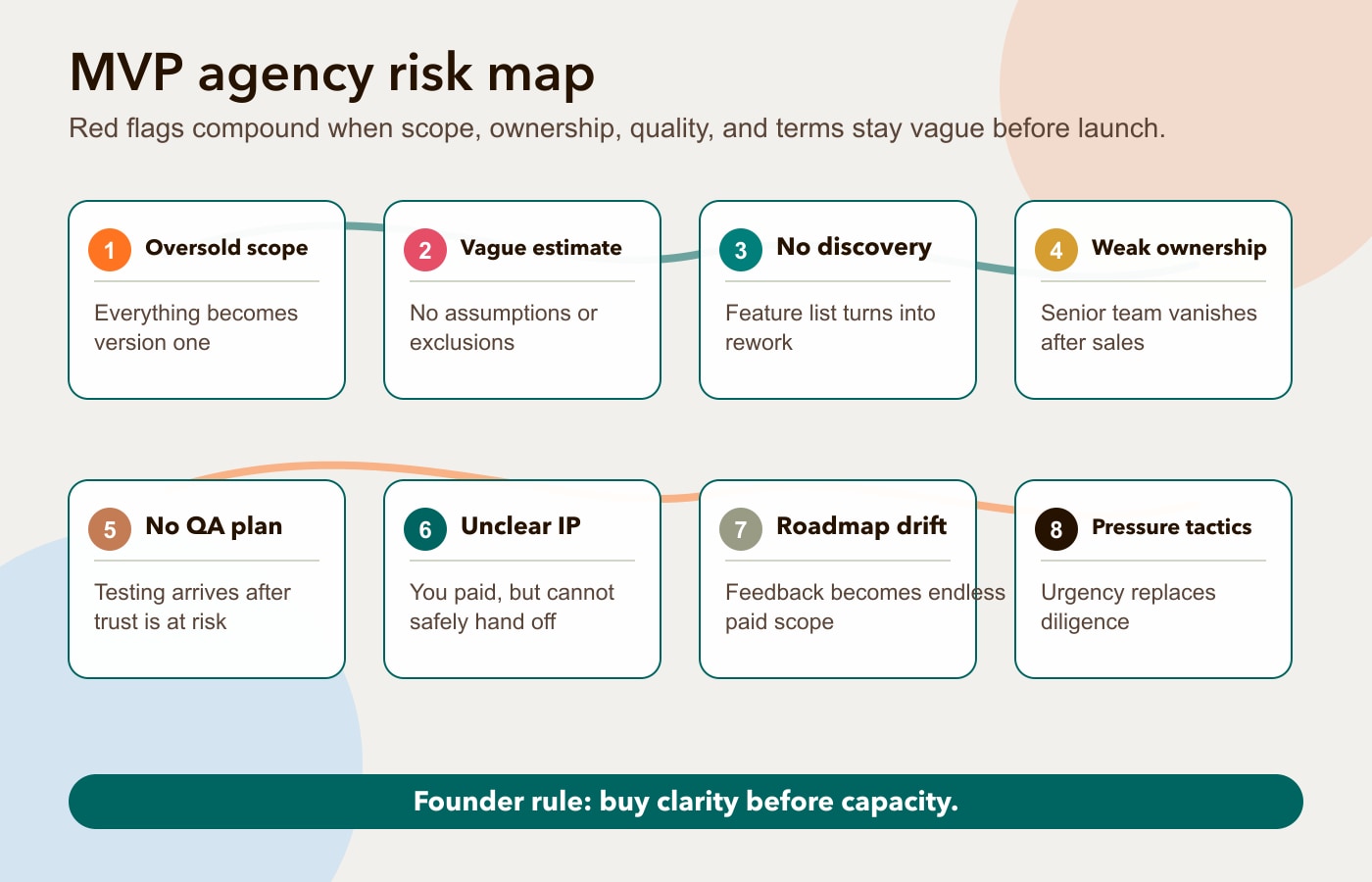
A serious MVP partner does not win the deal by agreeing with everything. They make the work clearer. They ask sharper questions, identify what is unknown, explain which features belong outside version one, and put commercial terms in writing before the build gets expensive.
Use this table as a fast screen:
| Risk area | Red flag | Serious partner behavior |
|---|---|---|
| Scope | Every requested feature is treated as version-one work. | They connect scope to the first user, first workflow, and first proof point. |
| Estimates | They quote a fixed budget after one call. | They show assumptions, exclusions, risks, and a discovery step where needed. |
| Discovery | They skip problem, user, workflow, and technical review. | They run enough discovery to turn uncertainty into a buildable plan. |
| Ownership | The senior people disappear after sales. | They name the accountable product, technical, and delivery owners. |
| QA | Testing is described as something developers do at the end. | They define acceptance criteria, staging, regression checks, and release gates. |
| IP | The contract says you can “use” the product but not what you own. | They clarify code, design files, data, credentials, third-party components, and transfer terms. |
| Roadmap | Version two is sold before version one has evidence. | They set a launch metric and a rule for what earns roadmap priority. |
| Sales pressure | Urgency is used to rush signature or deposit. | They help you make a confident decision, even if the next step is smaller. |
Treat multiple vague answers as a prompt for further diligence, not a validated numerical rejection rule. One unresolved ownership, security, or payment-control issue can be enough to pause. Where uncertainty can be tested safely, use a narrow paid discovery, prototype, technical spike, or proposal review with written outputs.
Red Flag 1: They Over-Scope Version One
Over-scoping is an MVP agency warning sign that can sound helpful. The agency says, “We should include this too,” and each addition feels small. Then version one becomes a mini-platform with onboarding, admin tools, notifications, dashboards, roles, analytics, integrations, and future-state settings before the core user behavior has been tested.
The issue is not ambition. The issue is sequence. Version one should prove whether a specific user will complete a specific workflow strongly enough to justify more investment. Anything that does not support that learning goal should compete hard for its place.
Ask:
- Which features would you cut from our first release?
- What does this MVP need to prove before we build version two?
- Which requested features are only useful after we have active users?
- What can stay manual behind the scenes during the pilot?
- If we had to launch in half the time, what would still remain?
Good answer sounds like:
“For version one, I would keep onboarding, the core workflow, admin review, basic notifications, and usage tracking. I would move advanced reporting, secondary integrations, custom roles, and polished settings to version two unless they are needed for the first pilot.”
Bad answer sounds like:
“All of this is important. It is better to build the full platform now so you do not have to come back later.”
A real partner may recommend extra scope when it reduces a known risk. For example, they may insist on audit logs for a regulated workflow, payment reliability for a paid pilot, or admin controls for a marketplace. That is not upsell. It is risk management. The test is whether they can explain the risk in plain language.
Red Flag 2: The Estimate Is Confident Before Discovery
A vague estimate is not always dishonest. Early estimates are naturally uncertain. The red flag is false confidence: a fixed price, fixed timeline, and fixed feature set before the agency has reviewed users, workflows, integrations, data, design depth, QA, security, and launch responsibilities.
Good MVP estimates make uncertainty visible. They show what is included, what is excluded, what assumptions could change the price, and which unknowns need discovery. The Design Council’s Double Diamond is useful here because it separates understanding the problem from delivering the solution. Your agency does not need that exact framework, but it should have a way to move from assumption to decision.
Ask:
- What assumptions are inside this estimate?
- What is excluded from this number?
- Which parts of the work could change the estimate after discovery?
- What do we need to learn before a fixed build price is responsible?
- Can we price discovery separately from the full build?
Good answer sounds like:
“We can estimate discovery now. The full build estimate should follow after we review the workflow, data model, integrations, design expectations, QA needs, and launch support. We can give a directional range today, but not a responsible fixed price.”
Bad answer sounds like:
“We have built many apps like this. The cost will be $X if you sign this week.”
If you want to avoid a bad MVP development partner, look for the team that is willing to slow the sales moment down just enough to make the estimate honest.
Red Flag 3: There Is No Real Discovery
No discovery usually means the founder becomes the unpaid product manager later. The agency starts coding from a feature list, then every missing assumption becomes a change request, delay, bug, or awkward tradeoff.
Discovery does not have to be bloated. For an MVP, it should be just enough to answer:
- Who is the first user?
- What problem or workflow matters first?
- What evidence says this problem is real?
- What must version one prove?
- What should be excluded?
- What technical risks need review before build?
- What quality bar is required for launch?
- What happens after launch signal arrives?
This is where a technical discovery step matters. It should connect product scope to architecture, data, integrations, security, testing, deployment, and ownership. If an agency treats discovery as a workshop deck with no build consequences, that is also weak. Good discovery changes the plan.
Ask:
- What decisions will discovery produce?
- Will discovery change the scope if the evidence is weak?
- What artifacts do we receive before development starts?
- How do technical findings affect budget and timeline?
- What would make you recommend a prototype or proof of concept instead of a full MVP?
Good answer sounds like:
“Discovery will produce a scoped backlog, wireframes or workflow map, technical assumptions, integration notes, QA plan, milestone plan, and a recommendation on whether to build, prototype, spike, or reduce scope.”
Bad answer sounds like:
“We understand the idea. Discovery will slow us down.”
Red Flag 4: Ownership Is Fuzzy
Fuzzy ownership is expensive because founders often do not notice it until the build is already moving. The agency may have a strong salesperson, polished portfolio, and senior people on the first call, but the actual work is handled by a rotating group with no single accountable owner.
For an MVP, ownership should be clear in three places:
- Product ownership: who helps make scope and roadmap decisions.
- Technical ownership: who makes architecture, stack, data, security, and handoff decisions.
- Delivery ownership: who manages timeline, blockers, communication, and release readiness.
Ask:
- Who is the day-to-day accountable lead?
- Who is the senior technical owner, and how much time will they actually spend?
- Who decides whether a feature is version one or version two?
- Who reviews code, architecture, security, and dependencies?
- What happens if the assigned team changes?
Good answer sounds like:
“Your account lead will not be the only owner. The named product lead runs scope decisions, the technical lead reviews architecture and key pull requests, and the delivery lead owns schedule, blockers, and release readiness. If we change any of those people, we will tell you before it happens.”
Bad answer sounds like:
“We have a large team, so someone will always be available.”
Availability is not ownership. You want a partner who can tell you who is accountable when a decision is hard, not just who attends the next meeting.
Red Flag 5: QA Is Treated as Cleanup
Weak QA is one of the quietest ways an MVP becomes hard to trust. A founder may accept rough edges in version one, but users will not forgive broken signup, failed payments, missing data, bad permissions, confusing errors, or a demo that collapses during a pilot call.
QA should be designed into the work, not added as a final polish sprint. The Agile Alliance definition of done frames “done” as explicit criteria that must be met before an increment counts as complete. For MVPs, that means each story should have acceptance criteria, test expectations, and release checks before it is treated as ready.
Ask:
- What does “done” mean for a feature?
- Do user stories include acceptance criteria?
- What is tested manually, automatically, and during regression?
- Is there a staging environment before production?
- Who signs off on UAT?
- What happens if bugs are found after launch?
- How do you test authentication, permissions, payments, integrations, and data loss risk?
Good answer sounds like:
“Each must-have story has acceptance criteria. We test in staging, run regression before release, review critical flows, track bugs visibly, and define a post-launch bug warranty. For security-sensitive work, we add dependency checks and review controls against the product risk.”
Bad answer sounds like:
“Our developers test their own work. QA is included.”
For products involving customer data, payments, AI outputs, or regulated workflows, QA should also connect to secure development practice. NIST’s Secure Software Development Framework is not an MVP checklist, but it is a useful signal: serious teams can explain how they reduce vulnerabilities, protect software components, and respond to issues in proportion to the product’s risk.
Red Flag 6: IP and Handoff Terms Are Unclear
Unclear IP is not a detail to clean up after launch. It affects whether you can raise capital, switch vendors, bring work in-house, reuse the code, control design files, manage hosting, and access your own data.
The U.S. Copyright Office notes that work made for hire has specific legal requirements, including an employee relationship or a qualifying commissioned work with an express written agreement. The broader lesson for founders is simple: do not assume ownership because you paid an invoice. Get the terms reviewed and written clearly for your jurisdiction.
Ask:
- Who owns custom source code after final payment?
- Who owns design files, copy, product documents, and prototypes?
- What pre-existing code, templates, libraries, plugins, or frameworks are being reused?
- Are any open-source licenses involved that affect distribution or resale?
- Who controls repositories, domains, hosting, cloud accounts, analytics, and API keys?
- What documentation is delivered at handoff?
- Can another team maintain the product without the agency?
Good answer sounds like:
“Custom work transfers to you under the contract terms. We will disclose pre-existing components, third-party services, and open-source dependencies. You will own the repository, environments, credentials, design files, documentation, and product data needed for another team to continue.”
Bad answer sounds like:
“You will be able to use everything once it is paid for.”
“Use” is not the same as own, modify, transfer, resell, or maintain. That difference matters when the MVP becomes company infrastructure.
Red Flag 7: There Is No Roadmap Discipline After Launch
Some agencies oversell before launch. Others oversell after launch by turning every piece of feedback into the next paid feature. That is how a small MVP becomes a permanent backlog treadmill.
A version-one roadmap should be tied to evidence. Before launch, decide which signals will earn more investment. Those signals might include activation, completion, paid pilots, repeat usage, time saved, error reduction, or qualified customer conversations. The exact metric depends on the product. The discipline is the same: features should earn their place.
Ask:
- What metric tells us version one worked?
- What would make us stop, pivot, or reduce scope?
- How will feedback be sorted after launch?
- What gets fixed immediately versus parked for version two?
- How do we prevent stakeholder requests from taking over the roadmap?
Good answer sounds like:
“We will separate bugs, launch blockers, usability fixes, and new feature requests. Version two will be prioritized against the original learning goal and real usage data, not the loudest post-launch opinion.”
Bad answer sounds like:
“Once users respond, we can keep adding the features they ask for.”
Users often ask for familiar features. Founders need product judgment to decide whether those requests improve the core value loop or just recreate the tools users already have.
Red Flag 8: Pressure Tactics Replace Better Decisions
Pressure is not the same as urgency. Founders often have real deadlines: investor meetings, pilot windows, customer commitments, launch seasons, or internal budget cycles. A good agency respects that urgency and helps you choose the smallest responsible next step.
A bad MVP development partner uses urgency to remove diligence. They push a deposit before scope is clear, frame questions as distrust, discount only if you sign immediately, or imply that a smaller first step means you are not serious.
Ask:
- What decision do you need from us today, and why?
- What happens if we start with discovery instead of a full build?
- Can we review the contract, IP language, and assumptions before paying a deposit?
- What would you recommend if you were protecting our runway?
- Which part of this proposal is optional?
Good answer sounds like:
“If the deadline is real, we should narrow the pilot scope and make the first release smaller. I would rather start with the part we can deliver well than sell you a larger plan that becomes fragile.”
Bad answer sounds like:
“This price is only available if you commit now.”
Founders should move quickly. They should not be rushed into unclear scope.
Questions That Expose MVP Agency Red Flags Early
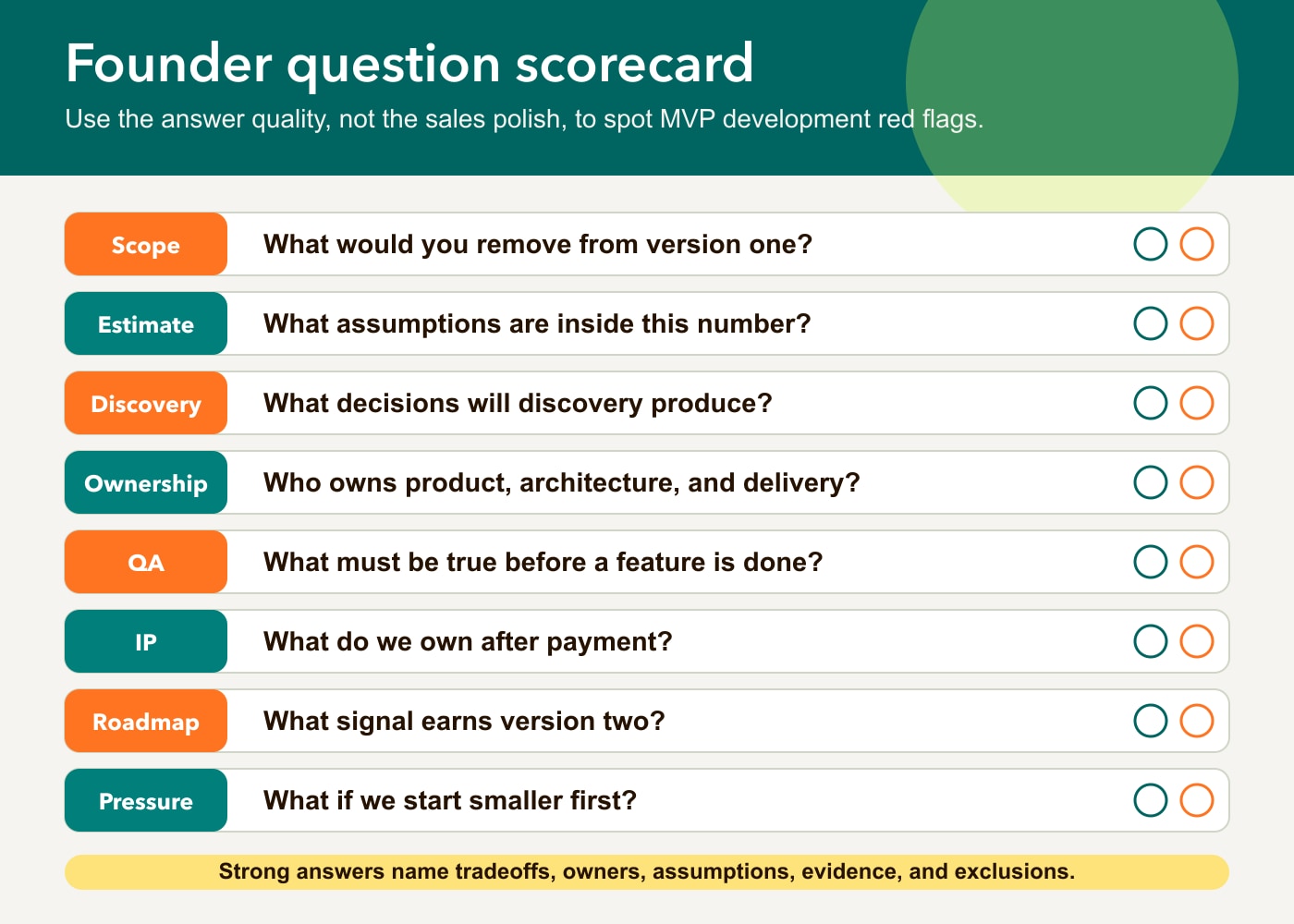
Use these questions before you choose an MVP partner. The goal is not to interrogate the agency. It is to see whether they can reason clearly about risk.
| Question | What it reveals |
|---|---|
| What would you remove from our first release? | Product judgment and resistance to over-scoping |
| What assumptions are inside your estimate? | Estimate quality and commercial honesty |
| What happens during discovery? | Whether discovery produces decisions or just artifacts |
| Who owns architecture and technical tradeoffs? | Senior technical involvement |
| What is your definition of done? | QA maturity and release discipline |
| What do we own after payment? | IP, handoff, and vendor dependency risk |
| What must version one prove? | Roadmap discipline and validation thinking |
| What would make you recommend not building yet? | Whether the agency can protect the client from a bad spend |
| How do change requests work? | Budget control and conflict prevention |
| What support exists after launch? | Maintenance, bug warranty, and operating continuity |
The strongest answer to these questions is not always “yes.” Sometimes the strongest answer is, “We need to find out,” followed by a practical plan for finding out.
How to Choose a Serious MVP Partner
Choose the partner that makes the decision cleaner. A serious agency should help you understand whether you need a full MVP, a prototype, a proof of concept, a manual pilot, or a smaller discovery step before custom development.
Look for:
- Clear discovery outputs.
- Written assumptions and exclusions.
- A visible backlog and release plan.
- Named product, technical, and delivery owners.
- Scope discipline around version one.
- Acceptance criteria and QA plan.
- Transparent IP, data, and handoff terms.
- A post-launch roadmap rule based on evidence.
- Calm sales behavior under deadline pressure.
Do not reject an agency because it raises risks. That is often exactly what you are paying for. Reject the agency that cannot explain which risks matter, what they cost, and how the first release should reduce them.
A useful buying heuristic is to resolve material uncertainty before committing to more capacity. If the agency helps you clarify the user, workflow, scope, technical risk, ownership model, and launch evidence, the build has a better chance of producing a useful decision. If the agency mostly sells more features, more urgency, or more confidence than the facts support, you have found the red flag.
When you review MVP development red flags, remember the real goal. You are not trying to find the cheapest agency or the most agreeable one. You are trying to choose a partner who can protect version one from oversell, ship the smallest useful product, and leave you with evidence strong enough to decide what should happen next. Hapy’s MVP Development work is built around that kind of early product discipline: scope first, build second, learn before the roadmap hardens.
The sample good and bad answers above are illustrative, not transcripts or results from Hapy client engagements. Verify claims through the proposed team’s actual artifacts and references. The U.S. work-made-for-hire example is jurisdiction-specific; have counsel review assignment, pre-existing components, contractor rights, and handoff terms under the governing law before relying on ownership language.