Agile MVP development reduces waste when the team treats scope as the variable, quality as non-negotiable, and learning as the real deliverable. It fails when agile becomes a faster way to ship unvalidated features.
That distinction matters for founders. A minimum viable product is not a smaller final product. It is a focused operating experiment: one user segment, one painful workflow, one core value loop, and enough telemetry to decide what should happen next.
This article presents Hapy’s synthesis of scope control, discovery, and delivery practices, with external sources linked where used. Agile does not automatically protect a startup from waste. Leaders still need to decide what will not be built with the same seriousness as deciding what will be built.
For Hapy clients, this is the practical version: the MVP should answer a business question before it becomes a roadmap habit. If the first release cannot tell you whether the product deserves more investment, the team is probably building momentum theater.
What agile MVP development should actually reduce
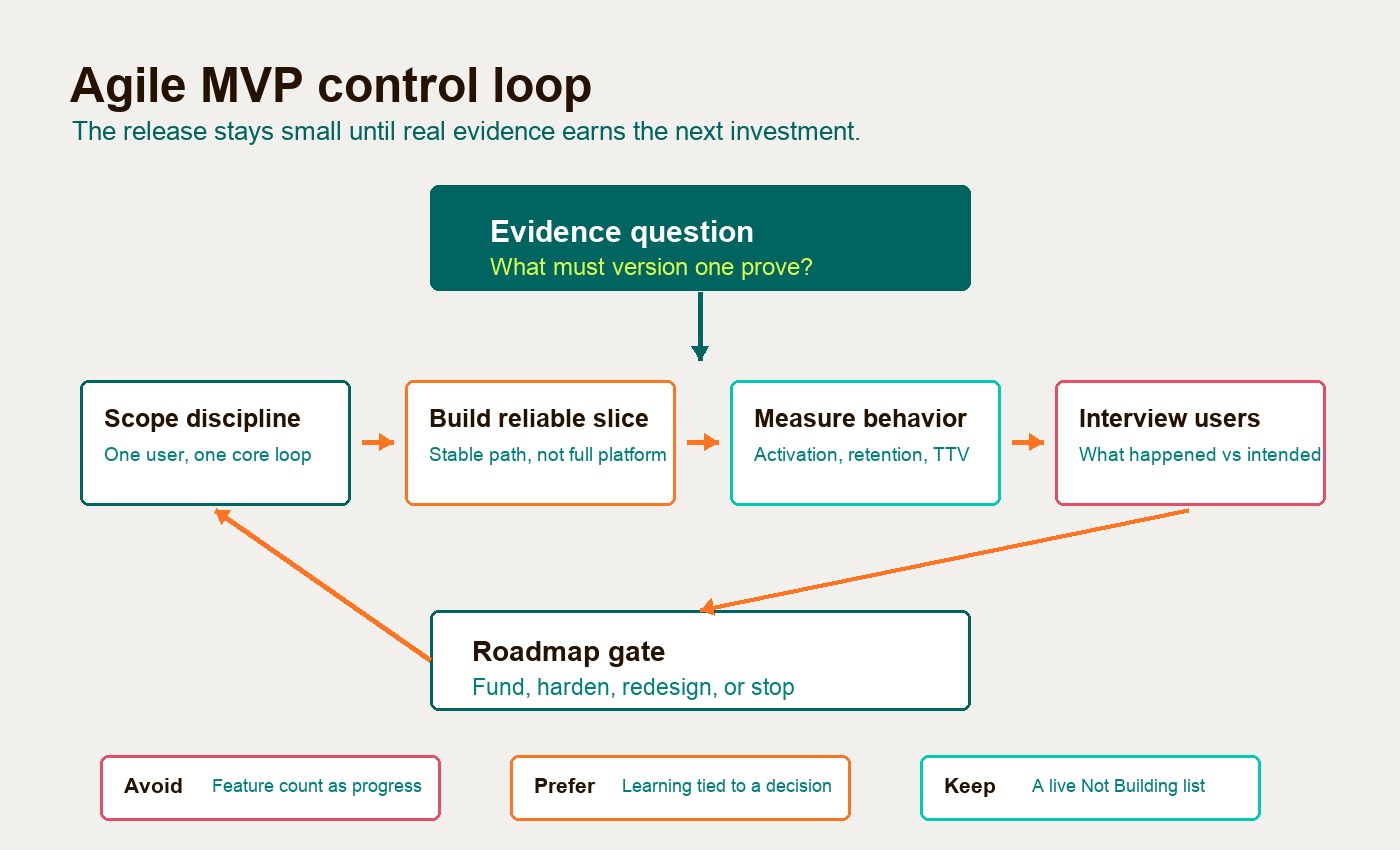
Agile MVP development should reduce overproduction, unclear priorities, late learning, and expensive rework. The goal is not simply to move faster. The goal is to spend less engineering time on features that do not prove the product’s core assumption.
A useful MVP has four boundaries:
| Boundary | What it protects |
|---|---|
| One first user segment | Prevents contradictory feedback from unrelated audiences |
| One core value loop | Keeps the release focused on the action that proves value |
| One evidence question | Makes the team agree what the MVP must learn |
| One post-launch decision rule | Stops the roadmap from expanding before signal is clear |
That is why agile can work well under uncertainty. The University of Maryland’s summary of the Second Nature Software case describes a startup that began with no product or target market and, within one year, developed an application piloted by five large research institutes, including two NIH institutes. The lesson is not “agile makes teams fast.” It is that lean discovery and agile execution can work together when the team learns what not to build.
This is also where founders need to separate agile from activity. Daily standups, tickets, sprints, and demos can create a feeling of control. They do not prove that the product is getting closer to the right market.
The build trap is agile without product discipline
The build trap happens when shipping becomes the goal. Melissa Perri describes the build trap as a cycle where teams keep building and releasing because production is visible, while research, experimentation, and strategic thinking are treated as less valuable because they do not immediately produce code.
In an MVP, that trap usually shows up quietly:
- Velocity improves, but activation does not.
- The backlog grows, but the customer segment is still vague.
- Demo quality improves, but retention is unknown.
- The team ships a dashboard, a notification engine, and a settings area before the core workflow has been proven.
- Founders ask for more “small” features because each one feels reasonable in isolation.
A useful way to describe this problem is feedback fog. When a version-one product tries to serve multiple segments or validate too many assumptions at once, the data becomes hard to interpret. A founder might see signups, a few payments, and positive comments, but still not know which user, problem, or feature is creating the signal.
That is not product validation. It is MVP theater.
The fix is uncomfortable but useful: before each sprint, name the outcome the sprint is meant to change. If the team cannot connect a feature to activation, retention, payment intent, task completion, or a specific learning question, the feature probably belongs outside version one.
Before the first sprint starts, a practical MVP development checklist can help confirm the user, core action, scope boundary, QA bar, and launch signal.
The founder owns the discipline of exclusion
Weak operating discipline around scope, feedback, telemetry, and decisions can undermine an MVP even when the engineering is sound.
Founders should own four controls before the team starts production code.
These controls are planning recommendations, not a measured ranking of startup failure causes. Agree who can change scope, what evidence they need, and when the team will review the decision.
1. A written Not Building list
A Not Building list is the cheapest scope-control tool in MVP development. Put it next to the feature list. Review it every sprint. Use it to park attractive ideas without pretending they are gone forever.
Good candidates for the Not Building list often include:
- Admin dashboards that can be handled manually at first.
- Complex notification rules.
- Custom design systems.
- Multi-language support.
- Competitor feature parity.
- Advanced permissions that are not needed for the first cohort.
- Reporting features that do not affect the evidence question.
This is not anti-ambition. It is financial discipline. Every feature adds design, engineering, QA, analytics, support, and maintenance surface area. A feature that looks like a one-line request in a meeting can become a week of edge cases once it touches real users.
2. Active discovery, not passive feedback
Passive feedback is easy to misread. People are polite. Stakeholders are biased. Early users ask for features that fit their current habits, not necessarily the product’s best future.
Before writing production code, founders should run structured interviews around the existing problem. The question is not “Would you use this?” The better question is “Show me how you solve this today.”
After launch, the feedback loop should stay active. Interview a small number of real users every week and compare what they say with what the telemetry shows. The useful gap is the difference between how the product was designed to work and how users actually move through it.
3. Telemetry before polish
An MVP without analytics is a product that cannot explain itself. At minimum, version one should capture:
| Metric | What it reveals |
|---|---|
| Activation rate | Whether users reach the first meaningful action |
| Core task completion | Whether the main workflow works under real conditions |
| Cohort retention | Whether the product creates enough value to revisit |
| Time-to-value | How quickly users experience the main benefit |
| Drop-off points | Where trust, UX, performance, or copy breaks |
| Error and support themes | Which failures block users from learning the product |
Design the measurement layer before launch. Event names, timestamps, backend errors, and funnel definitions sound boring until the founder is trying to decide whether to keep funding the product.
If the team is already wrestling with MVP risks, Hapy’s guide to MVP development challenges is a useful companion because it covers analytics, QA, integrations, and launch ownership in version one.
4. Fast binding decisions
Delayed decisions create hidden burn. When founders take days to approve designs, resolve tradeoffs, or cut scope, the team keeps carrying uncertainty. That uncertainty turns into rework, waiting time, and loose assumptions.
Timely founder decisions help limit waiting time and avoidable rework. In practice, that means a founder should be available to make binding calls on:
- What the MVP must prove.
- Which user segment matters first.
- Which features are excluded.
- Which risks need architecture now.
- Which tradeoffs are acceptable for launch.
This is where Hapy’s MVP Development work is intentionally decision-heavy. Version one needs engineering, but it also needs product judgment before the codebase starts absorbing ambiguity.
Use MoSCoW-ICE for sprint decisions
Early MVP teams often misuse heavy prioritization frameworks because they do not have enough historical data. RICE can be helpful later, but early teams usually cannot estimate reach with confidence.
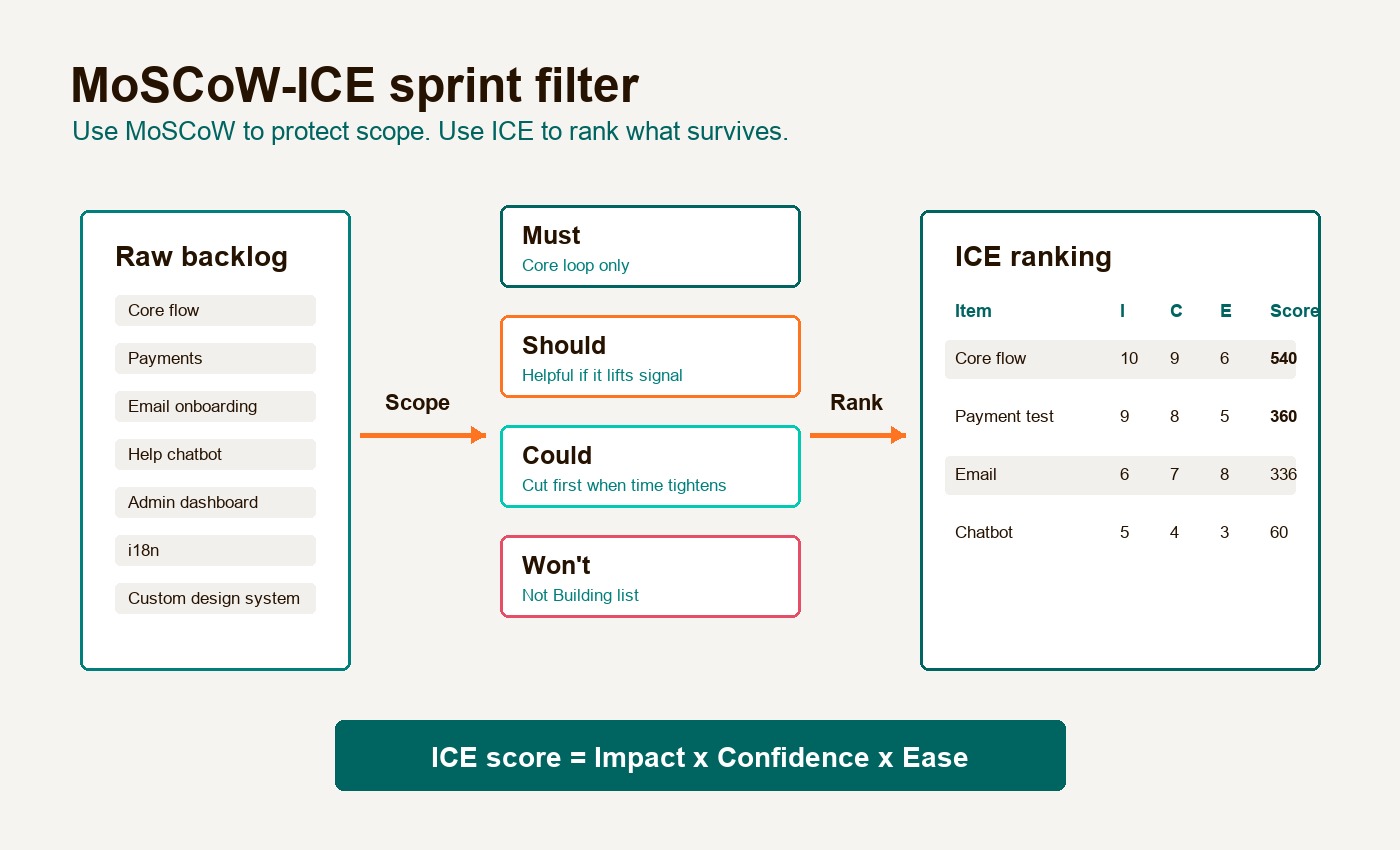
One lighter option is to use MoSCoW to define the release boundary, then use ICE to rank the surviving work.
Step 1: MoSCoW defines the boundary
MoSCoW prioritization sorts initiatives into must-have, should-have, could-have, and will-not-have categories. For MVPs, the most important category is not Must. It is Won’t.
Use the buckets this way:
| Bucket | MVP rule |
|---|---|
| Must-have | Without it, the core hypothesis cannot be tested |
| Should-have | Useful, but the MVP still functions without it |
| Could-have | Nice if cheap, cut as soon as timing tightens |
| Won’t-have | Explicitly excluded from this release cycle |
Keep the Must list tied to the hypothesis. A feature count alone cannot tell you whether the release is appropriately scoped; trace each item to the core workflow, a safety requirement, or the evidence question.
Step 2: ICE ranks the work that remains
ICE scoring uses Impact, Confidence, and Ease to compare ideas quickly. Each factor is scored from 1 to 10, then multiplied:
ICE score = Impact x Confidence x EaseFor an MVP, Impact should mean impact on the evidence question, not general usefulness. Confidence should come from interviews, prototypes, technical feasibility, or direct customer behavior. Ease should include design, build, QA, integration, and analytics work.
Here is a simplified example:
| Backlog item | MoSCoW | Impact | Confidence | Ease | ICE | Action |
|---|---|---|---|---|---|---|
| Primary user value flow | Must | 10 | 9 | 6 | 540 | Build first |
| Payment intent test | Must | 9 | 8 | 5 | 360 | Build second |
| Basic email onboarding | Should | 6 | 7 | 8 | 336 | Build if it supports activation |
| Help chatbot | Should | 5 | 4 | 3 | 60 | Defer |
| Admin analytics dashboard | Won’t | - | - | - | - | Keep on Not Building list |
This is not a magic formula. ProductPlan rightly notes that ICE is subjective and best used for relative prioritization, not as a full roadmap model. That limitation is fine for MVPs. The point is to force a clear conversation quickly instead of letting the loudest stakeholder win.
Link the MVP process to the roadmap, not the other way around
A product roadmap should not pressure the MVP into becoming a miniature platform. The roadmap should wait for MVP evidence.
Separate three concepts that founders can otherwise collapse:
| Concept | Job |
|---|---|
| MVP process | Validate the problem, user segment, and core value loop |
| App development timeline | Estimate the engineering path based on scope, risk, integrations, and QA |
| Product roadmap | Decide what to fund after the evidence is clear |
The order matters. If the roadmap is filled before the MVP has produced evidence, the team starts building commitments instead of learning.
For a broader planning system after version one, a product strategy roadmap can connect discovery, outcomes, delivery capacity, and leading indicators without turning every idea into a date commitment.
A healthier sequence looks like this:
- Discovery isolates the first user and problem.
- The MVP process defines the core loop and Not Building list.
- The app timeline estimates the smallest reliable release.
- Launch telemetry measures activation, completion, retention, and time-to-value.
- The roadmap unlocks only after the evidence supports more investment.
For SaaS products, the Sean Ellis product-market fit survey can be one useful gate. Rahul Vohra’s First Round Review essay on how Superhuman built a product-market fit engine explains the familiar 40% threshold: after Sean Ellis benchmarked nearly 100 startups, companies with strong traction tended to exceed 40% of users saying they would be very disappointed if they could no longer use the product. Superhuman started at 22%, then used segmentation and prioritization to improve the score.
Use that as a signal, not a religion. Hapy’s SaaS product-market fit guide goes deeper on why PMF needs convergence across retention, customer pull, efficient acquisition, and expansion signal.
The same caution applies to product-user fit. a16z argues that product-user fit comes before product-market fit, and early teams often mistake a narrow group of power users for full product-market fit. That distinction is useful for MVP teams. Version one may prove that a small group loves the product. The roadmap still has to prove whether that group is reachable, large enough, and economically attractive.
What disciplined agile MVP development looks like in practice
Disciplined agile MVP development feels narrower than founders expect. It asks the team to make fewer things, instrument them better, and learn faster from a smaller surface area.
Use this operating model:
| Operating area | High-discipline MVP behavior | Wasteful version |
|---|---|---|
| Success metric | Activation, retention, task completion, payment intent | Story points, feature count, demo polish |
| Scope | One core workflow and a written Not Building list | Multiple audiences and wishlist features |
| Feedback | Interviews plus behavioral data | Opinions, anecdotes, and vanity metrics |
| Technical footprint | Modular monolith, clear schema, standard components | Premature microservices, custom systems, fragile integrations |
| Roadmap | Gated by evidence from live users | Pre-filled feature calendar |
This is not less strategic. It is more strategic because the team is no longer confusing movement with progress.
The article on how to build an MVP covers the broad build sequence. This article’s narrower argument is that the build sequence must be governed by exclusion. In version one, the features you cut are often more important than the features you keep.
FAQ
What is agile MVP development?
Agile MVP development is the process of building a first usable product release through short cycles while using scope discipline, user feedback, and telemetry to validate a core business assumption. The goal is not to ship every requested feature faster. The goal is to learn whether the product deserves more investment.
How does agile reduce waste in MVP development?
Agile reduces MVP waste when teams keep schedule and quality stable while treating scope as flexible. Waste drops because the team builds only the features needed to test the main hypothesis, then uses real user behavior to decide the next sprint.
What is the build trap in MVP development?
The build trap is the pattern of measuring progress by output instead of outcomes. In MVP development, it shows up when a team ships more features, dashboards, and polish before proving activation, retention, willingness to pay, or task completion.
Is MoSCoW or ICE better for MVP prioritization?
Use them together. MoSCoW is better for defining what belongs in the release and what must be excluded. ICE is better for ranking the remaining items quickly by impact, confidence, and ease.
When should the product roadmap expand after an MVP?
The roadmap should expand only after version one produces credible evidence. That evidence may include activation, retention, time-to-value, payment intent, support themes, cohort behavior, and in some SaaS cases a product-market fit survey. Until then, the roadmap should stay focused on improving the core loop.
The practical takeaway
Agile MVP development is useful because it can reduce waste under uncertainty. But it only works when founders enforce discipline: one first customer, one core loop, one evidence question, a written Not Building list, clean telemetry, and fast decisions.
The risk is not that a team will fail to build enough. The bigger risk is that it will build too much before it knows what matters.
If you are planning version one, start with the question the MVP must answer. Then make the smallest reliable product that can answer it. Everything else belongs on the Not Building list until the evidence earns a place on the roadmap.