This guide uses early-2026 MENA funding reports to frame founder decisions, with operating examples focused on Saudi Arabia and the UAE. It is not a comprehensive North Africa or MENA market-entry survey. The funding window discussed below ends in April 2026; the September editorial update does not make those numbers a current-quarter forecast.
Choose a country by reachable buyers, licensing needs, talent, procurement, and operating cost. A regional funding headline cannot answer those questions. For additional country context, see the Qatar, Bahrain, and Saudi Arabia guides.
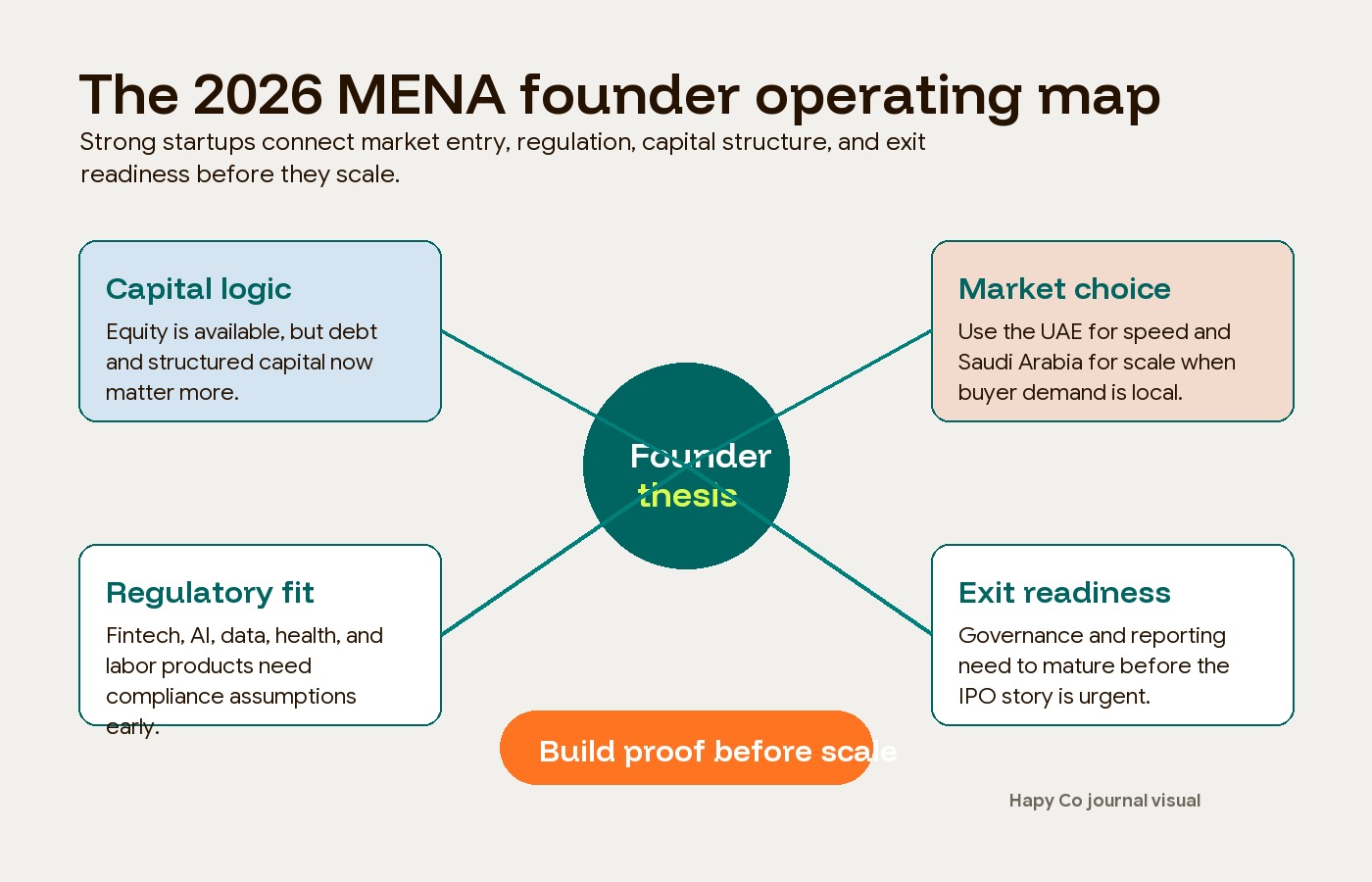
Read funding totals with their scope attached
The original sources describe different populations and instruments. Semafor’s report citing MAGNiTT describes Middle East venture deals in 2025; Wamda’s monthly reports cover MENA startup funding and include debt. They should not be joined into one comparable time series without reconciling geography, financing instruments, announcement dates, and treatment of large rounds.
Wamda’s April 2026 report records $150 million across 27 deals, including $80 million of debt in two deals. It also reports $95.8 million across 11 B2B deals and $35.8 million across 12 B2C deals. These totals show concentration and instrument mix in that month. They do not establish that an ordinary B2B startup is easier to fund, that consumer demand is weak, or that investors all prefer the same business model.
Before using any total in a pitch, save its publication date, geographic coverage, debt/equity definition, stage mix, and largest deals. Compare like periods from the same methodology and ask investors about their current mandate directly.
Why Saudi Arabia is setting the regional operating tempo
Saudi Arabia is one market to investigate when a product fits identifiable domestic buyers and policy priorities. Its relevance depends on the customer segment and a feasible route to procurement.
The Public Investment Fund’s 2026-2030 strategy is a useful lens. PIF says its new strategy moves from rapid growth toward sustained value creation, private-sector participation, and six domestic ecosystems: Tourism, Travel & Entertainment; Urban Development & Livability; Advanced Manufacturing & Innovation; Industrials & Logistics; Clean Energy, Water & Renewables Infrastructure; and NEOM.
For startups, those are not abstract policy labels. They are policy priorities that can guide buyer research, not confirmed purchase orders. A logistics SaaS company, AI infrastructure provider, industrial automation team, construction-tech platform, tourism operating system, fintech lender, or healthcare workflow product can now position around large domestic buyers rather than only consumer adoption.
Saudi’s broader economy supports the same story. Argaam, summarizing Vision 2030 data, reported that non-oil activities reached 55% of real GDP in 2025 and non-oil government revenue reached SAR 505 billion. These macro indicators do not measure the addressable budget for a particular startup product. The economy is deliberately building more non-oil operating capacity, and startups that serve that shift can become suppliers, partners, or acquisition targets.
SVC is one of the clearest examples of how public capital is trying to create private-market depth. Its total committed investments reached $1.2 billion since inception and stimulated $5.9 billion in partner commitments, according to Arab News. The number of VC investors in Saudi Arabia increased from 34 in 2018 to 200 in 2025. That is not just more money; it is more market plumbing.
Turn sector attention into a testable buyer thesis
The following are hypotheses, not forecasts of winners or investor preferences:
| Product direction | Buyer to investigate | Existing alternative | Evidence before a build |
|---|---|---|---|
| Fintech reconciliation | Finance lead at a licensed provider or merchant | Bank exports, accounting software, manual review | Permission to access data, repeated costly exceptions, and a budgeted pilot |
| Vertical SaaS | Operations owner in one industry | Existing ERP or configurable workflow tool | An unmet workflow with a named owner and measurable cost |
| Applied AI | Owner of a document-heavy enterprise process | Manual review, existing software, general AI tools | Representative evaluation data, error tolerance, review cost, and data permission |
| Logistics or ecommerce operations | Dispatch or fulfillment manager | Existing platform, spreadsheets, outsourcing | A repeated failure the current process cannot resolve economically |
| Health workflow software | Provider operations and information-governance owners | Clinical systems and administrative services | Approved scope, privacy and safety review, and procurement route |
Infrastructure investments and national strategies may enable these products but do not prove willingness to pay. For Saudi-specific research, use the SaaS market in KSA guide and assess the underlying SaaS technology choices separately.
Saudi Arabia vs UAE: choose the market by operating need
Founders often ask whether to start with Saudi Arabia or the UAE. The better question is: what does the startup need first?
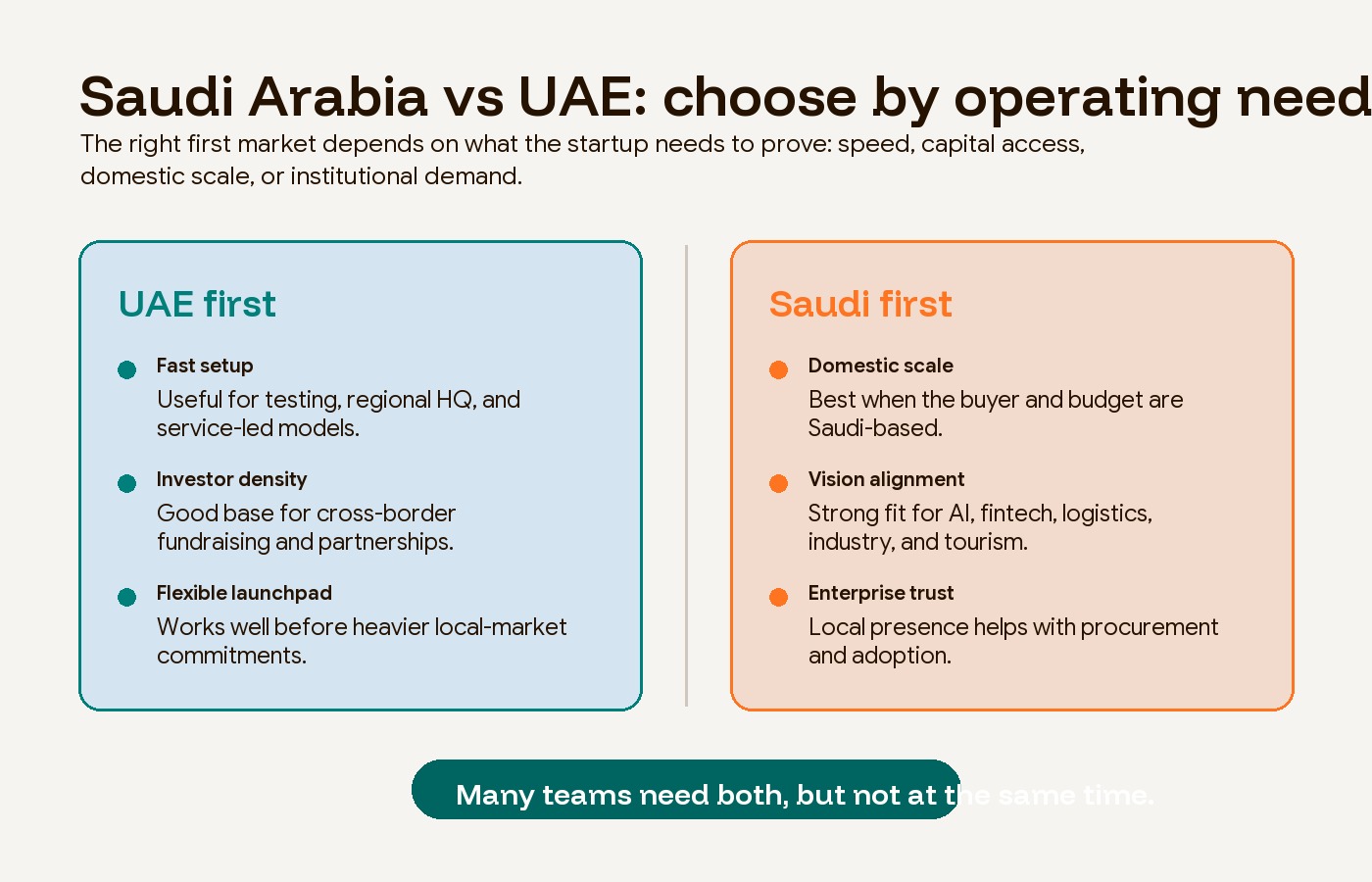
Use the following as a comparison worksheet, not a ranking of formation speed or investment quality. Verify licensing, tax, ownership, employment, and regulated-activity requirements with qualified local advisers for the exact entity and activity.
| Decision | Saudi Arabia investigation | UAE investigation |
|---|---|---|
| First buyer | Can you reach the actual budget holder and tender process? | Can you reach the actual budget holder and tender process? |
| Entity and permissions | What local entity, registration, or license does the activity require? | Which jurisdiction and license fit the activity and customer location? |
| Delivery | Are Arabic support, local implementation, or hosting terms required? | What language, hosting, and implementation terms do the target buyers require? |
| Team and cost | Get specific employment, office, advisory, and operating estimates | Get comparable estimates including jurisdiction-specific recurring fees |
| Expansion | Which next-country assumptions must be retested? | Which next-country assumptions must be retested? |
A UAE base followed by Saudi expansion is one possible sequence, not a default recommendation. Start where buyer access and lawful delivery are demonstrable. The UAE startup ecosystem guide offers additional questions for Dubai and Abu Dhabi.
Exit readiness is becoming part of the startup story
The Saudi startup ecosystem is also maturing because founders are starting to think about liquidity earlier. That is healthy, but it creates a new execution burden.
Endeavor Saudi Arabia reported that Saudi exchanges accounted for 106 of 130 GCC IPOs between 2023 and 2025, about 82% of regional listings. It also noted that Nomu expanded from 9 listed companies in 2017 to around 125 by September 2025. In the same report, 23 of 30 high-impact founders surveyed were actively considering going public, while half of those considering IPOs in the next two years said they were not at all or only little prepared for listing requirements.
That gap is one of the most important founder lessons in the region. A public-market story cannot be pasted onto a company at the end. Governance, reporting, leadership depth, risk management, and unit economics need to be built before the IPO conversation becomes urgent.
M&A is also becoming more important. Even during slower months, strategic acquisitions continued across AI, ecommerce, adtech, and services. This matters because not every strong MENA startup will become a public company. Some will become acquisition targets for regional incumbents that need technology, distribution, talent, or category expansion.
What founders should do differently in 2026
The best founder response to the 2026 market is not fear. It is discipline.
First, build for a specific buyer. “MENA is growing” is too vague. A better thesis is: Saudi logistics companies need compliance-aware fleet finance tools; UAE-based B2B marketplaces need embedded working-capital products; GCC healthcare operators need AI-supported intake and patient workflow systems; tourism operators need multilingual booking and operations software before peak-event demand.
Second, design the MVP around proof, not feature volume. In a selective funding market, an MVP should prove demand, pricing, implementation complexity, and buyer urgency. That is especially true for founders selling into Saudi Arabia, where enterprise trust and local execution matter. Hapy offers MVP development, including support for founders targeting KSA. Evaluate any proposed scope against the buyer test and acceptance criteria; a working product does not guarantee sales or funding.
Third, make compliance part of product strategy. Fintech, healthtech, AI, data, ecommerce, and workforce platforms all face regulatory questions. Do not leave those questions as investor diligence surprises. Turn them into a visible part of the roadmap, especially if the team is working with Arab clients in the Middle East and needs local trust from the start.
Fourth, prepare for flexible capital. April’s debt concentration is a reason to understand financing definitions, not a recommendation that a pre-revenue startup borrow. Venture debt, revenue-based financing, strategic capital, and government-linked programs may all matter depending on the model. Founders should understand which instruments match their margins, cash cycles, and collateral.
Fifth, define hiring around the next operating constraint. Use a role brief, consistent assessment, realistic compensation range, and references tied to relevant work. Test the role against actual candidates and the decisions the business needs owned.
A founder checklist for the MENA startup ecosystem
Use this checklist before committing to a market-entry plan or fundraising story:
- Define the first country by operating need, not ego.
- Name the exact buyer and the budget line your product fits.
- Identify whether the product is exposed to fintech, data, AI, health, labor, tax, or sector-specific regulation.
- Use a bounded learning plan, such as an illustrative 90-day pilot, to test demand and pricing; enterprise procurement may require a longer window.
- Decide whether the company needs Saudi local presence, UAE regional operations, or both.
- Show how the model performs under slower collections, longer enterprise sales cycles, and smaller cheque sizes.
- Prepare a capital plan that includes equity and non-equity options.
- Build reporting habits early if an IPO, strategic acquisition, or larger institutional round is a realistic future path.
The broader point is that founders should stop treating MENA as a hype cycle. The region is becoming a serious operating environment. That is good news for teams with product judgment, local context, and enough discipline to earn trust before chasing scale.
Choose the next decision from buyer evidence
For a hypothetical Saudi logistics workflow, identify one operations owner, confirm the budget and procurement route, test the current alternative, and agree a narrow pilot with a measurable outcome. For a UAE-based product, run the same exercise with the actual local buyer. Stop or rescope if access, regulation, or economics make the pilot infeasible.
Regional signals help choose what to investigate. The decision to build should rest on a specific buyer, an authorized workflow, a viable implementation plan, and evidence the buyer will keep paying for the result.