AI investment and national strategies create useful context for Middle East founders. They do not guarantee a grant, an accessible customer, affordable compute, or permission to use sensitive data. Start with one country, buyer, and workflow, then verify the requirements for that specific deployment.
This guide was reviewed September 8, 2026. It separates policy and company announcements from product availability and commercial evidence.
1. Read national strategies as direction, not demand
The UAE’s official AI strategy page describes the government’s AI ambitions and priority areas. Its objectives are policy aims; they are not proof that a ministry will buy a particular startup’s product.
For a founder, the useful step is to translate a broad priority into a workflow: document intake, service triage, maintenance planning, or Arabic-language search. Find the person accountable for the current process and ask what evidence would justify a pilot.

Saudi Arabia requires its own review. For products handling personal data, use SDAIA’s official Personal Data Protection Law resource as an entry point and have a qualified local reviewer assess the deployment. Do not assume UAE, Saudi, Qatari, or other national requirements are interchangeable.
2. Separate funding categories
A total for all MENA startup funding is not an AI-sector funding total. Before using a funding report, record the period, geography, company coverage, equity-versus-debt treatment, and definition of an AI company. Large infrastructure commitments, venture rounds, government budgets, and money available to your startup are different measures.
Use funding news to identify potential investors and partners, then check their stage, sector, location, and current investment criteria. Do not build a runway plan around an announced regional investment target.
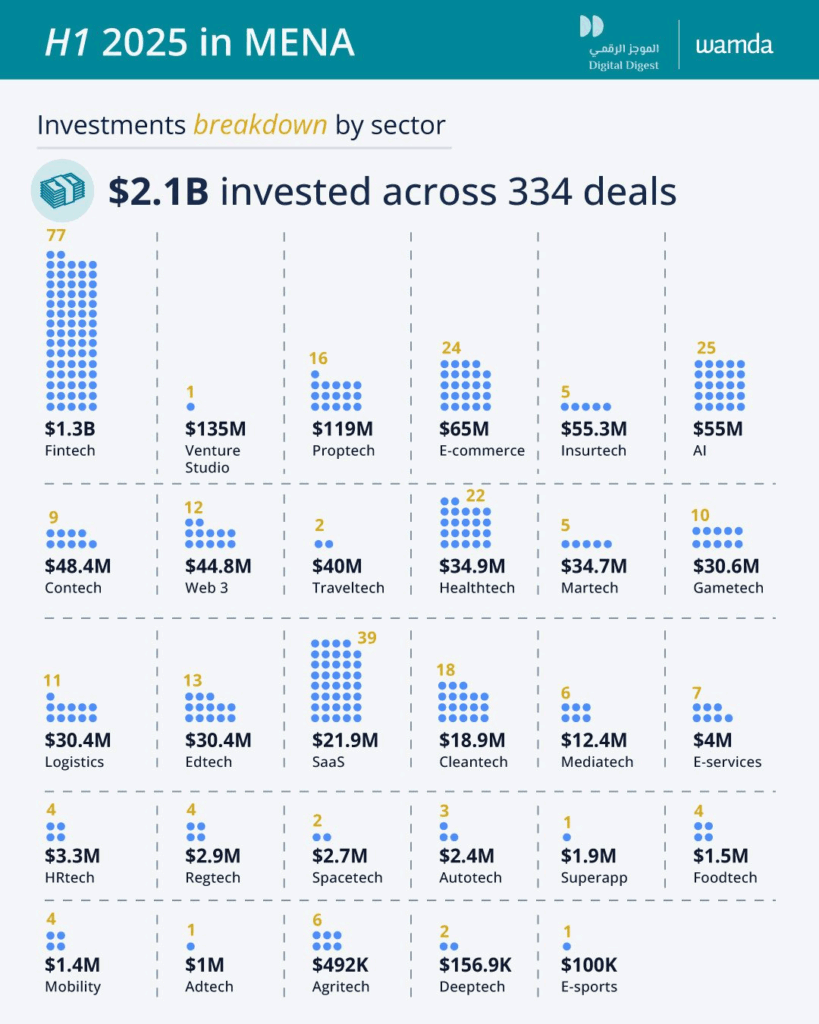
This retained funding illustration is contextual; it is not evidence of an AI-only funding amount or a current market total.
3. Verify what a company announcement makes available
PIF announced the launch of HUMAIN on May 12, 2025. Its official portfolio description describes an ambition spanning data centers, cloud infrastructure, models, and applications. That establishes the initiative’s scope, not a guarantee that a named facility or service is available to your company today.
For HUMAIN, G42, AIQ, or another potential provider, check the exact service you intend to use. For Arabic model projects such as Jais or Fanar, check the specific released model and license rather than transferring claims between versions. This guide does not assert current facility opening dates, model parameter counts, training-data totals, or unverified fundraising amounts.
| Decision | Evidence needed |
|---|---|
| Compute | Available region, capacity, price quote, service terms, and support route |
| Model | Version, license, supported input/output types, evaluation results, and restrictions |
| Arabic support | Performance on your dialects, mixed Arabic-English text, terminology, and document formats |
| Data | Retention, training use, access, transfer, deletion, and subcontractor terms |
| Operations | Rate limits, latency, failure behavior, monitoring, and human escalation |
Test the service with representative, authorized examples. A provider’s headline benchmark may not describe your documents, users, or operating conditions.
4. Make governance part of the product
Training initiatives and research institutions may help a founder find collaborators, but eligibility and participation need direct confirmation. A training program is not evidence that a startup has the staff needed to operate an AI system.

Treat governance as an operating responsibility. Name what the model can read, recommend, draft, and change. Decide which actions require approval, how users can correct a result, and who handles incidents. General AI principles do not certify compliance with a country’s laws or a buyer’s procurement rules.
5. A locally grounded founder pathway
For an AI startup considering Abu Dhabi, Hub71+ AI and the official Hub71 FAQs provide a program and application entry point. Check the current cohort window, stage and product criteria, location commitments, selection process, and any equity or incentive terms before applying. Support is conditional; alignment with a national agenda does not confer eligibility.
An illustrative first product could draft responses to Arabic-English support requests for one UAE business. Keep sending authority with a trained reviewer during the pilot.
- Confirm the buyer: name the support lead, procurement owner, budget holder, and current response-time and quality problems.
- Clear the data path: get permission for the test dataset, minimize personal information, and agree processing, retention, access, and hosting terms with the buyer’s reviewers.
- Define the evaluation: include dialect variation, mixed scripts, missing information, and requests outside policy. Measure factual correctness and policy fit, not only fluent language.
- Bound the operation: provide source references, require approval before sending, log corrections, and stop on missing source material or unauthorized requests.
- Agree the decision: compare handling time including review and rework with the baseline. Set quality and cost thresholds before the pilot, and decide whether to continue, narrow, or stop.

The pilot brief should also say who provides integrations, who supports users, and whether a successful trial creates a procurement opportunity or only another review. An incubator introduction is useful, but it is not a customer commitment.
6. Plan around deployment constraints
Infrastructure, talent, procurement, and data access vary by market and provider. Measure latency from the intended user location. Confirm service and model availability under your account and contract. Budget for review, integration, monitoring, maintenance, and fallback handling alongside model usage.
A narrow MVP engagement can test whether the workflow improves before a larger platform is funded. Use the AI automation ROI guide to distinguish saved capacity from realized cash savings.
The useful opportunity is a real user problem the team can solve under local operating constraints. Build the evidence for that workflow first, then decide whether regional expansion is justified.