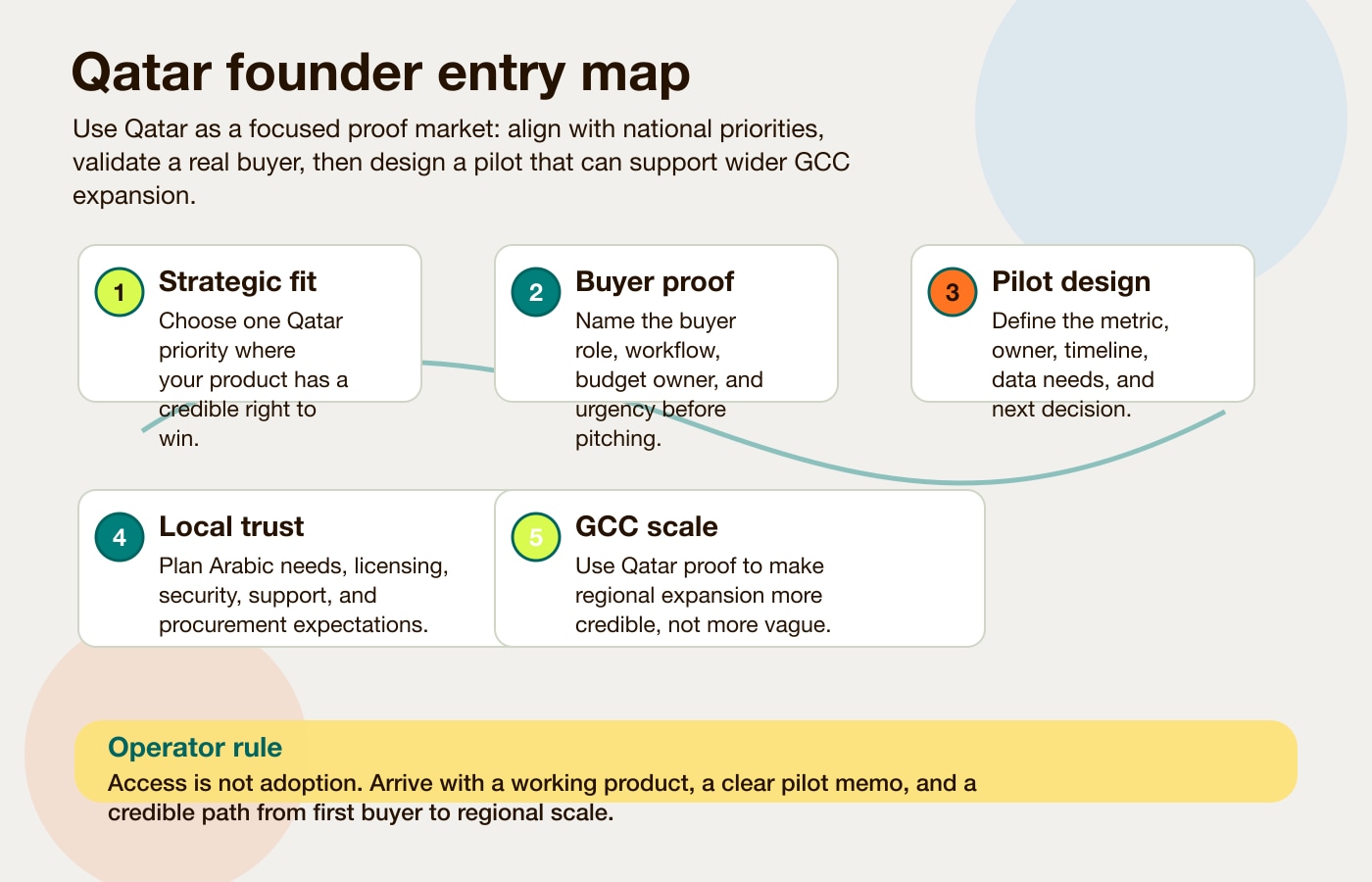
Treat Qatar as a concentrated pilot market, not a shortcut to GCC scale. Its advantage is proximity to government entities, development banks, accelerators, universities, free zones, and strategic buyers. It works best when your product maps to a priority sector and has a concrete pilot thesis.
That concentration is powerful when a founder has a sharp market-entry thesis. It is less useful when the startup only has a generic “GCC expansion” story.
In 2026, Qatar is strongest for founders who can connect product execution to national priorities: AI, fintech, digital transformation, logistics, sports, energy, climate resilience, agritech, health, Arabic-language technology, and enterprise software. Web Summit Qatar has made the ecosystem more visible. The real work is turning that visibility into pilots, licensing decisions, partner commitments, and products that can survive procurement.
For a wider regional view, read Hapy’s guide to the MENA startup ecosystem in 2026. Founders comparing smaller GCC launch markets should also review the Bahrain startup ecosystem, the Kuwait startup ecosystem, and the Oman startup ecosystem. Qatar is part of that shift, but it has its own operating logic.
Qatar startup ecosystem in 2026: the useful read
The useful way to read Qatar is as a controlled access market. It is not the largest GCC consumer market. It is not the cheapest place to test. It is not always the easiest place to sell without local context. Its value is that the right startup can get close to decision-makers, programs, infrastructure, and strategic buyers faster than in a more fragmented market.
The capital and policy signals are now more concrete. Qatar Investment Authority announced at Web Summit Qatar 2026 that it was adding $2 billion to its Fund of Funds program, bringing total commitment to $3 billion. QIA said the program now supports 12 regional and international fund managers in Qatar, with newer funds covering AI, fintech, blockchain technology, infrastructure, and special situations.
Qatar Development Bank is building the early-stage and landing layer around that capital. In a February 2026 QNA interview, QDB said Startup Qatar had invested nearly QR 150 million in more than 40 startups from 15 countries, all localized in Qatar, and that the program’s target portfolio size is set to reach QR 1 billion. The same report said Qatar attracted QR 214 million in VC investment in 2025, up 81% year over year, with private and foreign investors accounting for 86% of total VC investment.
Those numbers matter, but they do not remove the founder’s job. They raise the bar. If Qatar is using capital, incentives, residency, and events to pull startups into the country, founders need to show why their product deserves a place in that system.
Web Summit Qatar is a catalyst, not the strategy
Web Summit Qatar gives founders access, visibility, and timing. It does not replace market work.
The 2026 edition was large enough to matter as an ecosystem signal. QNA reported 30,274 participants from 127 countries, close to 1,000 investors, 1,637 startups, and more than 77 MoUs. Government Communications Office reporting said 247 Qatari startups participated, up 30% from 2025 and more than double the 2024 figure.
That makes the event useful for three jobs.
First, it compresses discovery. A founder can meet investors, program operators, corporate innovation teams, government entities, and local founders in a few days.
Second, it reveals the market’s active language. In 2026, the recurring themes were AI, fintech, digital infrastructure, mobility, sustainability, creative economy, and Arabic-market technology. These are not just stage topics. They are clues about where buyers, regulators, and funders are paying attention.
Third, it creates deadline pressure. Founders who prepare before the event can use it to move from “interesting product” to “pilot conversation.” Founders who arrive with a broad pitch usually leave with contacts, not commitments.
Hapy’s earlier Qatar Web Summit 2026 startup recap covers the event signal. This guide is the next layer: how to turn that event momentum into product execution.
Qatar funding and program architecture
Qatar’s startup support is not one program. It is a stacked system: sovereign fund commitments, QDB investment support, market-entry incentives, startup residency, accelerators, sector pilots, and specialized zones.
The founder question is not “Which program sounds best?” It is “Which program reduces the biggest risk in my current stage?”
| Program or institution | Best fit | What it helps reduce |
|---|---|---|
| QIA Fund of Funds | VC fund managers, later-stage venture networks, startups seeking global fund adjacency | Access to international VC expertise, regional HQ incentives, fund-manager presence in Doha |
| Startup Qatar Investment Program | Tech startups launching in Qatar or established startups expanding into Qatar | Investment funding subject to agreed terms, alongside separate incentives, R&D access, and market-entry support |
| QDB investment and financing | Qatar-localized startups, SMEs, technology ventures, contract-backed businesses | Early capital, debt or financing pathways, venture support, private investor crowd-in |
| Startup Qatar residency pathway | Entrepreneurs and executives who need long-term Qatar operating stability | Founder retention, residency continuity, relocation confidence |
| Qatar Financial Centre | Fintech, professional services, regional B2B software, asset management, service companies | Company setup, legal framework, 100% foreign ownership, business credibility |
| Qatar Science & Technology Park | Deep tech, R&D-heavy ventures, university spinouts, hardware or applied science teams | Research proximity, innovation licensing, technical ecosystem access |
| Qatar Free Zones | Logistics, advanced manufacturing, aviation, maritime, export-oriented tech, supply-chain businesses | Zone infrastructure, customs advantages, industrial and logistics proximity |
| TASMU Accelerator | Digital startups solving transport, logistics, healthcare, environment, or smart-city problems | Real-world pilots, sector partner access, public-private validation |
| Creative Destruction Lab Doha | Science-driven AI, health, agriculture, and food startups | Deep-tech mentorship, investor network, research commercialization support |
The Startup Qatar Investment Program is especially relevant for market entry. QDB says the program offers START funding up to US $1.1 million and GROW funding up to US $5.5 million, with priority sectors including AI and ML, agritech, B2B SaaS, climate tech, cybersecurity, edtech, energy tech, fintech, healthtech, IoT and big data, marketplaces, proptech, robotics and drones, sports tech, and supply-chain tech.
Program terms checked September 8, 2026: QDB lists investment funding separately from benefits such as licensing waivers, subsidized space or housing, and access to R&D grants. The public page does not specify the instrument, valuation, equity stake, or conversion terms for every investment. Do not budget START or GROW as a non-dilutive grant: request the proposed equity or convertible instrument and term sheet, if applicable, and confirm how each separate incentive is awarded.
QDB says funding is released against mutually agreed milestones. START applicants need a validated concept, technology roadmap, market-readiness and monetization plan, and a relevant team. GROW applicants need at least three years of established operations, qualified management, financial stability, and adequate funding history. These are application criteria, not an entitlement to the maximum award. Use the current Apply Now link on the official QDB program page, then confirm localization commitments, eligible spending, milestone evidence, and the current application window with the operator.
That priority list is useful because it tells founders what Qatar wants to attract. It should not be treated as a keyword list. A startup still needs a specific buyer, workflow, pilot plan, localization approach, and value case.
Accelerators and pilots are where the ecosystem gets practical
Qatar’s best startup opportunities are often pilot-led. The ecosystem is smaller than larger markets, so proof matters. A strong pilot with a respected entity can create more credibility than a large number of shallow meetings.
TASMU is a good example. During Web Summit Qatar 2026, TASMU Accelerator announced agreements with Mowasalat, DHL Express Qatar, and PwC Middle East. QNA reported that TASMU selected five proof-of-concept projects from four startups to co-develop with Mowasalat, including fuel optimization, document management, contractor collaboration, facilities management, fleet procurement, e-permits, and machine-learning integration.
That is the pattern founders should study. The product opportunity is not simply “smart mobility.” It is operational software that can sit inside a transport operator’s daily work and show measurable improvement.
The same principle applies to deep tech. Creative Destruction Lab says CDL-Doha is its first site in the GCC and Asia and will support more than 150 ventures over three years, with streams in AI, health, and agriculture and food. ESMT Berlin’s launch announcement said DEEP Qatar and CDL-Doha are designed to support science-driven ventures and technology transfer in partnership with QIA and QRDI.
For founders, that makes Qatar relevant when the product is not only software. It can also be applied research, climate resilience, food systems, AI safety and reliability, diagnostics, robotics, or industrial workflow improvement.
Sector opportunity matrix for Qatar startups
Qatar’s best sectors sit where national priorities, buyer access, funding attention, and pilot infrastructure overlap.
| Sector | Qatar opportunity | What founders should build first | Main execution risk |
|---|---|---|---|
| AI and Arabic AI | Government services, enterprise automation, Arabic-language workflows, AI governance, model evaluation | Narrow workflow product with human review, audit logs, Arabic support, and measurable time savings | Building a demo that cannot meet public-sector trust requirements |
| Fintech | Payments, SME finance, open finance, regtech, Islamic finance, embedded finance | Compliance-aware onboarding, reconciliation, permissions, fraud controls, partner API plan | Treating licensing and banking partnerships as late-stage details |
| B2B SaaS | Finance ops, procurement, HR, legal workflow, customer support, public-sector operations | Role-based workflow, admin controls, bilingual UX where needed, security basics, reporting | Vague buyer and weak enterprise readiness |
| Climate and energy tech | Energy efficiency, carbon tracking, smart buildings, water systems, industrial optimization | Data model, verification workflow, ROI calculator, asset-owner dashboard | Selling sustainability language without operational proof |
| AgriTech and food systems | Controlled-environment farming, food security, water efficiency, supply-chain freshness | Pilot-ready sensor, monitoring, yield, or resource-efficiency product | Underestimating harsh climate, unit economics, and operations |
| Healthtech | Diagnostics, care coordination, hospital operations, population health, data infrastructure | Privacy-first workflow, clinical accountability, Arabic support, integration assumptions | Building patient-facing UX without clinical governance |
| Logistics and supply chain | Last-mile optimization, fleet efficiency, customs, warehousing, delivery operations, drones | Exception dashboard, routing logic, integration plan, SLA reporting | Marketplace surface without operational depth |
| Sports tech and fan experience | Athlete performance, venue operations, broadcast, fan engagement, esports | Clear use case for clubs, venues, leagues, or event operators | Confusing event visibility with recurring buyer demand |
| Robotics and drones | Delivery, inspection, facility operations, asset monitoring, industrial automation | Safety case, operating environment, maintenance plan, regulatory path | Hardware complexity and unclear deployment ownership |
This is where Qatar becomes interesting for GCC and MENA founders. The country is not asking only for apps. It is signaling demand for operational technology that can plug into institutions, infrastructure, and strategic sectors.
Qatar digital transformation is a buyer signal
Founders should treat Qatar’s digital transformation agenda as a buyer map. The strongest opportunities usually sit inside specific public or enterprise workflows, not broad transformation slogans.
Qatar’s International Media Office says Digital Agenda 2030 aims to create 26,000 ICT jobs by 2030 and generate a cumulative annual digital economic impact of QAR 40 billion. It also points to Qatar’s AI strategy, nationwide 5G and fiber reach, Microsoft and Google Cloud infrastructure, and the launch of Qai as a QIA subsidiary focused on AI infrastructure and trusted AI systems.
The AI infrastructure signal became more concrete in December 2025, when Brookfield and Qai announced a $20 billion strategic investment partnership focused on AI infrastructure in Qatar and selected international markets.
For founders, the practical takeaway is not “build AI.” It is to build products that make AI usable in trusted environments:
- AI copilots with source visibility, approvals, and audit logs.
- Arabic and bilingual tools for legal, customer service, public information, education, and healthcare workflows.
- Evaluation and monitoring systems that help enterprises understand model performance.
- Data infrastructure products that clean, govern, and connect operational datasets.
- Automation tools that reduce processing time in high-volume government or enterprise tasks.
One Web Summit example makes this concrete. GCO reported that Qatar’s Smart Legislative Consultant program was designed to reduce legislative drafting and review timelines from an average of 35 days to around five days. Whether a startup sells into law, HR, procurement, customer service, or compliance, that is the shape of the opportunity: reduce a real process delay, keep human oversight, and make the system easier to trust.
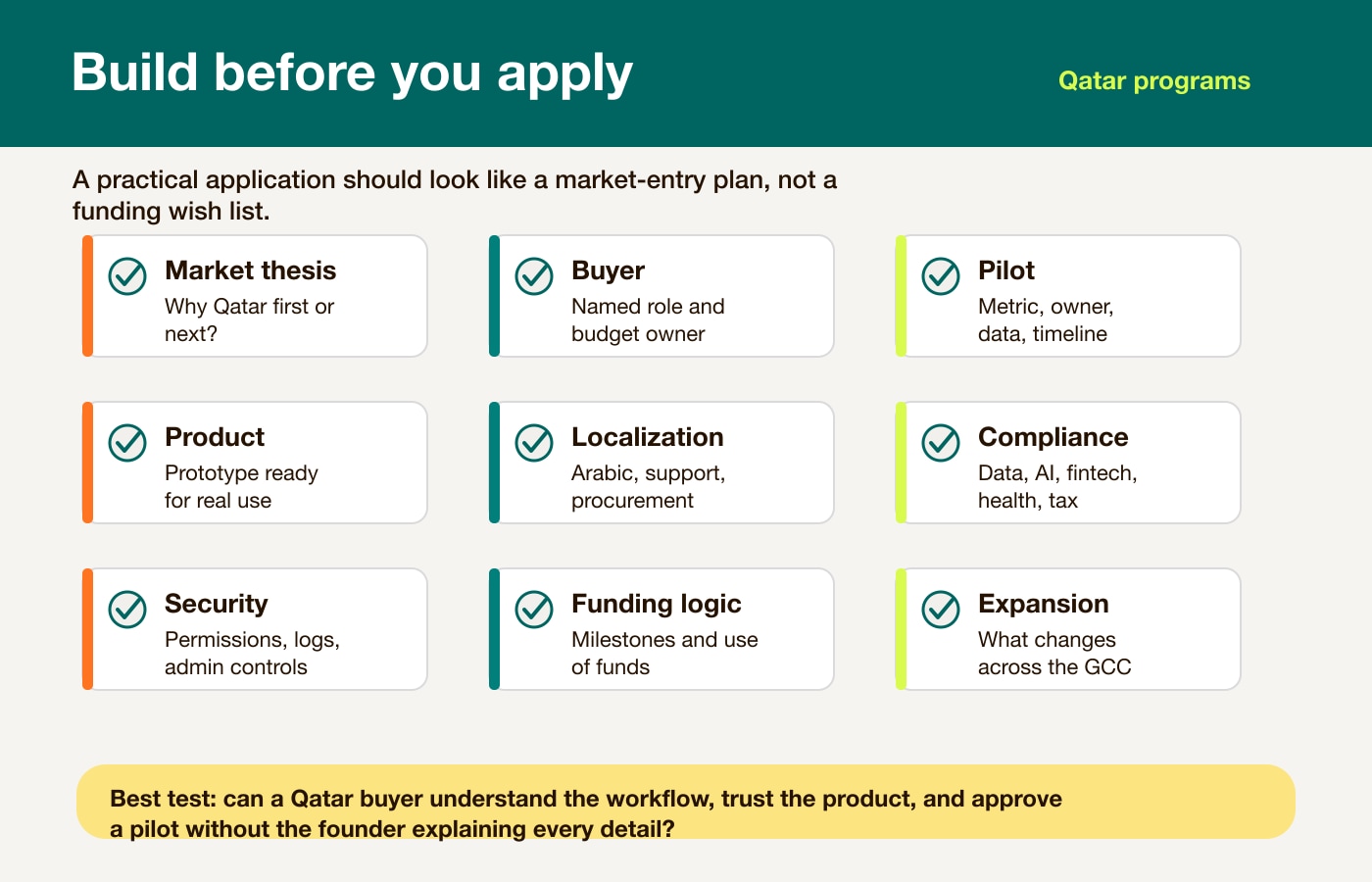
Build-before-you-apply checklist
Founders should not treat Qatar programs as a substitute for product work. A strong application should look like a serious market-entry plan.
| Readiness area | Minimum standard before applying |
|---|---|
| Market thesis | One clear reason Qatar is the right first or next GCC market |
| Buyer | One named buyer type, one urgent workflow, one budget owner |
| Sector fit | Direct fit with a Qatar priority sector, not a forced keyword match |
| Pilot design | Success metric, timeline, implementation owner, data needs, and post-pilot decision rule |
| Product maturity | Working product or validated prototype that can be tested with a real organization |
| Localization | English and Arabic needs, support model, local norms, and procurement expectations reviewed |
| Compliance | Data, fintech, health, AI, immigration, tax, sector, and licensing exposure mapped |
| Security | Admin controls, permissions, logs, data handling, and incident response basics ready |
| Funding logic | Clear use of funds, milestone plan, and what Qatar support unlocks |
| Expansion path | View of what changes for Saudi Arabia, UAE, Bahrain, Oman, Kuwait, or wider MENA |
The strongest founders will also prepare a “Qatar pilot memo” before they apply. It should fit on two pages: problem, buyer, workflow, product, pilot scope, success metric, required partner, implementation timeline, risks, and expansion logic.
Founder challenges in Qatar
The first challenge is over-relying on access. Qatar can create access quickly, especially around Web Summit, QDB, Startup Qatar, QFC, QSTP, and sector accelerators. Access is not adoption. Adoption still requires procurement, integration, support, trust, data readiness, and an internal owner.
The second challenge is market size. Qatar is a high-value market, but it is not a huge standalone market. Most startups need a Qatar-plus-GCC thesis. The right question is: what can Qatar help us prove that makes expansion into Saudi Arabia, UAE, Oman, Bahrain, Kuwait, or wider MENA more credible?
The third challenge is buyer concentration. A smaller market means fewer major buyers in some categories. That can help a focused founder, but it can punish vague positioning. If the buyer list is short, the product has to be sharper.
The fourth challenge is localization. Arabic support, local procurement norms, relationship depth, sector credibility, and local operating presence can matter more than the pitch deck suggests.
The fifth challenge is enterprise readiness. Many Qatar opportunities sit near government, finance, logistics, infrastructure, health, education, or national programs. These buyers will care about security, data handling, reliability, implementation, and support. A lightweight MVP is not enough if the workflow touches serious operations.
What product opportunities founders should prioritize
For fintech founders, prioritize infrastructure over novelty. Qatar does not need another thin finance app. It needs products that reduce friction around onboarding, payments, reconciliation, SME finance, compliance, merchant operations, and trusted embedded finance.
For AI founders, sell a workflow outcome. “AI assistant” is too vague. A stronger thesis is “reduce document review time for a legal department,” “automate bilingual customer support quality checks,” or “help a logistics operator forecast exceptions before they become service failures.”
For climate, energy, and smart-city founders, anchor the product in asset operations. Qatar’s built environment, transport network, energy systems, water constraints, and food-security priorities create demand for measurable efficiency. The product should make reporting, optimization, or operational control easier for a real owner.
For healthtech founders, start with trust and integration. Qatar’s healthcare system is sophisticated. A product needs privacy, clinical handoff, evidence, and workflow fit before it can scale.
For B2B SaaS founders, do not pitch digital transformation. Pick a department. Finance, procurement, HR, legal, customer service, IT, compliance, facilities, and operations all have different pain, budgets, and risk thresholds.
For founders still shaping the product, Hapy’s MVP development work is relevant because Qatar rewards a serious MVP: narrow enough to pilot, strong enough to trust, and local enough to be useful.
How to use Qatar as a market-entry thesis
Qatar is a strong choice when the product needs one or more of these conditions:
- A public-sector or enterprise pilot with a serious buyer.
- A controlled environment for AI, fintech, logistics, health, climate, sports, or smart-city technology.
- A strategic partner that can validate the product before wider GCC expansion.
- Access to state-backed programs without losing the need for commercial proof.
- A small but influential market where trust and coordination matter.
Qatar is a weak choice when the startup only wants a logo, a soft-landing subsidy, or a conference story. Those can help, but they will not compensate for a vague product, unclear buyer, weak localization, or missing compliance plan.
The best founder posture is practical: use Web Summit for momentum, Startup Qatar and QDB for structured entry, QFC or another jurisdiction for fit, TASMU or sector programs for pilots, and Qatar’s digital agenda as a map of buyer problems. Then build the product around the specific workflow that proves the thesis.
That is the real opportunity in the Qatar startup ecosystem: not just entering a state-backed innovation market, but using its concentration to build something that can be trusted, piloted, and expanded across the GCC.