A custom inventory management app is worth building when the way your business buys, stores, allocates, sells, transfers, or reports stock is part of your operating advantage. If the inventory process is mostly standard, packaged inventory software or an ERP module will usually be faster, safer, and cheaper to maintain.
That distinction matters because inventory systems are not simple databases. A real inventory app changes stock counts, purchasing decisions, warehouse behavior, customer promises, accounting records, and leadership reporting. When the system is wrong, people stop trusting it and rebuild the business in spreadsheets.
The better build vs buy question is not “Can we build an inventory app?” It is “Which inventory decisions should we own, and which ones should we let mature software handle?”
The Practical Build vs Buy Answer
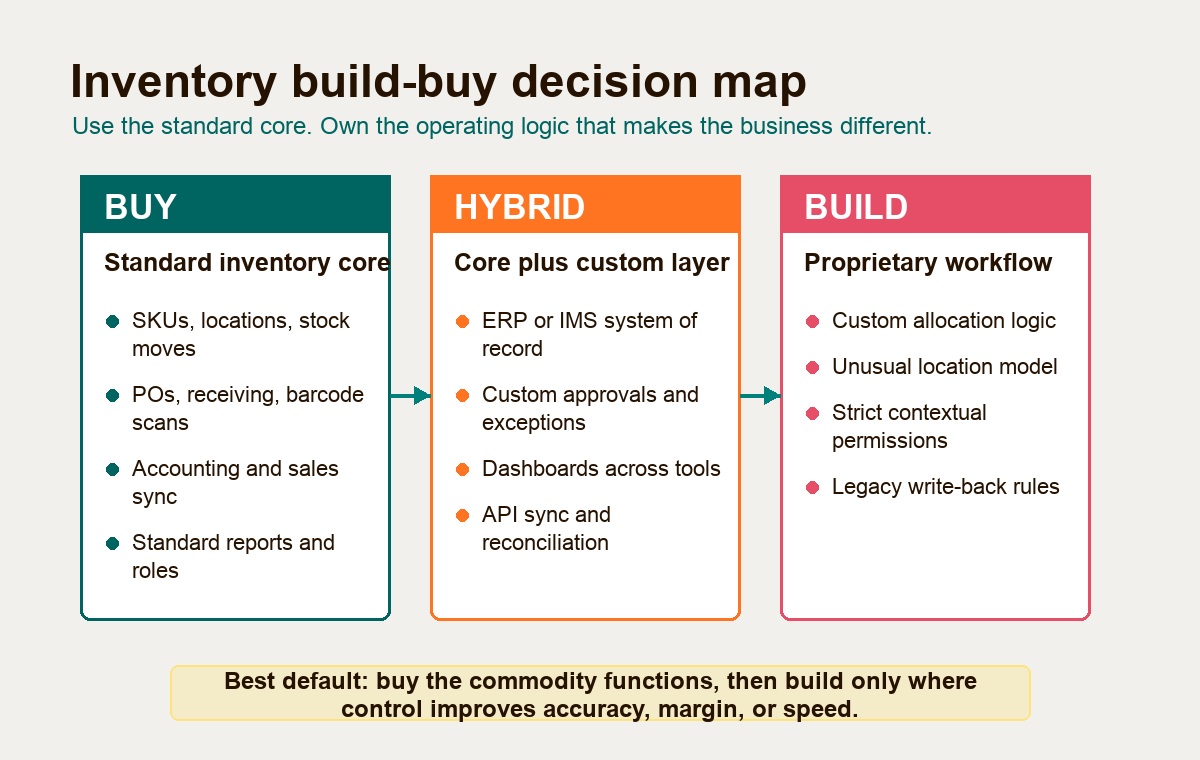
Buy packaged inventory software when your requirements look like normal inventory operations: SKUs, locations, stock adjustments, purchase orders, barcode scanning, order sync, reporting, accounting integration, and basic user roles. Tools in this category already solve the commodity work.
Build a custom inventory management app when the workflow itself is unusual or economically important. That might mean proprietary replenishment logic, complex approvals, custom allocation rules, unusual location models, industry-specific compliance, customer-specific pricing, cold-chain handling, repair inventory, consignment stock, field inventory, or a workflow that depends on several legacy systems.
Use a hybrid model when the business needs a stable inventory or ERP system of record, but the team also needs custom screens, automations, reports, or integration logic around it. This is often the strongest path for growing businesses: buy the core, then build the operating layer that makes the core fit the real work. Before estimating that layer, define the source-of-truth, sync, logging, and failure rules in a custom web app integration plan.
Hapy’s guide to custom ERP vs internal tools covers the wider version of this decision. Inventory is one of the places where that distinction becomes visible quickly because bad data turns into delayed orders, stockouts, overbuying, and manual reconciliation.
| Decision area | Buy inventory or ERP software | Build custom inventory software | Use a hybrid layer |
|---|---|---|---|
| Best fit | Standard stock, purchasing, warehouse, and reporting needs | Proprietary operational logic or unusual constraints | Standard core with custom workflows around it |
| Speed | Fastest to launch if requirements fit the tool | Slower because workflow, data, QA, and rollout all need design | Moderate: core launches first, custom parts follow |
| Cost shape | Lower upfront, recurring licenses, implementation, add-ons | Higher upfront, ongoing maintenance, hosting, support | Balanced setup cost plus selected build work |
| Main risk | Vendor lock-in, workflow gaps, forced workarounds | Scope creep, data bugs, maintenance burden | Brittle integrations if ownership is unclear |
| Strong examples | Basic stock control, purchasing, barcode scanning, accounting sync | Custom allocation, approvals, replenishment, industry logic | Custom portal, dashboards, exception workflows, API sync |
What Packaged Inventory and ERP Tools Already Do Well
Packaged inventory tools are strong when the business can adapt to standard operating patterns. They usually include item records, stock movements, reorder points, purchase orders, receiving, transfers, picking, packing, barcode support, reporting, and integrations with ecommerce, accounting, POS, 3PL, and shipping systems.
That maturity is valuable. Cin7’s 2025 State of Inventory Intelligence Study, based on 530 inventory and supply chain professionals in the US, Europe, and Australia, found that employees lose 16 hours a week manually syncing inventory across disconnected systems. The same study reported that outdated tools hold half of businesses back from scaling. When the problem is disconnected standard work, buying an integrated inventory platform can remove a lot of waste.
Packaged systems also carry features that are easy to underestimate in a custom build:
- Multi-location inventory and warehouse transfers
- Purchase orders, receiving, vendor records, and landed cost workflows
- Barcode scanning and label printing
- Role-based access, manager approvals, and audit trails
- Standard inventory valuation and accounting sync
- Ecommerce, POS, marketplace, shipping, and 3PL integrations
- Reporting across stock, sales, purchasing, and fulfillment
- Vendor support, documentation, upgrades, and security patches
Approval workflows are a useful vendor-demo test. Ask a shortlisted provider to demonstrate the exact transaction types, approval separation, and licensed roles you need. A generic claim of “approvals supported” does not establish that your workflow fits.
For a broader category view, Hapy’s enterprise application types guide explains how ERP, SCM, BI, workflow automation, and custom internal systems fit together.
Where a Custom Inventory Management App Wins
A custom inventory management app wins when the inventory workflow is too specific or too valuable to force into a vendor’s default model.
The strongest build cases usually include at least one of these conditions:
- Inventory decisions directly affect margin, availability, service levels, or customer promises.
- Stock moves across unusual location types, such as vans, job sites, pop-ups, repair benches, consignment shelves, or temperature zones.
- Approval rules depend on customer, region, location, value threshold, vendor, product class, or exception type.
- The business needs custom allocation, replenishment, pricing, reservation, or substitution logic.
- Barcode, RFID, QR, or serial tracking must support a workflow the vendor cannot model cleanly.
- The system needs to write to several tools with strict timing, rollback, or reconciliation rules.
- Standard reporting is not enough because leaders need operational metrics that combine inventory, purchasing, sales, finance, and fulfillment.
- Teams already use a packaged tool but keep a second “truth” in spreadsheets.
The last point is the one to take seriously. If employees keep private spreadsheets because the official inventory tool does not match the work, the company does not have one system. It has a licensed system plus an unmanaged shadow system.
Custom software can solve that by matching the exact workflow. But it also creates responsibility. A custom app needs data modeling, permissions, validation, testing, monitoring, support, documentation, training, and ongoing improvements. If nobody owns those after launch, the custom app becomes the next legacy system.
That is why Hapy’s internal tools examples guide treats custom tools as operating systems, not side projects. The build only works when it becomes easier and more trustworthy than the workaround it replaces.
The Edge Cases That Decide the Inventory App Build vs Buy Choice
The build vs buy decision usually becomes clear when you pressure-test the edge cases. A vendor demo can handle the happy path. Your decision should focus on the awkward parts of the workflow.
Approvals
Buy when approval rules are standard: purchase order thresholds, manager signoff, transfer approval, vendor bill approval, and basic separation of duties.
Build or extend when approvals depend on several variables at once, such as margin impact, customer tier, location, perishability, contract rules, stock age, demand forecast, or exception history. A custom approval layer can also be useful when the approval action needs to update inventory, notify finance, trigger purchasing, and create an audit record across several tools.
Locations
Buy when inventory sits in a small number of warehouses, stores, or bins that map cleanly to the vendor’s location model.
Build or extend when location logic is part of the business: mobile inventory, technician vans, production floors, job sites, customer-owned stock, consignment, multi-temperature storage, return locations, quarantine zones, or serialized assets that move between many temporary states.
Barcode, RFID, and Product Identity
Buy when standard barcode scanning, receiving, picking, cycle counts, and label workflows are enough. The global barcode ecosystem is mature: GS1 says its barcodes are scanned more than 10 billion times each day, which is one reason packaged systems usually treat barcode support as a core inventory feature.
Build or extend when barcode, QR, RFID, serial, lot, expiry, or sensor data needs special handling. RFID can improve inventory visibility, but it is not magic. Test read accuracy and reconciliation with your products, tags, readers, and physical environment before relying on RFID. The operational lesson is simple: scanning technology only helps when the app turns scans into trusted workflow changes.
Role Access
Buy when role access follows a standard model: warehouse worker, manager, purchasing, finance, admin, reporting user, and auditor.
Build or extend when permissions need to be contextual. For example, a regional manager can approve transfers only for certain locations, a warehouse worker can adjust damaged stock only below a threshold, or a buyer can view vendor pricing but not customer-level margin.
Purchasing
Buy when purchasing follows standard reorder points, supplier records, purchase orders, receiving, and vendor bill flows.
Build or extend when purchasing depends on custom demand signals, long supplier lead times, MOQ constraints, seasonal allocation, container optimization, landed cost rules, approval chains, or customer-specific commitments.
Reporting
Buy when leadership needs standard stock value, reorder, movement, sales, aging, and purchase reports.
Build or extend when reporting needs to answer operating questions the vendor cannot combine well: which locations are creating avoidable transfers, which SKUs tie up cash without protecting service levels, which customers drive exception handling, which vendors create lead-time risk, or which approval delays cause stockouts.
Integrations
Buy when the vendor already has reliable native integrations for accounting, ecommerce, POS, marketplaces, 3PL, shipping, EDI, and BI.
Build or extend when integrations are deep, legacy, write-active, or business-critical. Inventory is not just a read-only dashboard. It writes stock changes, purchase decisions, allocations, reservations, order status, and financial records. If a sync fails, duplicates, reverses, or arrives late, the app can make the business less accurate than before.
When a hybrid model fits
For many growing businesses, the right answer is not a full custom inventory platform or a pure packaged tool. It is a hybrid architecture: packaged software for the system of record, custom software for the parts that make the business different.
Evaluate the third-party dependency as well as the custom code. Buy standard capabilities where they fit, and build where control creates a demonstrated advantage. A hybrid system still needs a clear data owner and a tested response to failed or duplicate writes.
In inventory, a hybrid model might look like this:
- Use an ERP or inventory platform for item records, stock ledger, financial sync, purchasing, and audit history.
- Build a custom internal inventory tracking app for the team’s real daily workflow: approvals, exceptions, allocation, field inventory, role-specific screens, or operational dashboards.
- Use APIs, queues, validation rules, and reconciliation reports so the custom layer never becomes an uncontrolled second source of truth.
The goal is not to decorate an ERP with a prettier interface. The goal is to protect the core records while giving operators a system they can actually use.
Maintenance and Data Accuracy Are the Real Risks
The biggest custom inventory software risk is not the first release. It is month nine, when new locations, new approval rules, new purchasing exceptions, and new integrations start testing whether the system was designed for change.
Custom inventory systems need ongoing ownership in at least six areas:
- Data quality: SKU cleanup, duplicate records, unit conversions, location naming, vendor data, and historical imports.
- Transaction accuracy: receiving, transfers, adjustments, reservations, cycle counts, returns, and write-back rules.
- Security: role access, audit history, account provisioning, and separation of duties.
- Integration health: API limits, failed syncs, retry logic, reconciliation, and vendor changes.
- Operational support: training, issue triage, documentation, and release notes.
- Roadmap discipline: deciding which exceptions deserve software and which should stay as process rules.
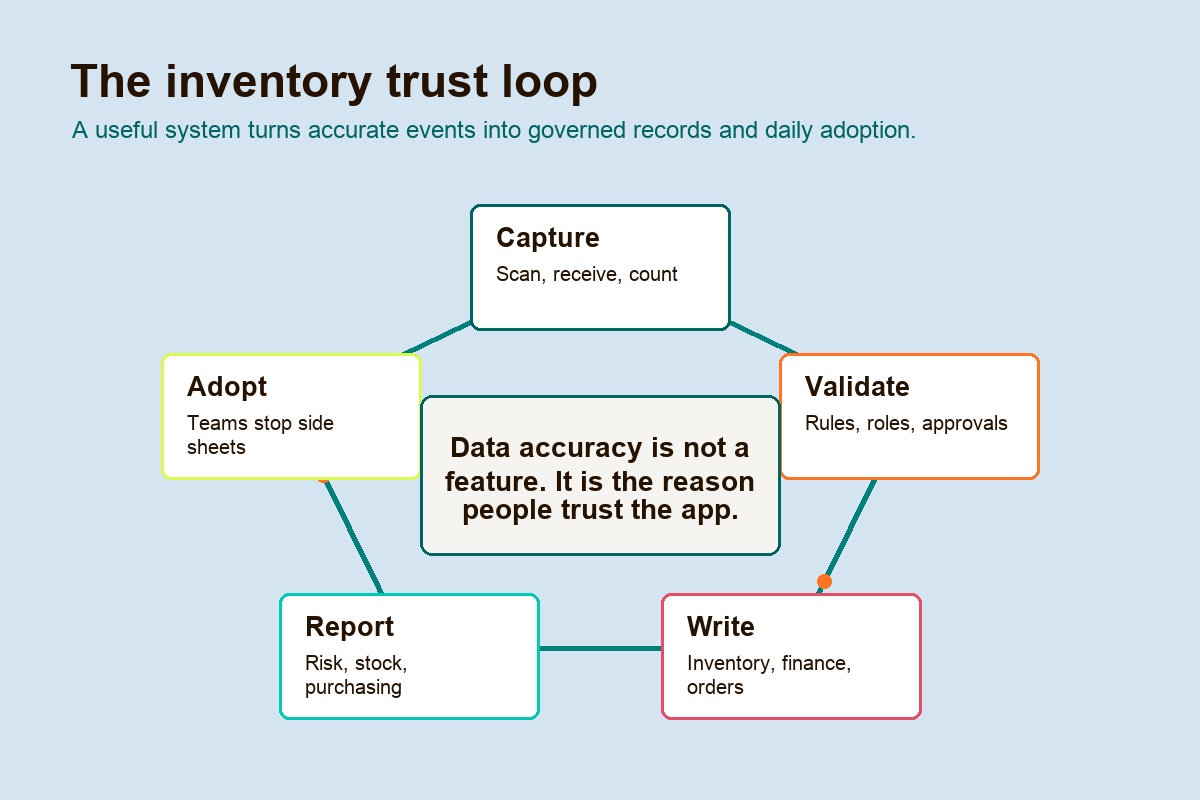
Do not build a custom inventory management app if the business is not ready to maintain it. Do not buy a packaged tool if the team will immediately bend the business back into spreadsheets. Both decisions fail when data accuracy is treated as a technical detail instead of the foundation of trust.
A useful hybrid pilot follows one physical stock movement from scan to ledger, accounting sync, and reconciliation. Compare completion time and correction work with a matched baseline. Do not assume a scanner or ERP connection improves accuracy until duplicate scans, missing scans, and sync failures have been tested.
A Simple Scorecard for the Decision
Use this unweighted planning heuristic before committing to a build, buy, or hybrid plan. Score each factor from 1 to 5 and record evidence for the score. User count alone does not favor a custom build: packaged systems can support large operations. Compare capacity, licensing, role fit, and support cost with the same workload.
| Factor | 1 favors buying | 5 favors building |
|---|---|---|
| Workflow differentiation | Same as peers | Proprietary operating logic |
| Location complexity | Few standard warehouses or stores | Many unusual or temporary inventory states |
| Integration depth | Native connectors are enough | Multiple write-active or legacy systems |
| Approval complexity | Basic manager approvals | Contextual, multi-rule approval flows |
| Data control | Standard reporting is enough | Strict ownership, audit, residency, or IP needs |
| Role fit | Vendor roles fit the required user groups | Demonstrated permission or workflow gaps across roles and partners |
| Maintenance capacity | No internal owner | Clear technical and operational ownership |
Interpret the pattern, not just the total:
- Mostly 1s and 2s: buy packaged inventory software or configure an ERP module.
- Mostly 3s: use a hybrid model. Buy the core and build the layer that handles workflow gaps.
- Mostly 4s and 5s: consider custom inventory software, but only after discovery, data cleanup, and maintenance ownership are clear.
The custom path should come with a serious implementation plan: workflow mapping, data model, permissions, integration architecture, QA, pilot rollout, support model, and measurable adoption criteria.
What To Do Before You Choose
Before talking to vendors or writing a custom app brief, document the operating reality.
- List the inventory workflows that cause the most manual work, errors, stockouts, overbuying, or reporting disputes.
- Identify the system of record for SKUs, locations, vendors, orders, stock movements, and financial values.
- Mark every place where people export, copy, re-enter, or “fix” inventory data in spreadsheets.
- Separate standard needs from differentiating needs.
- Decide which data changes must be controlled with approvals, audit trails, or reconciliation.
- Estimate the cost of the current workaround: labor hours, excess stock, missed sales, delayed purchasing, support tickets, and leadership time.
- Choose the smallest system change that would make the business trust inventory data more than its side spreadsheets.
That last sentence is the key. Inventory software succeeds when operators trust the system enough to stop maintaining private backups. It fails when the official record is technically present but operationally ignored.
If the decision points toward a narrow internal layer, Hapy’s Business Systems & Automation work can help map the workflow, design the operating layer, and connect the tools without jumping straight into a full ERP replacement. If the problem is broader and enterprise-grade, compare the path against enterprise application development before writing a larger custom software brief.
Final Takeaway
A custom inventory management app is not a badge of sophistication. It is a responsibility. Build one when inventory logic creates advantage and the business can maintain the system. Buy packaged inventory or ERP software when the workflow is standard and the vendor model fits. Use a hybrid model when the core records should stay governed, but the daily workflow needs a custom layer to become accurate, usable, and trusted.