Custom web app integrations connect internal software with the systems a business already depends on: CRM, ERP, accounting, inventory, support, analytics, ecommerce, and operations tools. The value is not just moving data between apps. The value is making sure the right system owns the right record, the right workflow updates at the right time, and the business can trust what happened when something fails.
The expensive integration mistake is treating the first successful API call as proof that the project is understood. It is not. A working connection can still corrupt data, overwrite the wrong source, miss delayed events, hide failures in logs, or create a manual cleanup burden that only appears after launch.
Good business app integration planning should happen before build. It should cover API access, system ownership, sync frequency, failure handling, logs, and data mapping in enough detail that the estimate reflects real risk, not a clean feature list. If those decisions are still unknown, pause before treating the build scope as fixed.
When API access, data quality, or ownership is still uncertain, use technical discovery to resolve those risks before the estimate becomes a commitment.
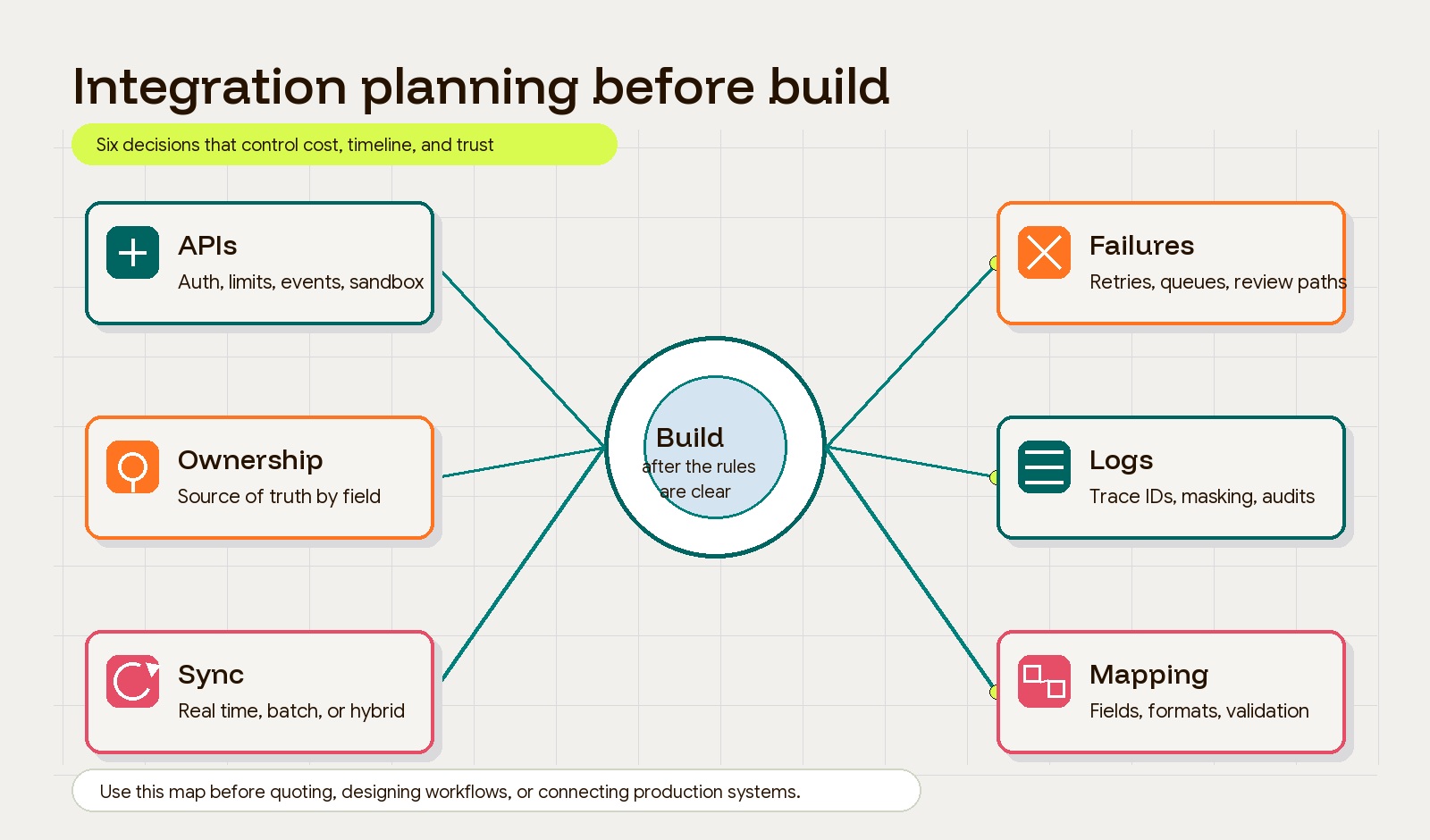
What custom web app integrations should decide before build
Custom web app integrations should define six things before development starts: which APIs are available, who owns each record, how often data should sync, what happens when systems fail, what must be logged, and how fields map between systems. These decisions shape architecture, QA, timeline, cost, and post-launch ownership.
Think of the planning phase as a control layer. It does not need to over-engineer every future state, but it does need to remove the ambiguity that can damage the system later.
| Planning area | Decision to make before build | Why it changes scope |
|---|---|---|
| API access | Which endpoints, auth model, limits, sandbox, and events are available | Weak APIs require middleware, queues, retries, or manual fallback |
| Ownership | Which system is the source of truth for each object and field | Bad ownership rules create duplicates, overwrites, and support cleanup |
| Sync frequency | Real time, scheduled, batch, manual approval, or hybrid | Real-time sync increases failure handling and monitoring needs |
| Failure handling | Retry, quarantine, dead-letter queue, manual review, or compensation | Recovery design can be larger than the happy-path integration |
| Logs and audits | What is tracked, masked, retained, and searchable | Sensitive data and compliance requirements affect observability design |
| Data mapping | Field names, formats, validations, transformations, and conflicts | Dirty or mismatched data adds profiling, normalization, and reconciliation |
This is where integration work connects directly to web application architecture. A light internal tool and a business-critical operating layer should not be designed the same way. If the custom app becomes the bridge between sales, finance, delivery, inventory, and reporting, the integration architecture is part of the product.
Start with the APIs, but do not stop there
API planning should answer what each connected system can actually support. Check authentication, scopes, endpoint coverage, payload formats, rate limits, sandbox access, webhook support, error codes, pagination, and versioning. The buyer-friendly question is simple: can this system support the workflow we want without forcing fragile workarounds?
For example, a CRM integration may look straightforward if the app only reads accounts and contacts. It becomes more serious when the same app must create leads, update opportunity stages, attach documents, trigger tasks, and keep sales activity aligned with finance. Salesforce exposes broad integration options through its REST API developer documentation, but the project still needs to decide which objects, fields, permissions, limits, and events matter.
ERP integrations usually need more caution. An ERP may own orders, inventory, tax, fulfillment, and invoicing rules that the custom app should not casually override. Oracle NetSuite documents REST web services as one option for external integration in its SuiteTalk REST Web Services guide, but access alone does not settle process ownership, validation, or rollback behavior.
Accounting tools add a different kind of risk. A custom app that sends invoice, bill, payment, or customer data into QuickBooks must respect accounting workflows, not just object names. Intuit’s QuickBooks Online Accounting API gives the endpoints, but the build plan still needs posting rules, tax handling, reconciliation, and review paths.
The API review should produce a short build-facing inventory:
- Systems to connect
- Objects and fields needed
- Authentication method and credential owner
- Read and write permissions
- Rate limits and throttling behavior
- Webhook or event availability
- Sandbox and test data availability
- Known gaps, manual workarounds, and fallback paths
If the API review is vague, the estimate will be vague even when the proposal looks precise.
Decide ownership before syncing records
Integration planning should assign a source of truth for each core data domain. The CRM might own customer identity and sales stage. The ERP might own orders, fulfillment, billing terms, and product availability. Accounting might own invoices, payments, credits, and tax records. Support might own tickets, service history, and customer issue categories. Analytics should usually consume data, not become the place where operational records are corrected.
This ownership decision sounds administrative, but it is architectural. If two systems can update the same field, the integration needs conflict rules. If one system can create records that another system must approve, the workflow needs state management. If a user edits a billing address in the CRM while finance edits the same customer in the ERP, the app needs to know which update wins.
A practical ownership map might look like this:
| Data domain | Likely source of truth | Common consumers | Planning risk |
|---|---|---|---|
| Leads and sales activity | CRM | Marketing, reporting, support | Duplicate accounts, weak dedupe rules, unclear lifecycle stages |
| Sales orders and fulfillment | ERP | CRM, inventory, shipping, BI | Status mismatch, partial order updates, tax or fulfillment constraints |
| Invoices and payments | Accounting or ERP finance module | CRM, customer portal, analytics | Timing differences, failed payment events, reconciliation gaps |
| Inventory and SKU availability | ERP, WMS, PIM, or ecommerce platform | CRM, ecommerce, support | SKU mismatch, overselling, stale availability |
| Support tickets and cases | Support platform | CRM, product, analytics | Customer identity mismatch, private notes, escalation rules |
| Performance reporting | Analytics or BI layer | Leadership, operations, sales | Metric definitions, delayed data, untrusted joins |
This is also where internal app API integrations can fail quietly. The app may appear to save data correctly, but the wrong system may become the de facto master because it updates faster or has the easier interface. Write the ownership rules down before implementation.
Pick sync frequency by business urgency
Not every integration should be real time. Real-time sync is valuable when the business needs immediate action, such as payment confirmation, inventory reservation, fraud review, shipping updates, or customer support escalation. Scheduled sync is often better for reporting, nightly reconciliation, catalog updates, financial close workflows, and bulk imports.
The planning question is not “Can we make it instant?” It is “How fresh does this data need to be for the decision it supports?”
Common patterns include:
| Sync pattern | Good fit | Watch for |
|---|---|---|
| Real-time webhook | Payment events, ticket escalation, order status, shipment updates | Retries, duplicate events, authentication, endpoint downtime |
| Scheduled polling | Legacy systems, low-urgency updates, systems without webhooks | API limit waste, stale data, repeated empty responses |
| Batch sync | Inventory snapshots, finance reports, analytics exports, catalog updates | Delays, failed batch recovery, business-hour performance |
| Hybrid sync | High-value events plus periodic reconciliation | More design work, but stronger trust over time |
| Manual approval sync | Finance, compliance, sensitive customer data, exception workflows | More operations work, but better control |
Stripe’s webhook documentation is a useful reminder that event-driven systems still need operational design: webhook endpoints can receive duplicate events, and systems should handle retries and idempotency rather than assuming each event arrives once. The same lesson applies outside payments. Shopify’s webhook documentation is also a good example of event-driven operational thinking for ecommerce and inventory-related workflows.
For many growing businesses, the strongest pattern is hybrid. Use events for urgent changes, then run scheduled reconciliation to catch missed events, delayed records, and downstream disagreements. That extra reconciliation step is often cheaper than having operators manually discover that the numbers no longer match.
Design failure handling as part of the product
Every integration fails eventually. Credentials expire. APIs time out. Vendors change fields. Rate limits get hit. Payloads arrive twice. Data does not validate. A finance record locks before the CRM update arrives. A support ticket references a customer ID the ERP does not know yet.
Failure handling should be designed before build because it affects user experience, architecture, support, and cost. A useful plan separates temporary failures from permanent failures.
Temporary failures may need retries, exponential backoff, queueing, or a circuit breaker that stops sending traffic to a failing service. Permanent failures need quarantine, manual review, better validation, or a business rule decision. A bad email format, missing SKU, duplicate customer ID, invalid tax code, or blocked accounting period will not fix itself because the system retries.
Plan these recovery paths:
- What should retry automatically?
- What should go to a review queue?
- Who gets alerted?
- What data does the support person need to fix it?
- Can the event be replayed safely?
- What prevents duplicate records?
- What happens if step three fails after steps one and two already succeeded?
This is where integration scope often expands. The happy path is small. The recovery path is what makes the system trustworthy.
If you are estimating this work, compare the integration plan with Hapy’s custom software development cost by risk. Integration risk, workflow ambiguity, compliance, data quality, and support ownership can all change cost even when the visible screens do not change.
Plan logs, audits, and observability without leaking sensitive data
Custom software integrations need logs because operators need to know what happened. But logs can become a liability if they store customer emails, payment tokens, access credentials, IP addresses, private support notes, or employee data without masking.
A useful logging plan answers four questions:
- What events must be tracked for diagnosis and audit?
- Which fields must never be stored in raw form?
- How long should logs be retained?
- Who can search, export, replay, or delete integration records?
OpenTelemetry describes observability through signals such as traces, metrics, and logs. In integration planning, those signals should map to operational questions: how many events were processed, how long each step took, which system failed, what error type occurred, whether the message was retried, and whether the final state reconciled.
The practical minimum is a correlation ID that follows one business event across systems. If a closed-won deal creates an ERP order, invoice draft, onboarding task, and analytics record, operators should be able to trace that chain without reading raw sensitive payloads.
For regulated or sensitive workflows, add masking at ingestion. Do not rely on people to avoid logging private values manually. The system should redact or hash sensitive fields before they are stored.
Map data before writing transformation code
Data mapping turns business meaning into implementation detail. A CRM field called account_id may not mean the same thing as an ERP customer number. A quote total may include discounts while an invoice total includes tax. A support priority may have four states while the CRM has three. A product name may be editable in one tool but locked in another.
Before build, map:
- Source and target field names
- Data types and formats
- Required and optional fields
- Character limits
- Picklist or enum values
- Currency, tax, timezone, and date rules
- Validation rules
- Conflict resolution
- Backfill and reconciliation method
The mapping stage should also include source data profiling. If the source data already contains duplicates, nulls, invalid dates, inconsistent SKUs, or historical one-off values, the integration will not magically clean it up. It will spread the problem faster.
For analytics integrations, the mapping plan must also define metrics. Google Analytics Data API reports are built from selected dimensions and metrics, but business reporting often needs CRM, ERP, finance, and support data joined with web behavior. The integration plan should explain what each metric means before it appears in a dashboard.
Examples across CRM, ERP, finance, inventory, support, and analytics
The best examples are boring in the right way. They remove manual work without hiding ownership.
| Integration example | Useful flow | Planning decisions |
|---|---|---|
| CRM to ERP | Closed-won deal creates a sales order | Who owns customer identity, billing address, order status, and product pricing? |
| ERP to CRM | Fulfillment status appears on the account record | How fresh does status need to be, and what happens when partial shipments occur? |
| Accounting to customer portal | Paid, unpaid, and overdue invoices appear for customers | Which finance system owns the ledger, and how are failed payment events replayed? |
| Inventory to ecommerce or sales tool | Available quantity blocks overselling | Is inventory real time, batch, location-specific, or reserved by pending orders? |
| Support to CRM | Ticket themes and account health appear for sales and success | Which notes are private, and how are contacts matched across systems? |
| Analytics to operations dashboard | Website, sales, revenue, and support signals appear together | Which metric definitions are trusted, and how often are reports reconciled? |
Zendesk’s ticketing API documentation shows how support records can be exposed programmatically, but connecting tickets to revenue or operations still requires identity matching, permissions, and clear field rules. That is the pattern across the whole stack: documentation opens the door, planning decides whether the workflow should walk through it.
Common risks that affect cost and timeline
Integration projects get expensive when uncertainty is hidden until development. The common risks are predictable:
| Risk | What it looks like | Cost and timeline effect |
|---|---|---|
| Weak API access | Missing endpoints, poor docs, no sandbox, unstable auth | More technical spikes, mocks, middleware, and QA |
| Unclear source of truth | CRM and ERP both update the same customer fields | Rework, duplicate cleanup, support tickets, conflict logic |
| Overuse of real time | Every workflow is treated as urgent | More queues, monitoring, retries, and production support |
| No failure model | Failed events disappear or require developer cleanup | More incidents, manual recovery, lost trust |
| Dirty source data | Duplicates, invalid formats, missing required values | Data cleanup, profiling, migration scripts, reconciliation |
| Sensitive logs | Tokens, emails, finance data, or private notes leak into logs | Security review, masking work, retention policy, access controls |
| Metric disagreement | CRM revenue, finance revenue, and dashboard revenue differ | More governance, definitions, and reconciliation cycles |
| Vendor change | API versions, auth rules, field behavior, or limits change | Maintenance budget and monitoring become necessary |
This is why custom software integrations should be priced by risk, not only by number of systems. A three-system integration with clean APIs and clear ownership can be simpler than a two-system integration with messy data and bidirectional finance rules.
A practical integration planning checklist
Before approving build scope, ask the team to produce these artifacts:
- System inventory: every platform, owner, API, environment, and credential path.
- Data ownership map: source of truth by object and field.
- Workflow map: trigger, action, approval, exception, and final state.
- Sync plan: real time, batch, polling, manual review, or hybrid for each data flow.
- Failure model: retry rules, quarantine, alerts, replay, and manual recovery.
- Logging plan: correlation IDs, metrics, audit events, masking, retention, and access.
- Data map: fields, types, transformations, validation, conflict rules, and test cases.
- Reconciliation plan: how systems are checked after the initial sync succeeds.
- Support ownership: who monitors, who responds, and who approves changes after launch.
For Hapy’s Business Systems & Automation work, this is the useful pre-build discipline. The goal is not to make planning heavy. The goal is to make the build honest enough that the system can run inside a real business without becoming another fragile tool.
The build should follow the operating risk
The right architecture depends on what the integration must protect. A lightweight internal reporting sync may only need scheduled pulls, field validation, and visible error reporting. A finance or fulfillment integration may need queues, idempotency, audit trails, role-based access, reconciliation, and human approval for exceptions. A customer-facing portal may need a different failure experience again because customers should not see internal system fragility.
Start with the smallest architecture that carries the real risk. Then add resilience where failure would damage revenue, operations, compliance, or trust.
That is the planning principle behind custom web app integrations: connect the tools, but design the ownership, failure paths, logs, and data rules first. The integration should make the business easier to run, not just move records faster between systems.