AI product development is the work of turning an AI capability into software that users can trust, operators can manage, and the business can afford to run. The hard part is rarely choosing the model first. It is choosing the right use case, designing the workflow around uncertainty, preparing the data, measuring output quality, controlling risk, and rolling out the product without letting a polished demo become a fragile system.
That distinction matters because AI adoption has already moved past isolated experimentation. McKinsey’s 2025 global AI survey found that 88% of respondents reported regular AI use in at least one business function, up from 78% the prior year. But using AI inside a function is not the same as shipping an AI product. Products need repeatable value, observable quality, defensible trust, and a roadmap that can survive messy users.
For founders, CTOs, and innovation teams, the practical question is not “Can we add AI?” The better question is: where should AI change the product experience enough that customers will care, and what operating model will keep that experience reliable after launch? The UK startup ecosystem guide applies that question to AI policy, city clusters, regulated buyers, and sector opportunities.
If the work is mostly about automating an internal process, start with Hapy’s Business Systems & Automation approach or the guide to AI automation ROI. This playbook focuses on AI as product: enterprise copilots, support automation that becomes a product workflow, research agents, and vertical SaaS AI features that users judge as part of the core product experience.
If the use case is still unproven, pair this with Hapy’s product validation framework before committing production budget. If the technical risk is the main unknown, run technical discovery before treating the demo as a build plan. For the narrower first-release plan, use the AI MVP development guide to define the workflow, evaluation loop, review controls, and budget boundary.
What AI product development actually includes
AI product development includes product strategy, use-case selection, UX design, data architecture, model integration, evaluation, guardrails, cost controls, release management, and post-launch monitoring. The model is one component inside a larger product system.
A useful AI product usually combines four layers:
| Layer | What it decides | Common failure when skipped |
|---|---|---|
| Product workflow | Who uses the AI, when, and what decision or job it improves | The feature feels impressive once but does not become a habit |
| Trust design | How users understand uncertainty, evidence, and control | Users either overtrust bad outputs or ignore useful ones |
| Data and architecture | What knowledge, tools, permissions, and integrations the model can use | The prototype works on curated examples but breaks on real data |
| Operating model | How quality, risk, cost, and rollout are measured after launch | The team cannot tell whether the product is improving or drifting |
This is where AI product strategy differs from a model-selection exercise. A customer-facing research agent may need citations, saved workspaces, source freshness, permissions, and review trails. An enterprise copilot may need role-based access, latency targets, escalation rules, and tenant-level controls. A vertical SaaS AI feature may need strict structured outputs, audit logs, and explainability because it changes a user’s business record.
The product decision comes first. The model decision follows.
Score the AI use case before you prototype
The best first AI use case is not the flashiest one. It is the one where user pain, data readiness, evaluation clarity, and risk control line up. Before building, score the use case against the conditions that make an AI product worth hardening.
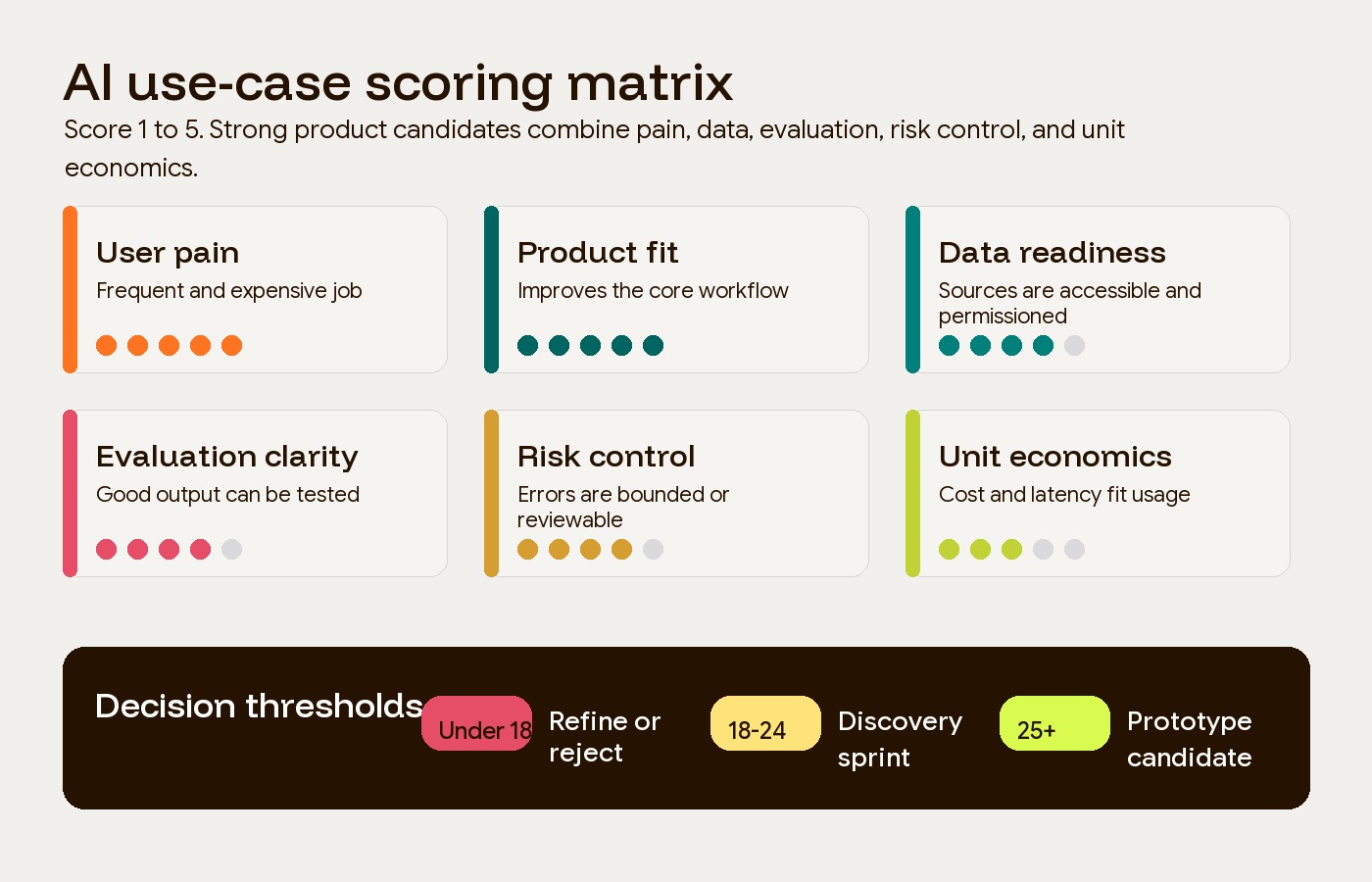
Use this scoring table as an illustrative Hapy planning heuristic, not a validated investment model. Score each dimension from 1 to 5, where 5 is strongest; use 3 for partial evidence and explain intermediate scores in writing.
| Dimension | 1 means | 5 means | Why it matters |
|---|---|---|---|
| User pain | Nice-to-have convenience | Frequent, expensive, or frustrating job | AI needs enough pain to earn adoption |
| Product fit | AI is a side demo | AI improves the core workflow | Keeps the roadmap from becoming a novelty layer |
| Data readiness | Inputs are scattered or inaccessible | Sources are available, permissioned, and current | Prevents prototype results from depending on hand-picked data |
| Evaluation clarity | Good output is subjective | Success can be scored with examples, rubrics, or outcomes | Lets the team improve quality systematically |
| Risk control | Errors are high-stakes and hard to reverse | Errors are bounded, reviewable, or reversible | Shows where human approval and guardrails belong |
| Unit economics | Every answer is expensive or slow | Cost and latency fit expected usage | Keeps the product margin from collapsing at scale |
Check mandatory gates before adding scores: unresolved data rights, cross-tenant access, unreviewable consequential actions, or an inability to stop unsafe execution block a prototype using live data. A high commercial score cannot offset a failed gate.
For candidates that pass those gates, totals below 18 suggest revisiting assumptions, 18–24 suggest discovery, and above 24 suggest considering a prototype. These uncalibrated bands organize discussion; replace them with thresholds informed by your own pilot evidence and risk tolerance.
The ranges below are hypothetical possibilities under favorable or unfavorable assumptions, not measured scores for product categories.
| Use case | Illustrative range | Product implication |
|---|---|---|
| Enterprise document copilot for internal policy search | 25-30 | Strong candidate if permissions and source citations are designed early |
| Support automation that drafts replies and routes escalations | 24-30 | Strong candidate when high-risk tickets stay human-reviewed |
| Research agent that monitors markets, filings, or internal knowledge | 22-28 | Good candidate if source quality, freshness, and traceability matter to users |
| Vertical SaaS AI feature that edits business records | 18-26 | Needs stricter approval, audit, rollback, and permission design |
| Open-ended chatbot added to a dashboard | 10-18 | Usually too vague unless tied to a specific workflow and success metric |
For example, a hypothetical draft-only support assistant might score user pain 4, product fit 4, data readiness 3, evaluation clarity 4, risk control 4, and unit economics 3: 22/30. The missing evidence is knowledge-base freshness and review cost, so the next step is a limited discovery trial. If retrieval exposes another customer’s records, the candidate fails the access gate even if its total remains 22.
This step also prevents AI automation work from being mislabeled as product work. Automating CRM cleanup may be valuable, but it is not necessarily an AI product. A CRM product feature that helps reps understand account risk, explain the signal, and take governed next actions is product development.
Design the UX around uncertainty and control
AI UX should make uncertainty visible without making the product feel fragile. Users need to know what the system can do, why it gave an answer, what evidence it used, and when they should review before acting.
Traditional software gives predictable responses. AI software gives probabilistic responses. That changes the interface. A good AI product should not pretend every response has the same confidence, source quality, or actionability.
Use these UX patterns deliberately:
| UX pattern | Use it when | Product detail |
|---|---|---|
| Draft mode | The AI creates text, analysis, or recommendations | Let users edit, accept, reject, and give feedback |
| Evidence panel | The answer depends on documents or knowledge bases | Show citations, source snippets, timestamps, and missing-source warnings |
| Confidence and limits | The system may be uncertain | Use plain-language confidence cues, not fake precision |
| Approval checkpoint | The AI can affect money, access, customers, health, legal status, or records | Require explicit human approval before action |
| Activity trace | The AI uses tools or multi-step reasoning | Show what tools ran, what changed, and where the run stopped |
| Recovery path | The system can fail or stall | Provide retry, escalation, manual override, and rollback options |
For an enterprise copilot, this might mean showing the retrieved policy section before drafting an answer. For support automation, it might mean separating “suggested reply” from “send reply.” For a research agent, it might mean letting the user inspect sources and mark a finding as useful, stale, or unsupported. For vertical SaaS, it might mean showing a before-and-after diff before the AI updates a record.
Trust is not a message in the empty state. It is a product behavior.
Prototype-readiness checklist
An AI prototype should prove the riskiest assumptions before the team invests in production infrastructure. It should not prove that a model can produce a good answer once. It should prove that the product loop has a path to repeatable value.
Use this checklist before starting the prototype:
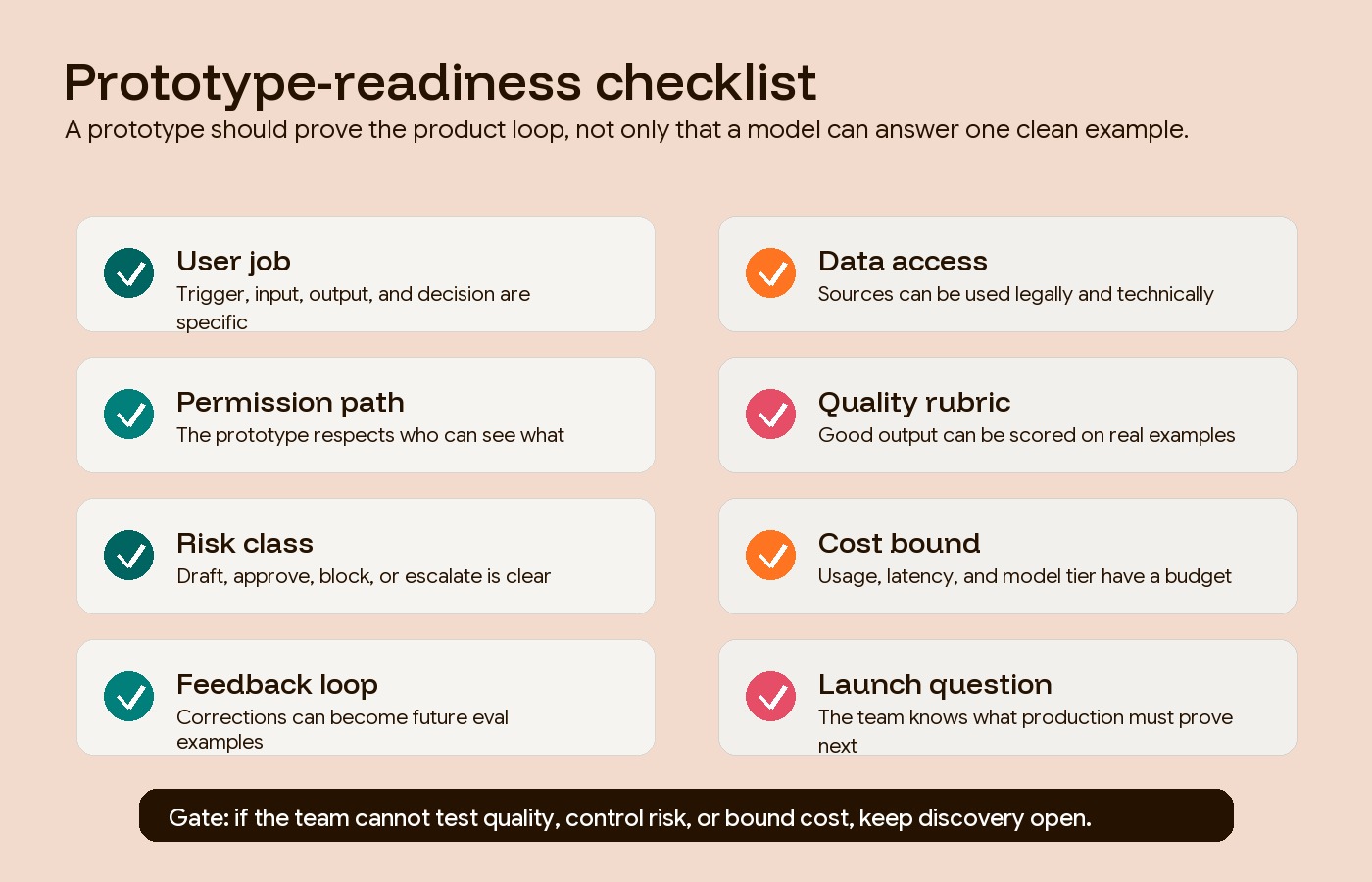
| Readiness question | Pass signal |
|---|---|
| Is the user job specific? | The team can name the user, trigger, input, output, and decision being improved |
| Is there a non-AI baseline? | The current workflow, manual workaround, or competitor behavior is understood |
| Is the data accessible? | Required documents, records, events, or APIs can be used legally and technically |
| Are permissions known? | The prototype can respect who is allowed to see which data |
| Can quality be evaluated? | The team can start with an illustrative 30 to 50 examples, then expand coverage by task, risk, and observed failure modes |
| Is the risk class clear? | The team knows which outputs can be auto-applied, drafted, blocked, or escalated |
| Is latency tolerable? | The user experience can handle generation time through streaming, background work, or async states |
| Is cost bounded? | Expected usage, token volume, model tier, and retrieval cost have a rough budget |
| Is the learning loop designed? | Users can correct outputs, flag failures, and feed examples back into evaluation |
The fastest useful prototype is often narrow. A research agent may start with one trusted source category. A support assistant may start with three intents and draft-only replies. A SaaS feature may start with one record type and a human approval step. Narrow scope is not lack of ambition. It is how the team learns which part deserves production investment.
Choose architecture from the product risk
AI software development should fit the product risk, not the team’s favorite stack. The architecture for a low-risk summarizer is different from the architecture for an agent that updates customer records across systems.
Most production AI products combine deterministic software with probabilistic model calls. Deterministic software should own identity, permissions, business rules, state, billing, audit logs, workflow routing, and irreversible actions. AI should help with interpretation, generation, classification, retrieval, and recommendation where probabilistic reasoning adds value.
For knowledge-heavy products, retrieval-augmented generation is often the first architecture to test. IBM describes retrieval-augmented generation as a pattern that connects a model to external knowledge sources so answers can be grounded in current or domain-specific information. That matters when the product needs source-backed answers, customer-specific knowledge, or changing policies.
Fine-tuning has a different role. It is usually better for behavior, style, output format, or task specialization than for fast-changing factual knowledge. Databricks makes a similar distinction in its guide to RAG vs. fine-tuning: retrieval is useful when the model needs updated external information, while fine-tuning is useful when the model needs to adapt behavior on a known task.
Use this decision frame:
| Product need | Prefer |
|---|---|
| Current facts, internal documents, citations, auditability | RAG or structured retrieval |
| Strict output format, domain tone, repeated classification, smaller task model | Fine-tuning or specialized model adaptation |
| Actions across tools, multi-step workflows, approvals | Agent orchestration with deterministic workflow controls |
| Sensitive or regulated data | Permission-aware retrieval, redaction, logging, and vendor review |
| High-volume routine tasks | Model routing, caching, batching, or smaller models |
Do not let the prototype hide data work. Production architecture needs ingestion, chunking, metadata, permissions, retrieval quality, source freshness, evaluation, and observability. If those pieces are invisible in the prototype, they will become the work later.
Guardrails and evals are product requirements
Guardrails and evaluations are not engineering polish. They are part of the product promise. If users rely on the AI feature to make decisions, the team needs a way to know when it is right, wrong, unsafe, unsupported, slow, or too expensive.
The NIST AI Risk Management Framework is useful because it frames AI risk around govern, map, measure, and manage. For product teams, that translates into practical controls:
| Control | Product question |
|---|---|
| Input guardrails | What user requests, files, or retrieved content should be blocked, sanitized, or routed elsewhere? |
| Output guardrails | What unsafe, unsupported, private, toxic, or malformed outputs should be stopped or corrected? |
| Tool permissions | What actions can the AI recommend, draft, or execute? |
| Human review | Which actions require approval before they affect a customer or record? |
| Evaluation set | Which examples prove the feature is improving across real user cases? |
| Monitoring | Which metrics show quality, latency, usage, cost, escalation, and drift? |
A practical evaluation system starts with representative examples. For a support assistant, that might include billing disputes, refund requests, angry customers, vague questions, edge-case bugs, and requests outside policy. For a research agent, it might include source conflicts, stale documents, missing citations, and ambiguous prompts. For vertical SaaS, it might include permission boundaries, record edits, and workflow exceptions.
Score outputs on dimensions that map to the product promise:
| Dimension | What it checks |
|---|---|
| Correctness | Is the answer or action right for the task? |
| Grounding | Is the output supported by the retrieved or allowed sources? |
| Relevance | Did it answer the user’s actual request? |
| Safety | Did it avoid disallowed, harmful, or private content? |
| Format | Did it return the required structure, fields, or schema? |
| Usefulness | Would the target user actually accept or act on it? |
LLM-as-judge evaluations can help, but they should not be treated as magic. LangChain’s guide to LLM evaluations is a useful starting point for thinking about task-specific rubrics, regression tests, and human review. The stronger pattern is to combine automated checks with expert-labeled examples and production feedback.
Cost belongs in the same conversation. If every user action triggers long prompts, large retrieved contexts, multiple model calls, and judge evaluations, a feature can become too expensive to scale. Budget should be designed into the product through model routing, retrieval limits, caching, batch work, usage quotas, and clear rules for when the system escalates to a more expensive model.
Production-readiness checklist
The move from AI prototype to production should be gated. A prototype can be allowed to surprise the team. A production product should be allowed to improve, but not to fail silently.
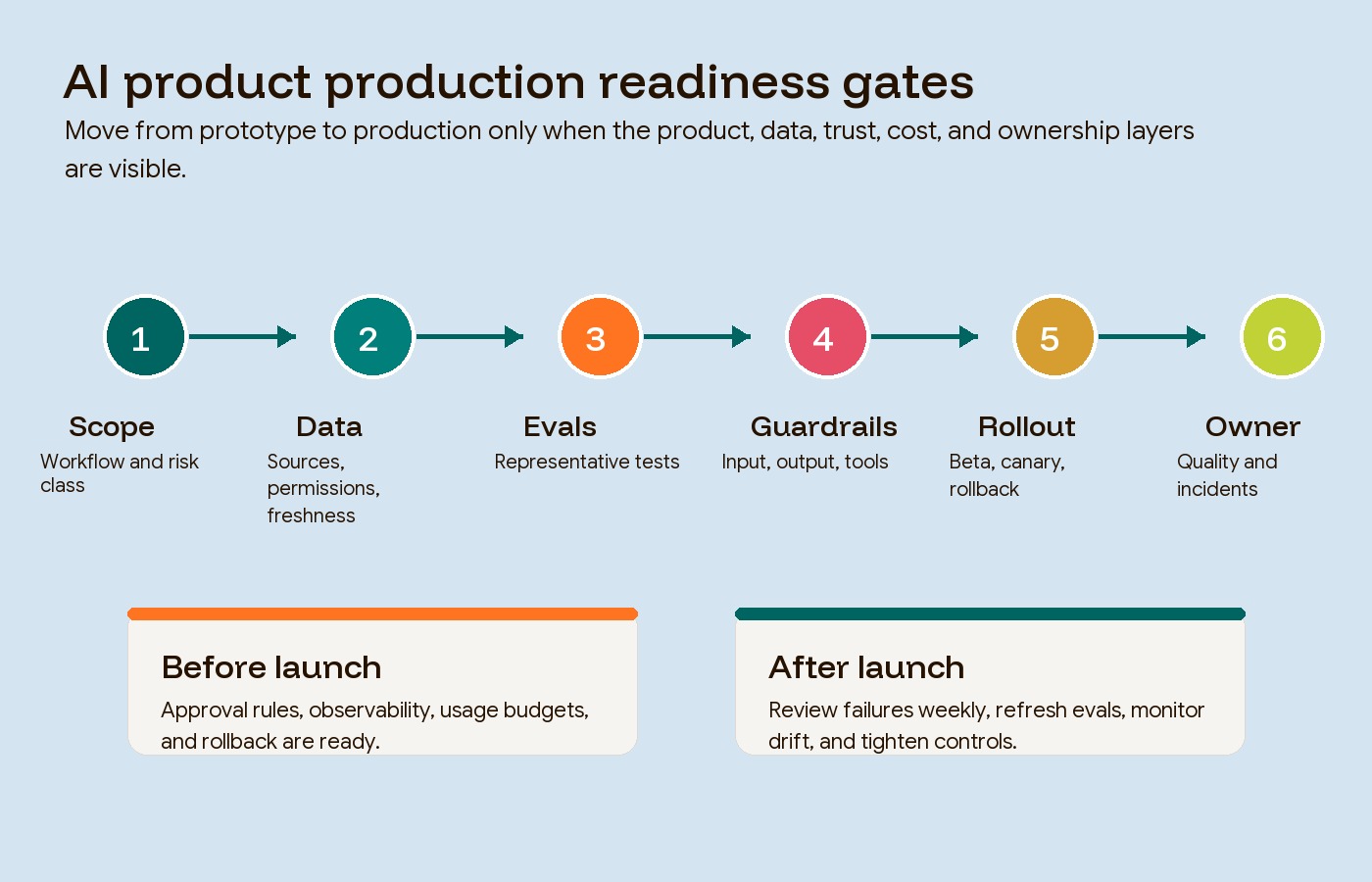
Before launch, confirm these production-readiness checks:
| Area | Production-ready signal |
|---|---|
| Product scope | The launch workflow, user roles, success metric, and excluded use cases are written down |
| Data | Sources are current, permissioned, versioned where needed, and monitored for freshness |
| Retrieval | Search quality is tested on representative queries, including keyword-specific and semantic cases |
| UX | Users can see evidence, edit outputs, provide feedback, and recover from errors |
| Guardrails | Input, output, tool-use, privacy, and topic boundaries are enforced outside the prompt |
| Human oversight | Approval rules exist for high-impact actions and are visible in the workflow |
| Evaluation | Offline evals run on a representative set before release and after major changes |
| Observability | The team tracks latency, errors, token usage, model calls, tool runs, feedback, and escalation |
| Cost control | Usage limits, routing rules, caching, and budget alerts are in place |
| Security | Secrets, logs, data retention, tenancy, and vendor data handling are reviewed |
| Rollback | The product can disable the feature, revert a prompt or model, or pause tool execution |
| Ownership | A named owner reviews quality, incidents, user feedback, and roadmap changes after launch |
The most important word is “outside.” Guardrails that only live in a prompt are fragile. The product should use code-driven validation, permission checks, structured schemas, rate limits, allowlists, review queues, and monitoring around the model.
Roll out AI products in stages
AI product rollout should reduce blast radius while increasing evidence. A good release path moves from internal use to controlled customers to broader production, with evaluation gates between each stage.
Use a staged roadmap:
| Stage | Purpose | Gate to advance |
|---|---|---|
| Discovery | Confirm use-case score, user job, data access, and risk class | Clear product thesis and prototype plan |
| Prototype | Test prompts, retrieval, UX, and basic outputs with curated examples | Users say the workflow is useful enough to continue |
| Alpha | Run with internal users or trusted operators on real data | Evaluation results and feedback show repeatable value |
| Private beta | Give selected customers access with strict monitoring and review | Quality, latency, cost, and support burden stay inside thresholds |
| Limited production | Expand to a bounded segment, plan, tenant, or workflow | No severe incidents, clear adoption signal, stable unit economics |
| General availability | Make the feature part of the standard product experience | Ownership, monitoring, support, and roadmap are ready |
For higher-risk products, add shadow or draft-only stages. A support automation feature can draft replies without sending them. A research agent can generate findings that analysts verify before sharing. A vertical SaaS feature can suggest record changes behind a diff and approval step before direct execution is allowed.
The product roadmap should also plan for drift. User behavior changes. Source documents change. APIs change. Model providers update models. Evaluation sets get stale. A production AI product needs a regular loop for reviewing failed traces, adding hard examples to the test set, updating retrieval sources, and tightening guardrails when the product sees new behavior.
How to decide what belongs on the AI product roadmap
An AI product roadmap should prioritize learning value and operating risk together. Do not rank features only by customer excitement or technical novelty.
A useful roadmap has four lanes:
| Roadmap lane | What goes there |
|---|---|
| User value | Workflow improvements, new use cases, better UI, collaboration, saved outputs |
| Trust and quality | Evaluations, citations, review flows, confidence design, feedback loops |
| Data and architecture | Retrieval, integrations, permissions, data cleanup, model routing |
| Operations | Monitoring, cost controls, incident response, support tooling, rollout gates |
This keeps the roadmap honest. If every sprint is a new AI feature and none of the work improves evaluation, permissions, cost, or observability, the product is accumulating hidden risk. If every sprint is infrastructure and none improves the user workflow, the team may be overbuilding before proving value.
For founders, the first roadmap should be small:
- Prove one high-value workflow.
- Make the evidence visible to users.
- Keep risky actions draft-only or approval-gated.
- Measure quality with real examples.
- Control cost before expanding usage.
- Add adjacent workflows only after the first one becomes dependable.
That is the path from impressive prototype to product capability.
When to bring in a product and engineering partner
Bring in a product and engineering partner when the AI feature affects the core product, needs custom architecture, touches sensitive data, requires a new user experience, or must integrate with systems that the business depends on. A lighter AI automation agency may be enough when the work is a bounded internal workflow. Hapy’s guide to AI automation agency vs. tech partner covers that decision in more detail.
For AI product development, the partner should be able to answer product and engineering questions in the same room:
| Question | What a serious answer should include |
|---|---|
| What should we build first? | A use-case score, risk class, user workflow, and validation plan |
| How will users trust it? | Evidence design, confidence handling, review points, and feedback loops |
| What data does it need? | Source inventory, permissions, retrieval plan, privacy handling, and freshness checks |
| How will quality be measured? | Offline evals, production feedback, rubrics, and failure review |
| What happens when it is wrong? | Guardrails, escalation, rollback, support process, and incident ownership |
| Can we afford usage at scale? | Cost model, model routing, caching, quotas, and monitoring |
Hapy Co’s MVP Development work is a fit when the first version needs product judgment, UX, architecture, and validation in one build path. The capabilities page is a better next read if the project needs broader technical leadership across product strategy, engineering, automation, and operating systems.
The main lesson is simple: AI product development is not a race to attach a model to a feature. It is a disciplined way to turn uncertain model behavior into a product experience that users can understand, evaluate, and trust. Start with the workflow. Prove the value. Design the trust layer. Then scale the architecture around the product that earned it.
FAQ
What is the difference between an AI prototype and an AI product?
An AI prototype proves that a model-assisted experience may work in a narrow setting. An AI product proves that the experience creates repeatable value for real users, with data access, permissions, evaluation, guardrails, cost controls, support, and release management around it.
Should an AI product use RAG or fine-tuning?
Use retrieval-augmented generation when the product needs current knowledge, internal documents, citations, or customer-specific context. Consider fine-tuning when the product needs more consistent behavior, output structure, tone, or task performance on a stable pattern. Many production systems use both.
When is an AI agent ready for production?
An AI agent is ready for production only when its allowed actions are bounded, tool permissions are explicit, high-impact steps have approval or rollback, evaluation covers representative failure cases, and monitoring shows quality, cost, latency, and error behavior in real use.