AI MVP development is not just normal MVP development with a model added to the stack. A traditional MVP mostly tests whether users want a workflow, screen, or transaction. An AI MVP has to test that too, but it also has to prove something harder: the output is trustworthy enough, the data is ready enough, the workflow is reviewable enough, and the unit economics are sane enough to keep running after the demo.
That is where many teams burn budget. They demo intelligence before they design trust.
The first version should not try to look like a full AI product. It should prove one narrow job under real constraints: a support triage assistant that routes tickets, a sales research assistant that drafts account briefs, a document summarizer that extracts risks from contracts, an operations copilot that prepares exception reports, or a vertical SaaS feature that turns messy customer data into a decision.
The practical question is not “Can AI do this?” For many use cases, it can produce a convincing first answer. The better question is “Can this workflow create value after we include data cleanup, model cost, evaluation, review, privacy, integration, and support?”
That is the founder guide version of AI MVP development: build the smallest trustworthy workflow, not the most impressive demo.
If the AI capability will become part of a recurring software product, use the SaaS product development roadmap to plan tenancy, billing, support, and post-launch ownership. When data, integrations, or production risk are still unclear, run technical discovery before committing the build budget.
Why AI MVPs fail differently
AI MVPs fail when teams validate the interface but skip the operating system around the model. The prototype looks useful because the test inputs are clean, the founder is watching every response, and nobody has measured what happens when data is incomplete, users ask strange questions, or the model gives a confident but unsupported answer.
This matters because AI adoption is already widespread, while enterprise-level value is still uneven. McKinsey’s 2025 global survey found that 78% of respondents said their organizations used AI in at least one business function, but more than 80% said gen AI had not yet produced tangible enterprise-level EBIT impact. Gartner’s April 2026 survey of infrastructure and operations leaders found that only 28% of AI use cases fully succeeded and met ROI expectations.
Those numbers do not mean founders should avoid AI app development. They mean the first build has to be scoped around evidence. For an AI startup MVP, evidence includes:
- Can the system handle real inputs, not just demo prompts?
- Can users understand when to trust, edit, or ignore the output?
- Can the team measure whether the answer is good?
- Can sensitive data move through the system safely?
- Can a human review the cases that carry real consequence?
- Can the product afford its own model usage at expected volume?
The MVP is not finished when the model answers. It is finished when the workflow produces repeatable value with known failure modes.
Choose the right AI MVP type
The cheapest AI MVP is often not automated on day one. Before you build an AI MVP, decide how much technology is needed to test the riskiest assumption.
| AI MVP type | What it tests | Best fit | Budget risk |
|---|---|---|---|
| Landing page or fake door | Demand, messaging, segment urgency | New product category, uncertain buyer interest | Low build cost, weak proof of retention |
| Concierge MVP | Workflow value, willingness to pay, manual service logic | High-touch B2B workflows, founder-led pilots | Labor scales poorly, but learning is rich |
| Wizard of Oz MVP | UX, perceived automation value, response expectations | AI assistant concepts where the interface matters | Hidden manual work can distort cost assumptions |
| Piecemeal MVP | Workflow orchestration using existing tools | Internal copilots, ops workflows, sales research | Tool costs and brittle handoffs can creep up |
| Single-feature AI MVP | One automated capability with a clear quality bar | Triage, summarization, extraction, classification | Narrow scope may not prove full product demand |
| Production-thin MVP | Real workflow, limited automation, real controls | Regulated or customer-facing use cases | More upfront engineering, better production signal |
For support triage, a Wizard of Oz MVP may be enough to learn whether agents trust suggested routing and escalation summaries. For a document summarizer used in legal or finance review, manual review should be explicit from the start. For a vertical SaaS feature that predicts risk, a fake door may test interest, but it will not test data quality or output trust.
The strongest early AI MVPs usually combine narrow automation with visible review. They do not pretend the model is perfect. They make uncertainty usable.
Prototype, pilot, and production are different promises
An AI prototype proves that a concept can be shown. An AI pilot proves that a workflow can be tested with real users or data. A production AI MVP proves that a narrow workflow can run with acceptable quality, cost, privacy, monitoring, and support.
Blurring those stages is expensive. A prototype can use manual data uploads, loose prompts, and founder review. A production MVP needs authentication, permissions, logging, data handling rules, fallback states, and a repeatable evaluation set.
Use this decision frame:
| Stage | Main question | Good enough evidence | What not to overbuild |
|---|---|---|---|
| Prototype | Does the idea make sense to users? | Users understand the workflow and ask to try it on real cases | Full infrastructure, custom model training, enterprise admin |
| Pilot | Does it improve a real workflow? | Real inputs, repeated usage, measured corrections, known edge cases | Broad feature surface, full self-serve onboarding |
| Production MVP | Can the first workflow be trusted and operated? | Evals, review gates, monitoring, cost model, privacy controls, owner signoff | Multi-workflow agent platform, premature fine-tuning |
This is also why AI-assisted prototyping tools should be treated carefully. They can speed early screens and flows, but a generated prototype is not automatically a production system. Hapy’s guide to the forward deployed engineer role makes the same point from the enterprise side: the hard part is turning a demo into an integrated workflow that survives real data, users, and accountability.
LLM API, custom model, or buy a tool?
Most founders should start AI MVP development with a managed LLM API or an existing AI tool. Custom models become attractive later, but only after the workflow proves enough volume, specificity, or control needs to justify the operational cost.
| Option | Use it when | Avoid it when | What to measure |
|---|---|---|---|
| Buy an existing tool | The workflow is standard and low-risk: meeting notes, simple support drafting, generic research | The workflow depends on proprietary data, custom rules, or product differentiation | Adoption, time saved, review burden, data access limits |
| Managed LLM API | You need a custom experience quickly without managing infrastructure | Usage volume is very high, latency is strict, or provider constraints block the use case | Cost per task, latency, quality, retry rate, privacy terms |
| Open-weight API | You want lower-cost models or more model choice without self-hosting | The team needs frontier reasoning or enterprise support guarantees | Quality against baseline, price, vendor reliability, model switching effort |
| Self-hosted model | You have sustained volume, strict data control, specialized latency, or model ownership needs | The MVP has not proven repeat usage or the team lacks ML operations capacity | GPU utilization, engineering hours, reliability, total cost per successful output |
| Fine-tuned model | The task has stable examples and prompting/RAG is not enough | The product is still changing or labeled data is thin | Accuracy lift, regression risk, training data quality, maintenance cost |
The build/buy choice should be revisited after the pilot, not argued forever before it. Early on, the bigger risk is usually building the wrong workflow, not paying a few extra cents for a better model during validation.
Cost still matters. OpenAI’s prompt caching documentation notes that cached prompts can reduce repeated-input cost and latency by reusing recently seen input tokens, while Anthropic’s documentation explains that caching works by reusing prompt prefixes. In a 2026 engineering write-up, ProjectDiscovery reported cutting LLM costs by 59% with prompt caching on complex multi-step security workflows. That is a useful production lesson: cost control is an architecture choice, not a line item to check after launch.
For an MVP, the first cost model can be simple:
- Estimate monthly workflow volume.
- Estimate average input, retrieval, and output tokens per successful task.
- Add retries, failed runs, review screens, and background jobs.
- Include non-model costs: vector database, storage, observability, workflow tools, support, and human review.
- Compare cost per successful outcome against the value of the workflow.
Hapy’s guide to AI automation ROI is useful here because the same principle applies: a cheap model call can still be an expensive system if it creates review work, mistakes, or support load.
Data readiness is the real MVP gate
An AI MVP cannot outrun bad source data. If the product needs to summarize documents, retrieve policy answers, classify tickets, or generate sales research, the team has to know where the data comes from, who can access it, whether it is current, and what happens when it is missing.
Before building the first automated version, score the workflow across five data questions:
| Data question | Pass signal | Red flag |
|---|---|---|
| Availability | The needed data exists and can be accessed through approved systems | The data is scattered across inboxes, PDFs, exports, and private drives |
| Quality | Records are complete enough for the task | Key fields are missing, duplicated, stale, or inconsistent |
| Permission | The system can enforce user-level access | The MVP assumes every user can see every source |
| Lineage | The output can cite or trace its source | Users cannot tell why the system gave an answer |
| Refresh | The data can stay current without heroic manual work | The demo depends on a one-time upload |
This applies across examples. A support triage tool needs ticket categories, customer history, product areas, and escalation rules. A sales research assistant needs account data, CRM notes, approved external research, and a clear boundary between facts and generated inference. A document summarizer needs source files, metadata, clause definitions, and review history. An ops copilot needs system-of-record data, exception rules, and escalation owners.
If the data is not ready, the right MVP may be a data preparation sprint rather than a model build. That is not a delay. It is how teams avoid spending engineering budget on a system that cannot be trusted.
Evaluation is a product feature
Evaluation should be designed before the AI feature reaches users. If the team cannot say what a good answer looks like, the model will define quality by vibes.
For RAG systems, Microsoft Foundry’s RAG evaluator documentation, reviewed on September 8, 2026, frames common evaluation dimensions around retrieval quality, groundedness, relevance, and response completeness. That maps well to founder-level AI software development:
| Evaluation area | What to test | Example pass rule |
|---|---|---|
| Task success | Did the workflow produce the intended useful outcome? | At least 80% of low-risk cases need no human correction |
| Groundedness | Are claims supported by approved source material? | No unsupported factual claims in sampled production outputs |
| Retrieval quality | Did the system fetch the right documents or records? | Relevant source appears in top results for known test cases |
| Completeness | Did the answer miss critical information? | Required fields or risks are present in structured output |
| Safety and policy | Did the model follow risk, privacy, and brand rules? | High-risk cases route to review instead of auto-execution |
| Cost and latency | Can users tolerate the workflow economically and experientially? | Cost per successful task and response time stay within threshold |
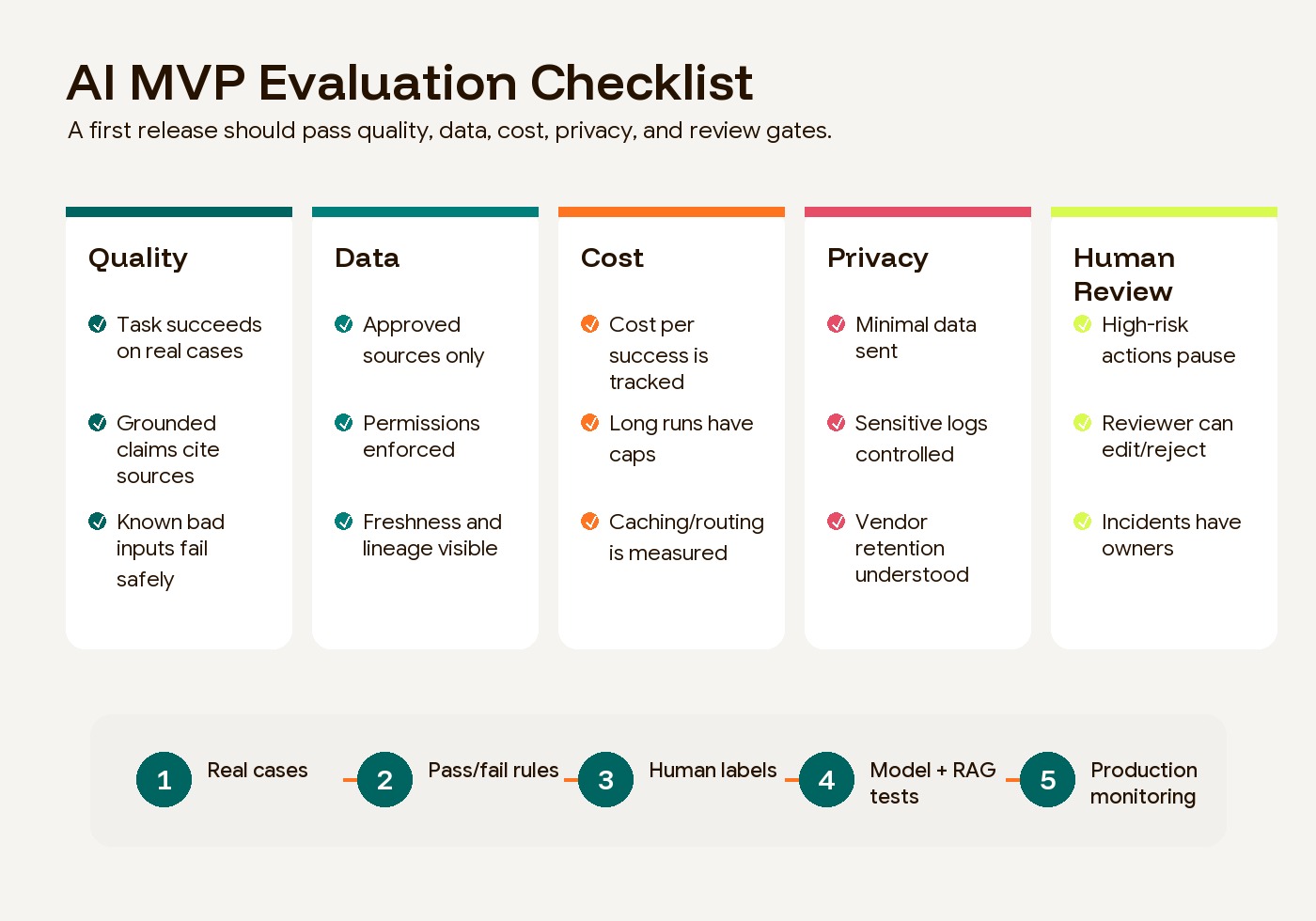
Build a small evaluation set from real examples as soon as possible. Include normal cases, ambiguous cases, bad inputs, adversarial prompts, missing data, and edge cases that would be embarrassing if they reached a customer. Then keep it. The eval set becomes a regression suite whenever prompts, retrieval settings, models, or data sources change.
Model-as-judge evaluation can help with scale, but it should not be the only judge. A founder, operator, domain expert, or customer-facing reviewer still needs to inspect enough cases to know whether the scoring matches business reality. The most dangerous eval failure is a false pass: the system looks good on a dashboard while quietly giving wrong or unsupported answers.
Design trust before autonomy
Human-in-the-loop is not a weakness in an AI MVP. It is often the feature that lets the product reach production sooner.
The key is to decide which actions can be automated, which require review, and which should be blocked. A support assistant may auto-tag tickets but require approval before sending a customer response. A sales research assistant may draft outreach but keep the rep in control of the final message. A document summarizer may highlight risky clauses but send the final interpretation to legal review. An ops copilot may prepare a refund recommendation but require a manager before money moves.
Use review gates when the workflow affects:
- Money, refunds, pricing, billing, or financial reporting.
- Contracts, legal rights, policy interpretation, or compliance.
- Healthcare, employment, lending, insurance, or regulated advice.
- Customer-facing commitments.
- Access permissions, account changes, or production systems.
- Irreversible database updates or external messages.
The NIST AI Risk Management Framework is useful because it does not treat risk as a single launch checklist. It organizes risk work around govern, map, measure, and manage functions across the AI lifecycle. For a founder, that translates into plain questions: who owns this AI system, where can it fail, how do we measure that failure, and what happens when it does?
Customer-facing AI can give users incorrect policy information. Keep approved policies accessible, provide an escalation route, and review responses that make commitments. Ask counsel to assess responsibility under the contracts and jurisdictions relevant to the product.
Privacy cannot wait for enterprise sales
Privacy is not an enterprise checkbox to add later. If the AI MVP touches customer records, contracts, health information, financial data, employee data, or proprietary documents, the privacy model should shape the first architecture.
OpenAI’s API data controls, reviewed on September 8, 2026, state that API inputs and outputs are not used to train OpenAI models by default, unless the customer opts in, and that abuse monitoring logs are retained for up to 30 days by default, with stated legal and safety exceptions. Some features retain application state separately; check the endpoint table and your agreement before selecting a retention policy. That may be acceptable for some MVPs and unacceptable for others. The point is not that one provider policy is always right. The point is that the founder must know what data is sent, where it is stored, how long it is retained, and what contract terms apply.
At MVP stage, privacy planning should cover:
- Data minimization: only send the fields the task requires.
- Redaction: remove unnecessary personal or sensitive information before model calls.
- Access control: enforce who can retrieve which documents or records.
- Logging: avoid storing raw sensitive prompts in places the team will forget.
- Vendor terms: review training, retention, deletion, and enterprise controls.
- Review workflow: route regulated or high-impact outputs to humans.
Zero data retention may matter for some healthcare, finance, legal, or enterprise workflows, but it is not a magic phrase. It has to apply across the model provider, retrieval layer, logs, analytics, error tracking, and human review tools. A system that sends no data to the model provider but dumps raw prompts into an internal log still has a privacy problem.
Scope the first AI MVP around one workflow
The best AI MVP scope is usually one role, one workflow, one data path, and one measurable outcome. That is enough complexity.
Here are five practical scopes:
| Example | Version-one scope | Human review | Success metric |
|---|---|---|---|
| Support triage | Classify new tickets, suggest priority, summarize context | Support lead approves escalations and external replies | Faster first response, fewer misroutes, lower review time |
| Sales research assistant | Produce account brief from CRM notes and approved public sources | Rep edits before outreach | Better meeting prep, faster research, improved follow-up quality |
| Document summarizer | Extract key clauses, obligations, and risks from a document set | Domain reviewer approves interpretation | Reduced review time without missed critical items |
| Ops copilot | Draft daily exception report from system data | Ops manager approves actions | Faster issue detection, fewer manual reporting hours |
| Vertical SaaS feature | Generate a domain-specific recommendation inside an existing workflow | User confirms before saving or sending | Higher workflow completion and repeat usage |
The wrong scope is “an AI assistant for the whole company” or “a copilot that can answer anything.” Broad assistants are easy to pitch and hard to evaluate. Narrow workflows expose the truth faster.
This is where Hapy’s Business Systems & Automation work connects to AI product development. Many useful AI features are not standalone products at first. They are workflow improvements inside existing operations: cleaner intake, better routing, faster reporting, safer review, and clearer ownership.
If the AI feature becomes a core product capability rather than an internal workflow, Hapy’s technical and AI capabilities are the better lens: product judgment, architecture, data flow, UX, and delivery ownership all have to move together.
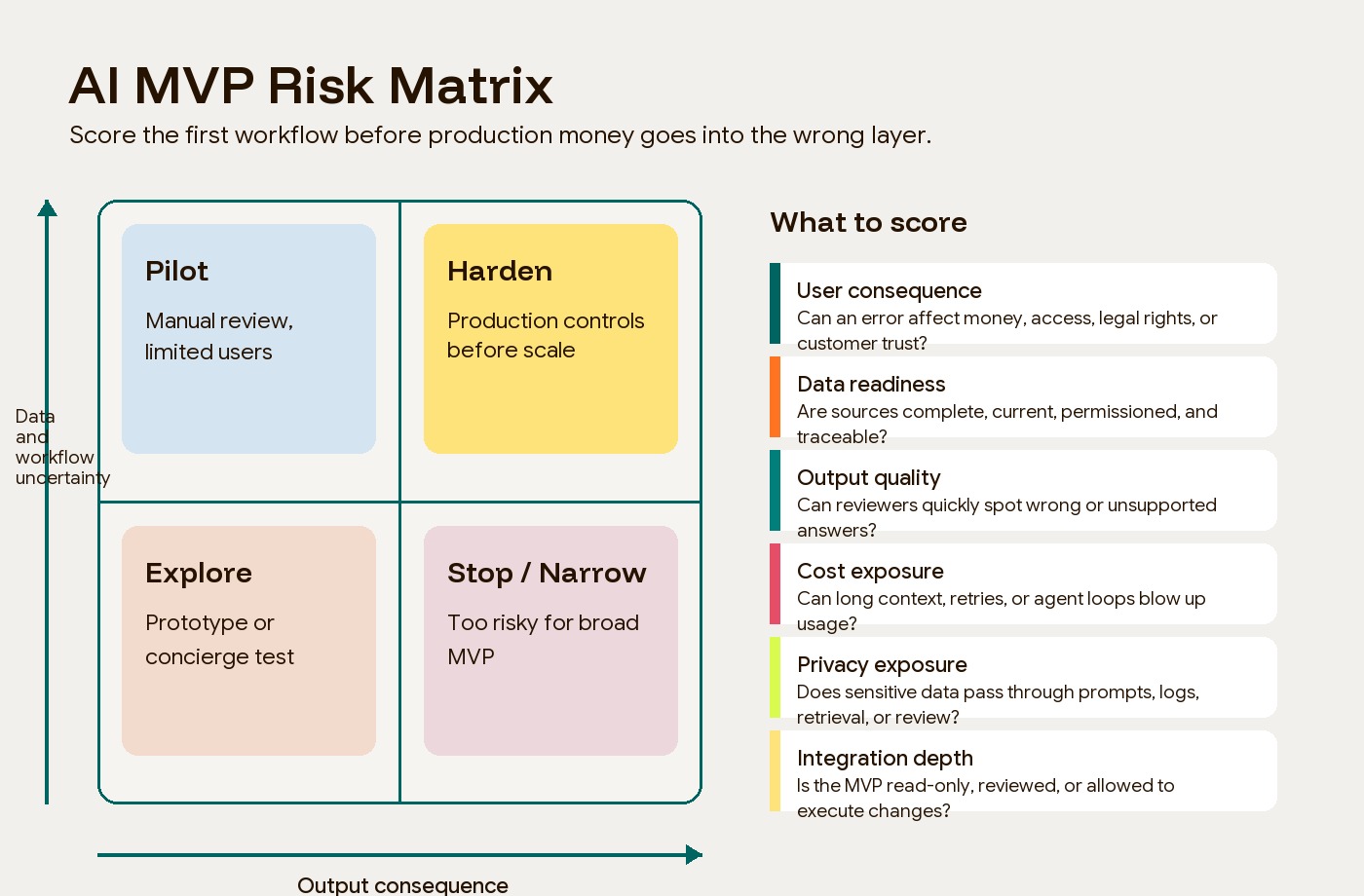
Use this AI MVP risk matrix before funding build
Founders should score the MVP before development starts and again before production rollout. The goal is not to eliminate risk. The goal is to know which risks are acceptable for an MVP and which ones would make the first version misleading.
| Risk area | Low risk | Medium risk | High risk | MVP control |
|---|---|---|---|---|
| User consequence | Internal helper, low-stakes suggestions | Customer-facing drafts or operational recommendations | Money, legal, healthcare, access, or compliance decisions | Add approval gates and audit logs |
| Data readiness | Clean, accessible, current sources | Some manual cleanup or weak metadata | Missing, restricted, stale, or unowned data | Run data readiness before automation |
| Output quality | Easy to check and correct | Ambiguous quality, but reviewers can catch errors | Errors are hard to detect before harm | Narrow scope or keep human delivery |
| Cost exposure | Predictable short tasks | Multi-turn workflows with retrieval | Long agent loops, high retries, large context | Set cost caps, caching, routing, and kill switches |
| Privacy exposure | No sensitive data | Limited customer or business data | Regulated or personal data at scale | Minimize data, review vendor terms, control logs |
| Integration depth | Read-only or isolated workflow | Writes to internal systems after review | Autonomous external actions or production changes | Start read-only, then add controlled writes |
As a Hapy planning heuristic, not a validated safety threshold, if two or more areas are high risk, the MVP should probably be narrower, more manual, or built as a controlled pilot before customer release. A single unacceptable legal, privacy, or user-harm risk can also block release regardless of the total. Agree the release gates with accountable domain owners.
The first 30 days of AI MVP development
A practical 30-day AI MVP plan should spend more time on workflow truth than model experimentation.
Week 1: Define the job and failure modes
Pick one user and one workflow. Write the before state: volume, cycle time, cost, error rate, review burden, and business consequence. Define the riskiest assumption. For a support triage AI MVP, the riskiest assumption may be that the system can classify urgency accurately enough for agents to trust it. For a document summarizer, it may be that the source documents are structured enough to extract obligations reliably.
Week 2: Prepare data and build the eval set
Collect real examples, source documents, edge cases, and unacceptable outputs. Decide what the model can access. Define pass/fail rules. Build a small evaluation set before tuning prompts too deeply. If the eval set is weak, the demo will teach very little.
Week 3: Build the thinnest workflow
Use the simplest architecture that can test the risk. That may be a managed LLM API, lightweight retrieval, a small admin review screen, and a few deterministic rules. Add logging for inputs, outputs, cost, latency, review decisions, and error types. Keep writes to external systems behind approval.
Week 4: Run real cases and make the scale decision
Test with real users and real data. Measure task success, correction rate, cost per successful outcome, latency, review time, and user trust. Then decide: fund, narrow, harden, or stop.
Stopping is an acceptable MVP outcome. The budget was protected because the team learned before building the wrong full product.
The practical takeaway
AI MVP development should make a founder more disciplined, not more theatrical. The model is only one part of the product. The real system includes data, workflow, evaluation, cost controls, privacy, human review, and ownership after launch.
If you are planning an AI MVP, start with one workflow that matters. Decide what should be manual, assisted, or automated. Use APIs before custom models unless the evidence says otherwise. Build evals before scale. Keep humans in the loop where the consequence justifies it. Measure cost per successful outcome, not cost per impressive response.
That is how to build an AI MVP without burning budget: prove trust before autonomy, prove workflow value before platform scope, and prove production evidence before you scale.