This UK startup ecosystem brief separates policy intent, dated survey evidence, and proposed AI product opportunities. Reviewed on September 8, 2026, it focuses on founder decisions; it is not a ranking of sectors or a forecast of investment returns. Hapy publishes it as a potential product-development supplier.
Dealroom’s UK tracker is a live dataset whose funding and enterprise-value figures can be revised. Before using those metrics in a decision, save the access date, period, geography, currency, funding-instrument definition, and treatment of large rounds. Doubling a half-year total is an arithmetic scenario, not a full-year forecast.
For founders and scaleups, the practical question is not “Is the UK a good market?” It is: where does the UK give us an unfair product advantage, and can we execute quickly enough to use it? The broader startup funding trends for 2026 explain why strong market totals do not make capital evenly available, while Hapy’s AI product development guide covers the path from prototype attention to production trust.

Why the UK Startup Ecosystem Still Matters
The UK startup ecosystem still matters because it combines four advantages that rarely sit in one market: deep venture capital, world-class universities, a sophisticated financial system, and a public sector that is now explicitly trying to become a better buyer of AI and digital products.
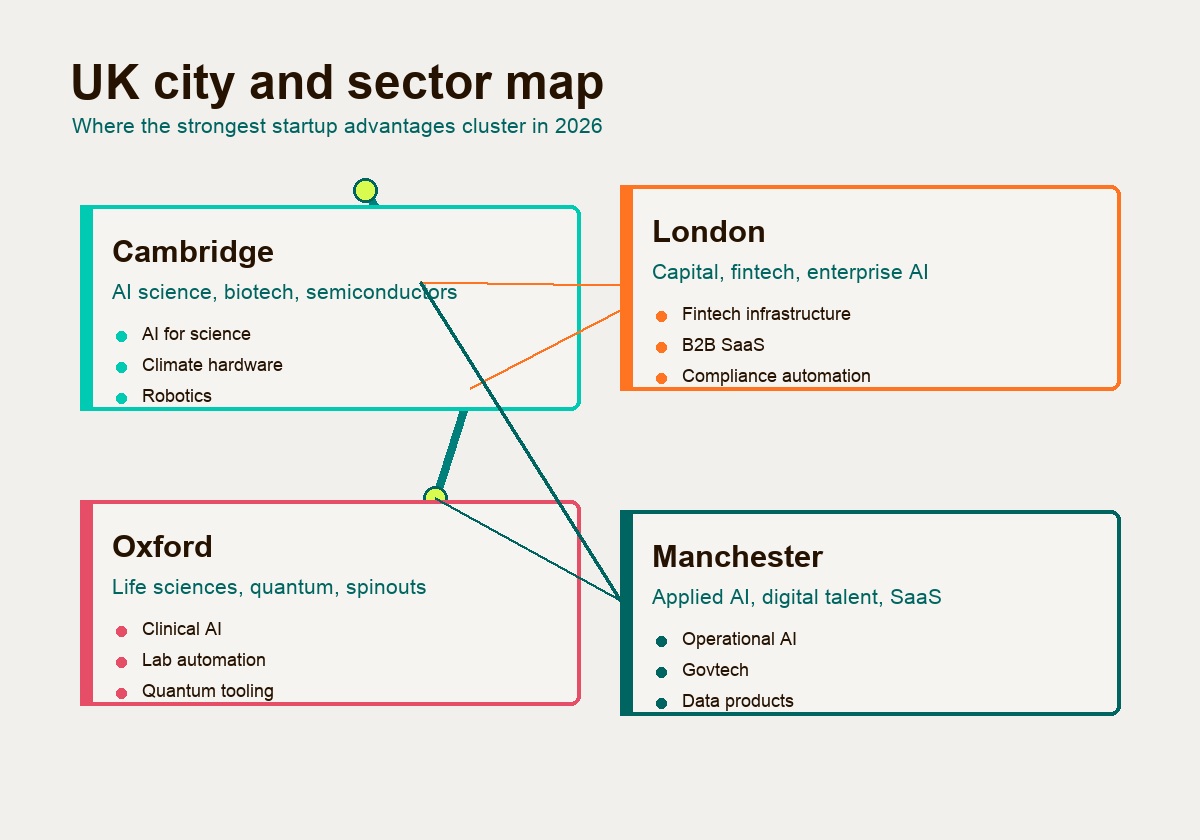
The city comparisons below are research hypotheses around buyer and technical access, not a measured ranking. London, Cambridge, Oxford, and Manchester are examples rather than a complete UK map. Compare actual customers, lab or university access, hiring, and operating costs before choosing a base.
| City cluster | Advantage to investigate | Proposed product opportunities | Founder risk to manage |
|---|---|---|---|
| London | Capital, customers, fintech, enterprise buyers | Fintech infrastructure, AI workspaces, B2B SaaS, compliance automation | High costs and crowded categories |
| Cambridge | Research depth, AI science, biotech, semiconductors | AI for science, climate hardware, healthtech, materials science, robotics | Long R&D cycles and specialist hiring |
| Oxford | Life sciences, quantum, fusion, university spinouts | Clinical AI, diagnostics, lab automation, quantum tooling | Clinical proof, IP terms, procurement time |
| Manchester | Applied AI, digital talent, fintech, SaaS | Operational AI, B2B SaaS, civic tech, data products | Smaller funding pool and buyer concentration |
AI Policy Is Creating a Product Window
The AI Opportunities Action Plan is the clearest policy signal in the UK market. Published by the Department for Science, Innovation and Technology in January 2025, the plan sets out 50 recommendations to grow the UK AI sector, increase adoption across the economy, and improve products and services.
For founders, the policy suggests three areas for buyer research. Each needs a separate test of budget and procurement access:
- AI infrastructure, including sovereign compute, AI Growth Zones, energy-aware data centres, and secure model operations.
- AI adoption in public services, especially where pilots can move into evaluated, governed deployment.
- Homegrown AI capability, where the UK wants stronger domestic companies at more layers of the AI stack.
The compute piece is especially important. The action plan recommends expanding the AI Research Resource by at least 20x by 2030 and establishing AI Growth Zones to accelerate AI data centre buildout. That suggests tooling questions around deployment, governance, energy, and operations; it does not prove an accessible budget for a new vendor.
For AI founders, this changes the product brief. “We use AI” is not enough. A stronger UK AI startup can answer:
- Which regulated workflow are we improving?
- What data rights, safety case, and audit trail does the buyer need?
- How does the product reduce labour, risk, cost, delay, or energy use?
- Can we move from pilot to production without rewriting the architecture?
That last point is where many UK AI startups will win or lose. The market has no shortage of demos. The shortage is production systems that satisfy security, procurement, compliance, integration, and user adoption at the same time.
Distinguish funding context from customer evidence
A large funding round can change a market total without making capital easier to access for other companies. Compare stage-specific deal counts and investor mandates; do not infer an individual startup’s funding odds from aggregate value.
The operating environment is also more complicated than the funding charts suggest. In March 2026, techUK and Public First polling found that 56% of tech firms described the UK environment as challenging for expansion, and 45% had considered relocating investment or operations outside the UK. The source notes 275 tech and 256 non-tech decision-makers, with fieldwork from February 24 to March 6, 2026 and weighted results. The 56% and 45% figures refer to tech respondents; they describe sentiment and consideration, not observed relocation or buyer demand.
That pattern is reinforced by domestic capital reform. The British Business Bank’s British Growth Partnership is designed to help pension funds allocate more capital into UK venture. Its first fund announced a GBP 200 million first close on April 1, 2026, backed by Aegon UK, NatWest Cushon, and M&G. The direction is useful for scaleups, but it does not remove the need for product evidence.
Early-stage founders should expect investors to ask for:
- A tighter customer segment
- Clear retention or repeat-use evidence
- A visible path to revenue quality
- A realistic view of technical debt
- Compliance assumptions tested before enterprise sales
- A product roadmap connected to funding milestones
Before choosing a build partner, use the buyer test and operating constraints to assess Hapy’s MVP development service or another delivery proposal. A stronger funding story starts with product proof: a buyer problem, a working wedge, a measurable outcome, and a credible build path. Hapy’s guide to SaaS product-market fit is useful here because it separates traction from durable fit.
UK AI Product Opportunity Matrix
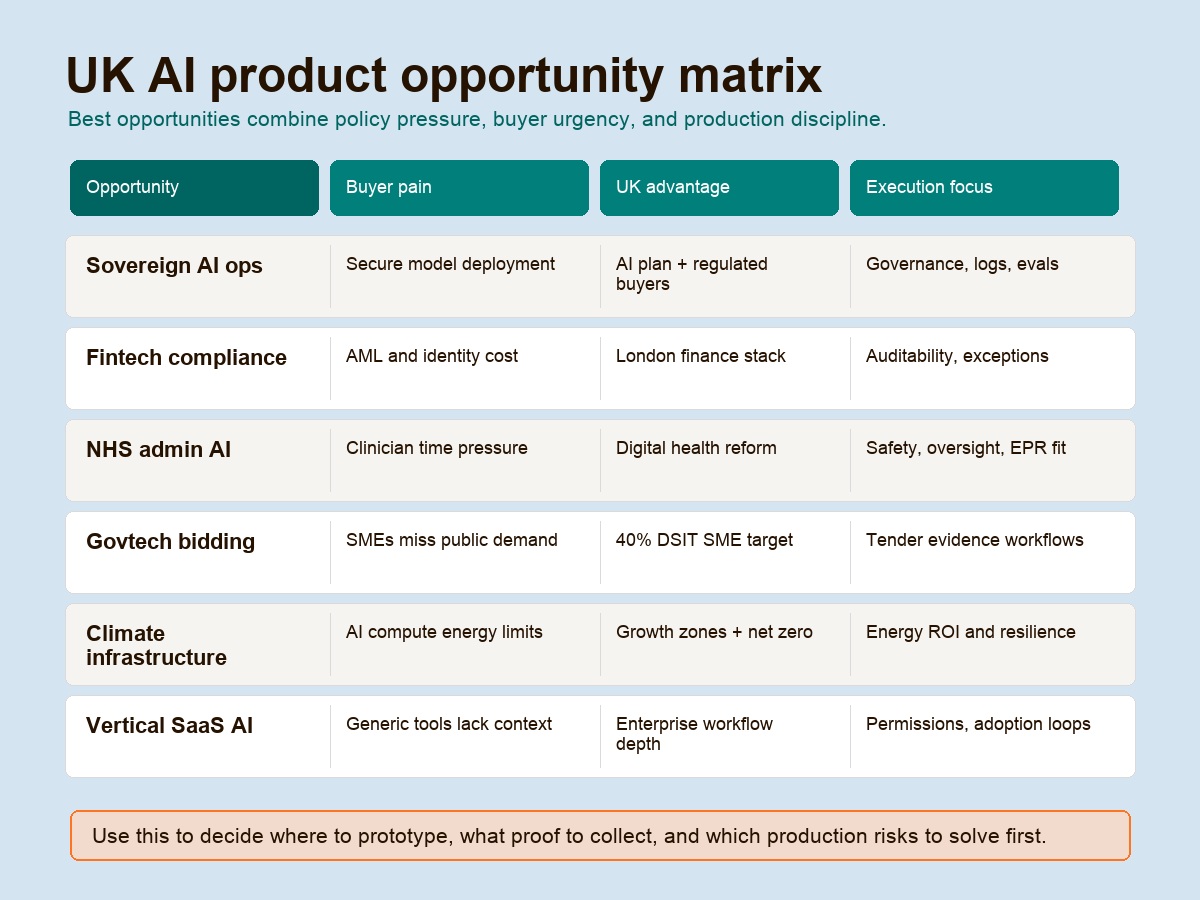
The matrix below contains Hapy opportunity hypotheses. Its buyer-pain statements need confirmation through workflow evidence, budget authority, and comparison with existing alternatives.
| Opportunity | Buyer pain | Why the UK is a good testbed | Product execution requirement |
|---|---|---|---|
| Sovereign AI operations | Public and regulated buyers need secure AI deployment, audit trails, and data residency | AI policy, public-sector demand, and regulated industries are moving together | Governance, logging, access control, red-team process, model evaluation |
| Fintech compliance infrastructure | AML, fraud, onboarding, identity, and cross-border controls remain expensive | London has banks, fintechs, regulators, and enterprise buyers in one market | Low-latency integrations, explainability, false-positive management |
| NHS admin automation | Clinicians and admin teams need time back before clinical AI can scale | The England health plan proposes digital and AI changes; other UK nations require separate research | Clinical safety, human oversight, workflow integration, procurement patience |
| Govtech bidding and compliance | SMEs struggle to find, qualify for, and respond to public opportunities | DSIT states a scoped SME spend target; see its exclusions below | Tender intelligence, policy mapping, evidence packs, compliance workflows |
| AI-enabled climate infrastructure | Data centres and industry need lower energy cost and better grid resilience | AI Growth Zones suggest infrastructure questions to validate with operators | Hardware/software integration, energy data, ROI proof, regulatory readiness |
| Vertical B2B SaaS workspaces | Teams need AI inside the workflow, not as a separate chatbot | UK has strong enterprise SaaS, fintech, professional services, and applied AI buyers | Workflow depth, data permissions, adoption loops, integration quality |
Sector Opportunities For UK Startups
Fintech: Test an infrastructure hypothesis
UK fintech startups still benefit from London’s banking depth, open banking history, and capital markets expertise. One hypothesis to investigate is infrastructure: compliance, identity, fraud, payments operations, treasury, SME lending workflows, and embedded finance controls.
The British Business Bank reported that gross SME bank lending increased to GBP 68 billion in 2025, and that challenger and specialist banks accounted for 60% of gross SME bank lending. That matters because fintech demand is no longer only consumer apps and challenger current accounts. It is the operational layer underneath lending, risk, onboarding, and business finance.
The product opportunity is to make regulated finance faster without making risk teams nervous. Founders should design for auditability, explainability, human review, and exception handling from the start.
Healthtech: Start With Admin, Then Earn Clinical Trust
The health-policy evidence in this section concerns England. Scotland, Wales, and Northern Ireland have distinct health systems and require their own policy, safety, and procurement assessment. The 10 Year Health Plan for England sets out three shifts: hospital to community, analogue to digital, and sickness to prevention. Its executive summary says the plan aims to make the NHS “the most AI-enabled care system in the world.”
For founders, the near-term opportunity is not to replace clinicians. It is to remove administrative drag, improve access, reduce missed appointments, support triage, and make care pathways more visible.
Healthtech teams should assume clinical safety and procurement friction from day one. Products touching clinical workflows need safety cases, clear human oversight, data protection, integration planning, and evidence that the tool improves outcomes or releases capacity.
Govtech: Procurement Reform Creates a New Wedge
Govtech policy describes an intention to lower procurement friction; it does not demonstrate that a particular startup can reach an authorized buyer. DSIT’s SME Action Plan for 2025 to 2028 commits to a target of 40% of procurement spend with SMEs and points to demo-based procurement, simplified templates, and an Innovation Marketplace.
The plan states no current baseline for its 40% target. It excludes BDUK direct spend, the Next National Supercomputing Service, and AIRR+. This is a departmental target, not a government-wide entitlement or a forecast of startup contract awards. Use Find a Tender to inspect actual notices, eligibility, deadlines, and the named contracting authority.
The constraint is still trust. Govtech founders should build products that make procurement officers’ lives easier, not just products that tell startups where tenders exist.
B2B SaaS: Vertical AI Needs Workflow Ownership
UK SaaS startups have a good market if they solve expensive work in finance, professional services, healthcare, logistics, insurance, energy, construction, or government. The weak version is a generic AI assistant. The strong version owns a workflow, understands the data model, and creates evidence that the customer can use.
For UK SaaS founders, the question is whether AI improves a measurable process: faster underwriting, fewer missed compliance tasks, shorter reporting cycles, cleaner onboarding, better project visibility, lower support burden, or faster product delivery.
The build risk is technical debt. AI features often move quickly in prototype and then become hard to operate when permissions, latency, monitoring, data retention, and customer-specific workflows arrive. Hapy’s guide to technical debt cost in 2026 is relevant because the tax appears exactly when a team tries to scale.
Climate Tech: Compute And Energy Are Now Connected
Climate tech is no longer separate from AI infrastructure. If the UK expands compute capacity, it will need better power planning, cooling, grid flexibility, waste-heat reuse, and energy-aware scheduling. That gives climate startups a practical buyer path: reduce the cost and constraint of AI infrastructure.
The UK opportunity is not only carbon accounting. It is operational climate software and hardware that helps data centres, industrial sites, universities, hospitals, and local authorities lower energy cost while keeping systems reliable.
Founder Readiness Checklist
Founders should use the UK market’s momentum as a forcing function. Before raising, applying to an accelerator, or selling into regulated buyers, pressure-test the product in six areas.
| Readiness area | What good looks like | Red flag |
|---|---|---|
| Customer wedge | A specific buyer, workflow, and urgent pain | “Everyone in finance/health/government” |
| Policy fit | The product aligns with a funded or mandated priority | The policy reference is only a slide-deck claim |
| Compliance path | Data, safety, audit, and procurement assumptions are mapped early | Compliance is left for enterprise sales |
| Prototype evidence | Users complete a real workflow and measurable value appears | Demo praise without usage depth |
| Production plan | Architecture supports permissions, monitoring, integrations, and support | Prototype stack would need a rebuild |
| Funding logic | Capital accelerates a validated learning or scaling milestone | Raise size is based on market excitement |
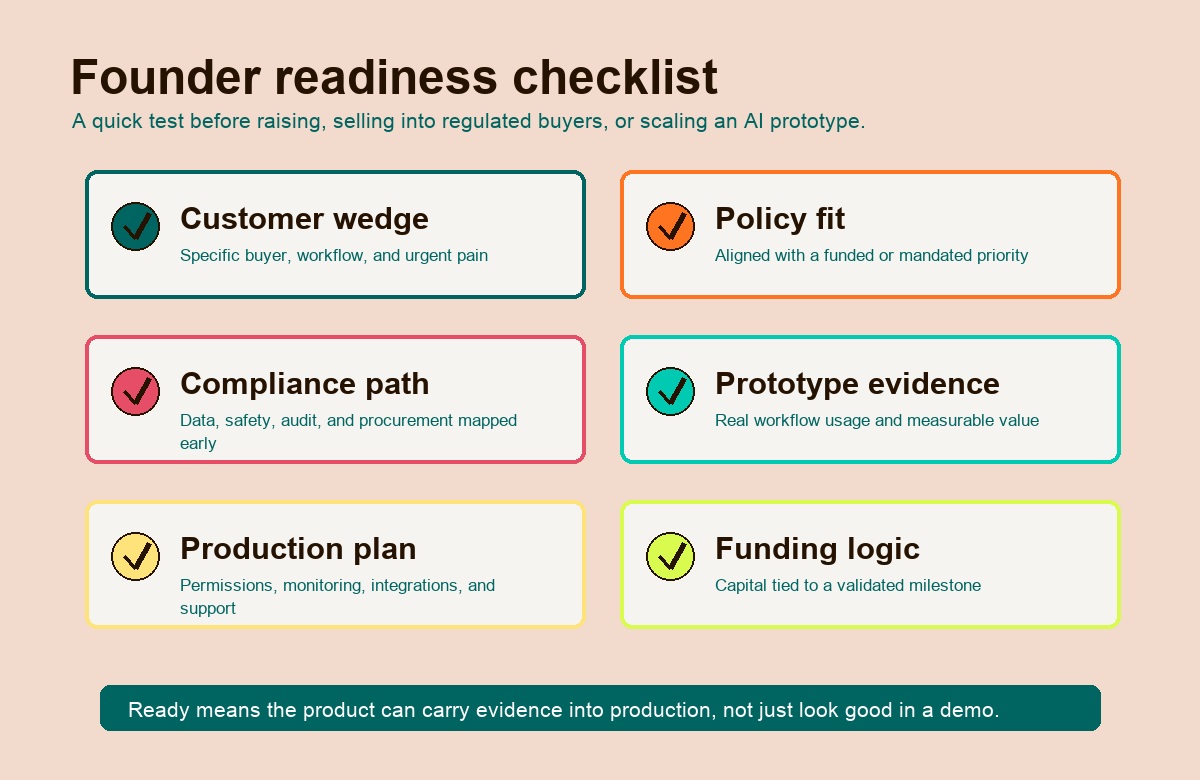
This checklist matters because the UK market rewards credibility. A founder selling into an NHS trust, local authority, bank, insurer, or enterprise buyer cannot rely on speed alone. The product has to move fast and carry evidence with it.
Test access, alternatives, and one outcome
| Hypothesis | Buyer and route to investigate | Existing alternative | Low-cost validation test |
|---|---|---|---|
| Sovereign AI operations | A named public authority’s technology/security owner through a relevant notice or market-engagement exercise | Cloud governance tooling and internal operations | Review an approved deployment scenario and identify an unmet control with a budget owner |
| Fintech compliance | Compliance operations lead and procurement at a specific bank or provider | Existing compliance platform and manual analysts | Evaluate permitted historical cases against current review time and error handling |
| England health administration | A specific provider’s operations, digital, information-governance, and procurement teams | Existing clinical/admin system and process redesign | Map one non-clinical task using synthetic data; confirm safety and data scope before a live pilot |
| Govtech bid support | SME bid manager, reached directly; verify opportunities on Find a Tender | Bid consultants, spreadsheets, existing tender tools | Test a transparent sample brief against a current tender and measure correction effort |
| Climate infrastructure | Facilities or energy manager at one operator | Existing energy-management system and engineering services | Review permitted historical operational data and test whether the proposed insight changes an action |
| Vertical SaaS | Operations owner in one professional workflow | Existing SaaS, configurable automation, manual work | Offer a narrow paid concierge pilot and measure repeat use and delivery effort |
These are proposed experiments, not completed projects. Record the baseline, permissions, cost, acceptance criteria, decision owner, and what would make the test fail. For regulated or safety-relevant work, obtain the relevant review before using real data or affecting decisions.
Retain the readiness checklist above, but require evidence in each row. Policy alignment, a university connection, or a funding headline does not substitute for a purchase path. Hapy can help translate a validated workflow into a scoped product roadmap; the build should follow the evidence.