A zero downtime Astro migration is a launch plan that prevents a planned visitor-visible outage while traffic moves from the old site to the new one. It keeps the old site available until the new Astro site has passed production-like checks, then moves traffic with a controlled DNS or hosting switch, validated redirects, tested forms, working analytics, and a documented rollback path.
For business owners and marketing teams, the safest mindset is simple: do not treat launch day as the first real test. Treat it as the moment you switch from a validated staging system to a monitored production system.
This article focuses on launch operations. If you need the broader SEO preservation work, use Hapy’s website migration SEO checklist for URLs, metadata, canonicals, sitemaps, schema, and ranking protection. If you are still scoping the rebuild, start with the website migration audit so the team knows what pages, forms, scripts, and conversion paths must survive the move. The Astro migration timeline shows where launch preparation fits across the wider rebuild.
If you need a team to plan and execute the migration, Hapy’s Astro migration service covers the audit, rebuild, redirect, QA, and launch work.
Use the Astro website integrations checklist to verify that forms, CRM routing, email, analytics, pixels, chat, CMS publishing, and scheduling still work after the switch.

What zero downtime means in practice
Zero downtime does not mean every resolver, browser, or edge cache changes at the same instant. During a DNS or hosting change, some visitors can still reach the old origin while others reach the new origin. Plan for that overlap. Keep both origins safe to serve requests until validation is complete, and document the limits of rollback propagation.
The old site should stay live until the new site proves it can serve the same business jobs:
- Important pages load on the final domain or production-equivalent preview.
- High-value old URLs resolve through direct redirects.
- Forms submit to the right CRM, inbox, automation, or thank-you path.
- Analytics, pixels, consent behavior, and conversion events fire.
- Search Console and sitemap tasks are ready.
- The team knows exactly how to roll back if the launch fails.
- DNS, CDN, browser-cache, and rollback behavior are understood for the actual host.
That last point matters. A rollback plan is not pessimism. It is what makes the launch calm enough to execute.
Set up staging like the real launch
Staging should be close enough to production that the launch checklist tests real behavior. A password-protected preview that hides broken redirects, missing environment variables, blocked API calls, or disabled forms is useful for design review, but it is not enough for launch readiness.
At minimum, staging should verify:
| Launch surface | What to test before production |
|---|---|
| Build output | The Astro build completes cleanly and produces the expected routes, assets, sitemap, and redirects |
| Domain behavior | The final host pattern, SSL behavior, trailing slash policy, and www or non-www preference are understood |
| Content | Priority pages, landing pages, journal posts, legal pages, and conversion pages exist |
| Forms | Every form submits, validates, prevents spam, routes correctly, and shows the right success state |
| Tracking | GA4, pixels, consent tools, UTM capture, key events, and CRM attribution work |
| SEO controls | Titles, descriptions, canonicals, robots rules, sitemap, and redirects match the migration plan |
| Rollback | The old site, DNS records, deploy target, and rollback owner are documented |
Astro-specific staging should also confirm the deployment mode. Astro’s configuration reference documents options such as site, trailingSlash, redirects, and output. Those choices affect canonical URLs, generated sitemap behavior, route matching, and how redirects work on the host.
The marketing-side question is not “Did the page look right in staging?” It is “Did the business workflow work in staging?”
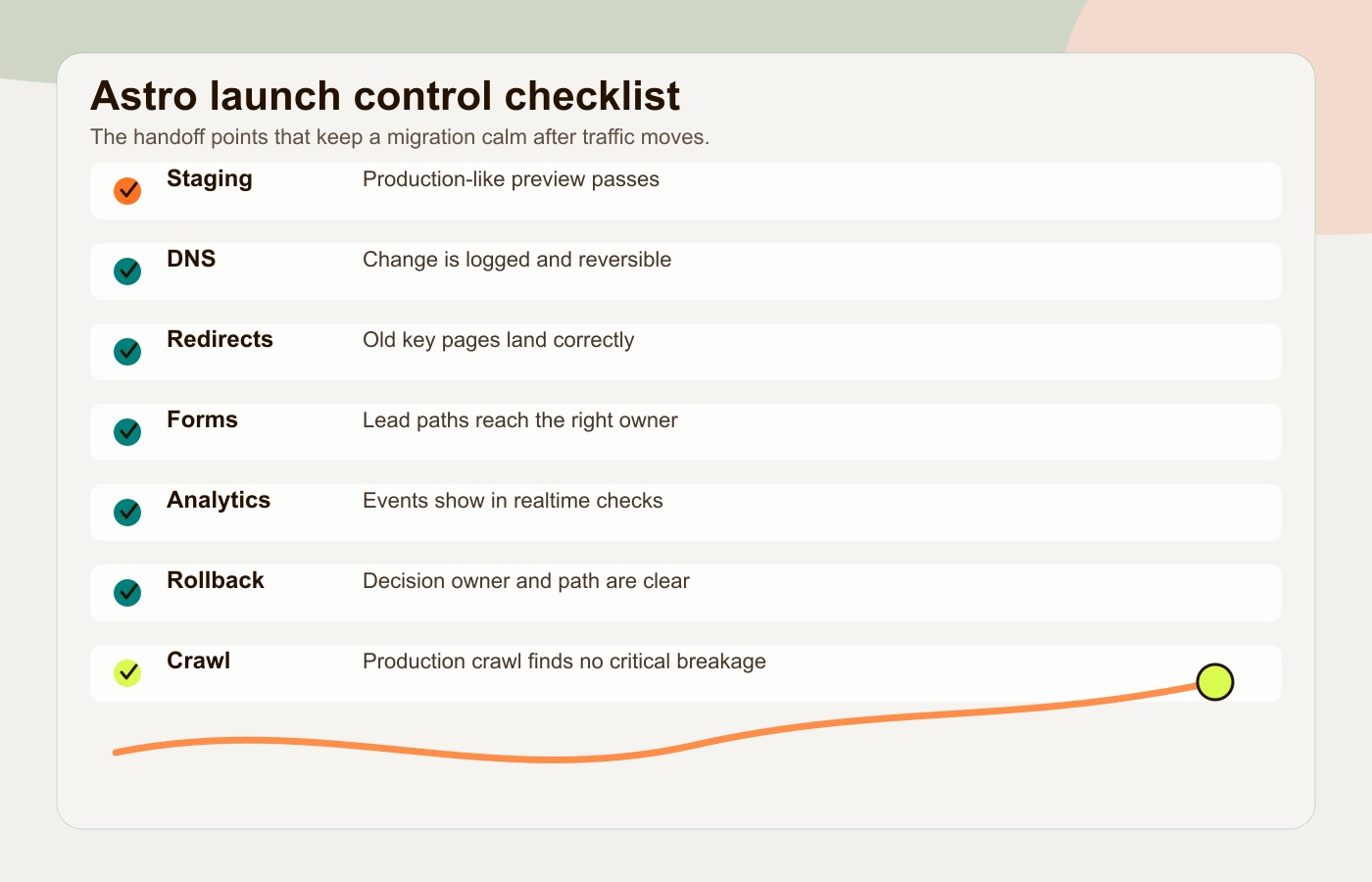
Create the Astro migration launch checklist
An Astro migration launch checklist should separate pre-launch readiness, the launch window, and post-launch validation. Mixing those together creates launch-day noise.
Use this working sequence:
- Freeze the launch scope.
- Export the latest current-site crawl, sitemap, analytics landing pages, and Search Console priority URLs.
- Confirm the new build has the approved redirects, metadata, robots rules, sitemap, analytics tags, forms, and environment variables.
- Back up the old site’s deploy state, CMS export, media library, redirect rules, DNS records, and critical configuration.
- Confirm who can change DNS, who can deploy, who can test forms, who can inspect analytics, and who can approve rollback.
- Launch during a low-risk traffic window.
- Switch traffic.
- Test priority URLs, redirects, forms, analytics, and Search Console signals.
- Crawl the production site.
- Keep monitoring for at least the first week, with a deeper SEO review across the first 30 to 90 days.
That list is intentionally operational. The SEO detail belongs in the migration checklist. This launch plan is the control room for getting the new Astro site live without surprising the business.
Backups and rollback come before DNS
Before DNS changes, create a rollback bundle. This should be boring and explicit.
The rollback bundle should include:
- Current DNS records and where they are managed.
- Current hosting provider, deploy target, branch, build artifact, or release version.
- Current redirect rules.
- Current environment variables and secrets ownership, without exposing secret values in the launch document.
- Current CMS export or content backup.
- Current media backup.
- Current analytics, tag manager, consent, and CRM configuration notes.
- Names of the people allowed to approve rollback.
For static Astro deployments, rollback may be as simple as redeploying the previous host version or pointing DNS back to the old provider. For server-rendered Astro projects, rollback may also include adapters, environment variables, server routes, form endpoints, and edge behavior.
The rollback decision should have a timebox and measurable pass conditions. Record the values before launch. For example, use this decision record and replace the sample thresholds with values agreed by the launch owners:
| Critical path | Example pass condition |
|---|---|
| Homepage and priority pages | Return the expected success status, load the final host, and show the expected canonical URL from two independent networks |
| Top old URLs | Reach the correct new destination with one intended redirect and no loop or chain |
| Critical forms | Two realistic submissions reach the expected CRM or inbox and show the expected success state |
| Analytics | A test page view and one key conversion event appear in the provider’s real-time diagnostic view |
| Crawl controls | The production robots response and sitemap are reachable and do not block the intended priority pages |
Example rollback rule: if any revenue-critical path fails two consecutive tests from two networks, or if the failure cannot be isolated within 15 minutes, the launch lead records the failure, restores the previous traffic route, and keeps the new deployment available for diagnosis. This is an example error budget, not a universal threshold. Use the actual business impact to set it.
After a rollback, do not assume that every visitor returns to the old origin immediately. DNS caches, CDN caches, and browser caches can preserve the new route or old response for different periods. Keep both origins able to handle residual traffic, verify the previous route from multiple networks, and record when the rollback is complete.
Treat DNS and cache overlap as part of the launch
DNS is only one part of launch. A clean DNS switch still fails if the new host serves the wrong redirects, blocks crawlers, drops forms, or ships analytics without consent behavior. DNS caches, CDN caches, and browser caches can also make the old and new behavior visible at the same time.
Before the switch:
- Confirm which DNS records change: apex,
www, subdomains, or only a proxy target. - Where configurable, lower TTL at least one previous TTL period before the switch so existing cached answers have time to expire; record the previous value and when to restore it.
- Confirm SSL certificates are ready on the new host.
- Decide whether traffic goes through Cloudflare, the hosting provider, or another edge layer.
- Document the exact old value and new value for every changed record.
- Keep the old site online until the new site is verified.
- Record the current TTL and use it as a minimum planning baseline, not a guaranteed cutover time. Lower it in advance when the DNS provider and business policy allow it.
- Record how the actual CDN purges or revalidates HTML, redirects, and assets. Versioned assets should remain available on both origins during the overlap.
- Test the new route from more than one network and with a clean browser session. Do not use one local result as proof that propagation is complete.
TTL controls how long a resolver may cache a DNS answer. It does not instantly clear answers already cached elsewhere, and it does not control every browser or CDN cache. Allow extra time beyond the previous TTL and keep the rollback route available during that period.
If Cloudflare is part of the stack, redirects may live at the edge rather than inside the Astro app. Cloudflare’s redirect documentation separates Single Redirects and Bulk Redirects, and notes that those redirect products require proxied DNS records for the hostname. That matters because a redirect plan written in a spreadsheet still needs to match how the edge actually evaluates requests.
A lower TTL does not invalidate answers already cached under the previous value. During the transition, some visitors may reach the old host while others reach the new one. Keep both origins, certificates and required form endpoints working through the observed transition and rollback window. Restore the normal TTL after stability is confirmed. Cloudflare’s TTL reference explains resolver caching and the different behavior of proxied records.
DNS caching is separate from CDN and browser caching. A DNS rollback may still send some users to the new host temporarily, and a host rollback may leave cached HTML or assets in circulation. Retain versioned assets, review cache headers and verify the affected cache layers. Reverting a deployment also does not undo database writes or messages already sent.
A DNS launch should have two people involved: one person makes the change, the other validates the result from outside the admin console.
Rehearse a static Astro deployment on Cloudflare Pages
This example applies to a static Astro site already using one Cloudflare Pages project with a working production deployment. It rehearses a host deployment rollback without changing DNS. A move between providers needs the additional DNS controls above.
- Record the existing successful production deployment ID and test the public domain, a priority redirect and a form using designated test data.
- Build and validate the candidate in a protected preview. Confirm assets, redirect rules and form configuration match the intended production environment.
- In an approved release window, deploy the candidate to production and have a second person repeat the checks against the public domain.
- Rehearse restoring the recorded production deployment: open the project’s Deployments list, select that deployment’s action menu and choose the rollback action. Cloudflare’s Pages rollback documentation says preview deployments cannot be rollback targets.
- Verify the previous version on the public domain, redirects, assets and form delivery. Record elapsed recovery time and any cache or external-service steps required. Review the evidence before rescheduling the candidate release.
This rehearsal does not prove recovery of database changes, external messages or secrets configuration. Keep those changes compatible with both versions, or create and test a separate recovery procedure before cutover.
Example: validate a Cloudflare-proxied Astro host
Use the actual production host and deployment provider in the run record. This example shows the order, not a universal Cloudflare configuration:
- Deploy the approved Astro commit to the new origin and record the deployment identifier.
- From two independent networks, request the homepage, one priority service page, and one old URL. Confirm the status, final host, canonical URL, and redirect destination.
- Check the response headers and the Cloudflare route for the host. Confirm that the response comes from the intended origin or edge rule, and that no staging host or old redirect rule is exposed.
- Submit a test form with the agreed test address. Confirm the success state, notification or CRM record, and conversion event.
- Check the production robots response and sitemap URL. Crawl the priority URL set.
- Make the DNS or edge change. Repeat the same checks from both networks during the overlap.
- Record the result against the pass conditions. If a critical condition fails, follow the recorded rollback rule and test the previous route again.
Cloudflare’s redirect documentation explains the available redirect products and their hostname requirements. Confirm the behavior on the actual proxied host; do not infer it from a local Astro configuration file.
Redirects need production checks
Redirects are one of the easiest migration controls to trust too early. A CSV can look perfect. A staging check can pass. The real host can still behave differently because of trailing slashes, lowercase paths, query strings, old platform rules, edge rules, or redirect precedence.
Google’s site move guidance recommends mapping old URLs to new destinations, using redirects, submitting the new sitemap in Search Console, and monitoring traffic after the move. For launch operations, translate that into a smaller production test set.
Create a redirect test list with:
- Top organic landing pages.
- Top paid landing pages.
- High-value service pages.
- Pages with backlinks.
- Old campaign URLs.
- Common folder patterns.
- URLs with and without trailing slashes.
- A few known deleted or merged pages.
Test each one after launch. The pass condition is not “does it eventually land somewhere?” The pass condition is “does the old URL reach the correct new destination directly, with the intended status, without a chain that creates delay or confusion?”
Astro can define redirects in configuration, but static hosting, SSR adapters, and edge platforms can change how status codes are served. That is why redirect QA belongs on the final host, not only in local development.
Forms are revenue infrastructure
Forms need their own launch owner because they sit between the website and the sales process. A contact form can look perfect while failing silently in CRM routing, spam filtering, notification delivery, hidden fields, consent fields, or thank-you page tracking.
Before launch, test every conversion path:
| Form or action | Launch test |
|---|---|
| Contact form | Submit with realistic data and confirm CRM, email notification, thank-you state, and tracking |
| Booking flow | Confirm calendar availability, redirect behavior, confirmation email, and sales attribution |
| Newsletter form | Confirm list assignment, double opt-in if used, and UTM capture |
| Download or gated resource | Confirm access, email delivery, automation trigger, and follow-up sequence |
| Job or partner form | Confirm routing to the correct owner, not only a generic inbox |
Do not test forms only with an internal email address. Use the same browser conditions a real visitor might have: consent accepted, consent declined, mobile viewport, ad-blocked browser if relevant, and a campaign URL with UTMs.
If a form fails after launch, rollback may not be necessary if the site itself is healthy and the fix is isolated. But the team should know the difference between a small routing issue and a broken revenue path.
Analytics and Search Console need launch-day proof
Analytics validation should happen before and after the switch. In GA4, Google’s troubleshooting guide recommends immediate checks such as DebugView, Tag Assistant, browser network requests, and Realtime reports to confirm that the tag is firing and events are arriving.
Use the launch window to verify:
- Page views on the homepage and priority pages.
- Form submission events.
- Booking or lead events.
- UTM capture.
- Consent mode behavior.
- Referral and source behavior after redirects.
- No obvious duplicate page views from tag duplication.
Do not wait for standard reports to settle before deciding whether tracking works. Google’s GA4 guidance notes that DebugView can show events within seconds, Realtime reports usually show data within minutes, and standard reports can take 24 to 48 hours to fully process.
Search Console is different. It will not give instant ranking answers. Use it for ownership, sitemap submission, URL inspection of priority pages, and early crawl/indexing signals. If the domain, protocol, or URL structure changed, follow the relevant Search Console process rather than assuming Google will infer everything quickly.
Run post-launch crawl checks
The first production crawl is the reality check. Run it soon after launch, then again after the team fixes the first wave of issues.
The crawl should look for:
- Unexpected 404s.
- Redirect chains.
- Redirect loops.
- Internal links pointing to old URLs.
- Pages blocked by robots rules or noindex tags.
- Missing title tags or duplicate title tags.
- Missing meta descriptions on priority pages.
- Canonicals pointing to staging, old URLs, or the wrong slash version.
- Broken image paths.
- Missing Open Graph images.
- Broken schema.
- Sitemap URLs that return errors or redirects.
- Forms or thank-you pages that are accidentally indexed.
Do not panic over every minor crawl warning. Prioritize issues that affect visitors, revenue paths, indexation, or high-value pages. A missing alt attribute on an old decorative image is not the same risk as a noindexed service page.
A practical Astro deployment checklist for launch day
Use this compact Astro deployment checklist when the team is ready to switch traffic.
| Timing | Owner question | Pass condition |
|---|---|---|
| 24-48 hours before | Is the scope frozen? | No unrelated content, design, tracking, or navigation changes are entering the launch |
| 24 hours before | Are backups complete? | Old site, redirects, CMS/media, DNS records, and configuration are recoverable |
| 12 hours before | Is staging approved? | Priority pages, redirects, forms, analytics, and sitemap pass production-like QA |
| Launch window | Who changes traffic? | DNS or host switch is made by the named owner and logged |
| Launch window | Who validates? | A second owner tests URLs, redirects, forms, analytics, Search Console tasks, and SSL |
| First hour | Is rollback needed? | The team decides against rollback only after critical paths pass |
| First day | What broke quietly? | Crawl, analytics, Search Console, CRM, and sales inbox checks are reviewed |
| First week | What needs cleanup? | Redirect chains, old internal links, sitemap issues, and form edge cases are fixed |
The checklist should be owned by one launch lead, but no one person should be the only person with access. If DNS, hosting, analytics, forms, and Search Console all depend on one unavailable login, the migration has an operational risk before the code even ships.
Keep monitoring after the site is live
A zero downtime Astro migration is not finished when the homepage loads. It is finished when the business can prove the new site is serving visitors, preserving search access, capturing leads, and giving the team reliable data.
Use the first 30 days to watch:
- Organic landing page changes.
- Search Console coverage and sitemap signals.
- Crawl errors and redirect behavior.
- Form submissions and sales handoff quality.
- Paid campaign landing pages.
- Referral traffic from old links.
- Core conversion events.
- Customer or sales team reports of broken pages.
Use the first 90 days for the slower SEO read. Google notes that processing moved URLs can take time, and visibility can fluctuate during a move. That does not mean every dip is harmless, but it does mean the team should compare against the migration baseline instead of reacting to one noisy day.
When to get help with the migration
Bring in help when the site carries meaningful organic traffic, paid campaigns, sales forms, editorial publishing, complex redirects, CRM integrations, or a stakeholder group that cannot afford a messy launch week.
Hapy’s Astro website migration work is built for that situation: audit first, preserve what already creates value, rebuild the site into a cleaner Astro foundation, and launch with redirects, analytics, forms, Search Console, rollback, and post-launch checks accounted for.
The point of a zero downtime Astro migration is not drama-free perfection. It is disciplined continuity. The old site keeps serving the business until the new site proves it can take over, and the team has a clear path back if the switch exposes something staging missed.