Astro website integrations are the business systems that must still work after the new site goes live: forms, CRM routing, email notifications, analytics, ad pixels, chat, CMS publishing, scheduling embeds, and any hidden workflows that turn a visitor into a sales conversation.
The migration risk is not that Astro cannot connect to these tools. It can. The risk is assuming a fast static-first site will automatically preserve the messy operating layer that grew around the old platform. A form can look right and stop writing to the CRM. GA4 can load and miss conversions. A scheduling embed can appear and lose UTM context. A chat widget can work on the homepage and fail on client-side page transitions.
That is why integrations should be audited as part of the migration, not added at the end. Use this guide with Hapy’s Astro SEO guide, website migration audit, and zero downtime launch plan before launch. SEO, forms, analytics, and sales handoff are not separate workstreams in a real marketing site. They are one revenue path.
If you need a team to execute the migration, Hapy’s Migrate to Astro engagement covers the audit, rebuild, integrations, redirects, QA, and production launch.
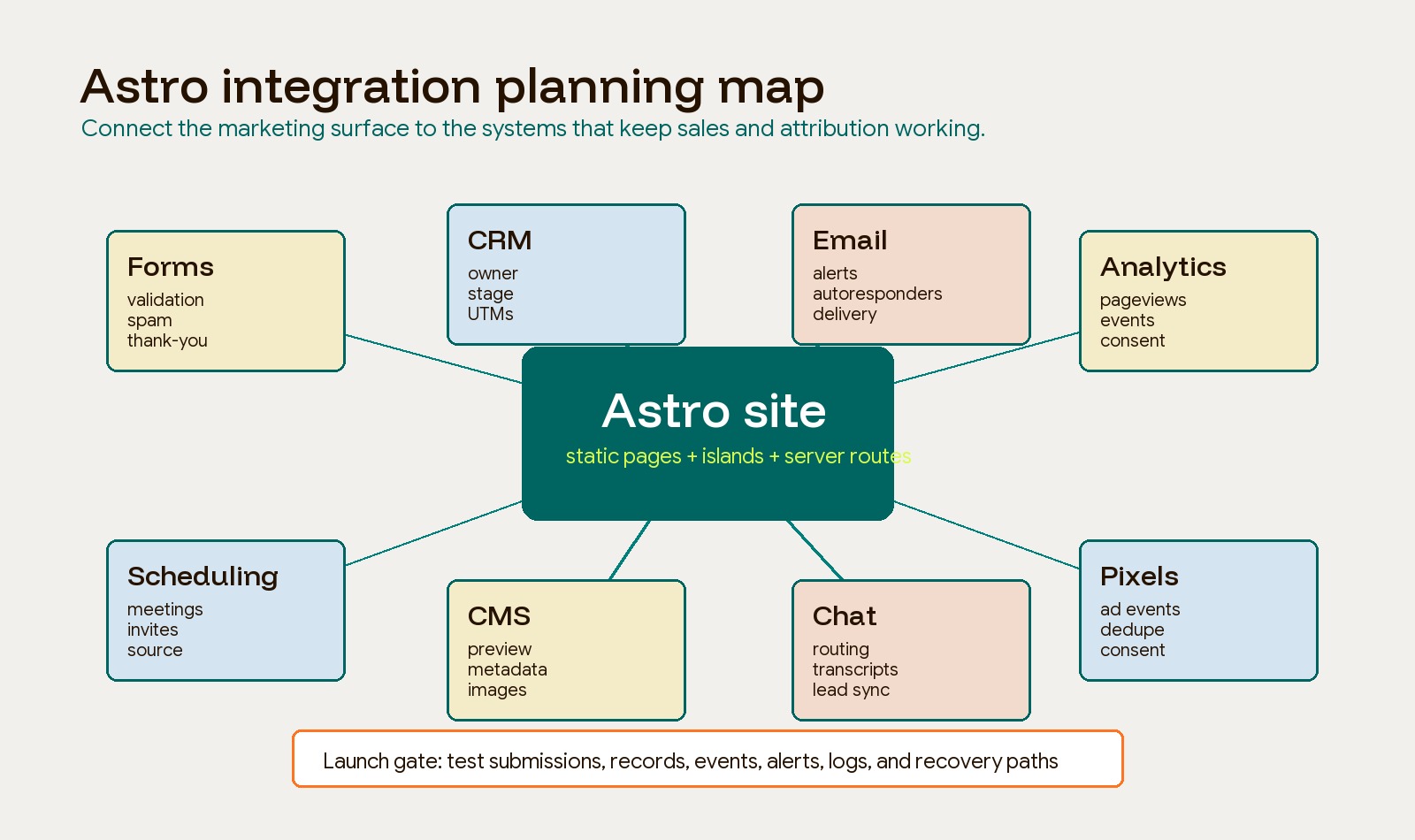
What Astro website integrations need to cover
Astro website integrations should cover every system that receives, sends, measures, or enriches visitor data. For most business sites, that means lead forms, newsletter forms, CRM writes, email notifications, analytics events, consent-aware ad pixels, live chat, CMS content, booking flows, and post-launch monitoring.
Start with a plain inventory. One row per integration is enough:
| Integration | What to decide before launch | What to test after launch |
|---|---|---|
| Forms | Hosted endpoint, Astro Action, API route, spam control, field validation, thank-you behavior | Submit real test leads, confirm success state, confirm error state, check spam controls |
| CRM | System of record, required fields, dedupe rules, owner assignment, lifecycle stage, source fields | Confirm lead/contact record, field mapping, owner assignment, activity history, UTM capture |
| Email notifications | Sender domain, recipients, templates, reply-to, fallback alerts, deliverability records | Confirm inbox delivery, SPF/DKIM/DMARC, failure alerts, sales notification timing |
| Analytics | GA4 or analytics tool, page views, key events, cross-domain rules, attribution model | Confirm page views, form events, booking events, route-change events, referral data |
| Pixels | Google Ads, Meta, LinkedIn, TikTok, retargeting, conversion APIs where needed | Confirm consent behavior, purchase/lead events, dedupe IDs, campaign landing pages |
| Chat | Widget script, routing hours, qualification rules, CRM sync, consent category | Confirm widget load, mobile behavior, lead capture, transcript routing |
| CMS | Content model, preview, publish flow, image fields, SEO fields, redirects, roles | Publish a test page, preview draft content, confirm metadata and images |
| Scheduling | Calendly, Cal.com, HubSpot meetings, routing forms, UTM preservation | Book a test meeting, confirm calendar invite, CRM activity, notification, thank-you route |
| Monitoring | Error tracking, server logs, form failure alerts, uptime checks, broken link checks | Review logs daily after launch and inspect failed submissions manually |
This inventory should exist before the final implementation sprint. If a tool has no owner, no test plan, or no definition of success, it is not ready for launch.
Forms are the first integration to protect
Forms are usually the most important Astro forms analytics CRM decision because they sit at the handoff between marketing and sales. The right implementation depends on how much server behavior the site needs.
A mostly static marketing site can use a hosted form endpoint or platform-native form handling. That keeps the site simple and pushes spam filtering, storage, and notification logic to a specialized service. This is often enough for contact forms, newsletter signups, gated resource requests, and simple quote forms.
When the form needs stronger validation, CRM enrichment, conditional routing, or secure API writes, move the processing to a server boundary. Astro supports standard server-handled HTML forms on on-demand rendered pages, and the official docs note that the page frontmatter can receive form data on the server without sending client JavaScript to the browser. Astro also supports Actions, which define type-safe backend functions and can be called from HTML form actions when the page is on-demand rendered.
That gives teams three practical patterns:
| Form pattern | Good fit | Watch out for |
|---|---|---|
| Hosted form endpoint | Contact forms, newsletters, low-risk lead capture, static hosting | Vendor ownership, field limits, spam settings, webhook reliability |
| Astro form handling | Custom validation, simple server-side processing, on-demand rendered pages | Requires server adapter or server mode planning |
| Astro Actions or API route | CRM writes, email notifications, enrichment, branching logic, secure server code | Needs environment variables, error handling, logs, retries, and QA |
The static-site tradeoff is straightforward: static pages are fast, cacheable, and easier to operate, but form submissions still need a place to go. That is not a limitation of Astro. It is a cleaner separation of responsibilities. The page can stay lean while the lead-processing work happens through a form service, server route, Action, serverless function, or backend API.
Before launch, test the unhappy paths too. Submit missing fields, invalid emails, duplicate leads, spammy messages, very long messages, and failures from the downstream CRM or email service. A polished success message is not enough. The team needs to know what happens when the form accepts the lead but the CRM rejects it.
CRM and email handoff should be server-side when it matters
CRM and email notifications are where a simple form becomes a business workflow. A lead might need to create or update a contact, attach UTM values, assign an owner, set a lifecycle stage, notify sales, trigger an autoresponder, and route the visitor to a thank-you page.
Keep private API keys out of the browser. Astro’s environment variable guidance separates server-only values from client-exposed values, and that distinction matters for HubSpot, Salesforce, Pipedrive, Resend, SendGrid, Mailchimp Transactional, and any other system that can create or update records. If a credential can change customer data or send email, it belongs behind a server boundary.
For email notifications, treat deliverability as part of launch, not an afterthought. If the site sends lead alerts, autoresponders, or confirmation messages through a provider such as Resend’s Astro email setup, confirm the sender domain, reply-to address, recipients, rate limits, and failure path. A lead notification that lands in spam is a broken sales integration even if the form technically submitted.
For CRM writes, confirm the data contract:
- Which record is created: lead, contact, company, deal, activity, task, or ticket.
- Which fields are required by the CRM.
- Which UTM fields and page context are preserved.
- How duplicates are handled.
- Who owns the lead when no routing rule matches.
- What happens if the CRM API is down.
- Where failed submissions are stored for manual recovery.
This is the section to keep boring on purpose. Marketing teams do not need a clever CRM integration. They need reliable handoff, clean records, visible failures, and enough context for sales to follow up well.
Analytics, pixels, and consent need a launch contract
Analytics should be specified as a contract, not as “install GTM.” The contract should say which events define success, which tools fire on which pages, how consent changes script behavior, and how route changes are tracked if the site uses Astro’s client-side navigation.
Astro’s Partytown integration can help move resource-heavy third-party scripts away from the main thread. That is useful for analytics and advertising scripts because they can quietly reintroduce performance drag into a site that was migrated partly for speed. Use it deliberately, then test the network requests and conversion events. Do not assume a tag works because the script appears in the page source.
Consent needs its own timing check. Google’s Consent Mode documentation explains that consent defaults should be set before measurement tags send data. In an Astro site, that means the consent defaults, banner behavior, tag manager configuration, and regional rules need to be reviewed together. If consent is initialized late, the analytics numbers may be wrong even though the tag manager looks active.
If the site uses Astro’s <ClientRouter /> for view transitions, confirm analytics across client-side navigation. Astro’s view transition docs include lifecycle events such as astro:after-swap and astro:page-load; those are the moments where teams often need to re-run pageview or widget logic. Without this check, a visitor can move through several pages while the analytics tool records only the first load.
The minimum analytics QA plan should include:
- Page views on a fresh load.
- Page views after internal navigation.
- Form start, form submit, and successful lead events.
- Booking click and booking completion events.
- Paid landing page UTMs.
- Consent denied, accepted, and changed states.
- Pixel events in each ad platform’s preview or diagnostics tool.
- Server-side events or conversion API dedupe where used.
Fast pages are valuable. Accurate measurement is also valuable. A migration should preserve both.
CMS, chat, and scheduling are operational integrations
CMS, chat, and scheduling integrations look less technical than CRM or analytics, but they can break daily marketing work if they are rushed.
Astro’s content collections are useful when the site has structured content such as journal posts, landing pages, case studies, authors, categories, or product/service descriptions. They can load local or remote content and validate content shape with schemas. That is strong for SEO because required fields such as title, meta description, slug, image alt text, category, and publish date can be made hard to forget.
When marketers need visual editing, approvals, localization, or non-developer publishing, review Astro’s CMS integration options before choosing the editing layer. Astro can work with many CMS models, but the decision should follow the team’s workflow:
| Editing need | Likely CMS direction |
|---|---|
| Developer-owned journal and service pages | Markdown, MDX, or Astro content collections |
| Marketing-owned publishing with previews | Headless CMS with draft preview workflow |
| Visual page assembly | CMS or builder layer with clear component constraints |
| Multi-region content | Headless CMS with localization and roles |
| Content that changes every few minutes | Live collections, API-backed pages, or server-rendered routes |
Chat should be treated like a sales integration. Check script performance, consent category, mobile behavior, routing hours, fallback messages, and CRM transcript sync. If chat only works on the homepage, or loses visitor context after navigation, sales may see fewer qualified conversations without knowing why.
Scheduling embeds need similar attention. Confirm the meeting type, owner routing, time zone, required fields, hidden fields, UTM preservation, CRM activity creation, calendar invite, reminder email, and thank-you page. Many sites migrate the visual embed and forget the attribution path that tells sales where the meeting came from.
What to check before launch
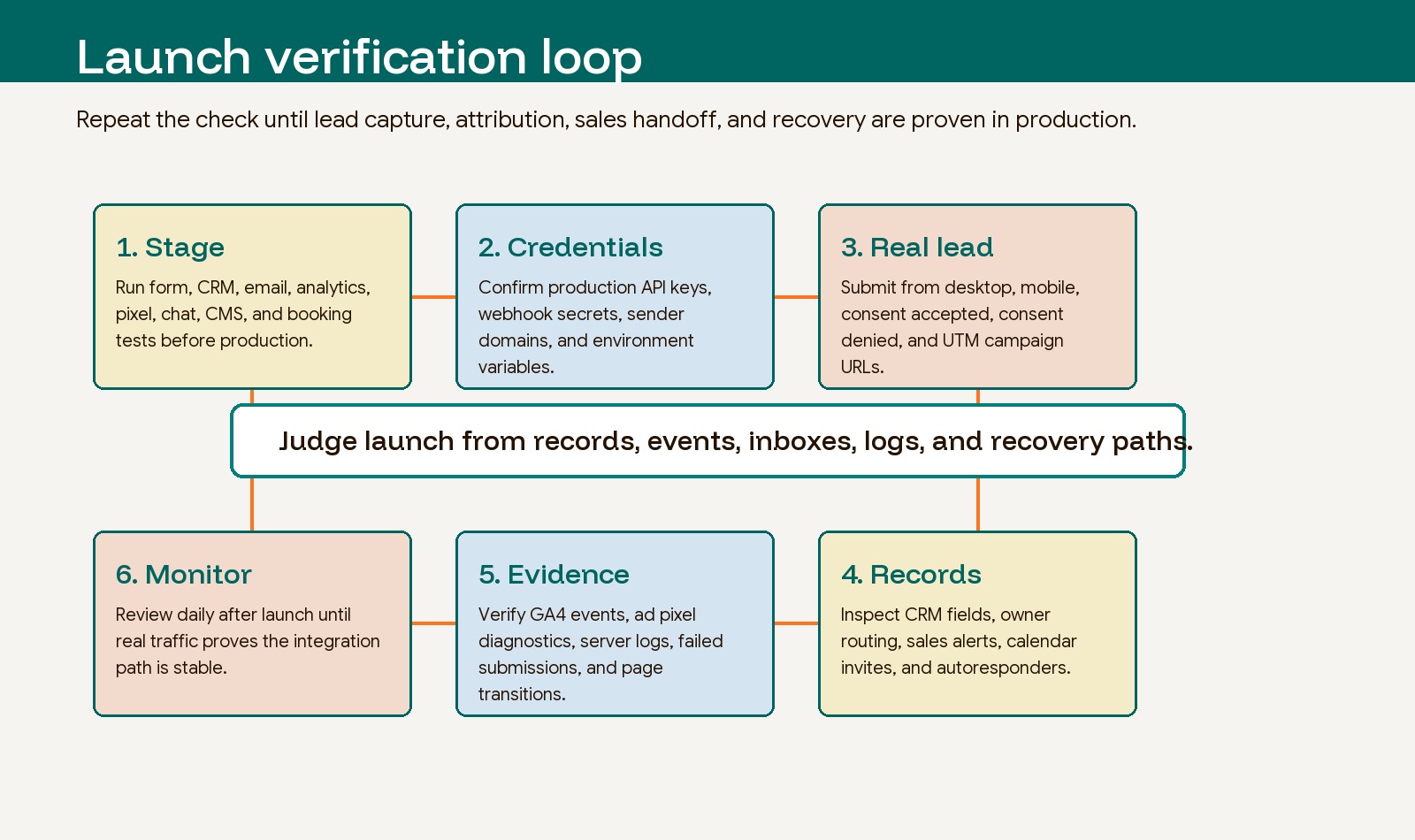
Before launch, run integration QA as a working session with marketing, sales, and engineering in the same loop. The goal is not to approve screenshots. The goal is to prove that a visitor can arrive, consent or decline, submit a form, book a meeting, trigger the right analytics, create the right sales record, and leave a recoverable trail if something fails.
Use this checklist before DNS, redirects, or production launch:
| Area | Pre-launch check |
|---|---|
| Access | All API keys, environment variables, service accounts, webhook secrets, and sender domains are configured in production, not only staging |
| Forms | Required fields, validation, spam controls, hidden fields, thank-you behavior, and error states are tested |
| CRM | Lead/contact creation, dedupe, lifecycle stage, owner routing, UTM fields, and activity logging are confirmed |
| Sales alerts, autoresponders, sender authentication, reply-to behavior, and failure alerts are confirmed | |
| Analytics | GA4, tag manager, custom events, booking events, form events, route-change pageviews, and conversions are verified |
| Pixels | Ad pixels respect consent, fire on the right events, and are visible in platform diagnostics |
| CMS | Editors can preview, publish, edit metadata, upload images, and roll back obvious mistakes |
| Chat | Widget load, routing, lead capture, transcript storage, and CRM sync are tested on desktop and mobile |
| Scheduling | Booking flow, calendar invite, notifications, CRM activity, time zone, and UTM preservation are tested |
| SEO-adjacent systems | Sitemap, robots rules, redirects, canonicals, metadata, schema, and analytics landing-page tracking are aligned |
Do at least one test using a paid-campaign-style URL with UTMs. Do one from mobile. Do one with consent denied. Do one with consent accepted. Do one where the downstream CRM or email service is intentionally unavailable if the integration is business-critical enough to warrant failure testing.
What to watch after launch
After launch, the first week should be treated as a monitoring period. This is where migration problems show up in real user behavior instead of controlled tests.
Check daily for the first few days:
- Form submissions in the form backend and CRM.
- Failed form or API logs.
- Sales notification delivery.
- GA4 real-time and conversion reports.
- Ad platform pixel diagnostics.
- Booking completions and CRM activities.
- Chat conversations and routing.
- 404s, redirect misses, and crawl issues.
- Sitemap and robots availability.
- Server errors from API routes, Actions, or webhooks.
Compare lead volume and conversion rate against the previous site only after accounting for campaign changes, traffic mix, seasonality, and tracking changes. A lower lead count may be a broken integration, but it may also be a traffic change. A higher lead count may be real, but it may also be duplicate events. Look at records, not just dashboards.
Assign one owner for the post-launch integration review. Otherwise, every tool looks like someone else’s problem. Marketing should own business acceptance, sales should confirm lead quality, and engineering should own logs, retries, and technical fixes.
The tradeoff to understand
Astro’s static-first model is a strength for marketing sites because most pages do not need to behave like applications. They need to load quickly, expose crawlable content, support structured metadata, and hydrate only the pieces that truly need browser JavaScript.
The tradeoff is that stateful business workflows must be placed intentionally. Forms, CRM writes, transactional emails, authentication, personalization, and real-time data need a backend, third-party service, serverless function, API route, Action, or server-rendered page. That planning is healthy. It forces the team to decide where sensitive data lives, where failures are logged, and which system owns each step.
For Astro marketing site integrations, the best architecture is usually mixed:
- Static pages for most content, landing pages, journals, case studies, and service pages.
- Hydrated islands for calculators, filters, carousels, chat widgets, and small interactive tools.
- Hosted services for simple forms, scheduling, email, or chat when they reduce maintenance.
- Server-side routes or Actions for secure CRM writes, enrichment, notification logic, and custom workflows.
- Headless CMS or content collections based on the editing model, not platform fashion.
That mix keeps Astro’s speed advantage while preserving the business systems that make the website useful.
The practical takeaway
Astro website integrations should be planned around the revenue path: visitor, consent, pageview, form or booking, CRM record, sales notification, attribution, and recovery if something fails. A migration is only successful when that path still works in production.
Before launch, inventory forms, analytics, CRM, email notifications, pixels, chat, CMS, and scheduling. After launch, test real submissions, inspect records, monitor failures, and compare the numbers to the old site with context. Do not wait for the sales team to notice missing leads.
If the current migration is still in planning, start with the website migration audit and the Astro SEO guide. If you are deciding whether Astro is the right move for a content-first marketing site, Hapy’s Migrate to Astro page explains the engagement in buyer terms: preserve what works, rebuild the foundation, and launch without breaking the systems that already support growth.