Hapy’s initial planning bands are 3 to 8 weeks for a business marketing site, 6 to 12 weeks for a WordPress migration, 8 to 14 weeks for a content-heavy rebuild, and 10 to 16+ weeks for complex integrations, ecommerce, membership logic, or heavy stakeholder review. Small brochure sites can move faster. Large sites slow down when content, redirects, CMS decisions, analytics, and approvals are not handled early.
That is the practical answer to “how long to migrate to Astro?” The framework is rarely the slowest part. Astro is built for content-driven sites, static output, and selective client-side interactivity through its islands architecture. The migration schedule gets longer when the old site has messy content, plugin-dependent workflows, fragile SEO history, unclear design ownership, or business systems that still need to work on launch day.
For a business website, the safest planning model is not “convert pages to Astro.” It is “protect what already creates value, rebuild what is dragging the site down, and launch without breaking search, forms, analytics, or editorial work.” That is why a serious website migration audit comes before any final timeline. Use the Astro migration cost guide for budget bands and the website migration SEO checklist when redirects, metadata, sitemap behavior, or organic traffic are material risks.
Before the production switch, use the zero downtime Astro migration launch plan to assign DNS, redirect, form, analytics, rollback, and post-launch verification responsibilities.
The Astro website integrations checklist covers the forms, CRM, email, analytics, pixels, chat, CMS, and scheduling workflows that need their own owners and production tests inside that launch plan.
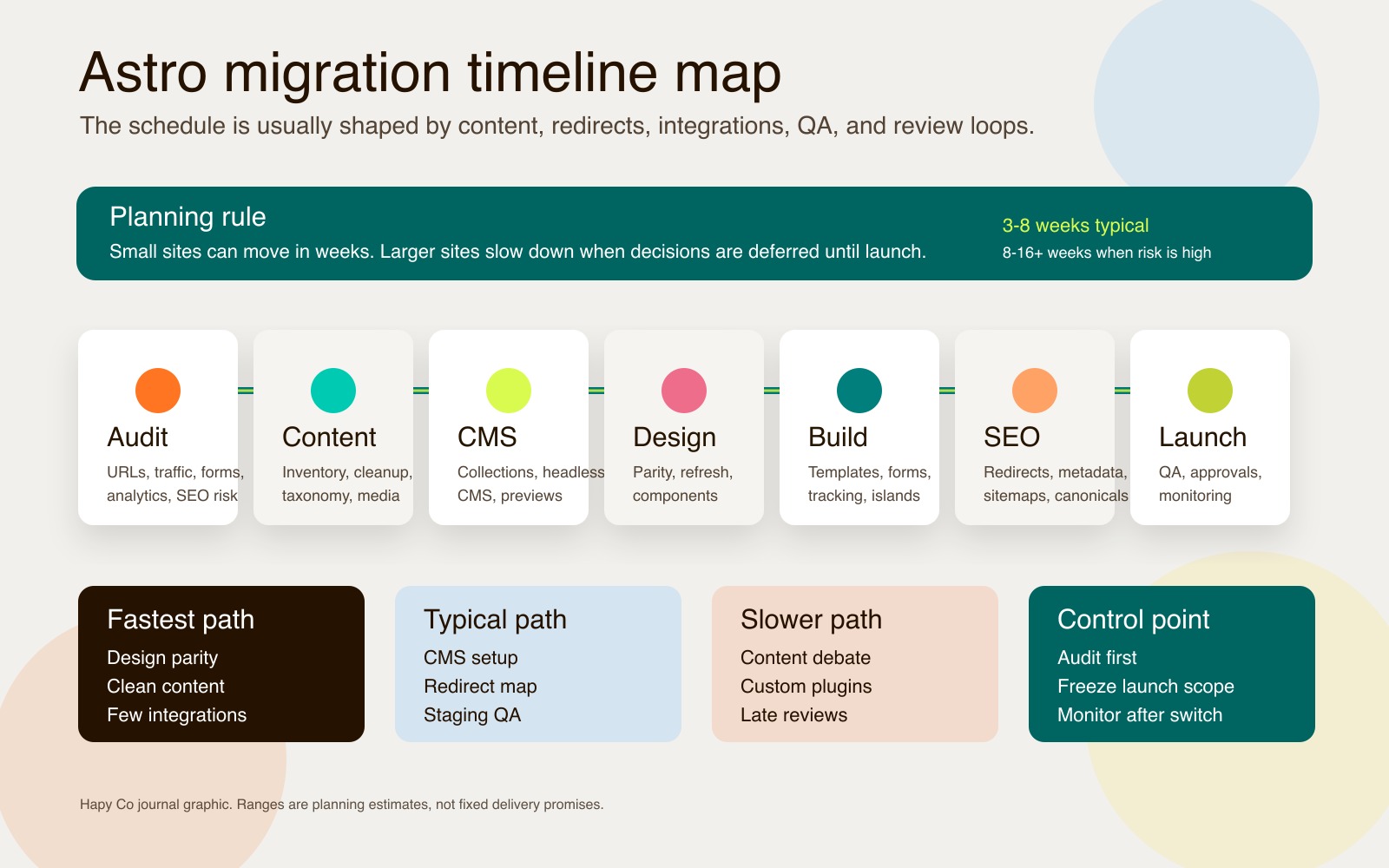
Astro website rebuild timeline by site size
These are Hapy planning heuristics, not measured market averages or a fixed quote. They assume one dedicated developer, part-time design and QA support, a named content owner, and feedback within two business days. Content cleanup and URL mapping can overlap template development after the content model is agreed; launch QA follows integration completion. Phase durations below therefore should not simply be added together. A solo part-time implementer or sequential approvals will need a longer calendar schedule. A 30-page site can take longer than a 300-page site if the 30 pages carry custom forms, multi-region content, legal review, and stakeholder debate. A 300-post blog can move quickly if the content model is clean and the redesign scope is narrow.
| Site type | Planning timeline | What the range assumes |
|---|---|---|
| Landing page or tiny brochure site | 1-3 weeks | Few templates, light content, minimal SEO risk, no CMS complexity |
| Small business marketing site | 3-5 weeks | 10-40 key pages, basic forms, analytics, redirects, design parity or light refresh |
| Mid-size business site | 5-8 weeks | 40-150 pages, reusable components, content cleanup, CMS setup, SEO mapping, QA |
| WordPress to Astro timeline | 6-12 weeks | Posts, pages, custom fields, plugins, redirects, media cleanup, editorial workflow decisions |
| Content-heavy site or resource hub | 8-14 weeks | Hundreds or thousands of URLs, taxonomy decisions, internal links, bulk migration, redirect QA |
| E-commerce, membership, or integrated site | 10-16+ weeks | Checkout, CRM, search, accounts, gated content, APIs, tracking, compliance, staged launch |
The fastest projects usually have three traits: the team agrees what should be preserved, the content inventory is known, and the launch checklist is boring. The slowest projects discover those things during development.
If a full rebuild is too risky for the next campaign cycle, a partial Astro migration can move the highest-value pages first while the old platform keeps running.
Phase 1: Audit the current website
Plan 2 to 5 business days for a small site and 1 to 2 weeks for a larger or high-traffic site.
The audit defines the rebuild surface. It should capture every active URL, indexed URL, page template, CMS collection, form, script, analytics event, redirect, canonical tag, sitemap entry, and business-critical landing page. Do not rely on the main navigation. Campaign pages, old blog posts, partner landers, and redirected URLs often sit outside the visible site but still carry search traffic or sales context.
For SEO-sensitive moves, Google recommends preparing redirects carefully when a site moves with URL changes, including mapping old URLs to new destinations and monitoring crawl issues after launch. Treat that guidance as the floor for the migration SEO checklist, not as an optional polish step.
The audit should answer:
| Audit question | Why it affects timeline |
|---|---|
| Which pages actually get traffic, links, leads, or sales support? | Prevents rebuilding low-value pages while missing pages that matter |
| Which URL patterns must be preserved or redirected? | Sets the redirect and QA workload |
| Which forms, tracking scripts, and integrations are live? | Avoids post-launch conversion and reporting gaps |
| Which content types exist? | Drives the CMS model, templates, and migration scripts |
| Which parts of the design must match exactly? | Defines visual QA effort and stakeholder review time |
If the audit is skipped, the project does not get shorter. The risk simply moves to launch week, where it is more expensive.
Phase 2: Content inventory and migration planning
Plan 2 to 5 days for a small site, 1 to 2 weeks for a mid-size site, and 2 to 4+ weeks for a large content library.
Content is the timeline driver teams underestimate most. Astro can manage Markdown and MDX content through Content Collections, with schemas that validate fields at build time. That is a strength, but it also forces decisions the old CMS may have avoided: which fields are required, which taxonomies still matter, which authors are valid, which images need alt text, and which legacy posts should be merged, refreshed, redirected, or dropped.
A useful content inventory separates pages into four groups:
| Content group | Migration action |
|---|---|
| Keep as-is | Preserve URL, metadata, content, and internal links where possible |
| Keep but improve | Refresh copy, structure, images, schema, or CTAs during the rebuild |
| Merge or redirect | Consolidate thin, duplicate, or outdated pages into stronger destinations |
| Retire | Remove only with a clear redirect or no-index rationale |
This is also where a WordPress to Astro timeline can expand. WordPress content may include posts, pages, categories, tags, authors, custom post types, Advanced Custom Fields, shortcodes, gallery blocks, page-builder layouts, media captions, and plugin-generated SEO fields. Moving that into Astro is manageable, but it needs a content model instead of a blind export.
Phase 3: Design parity or design refresh
Plan 1 to 2 weeks for design parity on a small-to-mid-size site. Plan 3 to 6+ weeks if the migration becomes a redesign.
Design parity means the new Astro site intentionally matches the old site’s visual system closely enough that the business does not reopen every brand decision. That can be the right choice when the business already likes the design but needs speed, ownership, content structure, and cleaner technical foundations.
A design refresh changes the timeline because it adds new decisions: page hierarchy, conversion paths, component behavior, copy rhythm, imagery, mobile layouts, and approval rounds. The rebuild may still be worth it, but the project should be named honestly. “Migration plus redesign” is not the same schedule as “migration with design parity.”
The best compromise for many business sites is selective refresh:
- Preserve the recognizable brand system.
- Rebuild the core templates as reusable Astro components.
- Improve high-value pages where conversion or clarity is weak.
- Leave low-risk archive content visually simple.
That keeps the Astro migration timeline tied to business value instead of turning the project into a full brand exercise.
Phase 4: CMS setup and editorial workflow
Plan 2 to 5 days for file-based content, 1 to 2 weeks for a headless CMS, and 2 to 4+ weeks when editorial roles, approvals, localization, or previews are complex.
Astro does not force one CMS model. A simple editorial site may work well with Markdown, MDX, and Content Collections. A marketing team that needs visual editing, approval workflows, page previews, localization, or non-technical publishing may need a headless CMS such as Sanity, Storyblok, Payload, Decap, or headless WordPress.
This decision affects more than developer preference. It changes who can publish, how drafts are reviewed, how images are managed, how metadata is entered, how preview environments work, and how future landing pages are created.
If the current WordPress editorial workflow is working, one option is a headless WordPress setup where WordPress remains the content backend and Astro becomes the frontend. Astro documents the basic model for migrating from WordPress, but the business decision is broader: keep WordPress only if the editing workflow is worth the operational overhead.
Phase 5: Development and integration work
Plan 1 to 3 weeks for a small site, 3 to 6 weeks for a mid-size site, and 6 to 10+ weeks for integrated or highly interactive sites.
Development includes templates, components, layouts, content loaders, image handling, forms, analytics, redirects, sitemaps, metadata, schema, accessibility fixes, and deployment configuration. Astro is efficient for content-first sites because it can ship less client-side JavaScript and hydrate only the interactive pieces that need it. But integrations still take real time.
Common rebuild work includes:
| Workstream | What has to be rebuilt or verified |
|---|---|
| Templates | Home, landing pages, blog, resources, case studies, authors, categories |
| Components | Navigation, footer, CTAs, cards, forms, accordions, media blocks |
| Forms | CRM routing, spam protection, validation, confirmation states, tracking |
| Analytics | GA4, pixels, consent tools, events, conversion goals, UTM behavior |
| Search and filters | Site search, category filters, faceted content, resource libraries |
| Interactive islands | Calculators, carts, forms, account widgets, embedded tools |
| Hosting | Build pipeline, preview deployments, environment variables, headers |
The development phase is also where AI-assisted tooling can help with repetitive transformations: converting page blocks, drafting component scaffolds, generating tests, or checking link paths. It should not be treated as a replacement for architectural judgment. Someone still has to decide the content model, integration strategy, SEO preservation plan, and launch path.
Phase 6: Redirects, metadata, and SEO preservation
Plan 2 to 5 days for a small site, 1 to 2 weeks for a mid-size site, and 2 to 4+ weeks for a content-heavy site with many URL patterns.
Redirects are not a final admin task. They are part of the rebuild architecture. If old URLs change, each meaningful old URL needs a destination. If a page is merged, the redirect should point to the best replacement, not the homepage. If a page is retired, the team should understand the traffic and backlink risk before removing it.
The SEO migration work should include:
- URL inventory from crawls, sitemaps, analytics, and Search Console.
- One-to-one redirect map for changed URLs.
- Metadata migration for titles, descriptions, canonicals, open graph fields, and schema where relevant.
- Internal link cleanup so new pages do not rely on redirect chains.
- XML sitemap and robots.txt review.
- Tracking and conversion event verification.
- Post-launch crawl monitoring.
This is where Hapy’s Astro migration cost depends on risk more than page count. A small site with years of organic traffic can need more SEO preservation work than a larger site with no search footprint.
Phase 7: QA, stakeholder review, and launch
Plan 1 week for a small site, 1 to 2 weeks for a mid-size site, and 2 to 4+ weeks when the site is high-traffic, multi-stakeholder, or integration-heavy.
QA should cover more than “does it look right?” The team should test mobile and desktop layouts, forms, analytics events, page speed, accessibility, internal links, redirects, 404 behavior, sitemap output, metadata, canonical tags, social previews, browser compatibility, and deployment rollback.
Stakeholder review is often the hidden timeline killer. If legal, brand, sales, leadership, product, SEO, and engineering all review the site late, the project can stall even after development is done. Build review checkpoints into the timeline:
| Review point | Who should review |
|---|---|
| Sitemap and redirect plan | SEO, marketing, product owner |
| Content model and CMS workflow | Marketing, content owners, engineering |
| Design parity or refresh direction | Brand, leadership, sales if relevant |
| Staging site | Marketing, QA, engineering, analytics owner |
| Launch checklist | Project owner, engineering, SEO, operations |
Launch should be staged when the risk justifies it. Low-risk sites can launch in one switch. Higher-risk sites may benefit from preview deployments, traffic-limited rollouts, DNS planning, redirects tested in staging, and a post-launch monitoring window.
Migration SEO checklist before launch
Before launch, confirm the following:
- Every important legacy URL has a mapped destination.
- Redirects use permanent redirects where the move is permanent.
- Redirect chains and loops have been removed.
- Titles, meta descriptions, canonicals, and open graph fields are present on priority pages.
- The XML sitemap contains the intended new URLs.
- Robots.txt does not block pages that should be indexed.
- Internal links point to final URLs, not old URLs.
- Analytics and conversion events fire on staging and production.
- Forms submit to the right destination and show useful success/error states.
- Search Console is monitored after launch for crawl errors, indexing changes, and redirect problems.
This checklist is not busywork. It is how a rebuild avoids turning a faster website into a traffic recovery project.
What slows an Astro migration down
Four things usually slow the schedule.
Content decisions. If the team has not decided which pages to keep, merge, rewrite, or retire, development waits on editorial judgment.
Integrations. CRM routing, analytics, consent tools, search, checkout, member areas, localization, and legacy APIs all add testing paths.
SEO redirects. The more URL history the site has, the more careful the mapping needs to be.
Stakeholder reviews. Late review cycles can add weeks because they reopen page structure, copy, design, CMS workflow, and launch risk at the same time.
There are also technical edge cases: old service workers, cached assets, page-builder shortcodes, plugin-generated metadata, inconsistent media libraries, and JavaScript widgets that were never documented. These do not make Astro risky. They make the old platform harder to leave cleanly.
How to keep the timeline realistic
The best way to shorten an Astro migration timeline is to reduce uncertainty before development starts.
Start with a crawl and content inventory. Decide the CMS model early. Separate design parity from redesign. Freeze the redirect strategy before staging. Assign one owner for analytics and forms. Put stakeholder review dates on the calendar. Decide which pages are launch-critical and which can follow later.
A phased launch is often smarter than a heroic full-site cutover. For example:
| Phase | Practical scope |
|---|---|
| Phase 1 | Homepage, top service pages, core navigation, forms, analytics, redirects |
| Phase 2 | Blog or resource hub migration, internal link cleanup, author/category templates |
| Phase 3 | Secondary landing pages, experiments, performance polish, schema expansion |
| Phase 4 | Advanced CMS workflow, personalization, search, integrations, new campaign templates |
This keeps the business moving while reducing launch risk. It also gives the team a cleaner way to learn from the first release before migrating every edge case.
The bottom line
Use 3 to 8 weeks as an initial marketing-site planning band; use 6 to 12 for WordPress, 8 to 14 for content-heavy sites, and 10 to 16+ for integrated sites under the staffing assumptions above. The difference is not just page count. It is content readiness, CMS complexity, design scope, redirects, integrations, QA, and stakeholder speed.
Astro can give a business site a faster, cleaner, more maintainable foundation. The migration succeeds when the plan protects the value already in the current site: rankings, content, forms, analytics, conversion paths, and editorial workflow. Start with the audit, make the timeline honest, and rebuild only after the risks are visible.