Transparent MVP development means a founder can see what is being built, why it matters, what changed, what it costs, what is risky, and what counts as done. It does not mean sitting inside the team’s task board all day or second-guessing every engineering choice.
That distinction matters for non-technical founders. You need visibility because version one is a capital allocation decision. You do not need to manage developers line by line. The right delivery system gives you enough evidence to make business decisions without turning the build into surveillance.
For an MVP, transparency should answer six questions every week:
- Are we still building the smallest useful version?
- What working software can I see?
- What changed in scope, and what did it cost?
- How much budget has been spent, and what runway remains?
- What risks, assumptions, issues, or dependencies could affect launch?
- What acceptance criteria tell us a feature is actually done?
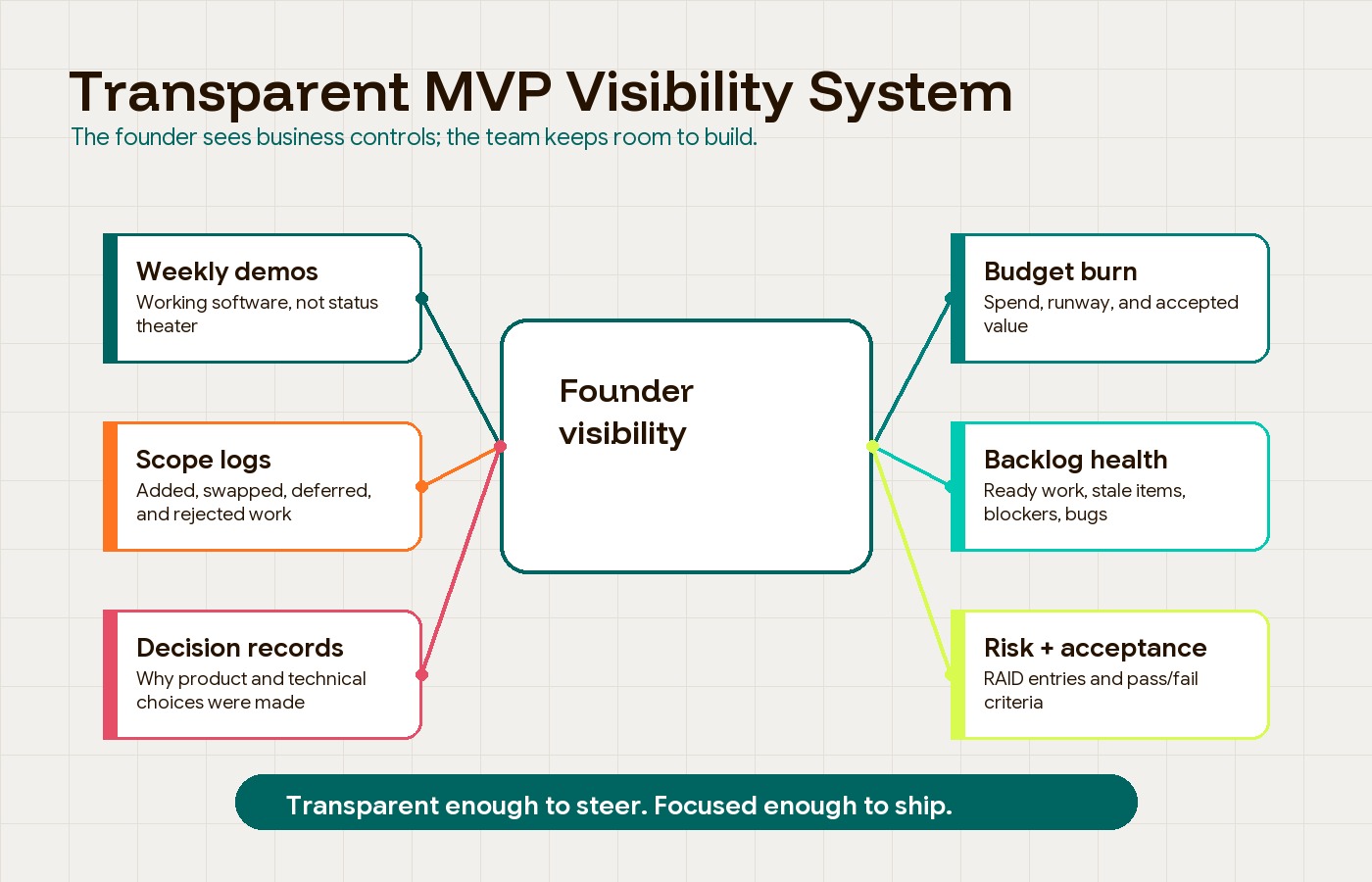
That is the operating layer this article covers: weekly demos, scope logs, decision records, budget burn, backlog health, a risk log, and acceptance criteria. Used together, they help founders track MVP development progress without micromanaging the team.
What transparent MVP development should make visible
Transparent MVP development should make the business state of the build visible, not every tiny implementation detail. A founder should be able to understand the current product boundary, the latest working increment, the financial burn, and the open decisions that could change the plan.
Use this as the minimum visibility set:
| Visibility area | What the founder should see | Why it matters |
|---|---|---|
| Weekly demo | Working software in a realistic flow | Progress becomes observable, not promised |
| Scope log | Added, cut, deferred, and swapped items | Scope creep becomes a decision, not a leak |
| Decision record | Why a product or technical tradeoff was made | The team stops relitigating the same choices |
| Budget burn | Spend to date, weekly burn, remaining runway | Cost stays tied to learning, not activity |
| Backlog health | Ready work, stale work, blocked work, bugs | Future delivery risk becomes visible early |
| Risk log | Risks, assumptions, issues, dependencies, owners | Problems get named before they become surprises |
| Acceptance criteria | Plain pass/fail conditions for important stories | Founders can approve outcomes, not vague effort |
The point is not to create a larger process. The point is to create a shared view that protects the MVP from two common failures: the founder losing visibility, and the team losing focus.
If the team is still defining what belongs in version one, pair this article with Hapy’s MVP development checklist. If the team is already working in sprints, Hapy’s agile MVP development guide is the better companion for keeping scope and learning connected.
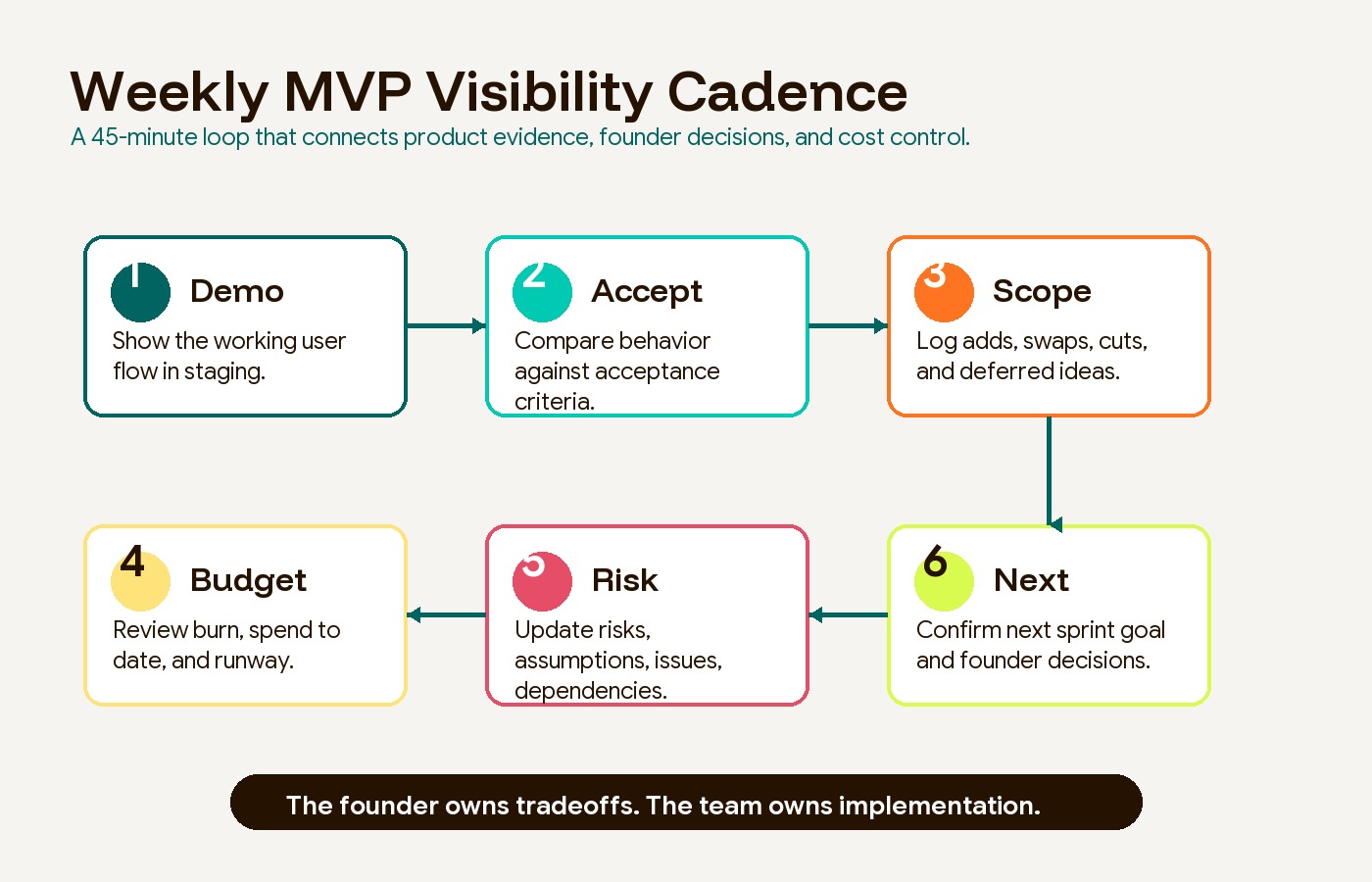
Weekly demos should show working product, not slides
A weekly demo is the founder’s best progress control because it turns delivery into something visible. The demo should show a working slice of the product in a staging or production-like environment. It should not be a status update, a slide deck, or a tour of tickets.
The Scrum Guide frames the Sprint Review as a working session where the team and stakeholders inspect the outcome of the sprint and decide what to adapt next. That idea is especially useful for MVPs. The demo is not a ceremony to prove the team was busy. It is a checkpoint for learning.
A useful weekly MVP demo usually follows this pattern:
| Demo segment | Founder question it answers |
|---|---|
| Context | What business goal did this week target? |
| Working flow | What can a user now do that they could not do before? |
| Acceptance check | Which criteria passed, failed, or changed? |
| Open decisions | What does the team need from the founder before the next sprint? |
| Risks and budget | What changed in risk, scope, or burn? |
| Next focus | What will be demonstrable next week? |
Keep the demo narrative user-facing. “A first-time clinic admin can invite a patient and see the appointment request” is better than “we finished auth tickets and notification tickets.” The founder can judge the former. The latter requires trust without enough context.
Record the demo and send a short written recap: what was shown, what was accepted, what was rejected, what decisions are needed, and what changed in scope or budget. That one recap often prevents days of confusion.
Track MVP scope before it becomes a budget problem
MVP scope management is where transparency either holds or collapses. Most scope problems do not arrive as obvious bloat. They arrive as reasonable requests: one extra report, one more login option, one admin shortcut, one integration the founder forgot to mention during discovery.
The fix is not to say no to everything. The fix is to make every change visible.
Use two logs:
| Log | What it captures | How to use it |
|---|---|---|
| Out-of-scope log | Good ideas explicitly excluded from this release | Review it weekly so deferred ideas feel parked, not ignored |
| Scope change log | Approved changes to the active release boundary | Record impact on budget, timeline, QA, analytics, and risk |
Every new request should get one of four outcomes:
- Defer: Keep it in the out-of-scope log for a later release.
- Swap: Add it only by removing work of similar effort or risk.
- Approve: Add it because the MVP cannot test the core assumption without it.
- Reject: Remove it because it weakens the learning goal or burns budget for polish.
The swap rule is the founder’s friend. It keeps the conversation practical. A founder can still make product decisions quickly, but the decision includes the tradeoff: “Yes, we can add local payment support now, and that means the referral workflow moves out of version one.”
For a non-technical founder, the most important artifact is the “not building” list. A serious MVP should have one. It tells everyone what the current release is protecting.
How to track MVP development progress without hovering
To track MVP development progress, look for evidence at three levels: working product, resolved decisions, and clearer risk. Ticket counts alone are weak progress signals because they can rise while the product becomes harder to ship.
Use this weekly progress view:
| Progress signal | Healthy version | Warning sign |
|---|---|---|
| Working product | Each demo shows an integrated user flow | Demos show isolated components or screenshots |
| Decisions | Tradeoffs are recorded and linked to scope | The same debate repeats every week |
| Backlog | Upcoming work is small, estimated, and testable | Sprint planning turns into requirements discovery |
| Quality | Important flows have acceptance criteria and tests | “Done” means only that code was written |
| Risk | Risks have owners and next actions | Risks are discussed verbally but not tracked |
| Budget | Burn and remaining runway are visible | Cost is reported only when invoices arrive |
Decision records are underrated here. Thoughtworks has long recommended lightweight architecture decision records because important technical choices need context and consequences, not only code. For MVP delivery, use the same idea for product decisions.
A product decision record can be short:
| Field | Example |
|---|---|
| Decision | Use Stripe first; defer local payment gateway |
| Context | First customer interviews validate card payment; local gateway adds testing delay |
| Alternatives | Local gateway now, manual invoicing, no payment in MVP |
| Consequence | Version one can test payment intent faster; later GCC rollout may need gateway work |
| Owner | Founder and product lead |
| Review date | After five paid pilots or before public launch |
This is how founders stay involved without hovering. They own business tradeoffs. The team owns implementation. The record keeps the two connected.
MVP cost tracking should connect spend to learning
MVP cost tracking should show whether budget is buying useful evidence. A beautiful burn chart is not enough if the team is spending money on features that do not test the product’s core assumption.
At minimum, review these numbers weekly:
| Cost signal | What to track |
|---|---|
| Weekly burn | Team cost for the week, including product, design, engineering, QA, and project leadership |
| Spend to date | Total cost already incurred |
| Remaining budget | Approved budget minus spend to date |
| Forecasted runway | How many weeks remain at the current burn rate |
| Approved scope changes | Cost or time impact from changes accepted this week |
| Value completed | Important flows accepted, not just tickets closed |
| Post-launch reserve | Budget left for fixes, analytics review, feedback, and iteration |
If your team uses earned value language, keep it simple. PMI’s overview of earned value management defines earned value as the budgeted value of work completed and actual cost as the cost incurred for that work. The common Cost Performance Index is:
CPI = Earned Value / Actual CostFor a founder, the exact formula matters less than the habit behind it: compare what has been spent with what has been accepted as useful, working product. If cost is rising faster than accepted value, ask whether the issue is scope churn, unclear requirements, underestimated complexity, rework, blocked decisions, or weak backlog health.
The cleanest commercial model for many MVPs is fixed budget, flexible scope. The budget creates a ceiling. The backlog creates options. The founder and team then choose the highest-value work inside that ceiling. This avoids the false comfort of fixed scope when the product is still learning.
For budget ranges and scope complexity, use Hapy’s MVP development cost guide before you compare proposals.
Backlog health is the early warning system
The backlog is where future cost problems usually appear first. A messy backlog creates long planning meetings, vague estimates, surprise dependencies, repeated rework, and sprint spillover.
The Scrum Guide describes the Product Backlog as an emergent, ordered list of what is needed to improve the product, with refinement adding details such as description, order, and size. The Agile Alliance product backlog glossary makes a useful founder-facing point too: a backlog item is an option, not a guarantee that the team will build it.
That idea protects the MVP. A backlog should help the founder preserve optionality, not create a promise to deliver every idea.
A healthy MVP backlog has these traits:
| Backlog trait | What it looks like |
|---|---|
| Ordered by learning value | The top items answer the current MVP question |
| Small enough for sprint planning | Near-term work can fit inside one sprint |
| Estimated with the builders | The people doing the work help size it |
| Acceptance criteria attached | Important stories have pass/fail conditions |
| Dependencies visible | Blockers are named before commitment |
| Stale items removed or parked | Old ideas do not crowd the release boundary |
| Bugs visible beside features | Quality work competes honestly for capacity |
For non-technical founders, the key is not to inspect every ticket. Ask for a weekly backlog health summary:
- How many items are ready for the next sprint?
- Which must-have items are not ready?
- Which stories are blocked by founder decisions, credentials, data, API access, or design?
- Which bugs threaten the core workflow?
- Which item should be removed because it no longer helps the MVP decision?
If those answers are vague, the next sprint is already carrying hidden risk.
Risk logs and acceptance criteria prevent late surprises
A risk log should separate four things that often get mixed together:
| Type | Meaning | MVP example |
|---|---|---|
| Risk | Something that might happen | App store review may reject the data collection flow |
| Assumption | Something believed but not proven | The payment provider supports the required sandbox behavior |
| Issue | Something currently happening | The import job times out on real customer CSV files |
| Dependency | Something outside the team’s control | Founder must provide production API credentials |
This is often called a RAID log: risks, assumptions, issues, and dependencies. The name matters less than the discipline. Every entry needs an owner, next action, severity, and review date. If a risk becomes real, move it to issues. If an assumption is verified, mark it verified. If a dependency blocks sprint work, it belongs in the founder’s line of sight.
Acceptance criteria are the matching control on quality. They define what must be true before a story can be accepted. The Agile Alliance definition of done explains why an explicit done checklist reduces misunderstanding between the team and customer or product owner. For MVPs, acceptance criteria are where founder intent becomes testable.
Gherkin is useful because it puts expected behavior into a plain Given/When/Then format. The official Cucumber Gherkin reference describes scenarios as concrete examples that specify initial context, event, and expected outcome. Hapy’s Gherkin language guide gives a broader explanation for teams that want to write acceptance tests in business language.
A simple MVP acceptance criterion might look like this:
Scenario: Founder reviews weekly budget burn
  Given the current sprint has accepted work and logged team cost
  When the founder opens the delivery dashboard
  Then the dashboard shows spend to date, weekly burn, remaining budget, and forecasted runway
Notice what this does for a non-technical founder. It does not require knowing the database schema or frontend framework. It says what outcome must be observable.
The founder visibility checklist
Use this checklist before signing an MVP build agreement or before the next sprint if the project is already underway.
| Visibility question | Evidence to ask for |
|---|---|
| What are we building now? | Current sprint goal, must-have scope, and active user flow |
| What are we not building? | Out-of-scope log and deferred feature list |
| What changed this week? | Scope change log with impact on cost, timing, QA, and analytics |
| What can I see working? | Weekly demo recording and accepted stories |
| What did we decide? | Product and architecture decision records |
| What does it cost? | Weekly burn, spend to date, remaining budget, and runway forecast |
| What could block us? | Risk, assumption, issue, and dependency log |
| Is the backlog healthy? | Ready work for the next sprint, blocked work, stale items, and bugs |
| How do we know it is done? | Acceptance criteria and definition of done for critical flows |
| What do you need from me? | Founder decisions, access, content, users, approvals, or tradeoffs |
This is enough visibility for most founders. More can become noise. Less can become blind trust.
What transparency should feel like
Good transparent MVP development feels calm, specific, and decision-led. The founder sees enough to steer the business outcome. The team has enough room to do its work. Scope changes are not forbidden, but they are priced in tradeoffs. Budget burn is not a surprise. Risks are not hidden until launch week. Acceptance is based on working behavior, not optimism.
The practical rule is simple: if a founder cannot understand the current scope, progress, cost, risk, and acceptance bar in less than 30 minutes a week, the delivery system is not transparent enough.
But if the founder needs to read every ticket to know what is happening, the system has gone too far in the other direction. Transparent MVP development is the middle path: visible enough to protect investment, focused enough to let the team build, and honest enough to change course while the cost of change is still low.
If you are planning version one, start with the MVP development checklist, then use Hapy’s MVP Development engagement when you need a senior product and engineering team to keep scope, delivery, and learning tied together.
FAQ
What is transparent MVP development?
Transparent MVP development is a delivery model where founders can see the current scope, working progress, cost burn, decisions, risks, backlog health, and acceptance criteria throughout the build. The goal is visibility for better decisions, not micromanagement of developers.
How can a non-technical founder track MVP development progress?
A non-technical founder can track MVP development progress through weekly working demos, a visible scope log, decision records, budget burn reports, backlog health summaries, risk logs, and plain-language acceptance criteria. The founder should judge outcomes and tradeoffs, not individual coding tasks.
What should be included in MVP cost tracking?
MVP cost tracking should include weekly burn, spend to date, remaining budget, forecasted runway, approved scope changes, accepted work, and a post-launch reserve. Cost should be reviewed next to scope and progress so the founder can see whether spending is producing useful product evidence.