This Kuwait startup ecosystem guide develops a B2B workflow hypothesis for founders to test. It does not establish that B2B is superior to consumer products or that seed capital is unavailable. Market rankings, connectivity, and public programs describe context; customer interviews, procurement access, and paid usage establish whether your specific product has a market.
A possible starting point is a narrow SaaS, fintech, or automation workflow that can later be tested in Oman or another GCC country. Regional expansion remains a separate validation exercise.
The current signal is mixed in a useful way. StartupBlink lists 82 Kuwait startups in July 2026, with the country ranked #89 globally and #8 in the Middle East. The U.S. International Trade Administration says Kuwait’s digital economy is supported by high connectivity, an ICT market valued at $20.4 billion in 2025, and 5G coverage reaching around 97% of the population. The gap is not whether people are online. The gap is whether local products can turn digital access into better operations.
For founders, Kuwait’s practical question is simple: can you build a product that reduces friction in a real business process, passes local trust requirements, and earns enough proof to scale beyond Kuwait?
Kuwait startup ecosystem in 2026: the useful read
Kuwait’s startup ecosystem is small, capital-rich, and execution-constrained. That combination creates fewer easy wins than larger GCC hubs, but it also leaves room for focused products that modernize everyday business workflows.
The policy backdrop is Kuwait Vision 2035. The official “New Kuwait” framing aims to make Kuwait a regional financial and trade hub where the private sector leads more economic activity, supported by better infrastructure, legislation, and a business-friendly environment. In practical terms, founders should read Vision 2035 less as a slogan and more as a list of pressure points: private-sector growth, government modernization, digital infrastructure, finance, logistics, and human-capital development.
The macro tension matters. The IMF’s 2025 Article IV report, published in 2026, says Kuwait has begun moving from an oil-dependent welfare state toward a more diversified economy. It also notes that roughly 80% of employed Kuwaitis work for the government, and that the public-sector wage bill exceeded 31% of GDP in FY 2024/25. Those aggregate employment figures do not measure software talent availability. Test hiring assumptions with actual candidates, role-specific salary expectations, and time-to-hire evidence.
So the Kuwait opportunity is not “everyone will quit and start a startup.” It is “existing businesses, banks, retailers, logistics operators, service companies, and public-sector-adjacent teams need better digital systems.”
Government context and SME support
Kuwait has real SME support infrastructure, but founders should understand what type of capital and validation it is built for. The National Fund for SME Development is an important institution, especially for Kuwaiti entrepreneurs and SMEs that fit public-sector definitions. OECD’s review of Kuwait’s innovation policy says the fund was established in 2013 as an independent public corporation with KWD 2 billion in capital, and was designed to provide soft loans for small and medium enterprises.
That is useful, but it is not the same as venture capital. A debt-style program can help a business with predictable cash flows, assets, or a clear commercial plan. It is a tougher fit for a risky software startup still proving retention, unit economics, or an enterprise sales motion. A founder building Kuwait fintech, Kuwait SaaS, or a Kuwait app development product should avoid assuming that SME funding automatically solves product-market fit.
The National Fund has also been used to improve SME access to government demand. Kuwait Government Online reported in December 2025 that SMEs had secured 176 government tenders worth more than KWD 129 million since 2017. That is a meaningful signal for operators: public procurement can become a demand channel, but only for companies that can handle documentation, compliance, delivery reliability, and long sales cycles.
Kuwait Digital Startup Campus is another signal to watch. KDSC describes itself as a joint project between the Kuwait Youth Public Authority and Boeing, with programs for founders, investors, corporates, and academia. Its 2026 accelerator targets Kuwaiti startups beyond the idea stage. The selection criteria emphasize traction, live pilots, paying customers, usage, signed contracts, market size, scalability, unit economics, and execution capability. These are program-specific criteria, not evidence of a trend across all Kuwait funding programs. Check the current cohort, application window, nationality and company-stage eligibility directly with KDSC before planning around support.
Active sectors in Kuwait startups
The following are opportunity hypotheses where digital transformation may meet daily operations. Kuwait already has visible examples in laundry and services, fintech and payments, property workflows, ecommerce, education, and mobile service platforms. StartupBlink’s current list places Justclean, Enabill, Baims, Btr.tech, MyHome, Zad, Bookr, Ajar Online, Raha, and myU among visible Kuwait-linked startups.
Founders should read those examples by pattern, not by copying the category:
| Sector | What Kuwait already shows | Product opportunity |
|---|---|---|
| Services and home operations | Demand for convenience, booking, delivery, and vendor coordination | Scheduling, dispatch, service quality, subscriptions, field-team tools |
| Retail and ecommerce | High digital access and mature payments behavior | Inventory, loyalty, Arabic-first catalogs, social commerce operations, omnichannel analytics |
| Logistics and fulfillment | Route density, urban delivery, cross-border GCC trade | Fleet planning, returns, warehouse visibility, vendor portals, SLA tracking |
| Fintech and payments | CBK-led modernization, KNET habits, open banking movement | Expense tools, SME cash-flow apps, payment reconciliation, compliance workflows |
| Real estate and property | Rent, brokerage, maintenance, facility workflows | Tenant portals, rent collection, property data, maintenance automation |
| Education and training | Strong demand for curriculum-aware learning and career skills | Adaptive learning, Arabic/English content ops, test prep, workforce upskilling |
| Business systems | Many firms still rely on spreadsheets, WhatsApp, email, and disconnected tools | CRM, ERP-lite, procurement, approvals, reporting, document workflows |
The boring-looking products may be the best ones. A Kuwait digital transformation product that removes manual rework from a family business, logistics company, clinic, retail chain, or SME finance team can be more valuable than a polished consumer app with weak retention.
Sector opportunity matrix for founders
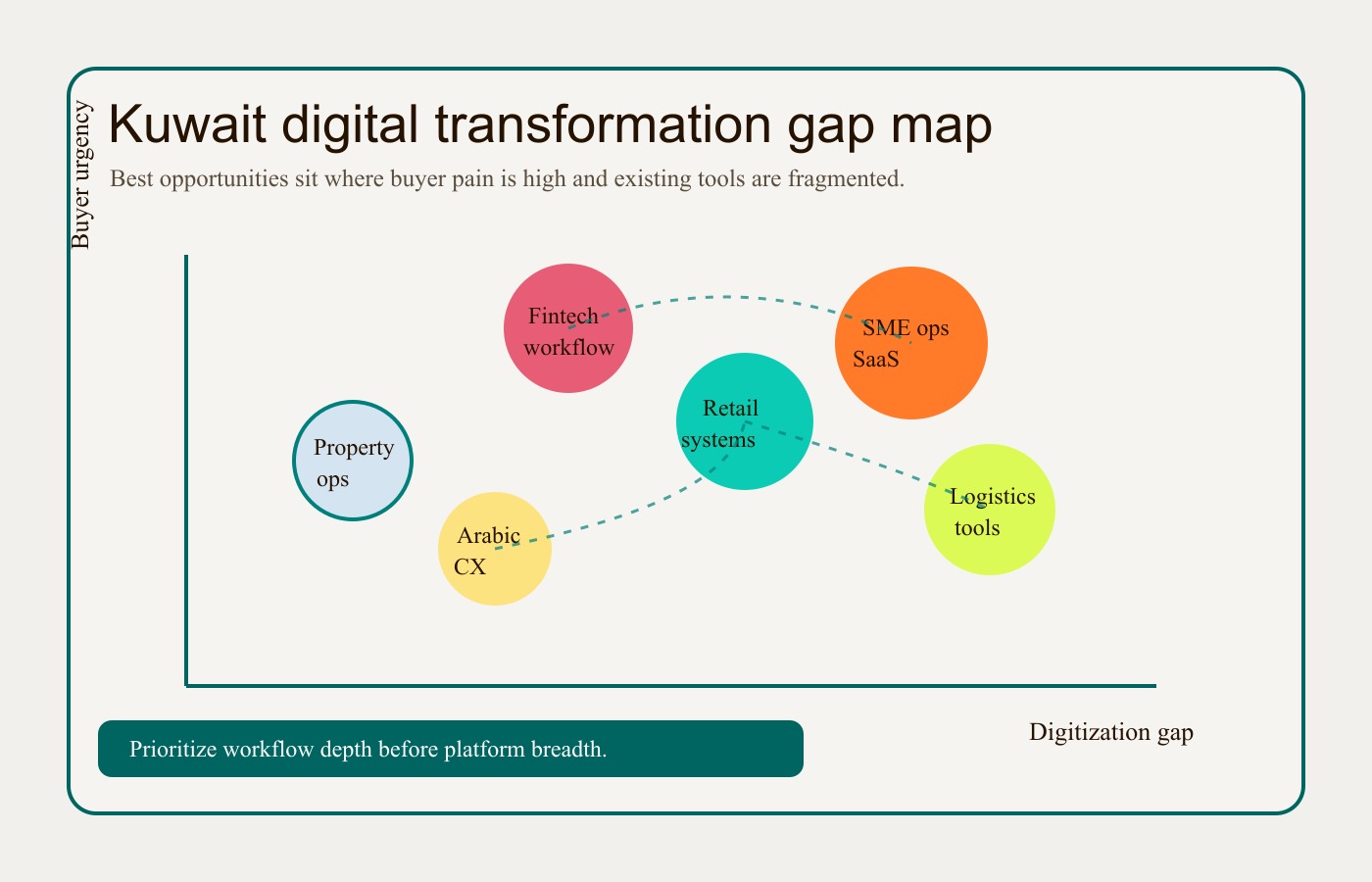
Use this hypothesis matrix to choose interviews; none of its buyer-pain or fit statements substitutes for evidence from the target segment.
| Opportunity | Buyer pain | MVP wedge | Why Kuwait fits | Watch-out |
|---|---|---|---|---|
| SME operations SaaS | Work is split across WhatsApp, Excel, email, paper, and legacy software | One workflow: approvals, orders, inventory, service tickets, or invoicing | Many SMEs need digitization before they need advanced AI | Buyer may expect implementation help, not self-serve onboarding |
| Retail and ecommerce systems | Stock, promotions, social selling, delivery, and loyalty are fragmented | Catalog, inventory, order routing, customer profiles, or returns dashboard | High connectivity and digital payments make adoption plausible | Must support Arabic UX, local payment flows, and store-level operations |
| Logistics and field-service tools | Dispatch, route planning, proof of delivery, and exception handling are manual | Driver app, dispatcher console, SLA alerts, client portal | Kuwait’s service and delivery density rewards operational efficiency | Integration with existing ERPs or accounting tools can slow launch |
| Fintech and SME finance | Cash flow, expense tracking, collections, and reconciliation are painful | Payment links, expense categorization, reconciliation, approval controls | CBK open banking work points toward structured bank-fintech collaboration | Compliance and bank partnership timelines can dominate product scope |
| Property and facility workflows | Leasing, rent, maintenance, and tenant communication are inefficient | Tenant portal, maintenance queue, rent tracking, document storage | Property managers and landlords need operational visibility | Data quality and habit change are harder than screen design |
| Arabic-first customer experience | English-first tools miss local support, search, and content needs | Bilingual onboarding, support flows, Arabic forms, localized notifications | Kuwait buyers often need both Arabic and English across teams | Translation is not enough; flows, tone, names, and support habits matter |
Kuwait fintech is promising, but compliance is part of the MVP
Kuwait fintech has a real opening, especially around SME finance, payments, open banking, budgeting, reconciliation, expense control, and banking-adjacent workflow software. But fintech founders should not treat regulation as a launch-afterthought.
The Central Bank of Kuwait’s Innovation Hub “Wolooj” is built as a controlled environment for fintech experimentation. CBK says Wolooj supports fintech firms and startups in testing new technologies, products, and services under supervisory guidance, with stages covering pre-application, application, guidance, pilot, soft launch, and graduation. During pilot testing, participants must measure compliance, verify security measures, maintain customer confidentiality and privacy, and provide progress reports through the Wolooj framework.
The following is a dated policy signal, not confirmation of current production access. Before planning a launch, confirm the final framework, licensing category, bank API access, testing obligations, and launch permissions directly with CBK and the partner bank. In June 2025, CBK issued a draft Open Banking Regulatory Framework to regulate data-sharing and payment-initiation services with explicit customer consent. CBK said the framework is intended to let local banks and licensed open banking service providers offer services in Kuwait, support bank-fintech partnerships, and advance digitization under New Kuwait 2035. It also said open banking would launch in phases after testing once the framework is finalized through the CBK open banking process.
For founders, the implication is concrete: a Kuwait fintech MVP needs more than account screens. It needs consent records, audit logs, permission design, customer-risk disclosures, test-user management, security controls, and operational reporting early enough that banks and regulators can take it seriously.
Founder gaps: what makes Kuwait hard
Kuwait’s founder gaps are less about lack of internet access and more about execution conditions. The hard parts are buyer validation, talent, procurement, integration, capital fit, and regional scale.
First, test local hiring feasibility. Public-sector employment incentives may affect some candidates, but the IMF’s aggregate analysis does not isolate startup engineers. Compare actual applicants, compensation, notice periods, and working arrangements before choosing local, distributed, or partner staffing.
Second, capital fit can be awkward. Kuwait has liquidity, family-business capital, SME programs, and some venture activity. But an early software startup may still struggle if investors prefer later-stage proof, relationship-led introductions, or businesses with clearer assets and cash flows. This is where clean validation evidence matters: pilots, paid proof-of-concepts, recurring revenue, retention, signed LOIs, clear unit economics, and a believable GCC expansion plan.
Third, procurement is slower than consumer adoption. Many good Kuwait opportunities sell into organizations rather than individual users. That means founders must plan for demos, approvals, security questions, legal review, payment terms, and implementation support. A product that cannot survive a three-month sales cycle may not be ready for the buyers it is chasing.
Fourth, localization goes beyond Arabic translation. Kuwaiti teams may need Arabic contracts, bilingual support, local payment rails, WhatsApp-adjacent communication, role permissions that reflect family business structures, and workflows that fit government, banking, or retail documentation habits.
MVP localization checklist
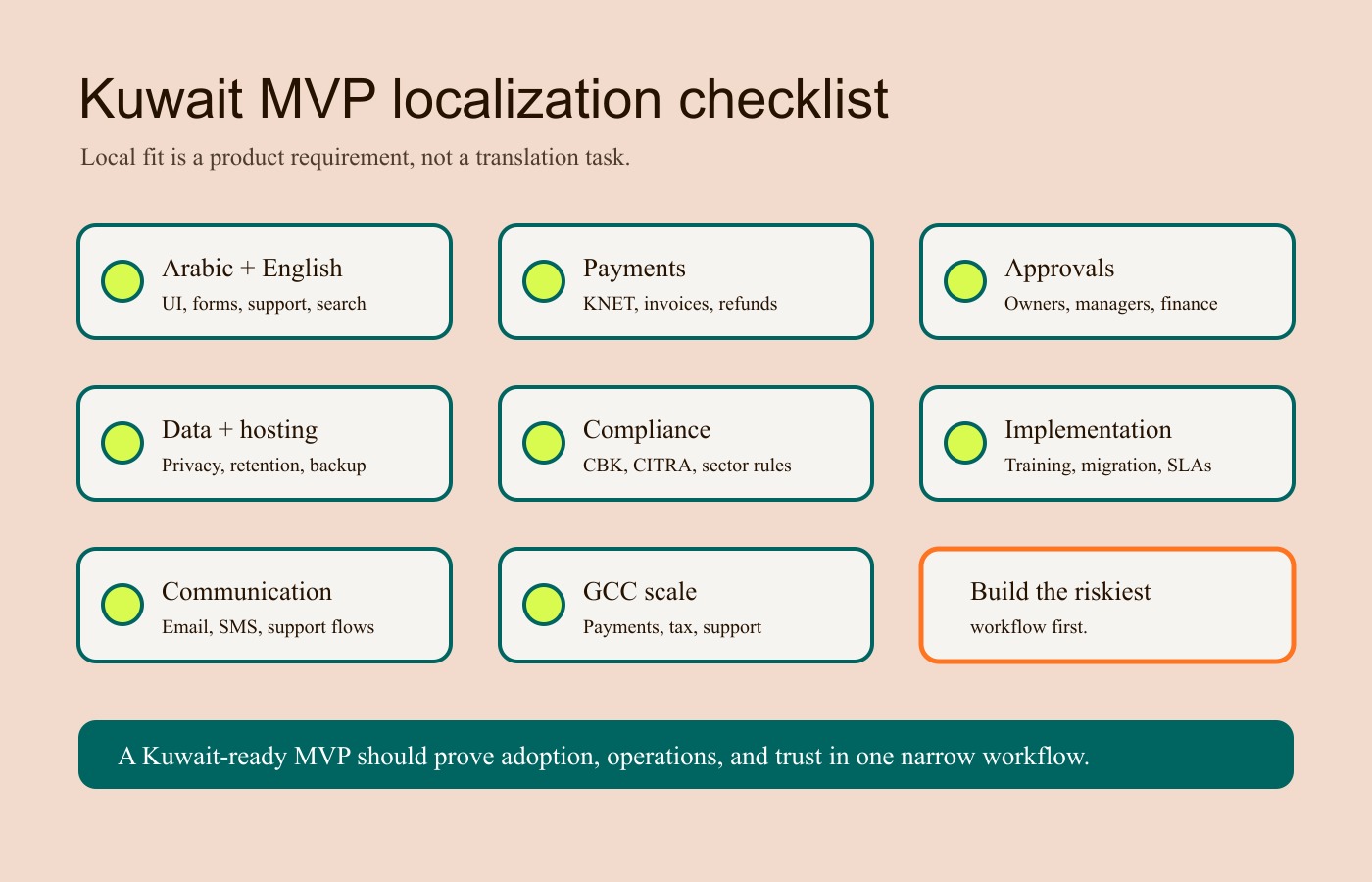
Before building a Kuwait MVP, check the product against local operating reality.
| Localization area | What to validate | Why it matters |
|---|---|---|
| Language | Arabic and English UI, notifications, help text, forms, search, and support scripts | Bilingual teams often switch languages by role, document type, and customer segment |
| Payments | KNET expectations, cards, Apple Pay or Google Pay behavior, invoices, refunds, reconciliation | Payment success is only one part of the workflow; finance teams need clean records |
| Communication | Email, SMS, WhatsApp-style updates, support tickets, and escalation paths | Many operational workflows depend on fast informal communication |
| Roles and approvals | Owner, manager, finance, operations, branch, driver, agent, customer, vendor | Kuwait businesses often need delegated authority without losing owner visibility |
| Data hosting and privacy | Sensitive data, cloud region comfort, backups, retention, audit logs | Government-adjacent, finance, and enterprise buyers will ask early |
| Compliance | CBK, CITRA, labor, tax, procurement, sector-specific requirements | The wrong compliance assumption can change the product architecture |
| Implementation | Data migration, onboarding, training, admin setup, and support SLAs | Many buyers will not adopt a self-serve tool without help |
| GCC scale | Saudi, UAE, Bahrain, Qatar, and Oman differences in payments, language, regulation, tax, and support | A Kuwait-only product may not justify venture expectations unless it can travel |
The MVP should prove the riskiest workflow, not the prettiest screen. If the product depends on bank data, test consent and data access. If it depends on dispatch efficiency, test real routes. If it depends on retailer adoption, test inventory and staff behavior in one or two branches before building a full platform.
Build vs buy for Kuwait operators
Kuwait operators do not need custom software for every digital gap. The right answer depends on how close the workflow is to the company’s advantage.
| Situation | Buy off-the-shelf | Customize or integrate | Build custom |
|---|---|---|---|
| Standard accounting, payroll, HR, email, or ticketing | Best default | Only if reporting or approvals are local-specific | Rarely worth it |
| Ecommerce storefront | Use Shopify, WooCommerce, or a mature platform when needs are standard | Add payment, Arabic UX, inventory, ERP, or loyalty integrations | Build only for unusual marketplace or operational logic |
| CRM and sales tracking | Use a known CRM for basic pipeline management | Customize fields, dashboards, WhatsApp/email flows, and lead routing | Build if the sales workflow is highly industry-specific |
| Logistics or field operations | Buy if route, driver, and proof-of-delivery needs are generic | Integrate with ERP, warehouse, finance, and customer portals | Build if the operating model is the business advantage |
| Fintech, bank data, or regulated payments | Use licensed providers where possible | Integrate with bank, payment, KYC, and compliance vendors | Build only with regulatory and security scope defined early |
| Internal approvals and document workflows | Start with workflow tools for simple cases | Automate around existing systems if teams already use them | Build if approvals, audit, roles, and reporting are core to the service |
| AI automation | Use existing AI tools for drafting, search, and internal productivity | Add guardrails, retrieval, approvals, logging, and human review | Build if AI output changes records, money, compliance decisions, or customer outcomes |
For many teams, the first move is business systems automation, not a full custom platform. Automate the painful manual workflow, measure the gains, and build custom software only when the workflow proves valuable enough to own.
Validation steps before building in Kuwait
A founder should not start with a large roadmap. Start with a validation sequence that reflects how Kuwaiti buyers actually decide.
- Pick one buyer segment: for example, independent retailers, pharmacy chains, laundry operators, property managers, SME finance teams, clinics, logistics firms, or fintech compliance teams.
- Map the current workflow from trigger to outcome, including every spreadsheet, message, approval, payment, and exception.
- Identify the cost of delay, rework, missed revenue, leakage, or customer frustration.
- As an illustrative discovery starting point, interview 10 to 15 operators and budget owners in one segment; this small purposive sample cannot estimate market-wide demand.
- Build a clickable or concierge prototype around the highest-friction workflow.
- Test Arabic and English screens with the actual people who will use them.
- Prove one measurable result: faster turnaround, fewer missed orders, better collection, lower support load, cleaner reporting, or higher repeat purchase.
- Secure a paid pilot, paid proof-of-concept, LOI with implementation terms, or recurring revenue.
- Decide which compliance, integration, and support features must be production-grade before wider rollout.
- Re-scope for GCC expansion only after Kuwait proof shows a repeatable buyer problem.
If the product is ecommerce-led, read Hapy’s guide to ecommerce in the Middle East before committing to channel, payments, and fulfillment assumptions. If the product depends on Arabic-first customer experience, the Arabic website design basics guide is a useful design companion. If you are comparing agency, in-house, and vendor build models, use the custom software development services buyer guide before writing the first brief.
What to build first
The first build should be narrow enough to learn, but serious enough to survive real operations. For Kuwait, that usually means a workflow MVP rather than a broad platform.
Good first versions look like this:
- A retailer inventory and order-routing dashboard for one branch and one ecommerce channel.
- A field-service dispatch tool for one service category and one operations team.
- A fintech reconciliation workflow that handles one bank/payment source and one accounting export.
- A property maintenance portal for one landlord portfolio and one tenant segment.
- A bilingual customer-service workflow for one support journey and one escalation path.
- An internal approval system for one document type, one finance rule, and one audit trail.
Weak first versions usually try to become a super app, marketplace, ERP, fintech platform, and AI assistant at the same time. Kuwait’s opportunity is not to build the biggest concept. It is to build the workflow a buyer will keep using after the novelty fades.
The practical conclusion
The Kuwait startup ecosystem rewards founders who treat digital transformation as operational work. The market has connectivity, purchasing power, government interest, SME support, fintech modernization, and visible founder programs. It also has structural friction: public-sector labor incentives, slower procurement, relationship-led capital, compliance requirements, and a small domestic market.
That does not make Kuwait unattractive. It makes the bar clearer.
Build where a business process is painful, localize the product deeply, prove demand with real operators, and design the MVP so it can travel across the GCC. Kuwait’s best startup opportunities are not hype stories. They are practical systems that make services, retail, logistics, finance, and operations work better.
Convert a hypothesis into local evidence
For a hypothetical retailer reconciliation tool, ask three unrelated operators to show anonymized recent mismatches, the time spent resolving them, and their existing software. Then offer one tightly scoped paid pilot with an identified budget owner, data-access permission, acceptance test, and procurement date. Track reconciled exceptions and staff effort against the current process. If a configurable existing tool solves the issue, use it. Program admission, a positive interview, or an LOI without budget authority is weaker evidence than a completed purchase and continued use.