The Oman startup ecosystem rewards founders who solve practical problems, not founders who arrive with a generic GCC expansion story. This guide proposes opportunities to investigate in SME digitization, fintech infrastructure, tourism workflows, logistics, energy, industrial operations, Arabic-first customer experience, and government-service modernization. These are hypotheses, not measured rankings of buyer demand.
Oman is a smaller market than Saudi Arabia or the UAE, and that changes the product strategy. A founder should not build for Oman as if domestic scale alone will carry the company. The better play is to use Oman as a focused validation market: prove a narrow workflow with a serious buyer, turn that proof into trust, and design the product so it can travel across the GCC.
Founders comparing focused GCC validation markets should also study the Kuwait startup ecosystem and Qatar’s startup ecosystem. Each market rewards a different mix of local relationships, sector fit, procurement readiness, and expansion planning.
For founders still shaping the first version, Hapy’s MVP development work is relevant because Oman does not need broad platforms pretending to be strategy. It needs lean products that fit real local workflows and can survive implementation.
Oman startup ecosystem in 2026: the useful read
The useful read on Oman is simple: the country has serious national direction, improving support infrastructure, and visible digital ambition, but the startup market is still early and smaller than the region’s loudest hubs.
That makes Oman attractive for founders with a disciplined product wedge. It is less attractive for founders who need a large consumer market, deep seed-stage density, or instant enterprise adoption.
The policy backdrop is Oman Vision 2040. The digital economy is a named part of the diversification plan, and the national digital program targets a rise in the digital economy’s contribution from roughly 2% of GDP in 2021 to 10% by 2040, according to the National Digital Economy Program summary. The 11th Five-Year Development Plan also points founders toward higher-potential sectors such as industry, logistics, tourism, fisheries, mining, technology, and SME growth through the official Oman Vision 2040 planning framework.
The startup base is becoming more measurable. In January 2026, the Promising Omani Startups Programme reported 205 technology and innovation startups, a combined market value of about USD 395 million, and 549 jobs for Omani youth, according to Oman News Agency coverage of the programme milestone. Those numbers are useful because they show momentum without pretending the market is mature.
For GCC founders, the takeaway is not “Oman is the next Dubai.” It is “Oman is a practical place to validate products tied to national priorities, SME pain, ports and logistics, tourism, energy, finance, and public-service digitization.”
Use Vision 2040 to choose buyer research
Founders can use Oman Vision 2040 to choose organizations and workflows to investigate; a national target does not establish an available customer budget. The best startup opportunities usually sit where a national priority creates pressure inside an organization: a logistics operator needs visibility, a tourism company needs better guest operations, an SME needs cash-flow control, a ministry needs service automation, or an industrial firm needs safer field workflows.
That matters because “digital transformation” is too broad to sell. A founder needs to translate it into a workflow a buyer already recognizes.
Good Oman product theses sound like this:
- Help tourism operators manage bookings, transport, guides, payments, and guest service across Arabic and English channels.
- Help SMEs replace spreadsheet, WhatsApp, and paper-based operations with one reliable workflow.
- Help logistics teams track exceptions, delivery quality, customs documents, fleet activity, and client service levels.
- Help energy and industrial operators digitize inspections, maintenance, safety, procurement, and field reporting.
- Help public-facing teams reduce document processing, approvals, citizen communication, and internal handoffs.
Tourism is a useful example. Oman has an official strategy to make the sector a larger part of the economy by 2040, with the Ministry of Heritage and Tourism targeting 12 million visitors by 2040 through its Vision 2040 tourism plans. That creates room for practical products, but only if they improve a real operating motion: itinerary planning, hotel and tour inventory, destination content, transport coordination, guest support, payments, reviews, or B2B distribution.
The same logic applies to logistics. Oman can point to ports, free zones, and geographic positioning, but a startup still needs to solve a narrow operational pain. A route optimization tool, warehouse visibility product, customs document workflow, or cold-chain exception dashboard is more credible than a vague “logistics platform.”
Support infrastructure is improving, but proof still matters
Oman now has more visible support for founders than it did a few years ago: sovereign capital, SME programs, accelerators, free zones, fintech sandboxes, corporate innovation programs, and national startup initiatives. The mistake is treating that support as validation.
Future Fund Oman is the largest capital signal. Oman Investment Authority describes Future Fund Oman as a five-year, OMR 2 billion program designed to attract investment, support SMEs, and fund national economic priorities through the Future Fund Oman platform. In 2026, the fund also announced a package of projects and investments valued at about USD 1.744 billion, including sovereign commitments and co-investment, through Future Fund Oman project announcements.
That capital matters, but it does not mean every early startup is fundable. Much of the largest capital is built for strategic projects, manufacturing, energy, infrastructure, healthcare, and larger national investments. Software founders still need the basics: a working product, buyer proof, a clear use of funds, and a path beyond Oman’s domestic market.
Riyada and the SME Development Authority matter for smaller businesses and Omani founders. Their value is not only funding. It is market access, compliance support, training, entrepreneurship cards, incubators, and links into regional programs. For an outside GCC founder, the practical question is which local partner, buyer, or program can reduce the biggest risk: licensing, buyer access, procurement, talent, or implementation.
The sector-specific programs are often more useful than generic startup support:
| Program or institution | Best founder fit | What it helps validate |
|---|---|---|
| Future Fund Oman | Scaleups, strategic projects, SME growth companies, industrial or national-priority ventures | Capital fit, national priority alignment, co-investment readiness |
| Riyada and Promising Omani Startups Programme | Omani SMEs, local startup founders, early tech companies | Local legitimacy, SME support, training, market access |
| Omantel Innovation Labs and ASYAD-Omantel Accelerator | Logistics, supply chain, enterprise tech, telecom-adjacent products | Corporate buyer access, pilot design, operations use cases |
| NBO Fintech Accelerator | Fintech, SME finance, payments, fraud, wealth, personal finance | Bank partnership exposure, compliance expectations, financial workflow fit |
| Central Bank and FSA sandboxes | Payments, lending, digital assets, crowdfunding, regulated fintech | Licensing exposure, consumer-risk controls, test-user governance |
| OPAZ zones and free zones | Logistics, manufacturing, AI, data centers, industrial tech, export businesses | Setup, infrastructure, customs, location fit, industrial customers |
Fintech is especially important because it is both promising and sensitive. The Central Bank of Oman describes its FinTech Regulatory Sandbox as a controlled environment for testing innovative financial products under regulatory supervision. The Financial Services Authority has also opened sandbox pathways for virtual assets, crowdfunding, and other regulated financial innovations through its fintech and innovation work.
The product implication is direct: an Oman fintech MVP needs consent, identity, permissions, risk disclosure, transaction records, support processes, security controls, and compliance thinking early. Those are not legal extras. They are part of the product.
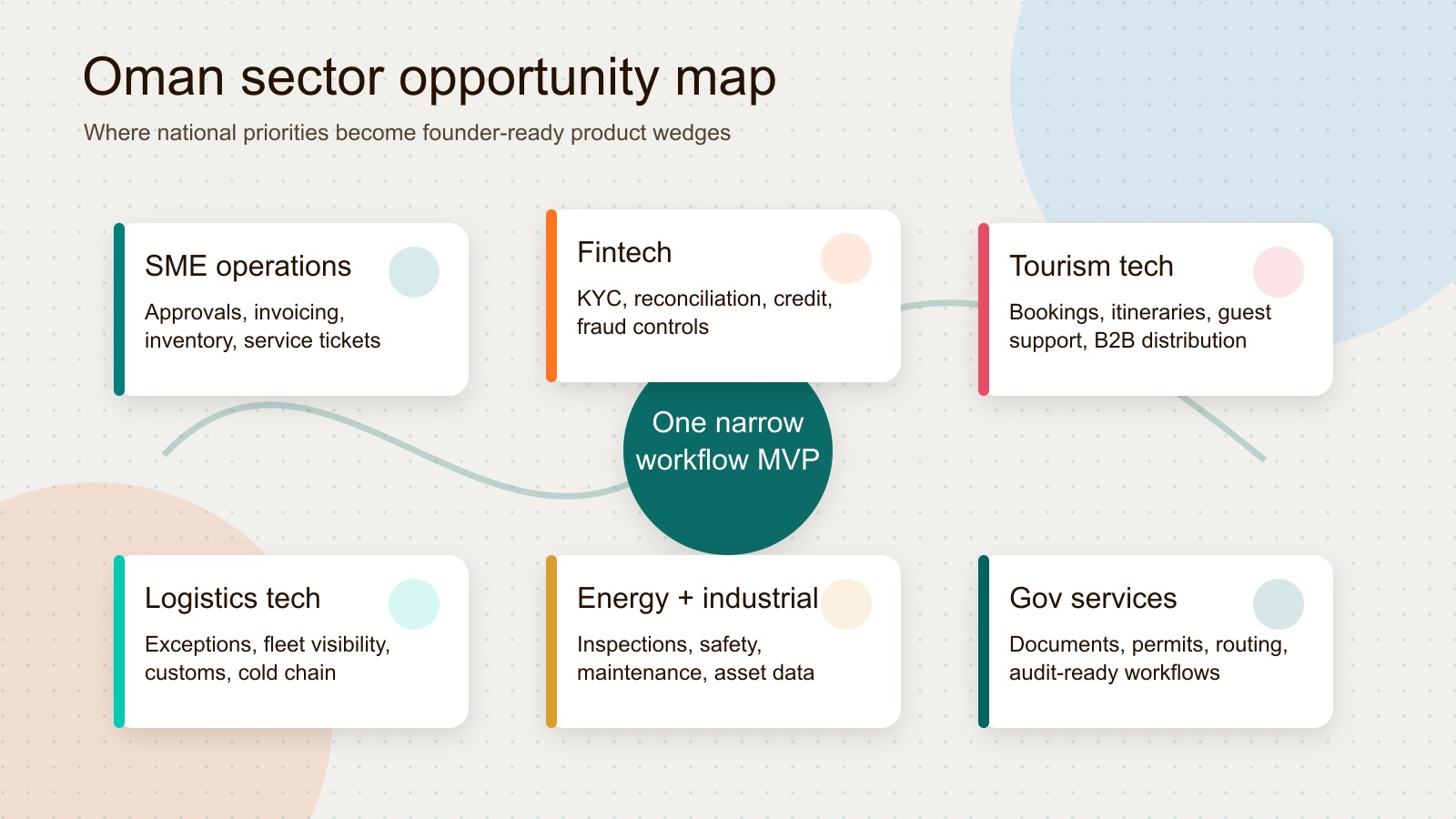
Oman sector opportunity matrix
The following matrix contains proposed buyer problems and MVP directions. Validate each with local operators before treating it as a business opportunity.
| Sector | Oman opportunity | What founders should build first | Main local risk |
|---|---|---|---|
| SME operations | Many small businesses still rely on disconnected tools, spreadsheets, paper, and messaging apps | One workflow: invoicing, approvals, booking, inventory, service tickets, or reporting | Buyers may need implementation help, not self-serve software |
| Fintech and SME finance | Payments, reconciliation, expense control, micro-lending, crowdfunding, fraud, credit decisioning | Compliance-aware onboarding, transaction records, approvals, dashboards, partner-bank assumptions | Regulation, banking partnerships, and trust can dominate the roadmap |
| Tourism tech | Destination operations, bookings, tour inventory, guest support, transport, Arabic/English content | Lightweight operator dashboard, booking workflow, itinerary builder, or B2B distribution tool | Seasonal demand, fragmented suppliers, and service quality |
| Logistics tech | Ports, free zones, shipping, field delivery, cold chain, customs, warehousing | Exception dashboard, fleet or warehouse visibility, document workflow, SLA reporting | Integrations and operator behavior may be harder than the interface |
| Energy and industrial tech | Oil and gas, renewables, safety, inspections, maintenance, procurement, asset monitoring | Field workflow, inspection app, predictive maintenance pilot, safety reporting, IoT data layer | Security, harsh operating environments, and procurement cycles |
| Government-service digitization | Citizen services, permits, documents, approvals, internal routing, case management | Narrow workflow automation with audit logs, role permissions, Arabic support, and reporting | Procurement, data handling, and change management |
| Arabic-first customer experience | Bilingual teams, Arabic forms, local support habits, right-to-left journeys | Localized onboarding, support flows, notifications, search, and content operations | Translation alone will not fix workflow trust |
The unifying point is that Oman rewards operational software. A founder who can reduce time, errors, support load, missed orders, payment friction, or manual coordination has a clearer path than a founder pitching another broad consumer app.
Payments, logistics, and corporate buyers are practical signals
Oman’s digital product opportunity is not only policy-led. There are signs of real behavior change in payments, logistics, and corporate innovation.
Digital payments are one signal. Data from the Central Bank of Oman showed that local digital payment gateways processed more than 168 million transactions worth about OMR 3.2 billion in 2025, according to reporting from Oman’s Ministry of Commerce, Industry and Investment Promotion. For founders, the point is not just that people can pay online. It is that payment-linked workflows around reconciliation, refunds, invoices, subscriptions, merchant dashboards, and finance operations become more viable.
Logistics is another signal. ASYAD announced in April 2026 that its Ligentia acquisition expanded the group to 24 countries and 76 cities, strengthening Oman’s global supply-chain reach through ASYAD’s expansion announcement. That expansion is a reason to investigate those workflows, not evidence of an unmet software need or an open procurement opportunity.
Corporate accelerators can turn those signals into pilots. The ASYAD-Omantel Accelerator focuses on supply-chain optimization, cold chain, and sustainable transport. NBO’s fintech accelerator has showcased startups in Sharia-compliant wealth, QR payments, disposable virtual cards, AI credit decisioning, personal finance, and fraud detection, according to Times of Oman coverage of the second accelerator cohort.
These examples show payment activity, an acquisition, and program themes. None directly measures willingness to buy a new startup product. Confirm demand with budget owners and compare existing systems before drawing a product conclusion.
Local launch risks founders should not ignore
The first risk is market size. Oman can be a strong validation market, but it is not usually enough for a venture-scale consumer thesis by itself. Products should be designed for GCC expansion from the beginning, especially if the revenue model depends on volume.
The second risk is slow enterprise conversion. Oman has active public and corporate buyers, but procurement, legal review, data questions, integration, and local support can stretch timelines. A founder should model the cost of learning in-market, not just the cost of incorporation.
The third risk is talent. Oman is investing in local technical capability, but specialized software engineering, AI, cybersecurity, and product talent can still be constrained. Distributed engineering may be practical, but the product still needs local product judgment, Arabic-aware UX, and implementation support.
The fourth risk is localization. Arabic is not a text layer. It affects search, forms, names, addresses, support scripts, approvals, legal documents, notifications, and trust. Hapy’s guide to working with Arab clients in the Middle East is relevant when the product depends on relationship-led sales or culturally fluent delivery.
The fifth risk is overbuilding. Because Oman has national strategies and large funds, it is tempting to build a grand platform. Most founders should do the opposite. Pick one buyer, one workflow, one measurable pain, and one route to a paid pilot.
Founder validation checklist for Oman
Use this checklist before building an Oman MVP, applying to a program, or pitching a local buyer.
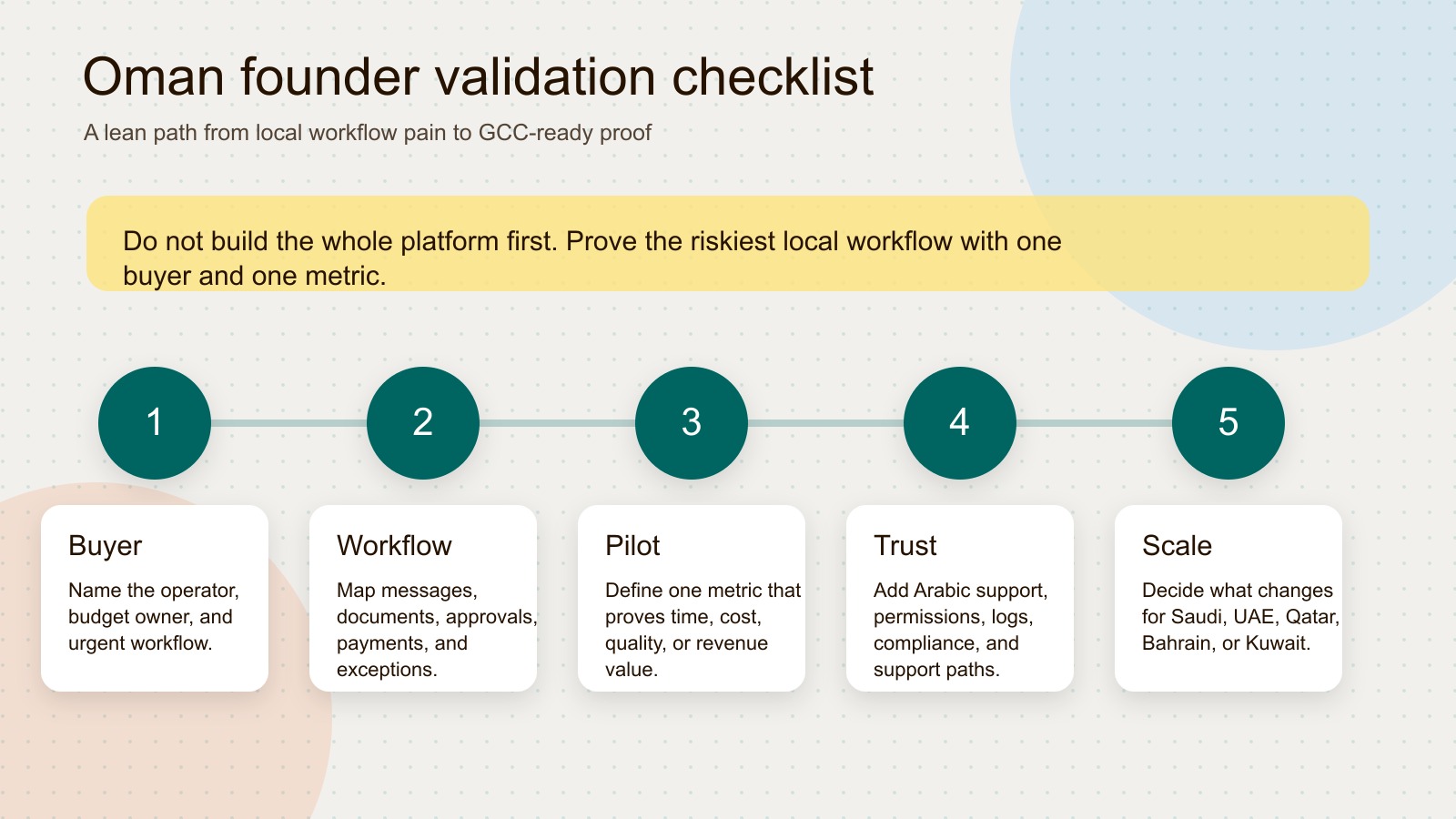
- Pick one buyer segment: tourism operators, logistics firms, SME finance teams, clinics, industrial contractors, property teams, government-service units, or retailers.
- Map the current workflow from trigger to outcome, including every spreadsheet, WhatsApp message, email, approval, document, payment, and exception.
- Identify the measurable pain: time lost, missed revenue, failed payment, delayed permit, poor guest experience, idle asset, support burden, or reporting error.
- Use 10 to 15 interviews as an illustrative discovery starting point, with operators and budget owners in one segment; it is not a statistically representative demand sample.
- Build a clickable prototype, concierge pilot, or thin working product around the riskiest workflow.
- Test Arabic and English usage with the people who will actually use the product.
- Map regulatory exposure early if the product touches money, identity, health, public records, telecom, logistics compliance, or sensitive operational data.
- Define one pilot metric: faster turnaround, fewer missed orders, lower support load, cleaner reporting, higher booking conversion, fewer safety incidents, or better collection.
- Secure a paid pilot, paid proof-of-concept, signed LOI with implementation terms, or a design partner with a named internal owner.
- Decide what changes for Saudi Arabia, UAE, Qatar, Bahrain, or Kuwait before claiming a GCC expansion story.
If the product is mostly a manual workflow today, Hapy’s business systems automation work is often the better starting point than a full custom platform. Automate the painful motion first, measure the result, then decide whether custom software deserves a larger build.
Build vs buy for Oman products
Founders and operators should be honest about what needs to be built. Oman needs more digital products, but not every workflow deserves custom software from day one.
| Situation | Buy first | Customize or integrate | Build custom |
|---|---|---|---|
| Standard accounting, HR, email, payroll, or ticketing | Best default | When local reports, approvals, or integrations are missing | Rarely worth it early |
| Tourism booking or guest operations | Use mature tools for simple inventory and payments | Add Arabic content, WhatsApp-style support, operator dashboards, and local payment flows | Build if the operating model or B2B distribution is the advantage |
| Logistics and field operations | Buy when route, fleet, or proof-of-delivery needs are standard | Integrate ERP, warehouse, payment, client portal, or customs documentation | Build when exception handling or service quality is the core product |
| Fintech and payments | Use licensed providers where possible | Integrate bank, payment, KYC, reconciliation, and compliance systems | Build only with regulatory scope and partner path mapped |
| Public-service or internal approvals | Start with workflow tools for low-risk cases | Automate around existing systems and documents | Build when audit, roles, Arabic workflows, and reporting are core |
| AI automation | Use existing AI tools for low-risk drafting or search | Add retrieval, approvals, logs, and human review | Build when AI changes records, money, compliance, safety, or customer outcomes |
For ecommerce-led ideas, Hapy’s guide to ecommerce in the Middle East is a useful companion because payments, fulfillment, trust, Arabic UX, and marketplace behavior vary across GCC markets.
What to build first
The best first version in Oman is usually a workflow MVP: narrow enough to learn, but serious enough for a real operator.
Good first versions look like this:
- A tourism operator dashboard that handles bookings, guides, transport, customer messages, and payment status for one destination.
- A logistics exception dashboard for one fleet, one route type, and one service-level metric.
- A fintech reconciliation flow for one payment source, one customer type, and one accounting export.
- A field inspection app for one industrial workflow with photo evidence, offline capture, approval rules, and audit logs.
- A bilingual SME approval system for one document type, one finance rule, and one reporting need.
- A government-service prototype that reduces one document-review or case-routing delay while preserving human approval.
Weak first versions try to become a marketplace, super app, ERP, AI assistant, payment product, and GCC platform at the same time. Oman is a smaller market. That is exactly why the first product has to be sharper.
The practical conclusion
The Oman startup ecosystem is useful for founders who understand the country’s operating reality. Vision 2040, SME support, free zones, fintech regulation, digital payments, tourism growth, logistics infrastructure, and corporate accelerators all point in the same direction: Oman wants practical digital products that make real organizations work better.
The market is smaller, the buyer set is more concentrated, and the startup pipeline is still developing. That is not a reason to ignore Oman. It is a reason to enter with discipline.
Pick a real workflow. Validate the buyer before the roadmap. Build the smallest serious product. Localize beyond translation. Treat compliance and implementation as product scope. Then use Oman as evidence for a wider GCC expansion story.
That is the real opportunity in the Oman startup ecosystem: not hype, but practical products that help SMEs, tourism operators, logistics teams, energy companies, fintech partners, and public-service teams move faster with less friction.
Confirm eligibility and test one local purchase
Start with the official Riyada card service and eligibility check and Omantel Innovation Labs program information. Confirm nationality, ownership, local registration, stage, sector, and application dates directly. Cohort pages may describe a closed intake. Sandbox participation is controlled testing, not general permission to offer regulated services; confirm the exact activity and approvals with the relevant regulator.
For a hypothetical tourism scheduling pilot, ask three operators to show anonymized recent booking conflicts and their current tools. Select one operator with budget authority, agree a paid pilot for one destination, and record scheduling errors, staff time, and ongoing support cost across comparable operating periods. Check whether seasonality or booking volume explains the change. If an existing booking platform solves the problem through configuration, prefer that before a custom build. A program place or introduction does not replace this purchase test.