An agent-ready website is a site that people can use normally and AI systems can read, summarize, route through, and act on without fighting the platform. In practice, that means clear content, semantic HTML, structured metadata, disciplined sitemaps, markdown-readable surfaces where useful, predictable routes, accessible forms, and interactions that do not depend on fragile JavaScript tricks.
That is a practical standard, not a magic badge. An agent-ready website does not guarantee AI citations, rankings, or autonomous purchases. It gives search engines, answer engines, browser agents, and future AI workflows a cleaner version of the same site humans already need: fast pages, stable structure, readable content, and honest paths to the next action.
Astro is a strong fit for this kind of site because it starts from content-first architecture. Astro’s islands architecture lets most page content ship as HTML, then adds client-side JavaScript only for the components that need interactivity. For marketing sites, journals, product pages, documentation, and landing pages, that default is useful: the important content is present, structured, and lighter to parse.

If your current site is slow, trapped in a visual builder, overloaded with plugins, or hard to control, Hapy’s Astro website migration engagement is the commercial next step. This article explains the underlying idea: what agent-readiness means, what Astro helps with, what matters now, and what should stay experimental.
For the surrounding migration decisions, compare the Astro vs Next.js marketing-site guide, the Core Web Vitals and Astro guide, and the website migration audit checklist before rebuilding the public site.
What an agent-ready website really means
An agent-ready website is built so machine readers can understand the page’s purpose, structure, content, and actions without special pleading. It should still be written for people first. The difference is that the site avoids unnecessary ambiguity.
The practical ingredients are simple:
| Ingredient | What it does for people | What it does for AI systems |
|---|---|---|
| Clear content | Answers the buyer’s actual question | Gives models extractable passages with less guesswork |
| Semantic HTML | Makes pages easier to scan and use | Exposes headings, lists, tables, labels, and landmarks |
| Structured metadata | Improves search snippets and sharing | Defines the page, author, date, canonical URL, and entity context |
| Sitemap discipline | Helps humans and crawlers find the right URLs | Gives crawlers a current map of public content |
| Markdown-readable surfaces | Makes long-form content easier to reuse and review | Offers dense text without layout or script noise |
| Predictable routes | Makes navigation, redirects, and internal links reliable | Reduces routing ambiguity for crawlers and agents |
| Accessible interactions | Helps every user complete the task | Gives browser agents stable labels, roles, errors, and controls |
This is why agent-readiness sits close to technical SEO, accessibility, content operations, and conversion design. It is not a separate discipline where the site gets rebuilt for bots. It is better site hygiene with the next layer of discovery in mind.
Why Astro helps an agent-ready website
Astro helps an agent-ready website because it makes content, routes, and page structure easier to control. The framework is not the strategy. It is the foundation that makes the strategy easier to execute.
Content-first architecture
Astro works well for content-heavy sites because pages, layouts, components, and content collections can be modeled deliberately. The official docs describe content collections as a way to organize local Markdown, MDX, JSON, YAML, or data content with schema validation. That matters because agent-readable content is only useful when the metadata stays clean.
For a marketing site, content collections can enforce fields such as title, description, author, publication date, category, canonical path, cover image, FAQ entries, or schema type. A misspelled field stops being a quiet production issue. It becomes a build-time problem the team can fix before launch.
Hapy’s own journal already uses this pattern. The site validates journal metadata with Astro content collections, including title, publication date, modified date, meta description length, categories, author reference, FAQs, and cover image. That is not glamorous, but it is exactly the kind of boring control that keeps an AI discovery website coherent at scale.
Low JavaScript by default
Many modern sites make crawlers and agents work harder than necessary. The page looks fine after scripts run, but the useful content, navigation, or form state may depend on client-side hydration, delayed embeds, or third-party widgets.
Astro changes the default. Its model is to send static HTML unless a component needs to become interactive. That does not mean an Astro site is automatically fast or accessible. A team can still add too many scripts. But the default encourages a cleaner split: content and layout remain readable; interactive islands carry the behavior.
For AI systems, that split matters. A page that exposes its article body, headings, links, tables, and form labels directly in the HTML is easier to summarize than a page that requires a full browser session just to reveal the core content.
Static and edge-friendly output
Agent-readiness depends on dependable public routes. Astro can output static pages, hybrid pages, or server-rendered routes depending on the site. That gives teams a practical path: keep public marketing and journal content static where possible, then use server or edge logic only where the business needs it.
This is useful for migration work. A site can preserve important URLs, metadata, redirects, sitemaps, schema, forms, and analytics while moving away from plugin chains or one-off builder pages. Hapy’s migration page puts it plainly: Astro is strongest for fast marketing sites, content sites, product pages, docs, and hybrid sites where performance and ownership matter.
Easier alternate formats
Astro also makes alternate machine-readable surfaces easier to produce. The official docs cover Markdown content in Astro, and Hapy’s codebase already includes an agent-markdown layer that maps public pages and journal articles to markdown artifacts under /__agent-markdown.
That is a useful example of agent-readiness as implementation, not theory. The site can serve normal HTML to humans while also producing cleaner markdown versions for priority routes. Those alternates should be handled carefully, with canonical HTML remaining the primary public page and duplicate-indexing risk considered. But for AI systems, editors, and future maintenance workflows, readable markdown can reduce friction.
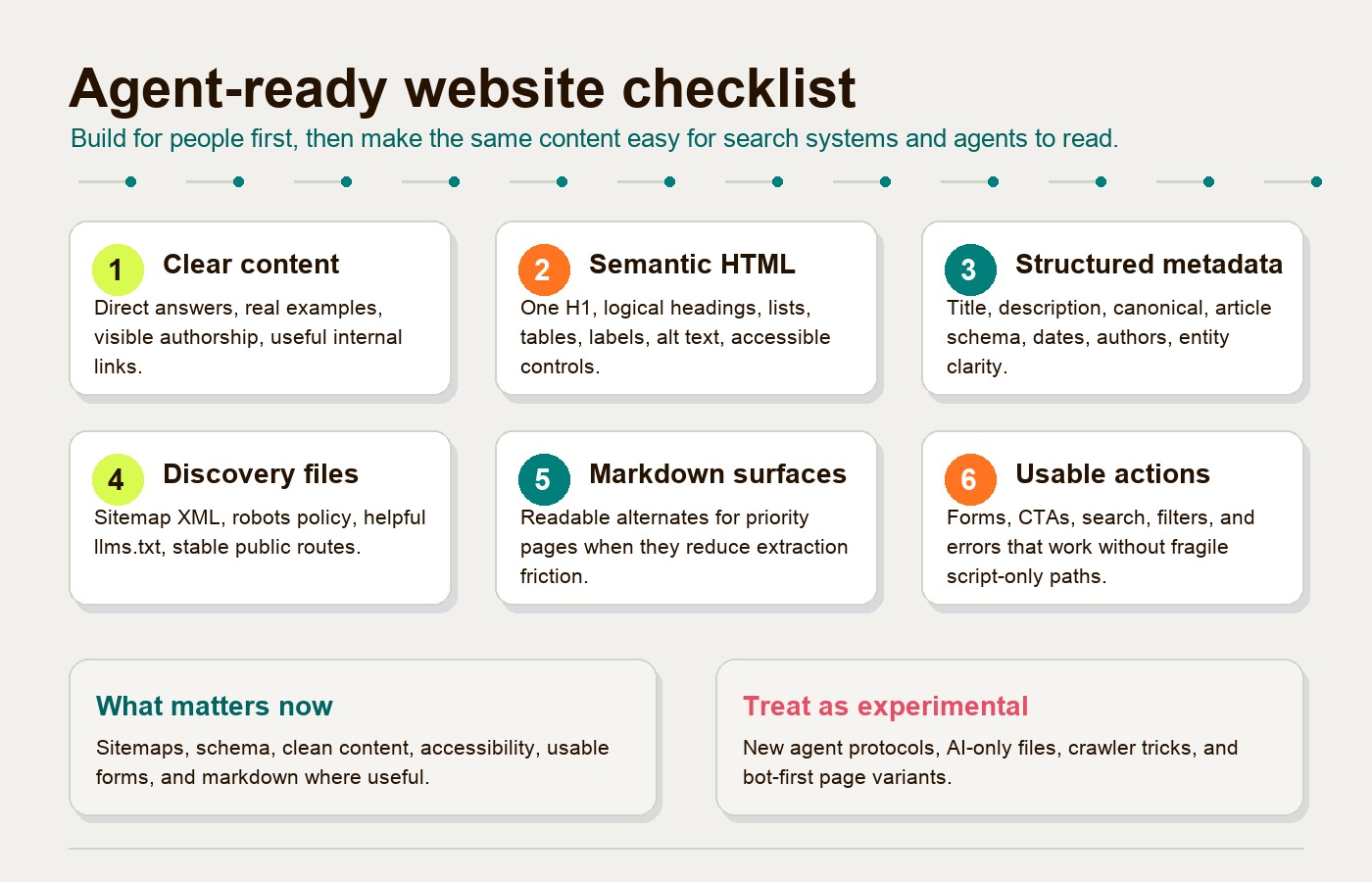
What matters now for AI discovery
The useful version of AI agent website best practices starts with things that are already good for search, accessibility, and users.
Clean content and direct answers
AI systems extract and synthesize passages. The page should answer the main question early, then add nuance, examples, tradeoffs, and next steps. That does not mean writing tiny artificial chunks. It means each section should lead with the point before expanding.
For this topic, the direct answer is: an agent-ready website is a human-usable website with cleaner machine legibility. If the page buries that definition under hype, both readers and AI systems have to work harder.
Semantic HTML and accessibility
Semantic HTML is not only an accessibility concern. It is also machine-readable structure. Use one H1, logical H2/H3 sections, real lists for lists, real tables for comparisons, descriptive link text, labeled form controls, useful alt text, and visible error states.
The accessibility tree matters because browser agents increasingly interact with pages through the same signals assistive technologies depend on: names, roles, labels, focus order, button states, form fields, and error messages. If a human using assistive technology cannot understand the form, a browser agent may struggle too.
Structured metadata and schema
Structured metadata helps systems identify what a page is about. At minimum, serious pages need a clear title, meta description, canonical URL, Open Graph basics, author or organization context, and dates where relevant.
For articles, Google Search Central’s structured data documentation explains how structured data can help Google understand page information. Schema is not a shortcut to rankings or AI citations. It is a way to remove ambiguity. For Hapy journal pages, that means article metadata, author context, dates, category relationships, and useful FAQs where the content genuinely needs them.
Sitemap and route discipline
A sitemap is still one of the most practical AI discovery website assets. The official Astro sitemap integration can generate sitemap files from site routes, which helps keep the public URL map aligned with the actual build.
The bigger discipline is route stability. Do not change URLs casually. Redirect old URLs deliberately. Avoid duplicate slugs, orphaned content, hidden canonical conflicts, and campaign pages that vanish without a plan. Agents cannot route through a site reliably if the site cannot route itself reliably.
Robots policy and crawl access
Robots rules should reflect a real business decision. Some teams want AI systems to cite their content. Some want to block model training while allowing search indexing. Some want stricter controls. The important thing is to decide intentionally and test the result.
Cloudflare’s Agent Readiness article is useful here because it frames agent-readiness as a measurable set of web signals: discoverability, accessibility, and the ability for agents to understand site content and capabilities. Whether or not a team uses Cloudflare’s tooling, the point holds: crawlers and agents need permission, access, and structure.
llms.txt where it helps
An llms.txt website file can give AI systems a concise map of important pages and context. The llms.txt proposal describes a markdown file that helps LLMs find useful site information. It is emerging, not a settled replacement for sitemap XML, robots.txt, schema, or good content.
Use llms.txt as a helpful guide, not as a place to stuff prompts. A practical version might point to the homepage, migration service page, priority journals, pricing or engagement pages, contact path, and any markdown-readable alternates. Keep it accurate. A stale AI guide is worse than no guide because it teaches systems the wrong map.
Forms and actions that still work
Agent-readiness is not only about reading. It is also about completing useful actions: requesting an audit, booking a call, searching content, filtering resources, submitting a form, or getting routed to the right page.
Forms should have real labels, clear required fields, understandable errors, spam protection that does not trap legitimate users, and a success state that confirms what happens next. A form that only works through a brittle embed or hidden script may be weaker for humans, search systems, and agents.
What is still experimental
The experimental layer is worth watching, but it should not drive the site architecture before the basics are right.
| Area | Status | Practical advice |
|---|---|---|
llms.txt |
Useful emerging convention | Add it when it can stay accurate, but do not treat it as a ranking factor |
| Markdown alternates | Useful for some content sites | Use for priority pages where clean text helps; manage duplicate indexing carefully |
| AI-specific crawler signals | Still uneven across platforms | Decide crawler policy intentionally and review it quarterly |
| Agent commerce protocols | Early and category-dependent | Track them if checkout or bookings matter, but do not rebuild a marketing site around them yet |
| Browser-agent tooling | Moving quickly | Make forms and interactions accessible now; adopt deeper protocols only when there is a real use case |
| AI-only content variants | Risky | Avoid separate bot-first pages that diverge from the human page |
This distinction matters because the web is in an awkward middle phase. AI assistants, answer engines, and browser agents are real. Their standards are not all stable. The safest move is to improve the website foundations that help every channel: content clarity, HTML structure, metadata, sitemaps, accessibility, and performance.
Where Astro does not solve the problem
Astro can make an agent-ready site easier to build, but it does not replace editorial judgment, information architecture, or governance.
Astro will not fix vague positioning. If a page cannot explain who it serves, what it offers, and why the reader should care, AI systems will not rescue it. They may simply summarize the ambiguity.
Astro will not invent authority. AI search systems still need credible content, sources, real examples, expert context, and useful internal links. If the article is generic, the framework does not make it citable.
Astro will not make every interaction safe for agents. If a workflow touches money, private data, account changes, regulated claims, or customer records, the site needs permissions, confirmation steps, logs, rate limits, and human review. Hapy’s AI automation guide covers that broader control problem for business workflows, and the AI automation ROI guide explains why teams should measure production evidence before scaling agents.
The framework gives the team a cleaner foundation. The business still has to decide what the site should say, what agents should be allowed to do, and where risk needs a human gate.
Do not chase hacks or write only for bots
The fastest way to weaken an agent-ready website is to forget the human reader. Bot-first writing usually creates thin definitions, repetitive FAQs, unnatural keyword use, and pages that sound optimized but say very little.
Avoid these mistakes:
- Creating duplicate AI-only pages for every query variation.
- Stuffing
llms.txtwith marketing claims that are not supported on the site. - Adding schema that does not match visible page content.
- Hiding important content behind scripts, tabs, modals, or gated PDFs.
- Blocking useful crawlers by accident while trying to control AI training.
- Treating accessibility as optional because the site “looks fine.”
- Promising AI citations because the site moved to Astro.
A stronger rule is this: write the page a smart buyer would want to read, then make the structure clean enough that a machine can understand the same page. That is better for SEO, better for AI search, better for accessibility, and better for conversion.
A practical Astro agent-ready site checklist
Use this checklist before calling a site agent-ready.
| Layer | Check |
|---|---|
| Content | Does each priority page answer the main question in the first few paragraphs? |
| Structure | Does the page use one H1, logical headings, descriptive links, lists, and tables where useful? |
| Metadata | Are title, description, canonical URL, author, date, and schema handled consistently? |
| Sitemap | Are priority public routes included and old URLs redirected? |
| Crawl policy | Are robots rules intentional for search, AI search, and AI training access? |
| llms.txt | If present, does it accurately point AI systems to the most useful pages? |
| Markdown alternates | Are priority pages available in readable text only where it helps? |
| Accessibility | Can forms, buttons, menus, and errors be understood through labels and focus states? |
| Performance | Are heavy scripts, embeds, images, and fonts controlled? |
| Actions | Do CTAs, forms, bookings, and search flows work predictably? |
| Governance | Who owns updates to metadata, sitemap, llms.txt, redirects, schema, and content quality? |
This is also a useful migration audit. If a WordPress, Webflow, Framer, or legacy site fails many of these checks, the issue is not just page speed. The site may need a cleaner content and routing foundation.
The buyer takeaway
An agent-ready website is not a futuristic rewrite for autonomous bots. It is a practical website foundation that helps people, search engines, AI assistants, and agents understand the same content with less friction.
Astro helps because it supports content-first architecture, clean static HTML, typed content collections, controlled interactivity, static or edge-friendly output, and easier alternate formats such as markdown artifacts. Those strengths line up well with the work marketing sites now need: clear pages, stable routes, structured metadata, readable content, accessible actions, and fewer scripts hiding the point.
The right order is simple:
- Fix the content and route structure.
- Make metadata, schema, sitemap, redirects, and crawl policy deliberate.
- Make forms and interactions accessible.
- Add
llms.txtand markdown alternates where they genuinely help. - Track experimental agent protocols, but do not let them distract from the basics.
That is the practical version of an Astro agent-ready site. It does not chase hacks. It makes the website easier to read, easier to route, easier to maintain, and easier to trust.