A development sandbox is a bounded environment for trying changes without intentionally affecting production. Its protection depends on the actual isolation, data, credentials and network access configured. Calling an environment a sandbox does not establish that it is safe to run arbitrary code there.
This guide focuses on testing a team’s own data-import change. It is not a malware-analysis setup or a claim that a development environment can contain every hostile program.
Define the use case and threats
Suppose a team is changing how vendor requests are imported from a CSV file. The test must find mapping errors, duplicates and partial failures before the importer touches live records.
The main risks are accidental production writes, exposure of personal data, unwanted emails, excessive resource use and a misleading test caused by unrealistic fixtures. Write those risks down before choosing a container, virtual machine or hosted test account.

Separate environment purpose from isolation strength
| Environment | Purpose | Boundary to verify |
|---|---|---|
| Developer workspace | Write and debug changes | Local secrets, shared files and reachable services |
| Integration environment | Exercise connected components | Separate accounts, queues, data and external side effects |
| Staging | Rehearse a production-like release | Configuration parity without live credentials or uncontrolled data |
| Vendor API sandbox | Test the provider’s simulated behavior | Test keys, endpoints, supported scenarios and differences from live service |
| Security-analysis sandbox | Investigate untrusted behavior | Specialist isolation appropriate to the threat model |
A demo can use a suitable non-production environment if its owner permits that use and its data is appropriate. Vendor quotas, naming conventions and administrative roles apply to that vendor, not to sandboxes universally. Production is the live environment; do not classify it as a sandbox merely because it uses virtualization.
Build the import-test boundary
For the CSV example, use a dedicated non-production project and database. Start with synthetic records containing the same field types, duplicate patterns and edge cases as production. Do not copy live personal or confidential data simply to make a demo realistic.
Configure the environment so that:
- Its service identity has no production permissions.
- Production database and API credentials are absent.
- Network rules restrict access to the services the test requires.
- Email, messages, payments and other side effects use test destinations or controlled substitutes.
- Shared host folders and mounted sockets are absent unless explicitly required and reviewed.
- Resource limits and a spending limit or alert constrain runaway work.
- Logs avoid unnecessary sensitive values and have a defined retention period.
Containers, VMs and hosted accounts have different boundaries. A container sharing a host kernel, a VM with writable shared folders and a test account holding a production token do not provide equivalent protection. Ask the environment owner to demonstrate the controls that matter to the stated risks.
Check defaults instead of assuming isolation
As a vendor-specific example, Microsoft’s Windows Sandbox configuration documentation says networking and clipboard sharing are enabled by default. Mapped host folders can also expose data or persist writes outside the disposable environment. This guidance was checked on September 8, 2026.
That example illustrates why the product name is insufficient. Review the selected platform’s supported configuration and prerequisites, disable unnecessary sharing and confirm the effective settings. A disposable guest does not automatically undo changes made to an external service or writable host folder.
Run a small, repeatable test plan
Create a known baseline, then run these hypothetical importer checks:
| Test | Expected result |
|---|---|
| Valid record | One correctly mapped request appears in the test database |
| Duplicate source ID | The defined duplicate policy applies without an extra request |
| Missing required field | The row is rejected with an actionable, non-sensitive error |
| Interruption partway through | Restart does not silently duplicate completed work |
| Notification trigger | Only the controlled test destination receives the message |
| Wrong environment configuration | The run is blocked by the agreed environment checks |
Inspect the test database, job logs and message sink rather than trusting a “success” banner. Record the code version, fixture version, settings and results. Verify restricted access through approved configuration and permission checks; do not probe production destructively to prove the sandbox is separate.
Understand what the test cannot prove
A sandbox may differ from production in data volume, identity policy, rate limits, timing or external integrations. Vendor API sandboxes may simulate only selected failure modes. Passing these tests supports the importer behavior under the tested conditions; it does not prove production performance or complete security.
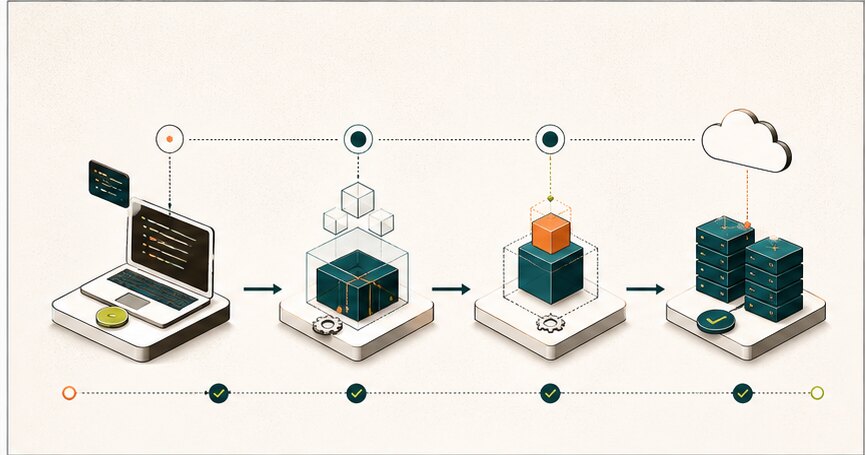
Document those gaps and address consequential ones in a production-like rehearsal or controlled release plan. Keep the live rollout, backups, monitoring and rollback decision separate from sandbox success. See the software development environment guide for the broader delivery path.
Clean up and preserve useful evidence
After testing, stop jobs, remove test data, revoke temporary credentials and delete unneeded environments. Confirm that external resources, scheduled tasks and billing items are also cleaned up. Preserve the approved fixtures, configuration and result summary needed to reproduce the test, without retaining sensitive material unnecessarily.
Name the owner and expiration date when creating a sandbox. A forgotten environment can accumulate old credentials, vulnerable dependencies or cost even if it no longer serves a test.
A readiness checklist
Before running the change, confirm the purpose, isolation boundary, permitted data, credentials, network destinations, side effects, resource limits and cleanup owner. If any of those are unknown, resolve the uncertainty before calling the environment ready.
Hapy can help define a test and release plan for a specific workflow. The useful deliverable is evidence about that workflow and its limits, not a blanket promise of safety.