A product discovery sprint is not a faster way to produce workshop artifacts. It is a faster way to decide whether a product is worth building, what evidence would make that decision responsible, and what version one should deliberately leave out.
That distinction matters for founders. A discovery sprint can produce interview notes, journey maps, wireframes, technical notes, estimates, and a backlog. But those are secondary. The real output is a decision: build this MVP, test a prototype first, run a proof of concept, recruit design partners, narrow the customer, or stop before development absorbs more runway.
This guide is written for startup founders, non-technical founders, and PMs who are deciding what must be true before they move into MVP development. If you are comparing validation formats, Hapy’s guide to POC vs prototype vs MVP explains which artifact fits which risk. This article focuses on the sprint before that choice becomes expensive.
What a Product Discovery Sprint Should Decide
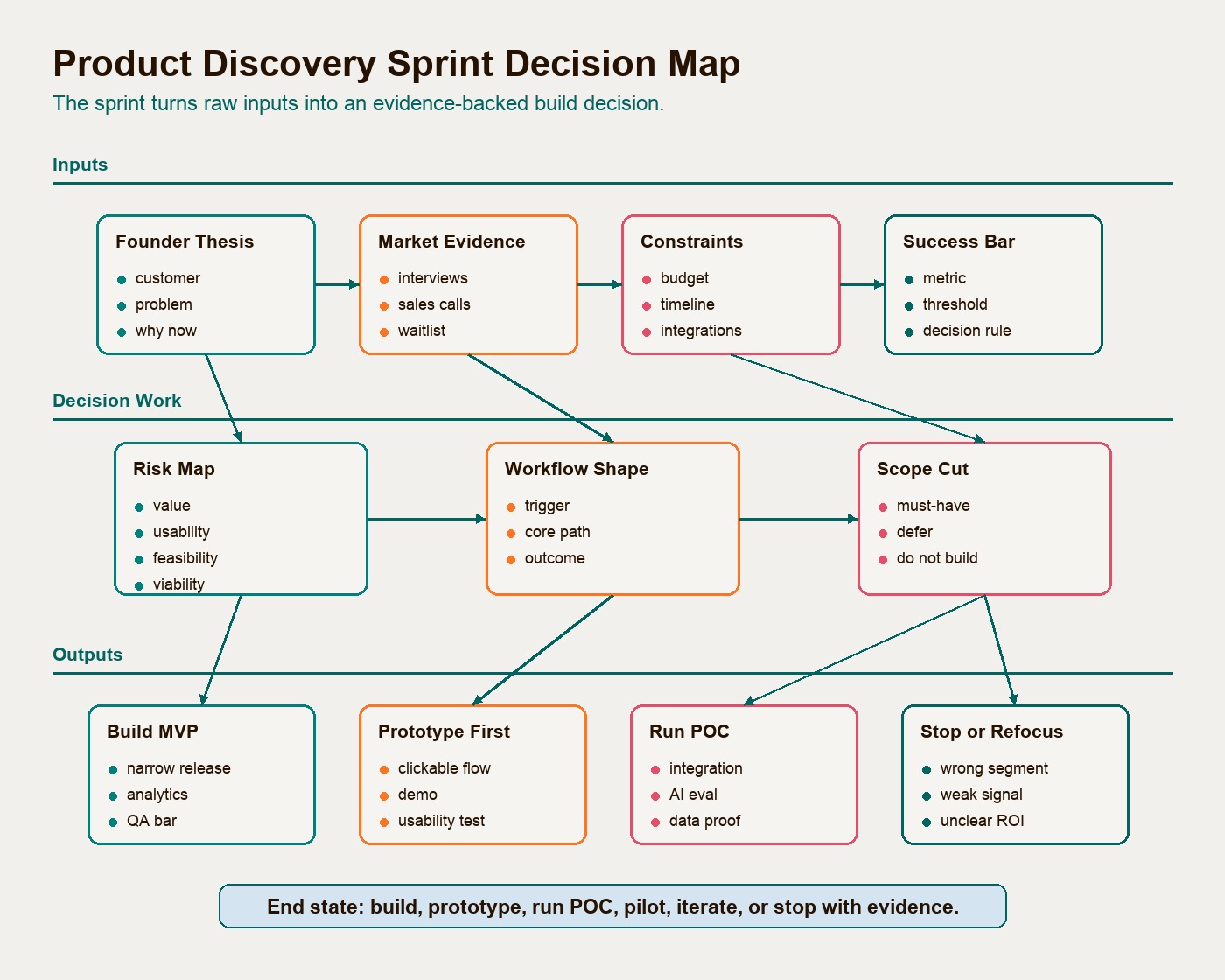
A product discovery sprint should decide the smallest responsible next move. For an early startup, that usually means answering five questions:
- Who is the first customer segment?
- What painful workflow, job, or buying trigger are they already experiencing?
- Which assumption could kill the product if it is false?
- What is the smallest credible test for that assumption?
- If the test passes, what exactly belongs in the first MVP scope?
The best sprint makes tradeoffs visible. A founder may enter with a broad idea for an AI platform, a two-sided marketplace, or a SaaS dashboard. The sprint should leave them with a sharper decision path: one user, one critical workflow, one evidence threshold, and one version-one boundary.
This is where discovery differs from general brainstorming. Brainstorming expands options. Discovery converts options into testable choices.
Inputs: What to Bring Into the Sprint
Discovery starts weak when the team arrives with only a product idea. It starts strong when the team brings the commercial and operational context needed to make decisions.
Useful inputs include:
- The founder thesis: who the product is for, what they believe is broken, and why now.
- Customer evidence: interview notes, sales calls, support tickets, waitlist data, founder-led demos, or user research.
- Market constraints: buyer type, sales motion, pricing assumptions, compliance expectations, geography, and competitive alternatives.
- Technical constraints: required integrations, data sources, AI model dependencies, security requirements, mobile or web expectations, and internal systems.
- Business constraints: runway, launch deadline, fundraising milestone, pilot commitments, team capacity, and budget.
- Non-negotiables: brand, legal, regulatory, accessibility, reporting, approval, or procurement requirements.
If those inputs are missing, the first part of the sprint should gather them. A beautiful wireframe made from weak inputs is still weak strategy.
A Practical One-to-Two Week Timeline
A focused one-to-two week engagement is an illustrative starting format for a narrow discovery question, not a benchmark for most startups. Recruiting participants or resolving feasibility and access questions may require longer. The format should be lighter than a full transformation program, but serious enough to produce a real go/no-go or scope decision.
| Sprint Stage | Main Work | Founder Decision |
|---|---|---|
| Day 0: Prep | Collect inputs, review current evidence, identify stakeholders, define the decision the sprint must support | What decision are we trying to make by the end of the sprint? |
| Days 1-2: Problem framing | Map customer segments, jobs, pains, current workarounds, and buying triggers | Which customer and problem are we choosing first? |
| Days 2-3: Risk mapping | Assess value, usability, feasibility, and business viability risk | Which assumption must be tested before we build? |
| Days 3-5: Solution shaping | Sketch workflows, prioritize must-have paths, outline prototype or MVP scope | What is the smallest product shape that can create evidence? |
| Days 5-8: Validation and feasibility | Run interviews, test a prototype, review integrations, check data and workflow constraints | Do we have enough evidence to build, test again, or stop? |
| Days 8-10: Decision packaging | Convert findings into scope, roadmap, architecture notes, metrics, budget ranges, and next steps | What will we build now, defer, or avoid? |
The exact cadence can flex. A B2B SaaS sprint may spend more time on buyer interviews and design-partner criteria. An AI workflow product may need feasibility spikes and evaluation criteria. A marketplace may need more time on liquidity, trust, and first-side supply. The timeline is only useful if it protects decision quality.
Discovery Sprint Deliverables That Matter
Founders do not need a giant deck. They need artifacts that make the build decision clearer and reduce avoidable ambiguity for product, design, engineering, and investors.
| Deliverable | What It Should Contain | Decision It Supports |
|---|---|---|
| Problem statement | Target customer, painful situation, current workaround, urgency, and business consequence | Is this problem specific enough to build around? |
| Customer evidence summary | Interview patterns, objections, current alternatives, willingness-to-pay signals, and unresolved questions | Is the problem real, repeated, and commercially relevant? |
| Risk map | Value, usability, feasibility, and business viability risks ranked by consequence and uncertainty | What must be tested before development? |
| Opportunity map | Outcome, customer opportunities, possible solutions, and assumption tests | Which path gives the best chance of learning? |
| Core workflow | The primary user journey from trigger to successful outcome | What must version one make possible? |
| Prototype or wireframes | Clickable or static representation of the core workflow, only when usability or sales clarity matters | Can users understand the product before code exists? |
| Technical feasibility notes | Integrations, data model, AI constraints, infrastructure, security, compliance, and unknowns | Can this be built within time, budget, and risk tolerance? |
| MVP scope | Must-have path, explicit exclusions, launch metric, analytics events, QA expectations, and release assumptions | What should engineering build first? |
| Decision memo | Build, prototype, POC, pilot, iterate, or stop recommendation with evidence and caveats | What is the next responsible move? |
The decision memo is the artifact founders should care about most. It should be uncomfortable in the right way: specific enough to prevent vague optimism, but practical enough to move the company forward.
Design Sprint vs Discovery Sprint
A design sprint and a discovery sprint are related, but they are not the same tool.
The classic Design Sprint, popularized by Jake Knapp and the Sprint team, is built around taking a small team through a one-week process to prototype an idea and test it with real customers. The official Sprint guide frames the method as a way to test important hypotheses, build realistic prototypes, run customer interviews, and compress months of product and strategy work into one week.
A discovery sprint is broader. It may include a prototype, but its purpose is not always interface validation. It is a founder decision process that can cover customer selection, pricing assumptions, technical feasibility, system dependencies, compliance risk, MVP scope, and whether a prototype is even the right next step.
| Question | Design Sprint | Product Discovery Sprint |
|---|---|---|
| Best when | The team has a specific product or UX problem to test | The founder needs to decide what is worth building |
| Typical output | Clickable prototype and user-test findings | Decision memo, risk map, scope, prototype or POC recommendation, and MVP plan |
| Main risk addressed | Usability and desirability of a proposed solution | Value, usability, feasibility, and business viability |
| Team needs | Focused product, design, engineering, and decision-maker availability | Founder, product, design, engineering, go-to-market, and domain expertise |
| Build implication | Improve, abandon, or develop the tested concept | Build, prototype, run POC, recruit pilots, narrow scope, or stop |
If the problem is “Can users understand this onboarding flow?”, a design sprint may be enough. If the problem is “Should we spend the next four months building this SaaS, marketplace, AI workflow, or internal tool?”, a discovery sprint is the better frame.
The Four Risks to Clear Before MVP Development
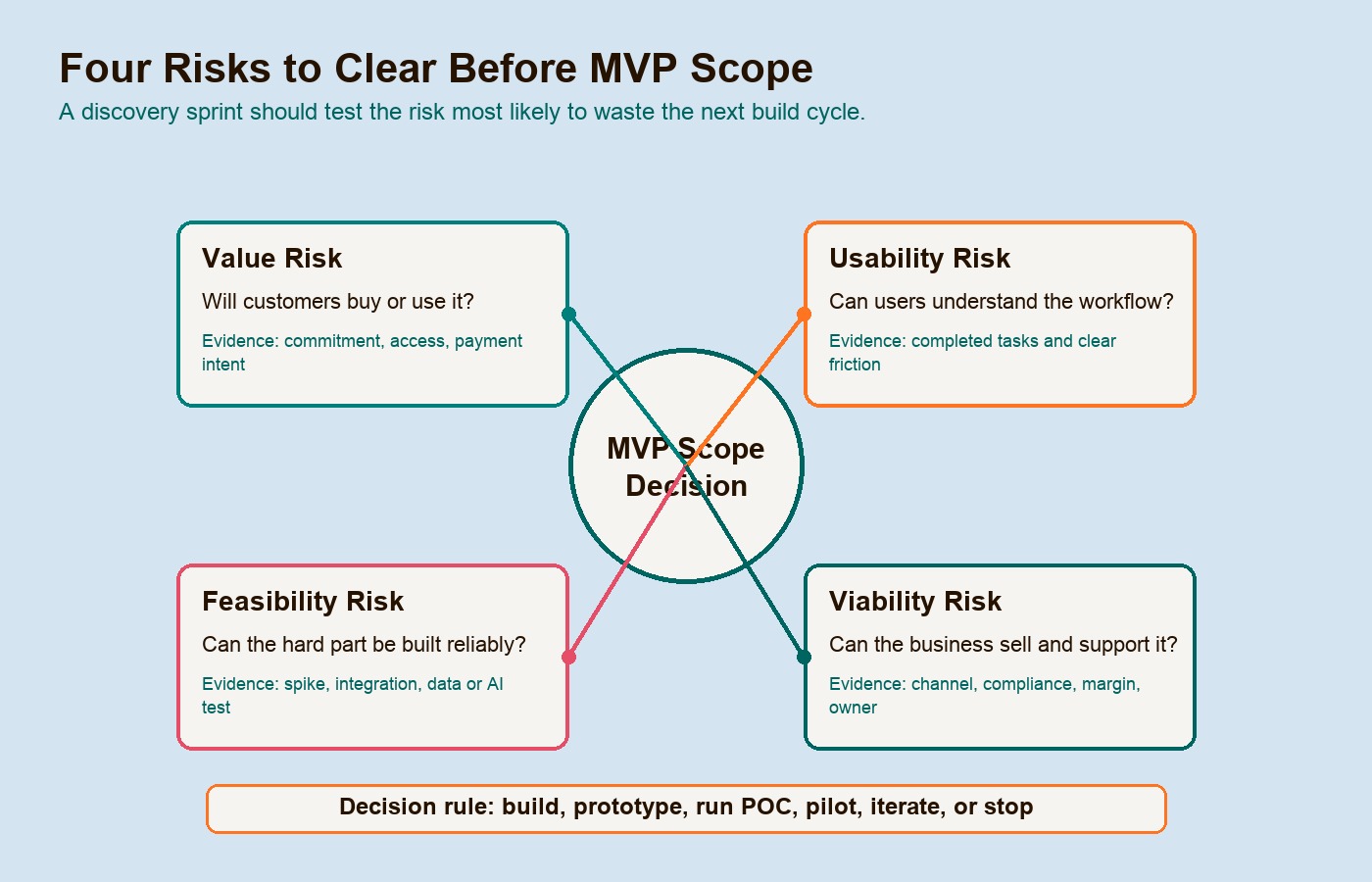
Product discovery should test the riskiest assumption first. Marty Cagan’s four product risks are a useful operating model: value, usability, feasibility, and business viability. A startup does not need perfect certainty across all four. It does need to know which risk is most likely to waste the next build cycle.
Value Risk: Will Anyone Care Enough?
Value risk asks whether customers will use, buy, or meaningfully adopt the product. The sprint should look for behavior, not compliments.
Stronger value signals include booked calls, repeated workflow pain, willingness to share data, internal stakeholder introductions, paid pilots, deposits, signed letters of intent, or a buyer saying what budget the product would replace.
Weak signals include “sounds interesting,” survey enthusiasm, likes, friendly investor encouragement, and feature requests from people who are not the target customer.
The founder decision: do we have enough evidence that the first customer segment has an urgent problem worth solving?
Usability Risk: Can People Understand the Workflow?
Usability risk asks whether the target user can understand the product, complete the core task, and trust the result. It matters before code when the product depends on a new workflow, a complex dashboard, a marketplace interaction, onboarding, payments, permissions, or an AI-assisted action.
Prototype testing is useful here, but only if the test is tied to a decision. Nielsen Norman Group’s guidance on testing with small groups is often cited because early qualitative tests can expose major usability problems quickly, especially when teams run multiple rounds rather than treating one test as final proof.
The founder decision: is the product concept understandable enough to build, or do we need to simplify the workflow first?
Feasibility Risk: Can We Build the Hard Part Reliably?
Feasibility risk asks whether the product can be built with the available time, budget, data, integrations, team, and infrastructure. For non-technical founders, this is where a discovery sprint often pays for itself.
The sprint should identify the hard part. It might be a payment split in a marketplace, a data sync between two systems, AI output reliability, healthcare compliance, permission logic, mobile offline behavior, or enterprise authentication. If the hard part is unknown, the next step may be a proof of concept rather than a polished prototype.
The founder decision: what technical unknown must be reduced before we can estimate or build responsibly?
Business Viability Risk: Can This Work as a Business?
Business viability risk asks whether the product fits the company’s commercial model, legal obligations, support capacity, brand promise, and go-to-market path. A product can be useful and usable but still fail because the sales motion is too expensive, the data access is unrealistic, or the support burden destroys margins.
This risk is especially important for B2B SaaS and AI workflow products. Buyers may like the idea but require procurement, security review, explainability, audit trails, or integrations that change the first release.
The founder decision: if this MVP works, can the company actually sell, support, and expand it?
Four Startup Examples
The easiest way to keep discovery practical is to tie it to a real product type. The sprint should not look the same for every startup.
B2B SaaS: Decide the Buyer and the Workflow
Imagine a founder building a compliance dashboard for finance teams. The product idea may start as “one place to monitor risk.” That is too broad for an MVP.
The discovery sprint should decide whether the first buyer is the CFO, compliance lead, operations manager, or analyst. It should map the current workflow, identify which report or review process creates the most pain, and test whether the buyer will commit time or budget to solving it.
The MVP should not become a full compliance platform. It may only need one data import, one review workflow, one approval path, and one export that matters to the buyer.
Marketplace: Decide Which Side Comes First
A marketplace founder may want to build supply profiles, search, booking, messaging, reviews, payments, dispute handling, referrals, and admin tools. Discovery should force a narrower choice.
The sprint should decide which side of the market is harder to acquire, what trust mechanism is required for the first transaction, and whether the founder can create liquidity manually before building a full platform. If the supply side is scarce, the first test may be concierge matching. If buyer trust is weak, the first artifact may be a vetted directory or high-touch pilot.
The MVP should prove one repeatable transaction, not every future marketplace behavior.
AI Workflow Product: Decide the Evaluation Bar
For an AI workflow product, the dangerous assumption is often not “can we build an AI feature?” It is “can the product produce reliable output in the workflow where a user will trust it?”
The discovery sprint should define the input data, expected output, human review step, failure mode, evaluation criteria, and threshold for acceptable quality. A legal intake assistant, healthcare triage tool, or sales research agent cannot be scoped only as a chat interface. The product must include controls, review loops, auditability, and escalation paths if the workflow requires them.
The first build may need an evaluation harness before it needs a beautiful dashboard.
Internal Tool: Decide the Operational Owner
Internal tools fail when they automate a messy process without deciding who owns the new process. A founder or operations lead may ask for a custom CRM, inventory tracker, approval dashboard, or reporting system. Discovery should examine where the manual process breaks and which team will maintain the tool after launch.
The sprint should decide the source of truth, permissions, required reports, integration points, and adoption path. If the tool saves time for leadership but adds work for frontline staff, the MVP may fail even if the software functions.
The first release should prove adoption inside the workflow, not just centralize data.
Use Opportunity Mapping to Prevent Feature Creep
A discovery sprint needs a way to stop every good idea from becoming MVP scope. Teresa Torres’s Opportunity Solution Tree is useful because it separates the desired outcome, customer opportunities, possible solutions, and assumption tests. That structure forces the team to ask whether a feature idea actually supports the outcome.
For founders, the practical version is simple:
- Put one business or product outcome at the top.
- List the customer pains or needs that could drive that outcome.
- Explore more than one solution for the selected opportunity.
- Break each solution into assumptions.
- Test the riskiest assumption before committing MVP scope.
This also helps with backlog cleanup. If a feature cannot be traced back to a validated customer opportunity and a business outcome, it does not belong in version one. It may be parked, reframed, or killed.
Decision Readiness Checklist
Use this checklist before development starts. The answer does not have to be perfect, but it should be explicit.
| Decision Area | Ready to Build When | Not Ready When |
|---|---|---|
| Customer | A specific first segment is chosen and reachable | The target is “small businesses,” “consumers,” or “teams” without sharper criteria |
| Problem | The team can describe the painful current workflow and why it matters now | The problem is described mainly as missing technology |
| Evidence | Customers have shown behavior, time commitment, access, or payment intent | The evidence is mostly praise, survey interest, or founder intuition |
| Risk | The team knows whether value, usability, feasibility, or viability is the biggest unknown | Every risk is treated as equally important |
| Workflow | The core path from trigger to successful outcome is mapped | The product is still a list of disconnected features |
| Technical path | Integrations, data, AI, security, and architecture constraints are understood enough to estimate | The hard technical part is hand-waved |
| MVP boundary | Must-haves, explicit exclusions, and post-launch metrics are defined | The MVP is a smaller version of the entire future platform |
| Decision rule | The team knows what result means build, iterate, or stop | The team plans to “see how it goes” |
As an editorial heuristic, three weak rows should prompt a discovery review. This is not a validated score: one unresolved safety, data-access, or feasibility blocker can stop the build regardless of the total.
Discovery, Prototype, and MVP Matrix
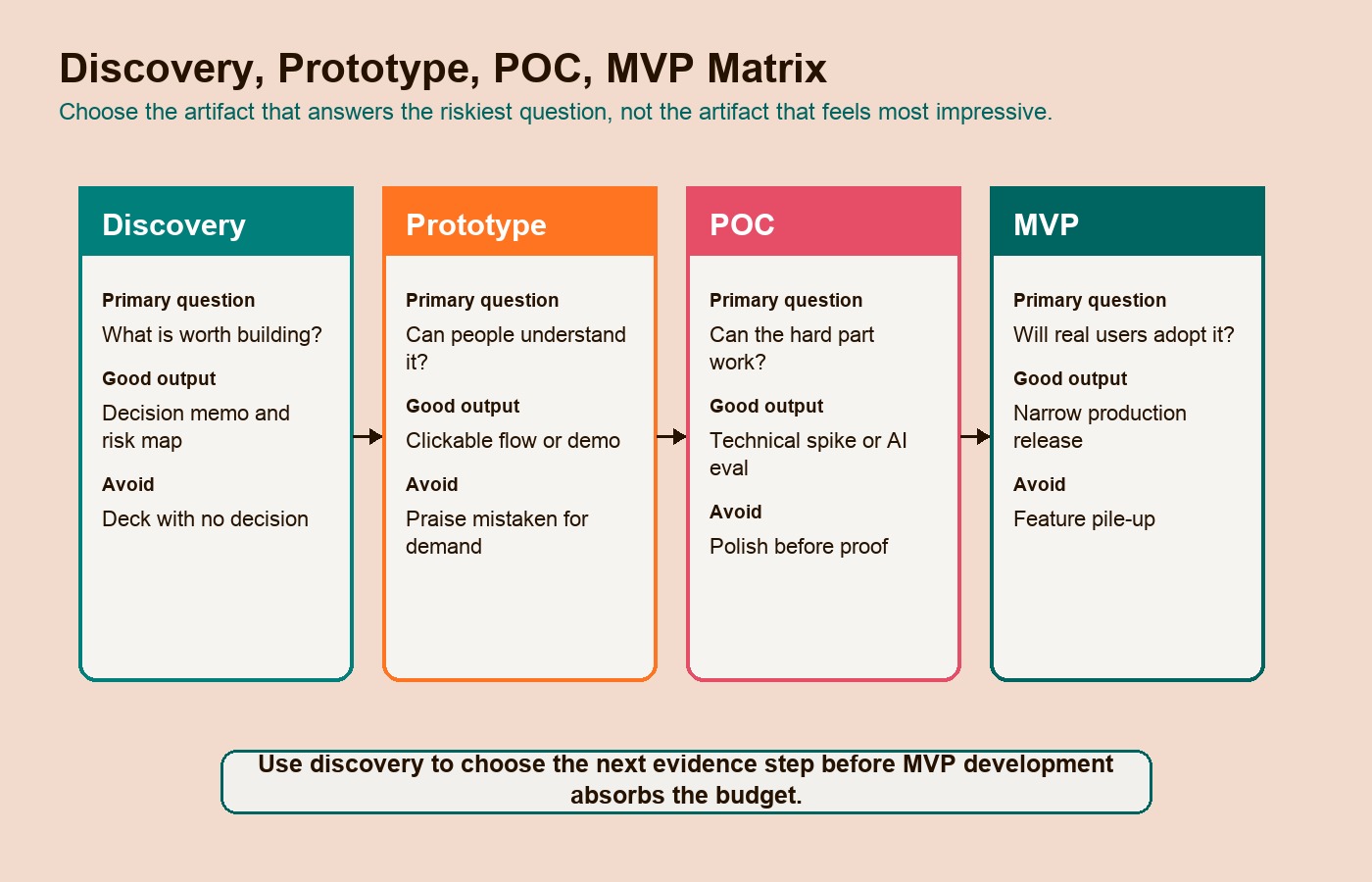
Discovery, prototype, and MVP are often blended together. That makes planning harder. Each one answers a different question.
| Step | Primary Question | Best Output | Good Signal | Common Mistake |
|---|---|---|---|---|
| Discovery sprint | What is worth building, and what risk must be reduced first? | Decision memo, risk map, scope, validation plan, and build recommendation | The team can make a clear build, prototype, POC, pilot, iterate, or stop decision | Treating discovery as a workshop deck with no decision |
| Prototype | Can users understand, trust, or navigate the proposed experience? | Clickable flow, mock workflow, sales demo, or usability test artifact | Users complete the task, explain the value, and reveal fixable friction | Treating prototype praise as proof of demand |
| Proof of concept | Can the hardest technical assumption work? | Technical spike, integration test, AI evaluation, or data proof | The hard part is possible within constraints, or the team learns why it is not | Polishing the interface before proving feasibility |
| MVP | Will real users adopt a minimal working product in market? | Narrow production release with analytics, QA, support, and learning loop | The target user completes the core behavior and creates the next commercial signal | Building every requested feature before the first market test |
This is the simplest way to avoid overbuilding: choose the artifact that matches the risk. If the riskiest assumption is market demand, do not start with engineering. If the riskiest assumption is AI reliability, do not start with a clickable sales prototype. If the riskiest assumption is workflow clarity, do not start with a backend-heavy MVP.
What Good Discovery Looks Like in Practice
Good discovery produces fewer features, not more. It narrows the first release until the product can answer a meaningful business question.
Overleaf’s product team gives a useful example. In a five-day discovery exercise, they mapped ideas, identified assumptions, ran a micro-survey, interviewed users, and reviewed product analytics. Their tag-sharing idea had a validation threshold of 20 percent of respondents collaborating with multiple groups; the survey returned 70 percent matching the criteria. The team wrote that they were able to see two ideas fail and one succeed without writing code.
The point is not that every startup should copy Overleaf’s exact method. The point is that the team defined a threshold before building, tested multiple concepts, and used evidence to reduce scope. That is the behavior founders should copy.
An illustrative sprint decision memo
Suppose a team proposes an invoice-review dashboard. During a ten-working-day discovery plan, it reviews sample records, interviews the intended reviewers, and tests the required accounting-system access. Imagine that the API cannot expose a field needed for reliable matching. The decision is to defer the dashboard build and run a bounded data-access proof of concept first.
The memo names the engineering owner, required sample records, access deadline, and acceptance condition: reconcile the required fields on representative invoices with exceptions visible to a reviewer. The founder approves a new build estimate only after that condition passes. This is a hypothetical outcome showing the decision format, not an anonymized Hapy client result.
When a Formal Discovery Sprint Is Overkill
Not every startup needs a formal discovery sprint. If the total build budget is tiny, the timeline is urgent, or the founder already has strong evidence from paying customers, a lighter discovery pass may be enough.
Use a lighter process when:
- The MVP is a simple landing page, concierge test, or manual service wrapper.
- The founder already has signed pilot customers and the main task is scope control.
- The team is improving an existing product with clear user feedback.
- The budget cannot support a separate discovery phase without starving the build.
Use a formal sprint when:
- The product is B2B, regulated, data-heavy, AI-heavy, marketplace-based, or integration-heavy.
- The founder is non-technical and needs technical risk translated into product decisions.
- Multiple stakeholders disagree on the first user, workflow, or feature set.
- The team needs an investor, design partner, or internal sponsor to trust the build plan.
The pragmatic rule: discovery should be proportional to the cost of being wrong. For illustration, a $5,000 experiment and a $150,000 platform build have different financial exposure; these are hypothetical budgets, not service prices. Risk to people or data may justify substantial review even at a small budget. But both need a decision rule.
The Founder-Led Decision Before You Build
The final output of a product discovery sprint should be a sentence the founder can actually use:
“We are building this first version for this customer, to solve this workflow, because this evidence cleared this risk, and we will know whether to continue when this metric changes.”
If the team cannot say that, the MVP is not ready. It may still be a promising idea, but the next move should be sharper validation, a prototype, a proof of concept, or a narrower scope.
For a deeper version-one planning pass, use Hapy’s MVP development checklist and the broader MVP development guide. If the team is already choosing between validation artifacts, the POC vs prototype vs MVP guide is the right companion.
Hapy Co’s MVP Development work is built around this same principle: version one should not be a monument to founder certainty. It should be the smallest credible product that can prove what the company needs to know next.