An internal web app security checklist should help operators decide whether a business tool can be trusted before real data and real workflows move into it. The practical checks are access, permissions, audit logs, backups, data retention, secrets, vendor access, monitoring, and incident response.
The point is not to turn every internal tool into a bank-grade platform. The point is to avoid the weak middle: an app that feels small during development but later handles customer records, employee information, approvals, exports, finance workflows, or compliance evidence.
Security for internal apps works best when it is scoped like product risk. Ask what could go wrong, who would be affected, what evidence the business would need afterward, and which controls must exist before launch. This internal web app security checklist is written for founders, operators, and business owners preparing to build a secure business web application with a development partner.
If the build decision is still open, pair this with Hapy’s guide to choosing a custom software development partner and the broader guide to enterprise application development. Security requirements should shape scope before the estimate becomes a promise.
Use the internal app feature checklist alongside this security review to connect each control to the roles, workflow states, integrations, exports, and support tools in the actual build scope.
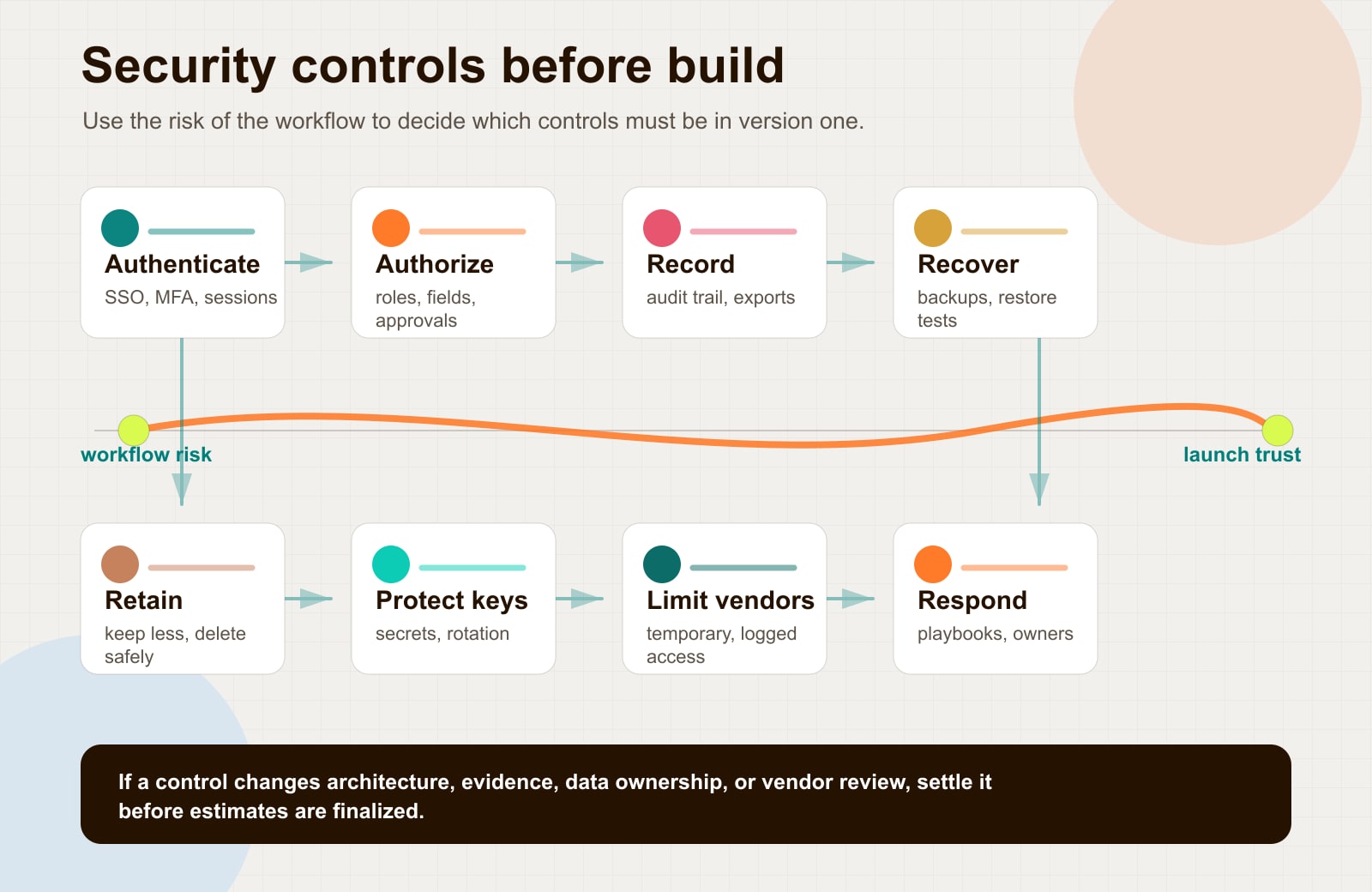
Start with the risk level
A custom internal app security plan should start with the sensitivity of the workflow, not with a generic security feature list. A tool that manages office lunch orders does not need the same controls as a tool that approves refunds, exports customer data, or gives vendors access to operational systems.
Use three risk bands before development starts:
| Risk band | Typical app | Operational controls to scope |
|---|---|---|
| Low | Internal directory, simple content queue, lightweight status tracker | SSO or strong login, basic roles, secure backups, basic activity history |
| Moderate | Sales operations tool, support console, inventory exceptions, vendor workflow | SSO, role-based permissions, audit logs, export controls, monitored backups, vendor access rules |
| High | Finance approvals, healthcare workflows, regulated records, admin consoles, sensitive customer data | Phishing-resistant MFA for privileged users, granular authorization, immutable audit records, tested restore process, incident playbooks |
These bands describe operational priorities, not a complete engineering security baseline. Every band also needs maintained dependencies and patch ownership, HTTPS, secure session cookies, server-side input validation, safe database queries and output encoding, protected file uploads where applicable, secret handling, and configuration review. A low-risk label does not excuse an exploitable application.
Before acceptance, ask the engineering lead to map applicable requirements from OWASP ASVS to implementation and verification evidence. Record the standard version, scope, authorization and input/file handling test results, dependency findings, unresolved risks, owners, and release decision. Scanners alone do not prove the business permission model works. Review that evidence when scope or integrations change.
NIST’s zero trust architecture guidance is useful here because it moves the security question away from “is this user inside the network?” and toward explicit verification of users, devices, assets, and resources. For operators, the takeaway from NIST SP 800-207 is simple: internal access is still access. Treat every important action as something that needs a clear identity, a valid permission, and a record.
Authentication: prove who is using the app
Authentication should answer one question clearly: who is trying to enter the app, and how much confidence do we have that it is really them?
For most business tools, the practical baseline is single sign-on through the company’s identity provider. SSO makes onboarding and offboarding cleaner because access can be managed from one place instead of scattered inside every app. It also lets the business enforce password policy, MFA, and account disablement consistently.
For higher-risk accounts, especially administrators and finance, HR, support, or security users, push the conversation further. NIST’s digital identity guidance treats phishing-resistant authentication as the stronger option for high assurance. In practical terms, NIST SP 800-63B points teams toward authenticators that are bound to the legitimate domain, such as WebAuthn/FIDO2 passkeys or hardware security keys, instead of relying only on codes that can be tricked out of a user.
Before work starts, define:
- Which identity provider the app must support.
- Whether SSO is required for every user or only employees.
- Which roles need MFA, passkeys, or hardware keys.
- How access is removed when an employee, contractor, or vendor leaves.
- Whether there are break-glass admin accounts for emergencies, and who can use them.
Do not leave session behavior vague. Session length, idle timeout, device changes, suspicious login alerts, and forced logout after role changes are part of the access model, not polish.
Authorization: decide what each user can do
Authentication gets someone into the app. Authorization decides what they can see, change, approve, export, or administer. Most internal tool compliance problems start here because teams build a broad “admin” role and fix edge cases one by one after launch.
Role-based access control is still a good first model. Define roles around responsibility instead of title: requester, reviewer, approver, finance admin, support agent, vendor user, auditor, system admin. Then map actions to each role.
| Action | Security question to answer |
|---|---|
| View | Can this role see the full record, a masked record, or only records they own? |
| Create | Can this role create new records, invite users, or open requests? |
| Edit | Which fields can be changed, and after which workflow state should edits be locked? |
| Approve | Does this role need amount limits, separation of duties, or a second approval? |
| Delete | Is deletion allowed, soft-deleted, delayed, or restricted to administrators? |
| Export | Can this role export data, and are sensitive fields masked or excluded? |
| Administer | Can this role change permissions, integrations, billing, or system settings? |
For sensitive workflows, do not rely only on UI restrictions. Permissions must be enforced on the server side and covered by tests. OWASP’s Application Security Verification Standard is a helpful buyer reference because OWASP ASVS gives teams testable requirements for web application security controls, including authentication, session management, access control, validation, and logging.
The plain-language test is this: if a user changes an ID in a URL, calls an API directly, or replays an old request, can they reach something they should not? If the answer is unknown, authorization is not done.
Audit logs: keep evidence of important actions
Audit logs are the trust layer for an internal app. They should show who did what, when, to which record, from where, and what changed. They do not need to record every mouse movement. They do need to record actions the business may later need to explain.
At minimum, log:
- sign-ins, failed sign-ins, and suspicious session events;
- permission and role changes;
- record creation, edits, approvals, rejections, deletions, and restores;
- exports and bulk downloads;
- vendor or support impersonation;
- integration failures and manual retries;
- admin overrides and configuration changes.
OWASP’s logging guidance separates ordinary operational logging from security-relevant events and calls out audit trails for data changes, exports, and compliance monitoring. That distinction matters. Debug logs help engineers fix issues. Audit logs help the business understand accountability.
Good audit logs should be structured, searchable, and protected from tampering. They should avoid storing secrets, unnecessary personal data, or sensitive payloads that create a new risk. For many internal apps, the useful record is not the entire field value. It is the actor, action, target, timestamp, result, and reason.
Backups and retention: know what you keep and why
Backups are not real until someone has restored from them. A founder does not need to dictate the exact cloud storage architecture, but the business should know what gets backed up, how often, how long backups are retained, and how restore tests are performed.
Before launch, answer:
- Which databases, files, logs, and configuration records are backed up?
- What is the recovery point objective if data is lost?
- What is the recovery time objective if the app goes down?
- Are backups encrypted and access-controlled?
- Are restore tests run in a sandbox?
- Who owns recovery during an incident?
Ransomware planning is another reason to discuss backups early. CISA’s StopRansomware guide recommends preparing incident response and recovery procedures before a crisis, not improvising after systems are unavailable. For an internal app, that means the restore process should be documented enough that the business can make decisions under pressure.
Data retention is the other half of resilience. Keeping everything forever feels safe until sensitive data becomes a liability. The FTC’s business guidance says companies should keep sensitive personal information only as long as there is a legitimate business need, and should use a written retention policy for what is kept, secured, and disposed of. Use the FTC’s Protecting Personal Information guide as the operator-friendly standard: collect less, keep less, protect what remains.
For internal apps, define retention by data type:
| Data type | Retention decision |
|---|---|
| User accounts | How long inactive users remain visible and when access is disabled |
| Business records | What must be kept for operations, finance, customers, or compliance |
| Audit logs | How long evidence is required and who can view it |
| Exports | Whether exports expire, are watermarked, or require approval |
| Deleted records | Whether deletion means soft delete, archive, anonymization, or permanent erasure |
| Backups | How retention rules apply when deleted data still exists in backup snapshots |
Secrets and integrations: protect the keys to the system
Secrets are the credentials machines use to talk to other machines: API keys, database passwords, signing keys, webhook secrets, service tokens, certificates, and private keys. They should not live in source code, chat threads, spreadsheets, shared documents, or long-lived developer laptops.
OWASP’s secrets management guidance recommends centralizing secrets, applying least privilege, automating rotation where possible, and keeping useful metadata about who created, used, rotated, and revoked a secret. That maps cleanly to operator questions:
- Where will secrets be stored?
- Who can view or rotate them?
- Are production secrets separate from staging and development?
- Are secrets ever printed in logs or error messages?
- How quickly can a compromised secret be revoked?
- Which integrations break if a secret rotates?
Integrations deserve the same scrutiny. A secure business web application often connects to CRM, ERP, accounting, support, warehouse, identity, email, SMS, analytics, or AI services. Each connection needs scoped credentials, failure alerts, retry behavior, and a named owner.
The first successful API call is not the control. The control is knowing what happens when the integration fails, leaks data, loses permission, or syncs the wrong record.
Vendor access: make outside help visible and temporary
Development partners, implementation consultants, support vendors, and auditors may need access to the app or its infrastructure. That access should be time-bound, role-limited, approved, and logged.
Vendor access planning should cover:
- named accounts instead of shared logins;
- least-privilege permissions tied to the work being done;
- temporary elevation for production support;
- approval before accessing sensitive records;
- visible support impersonation when a user session is being inspected;
- automatic expiration when the engagement ends;
- audit logs for all vendor actions.
NIST’s cybersecurity supply chain work defines supply chain risk management as identifying, assessing, and mitigating risk across the life cycle of technology products and services. The practical lesson from NIST C-SCRM guidance is that vendor risk is not only a contract issue. It shows up in access, code, infrastructure, dependencies, support, and data handling.
This is where the development partner conversation should be concrete. Ask how the team handles production access, secrets, auditability, subcontractors, dependency updates, incident reporting, and handover. If the partner cannot explain those basics before work starts, they are asking you to trust a process you cannot see.
Incident response: decide what happens when something breaks
Incident response does not need to be dramatic. It needs to be clear. When a user account is compromised, a vendor token leaks, an export goes to the wrong person, or a bug exposes another customer’s record, the team should know who decides, who acts, who communicates, and what evidence to preserve.
NIST finalized SP 800-61 Revision 3 in April 2025 to align incident response with cybersecurity risk management. The operator takeaway is that response should not sit in a forgotten PDF. It should connect preparation, detection, containment, recovery, communication, and post-incident improvement.
For an internal app, prepare playbooks for the most likely events:
| Scenario | First response decision |
|---|---|
| Lost or compromised employee account | Revoke sessions, disable access, review recent actions, reset credentials |
| Vendor token exposure | Revoke the token, create a scoped replacement, check access logs, notify owners |
| Unauthorized export | Identify records, recipients, reason, legal or contractual obligations, and containment |
| Broken permission rule | Disable affected action, patch server-side checks, review audit logs for misuse |
| Backup restore needed | Choose restore point, confirm data loss window, communicate operational impact |
| Suspicious admin activity | Freeze privileged access, preserve logs, verify whether the action was approved |
Do not wait for an incident to decide who has authority. The business owner, technical owner, security contact, legal contact, support lead, and communications owner should be named before launch, even if several roles belong to the same small team.
Questions to ask a development partner before work starts
Use this internal web app security checklist in discovery, sales calls, and estimate reviews. The goal is not to make a partner recite acronyms. The goal is to see whether they can turn risk into build decisions.
| Area | Question to ask | Strong answer sounds like |
|---|---|---|
| Authentication | How will users sign in, and how will access be removed? | SSO, MFA expectations, account lifecycle, session rules, emergency access |
| Authorization | How will roles and permissions be enforced? | Server-side checks, role matrix, tests, separation of duties, field-level rules where needed |
| Audit logs | Which actions will be logged and protected? | Structured event model, export logs, admin logs, retention, tamper resistance, searchability |
| Backups | How do we know backups can be restored? | Backup scope, schedule, encryption, restore tests, RPO/RTO assumptions, owner |
| Retention | What data should the app avoid keeping? | Data inventory, retention schedule, export policy, deletion or anonymization plan |
| Secrets | Where will credentials and API keys live? | Secrets manager, environment separation, rotation, access limits, no secrets in code or logs |
| Vendor access | How will your team access production? | Named accounts, approvals, just-in-time elevation, audit trail, no shared credentials |
| Incident response | What happens if access or data is compromised? | Playbooks, roles, escalation path, evidence preservation, notification process |
| Compliance | What evidence will the app produce for review? | Access matrix, audit logs, dependency records, backup evidence, change history, test results |
| Handover | What will we own after launch? | Repository, documentation, credentials transfer, runbooks, monitoring, support process |
This is also a good place to evaluate fit. A credible partner will not promise that every risk is solved by one tool. They will separate what must be designed now, what can be bought from trusted vendors, what can wait, and what needs a business decision.
What to build now versus later
Not every security feature belongs in version one. The right question is whether skipping it would block adoption, create unacceptable risk, or force rework after launch.
Build early when the control affects data structure, architecture, customer trust, or compliance evidence:
- identity provider integration;
- role and permission model;
- audit log event structure;
- backup and restore process;
- secrets storage;
- export controls;
- vendor access rules;
- incident ownership.
Defer carefully when the control is useful but not required for the first risk band:
- advanced anomaly detection;
- full SIEM integration;
- complex policy engines;
- automated access certification;
- long-term compliance reporting dashboards;
- extensive admin analytics;
- multi-region disaster recovery.
The main mistake is deferring foundations while building visible screens. Audit logs, permissions, retention rules, and data model decisions are easier to design early than to reconstruct from production history later.
The security checklist is a scope tool
The best internal web app security checklist is not a ceremonial document. It is a scope tool. It helps the business decide what must be true before people trust the app with real work.
For a low-risk internal tool, the operational layer may mean SSO, basic roles, backups, and a small activity history, alongside the engineering baseline and acceptance evidence described above. For a workflow that touches money, customer data, regulated records, vendors, or executive decisions, the checklist should shape architecture from day one.
Founders and operators do not need to become security engineers to make good decisions. They do need to ask the right questions early, choose a development partner that can explain tradeoffs plainly, and fund the controls that make the internal tool usable after launch. A secure internal app is not the one with the longest checklist. It is the one whose controls match the risk of the workflow.
FAQ
What is an internal web app security checklist?
An internal web app security checklist is a planning tool for deciding which controls a business application needs before launch. It should cover authentication, authorization, audit logs, backups, retention, secrets, vendor access, monitoring, incident response, and compliance evidence.
What is the most important security control for an internal app?
Access control is usually the first control to get right because it affects who can see, change, approve, export, or administer business data. For sensitive workflows, access control should include strong authentication, role-based permissions, server-side enforcement, and audit logs.
How much security does a small internal tool need?
A small internal tool needs security proportional to the workflow risk. For low-risk internal data, scope SSO, roles, backups, and activity history alongside dependency patching, secure transport, input and file handling, and verified application security requirements. If it handles customer data, employee data, money, approvals, exports, or compliance evidence, plan stronger controls before launch.
What should founders ask before hiring a development partner?
Founders should ask how the partner handles SSO, role-based access, audit logs, backups, data retention, secrets, production access, vendor access, incident response, dependency updates, documentation, and handover. The answer should be specific enough to affect scope and estimate assumptions.
Include those responsibilities and acceptance evidence in a business systems engagement before approving the implementation scope.