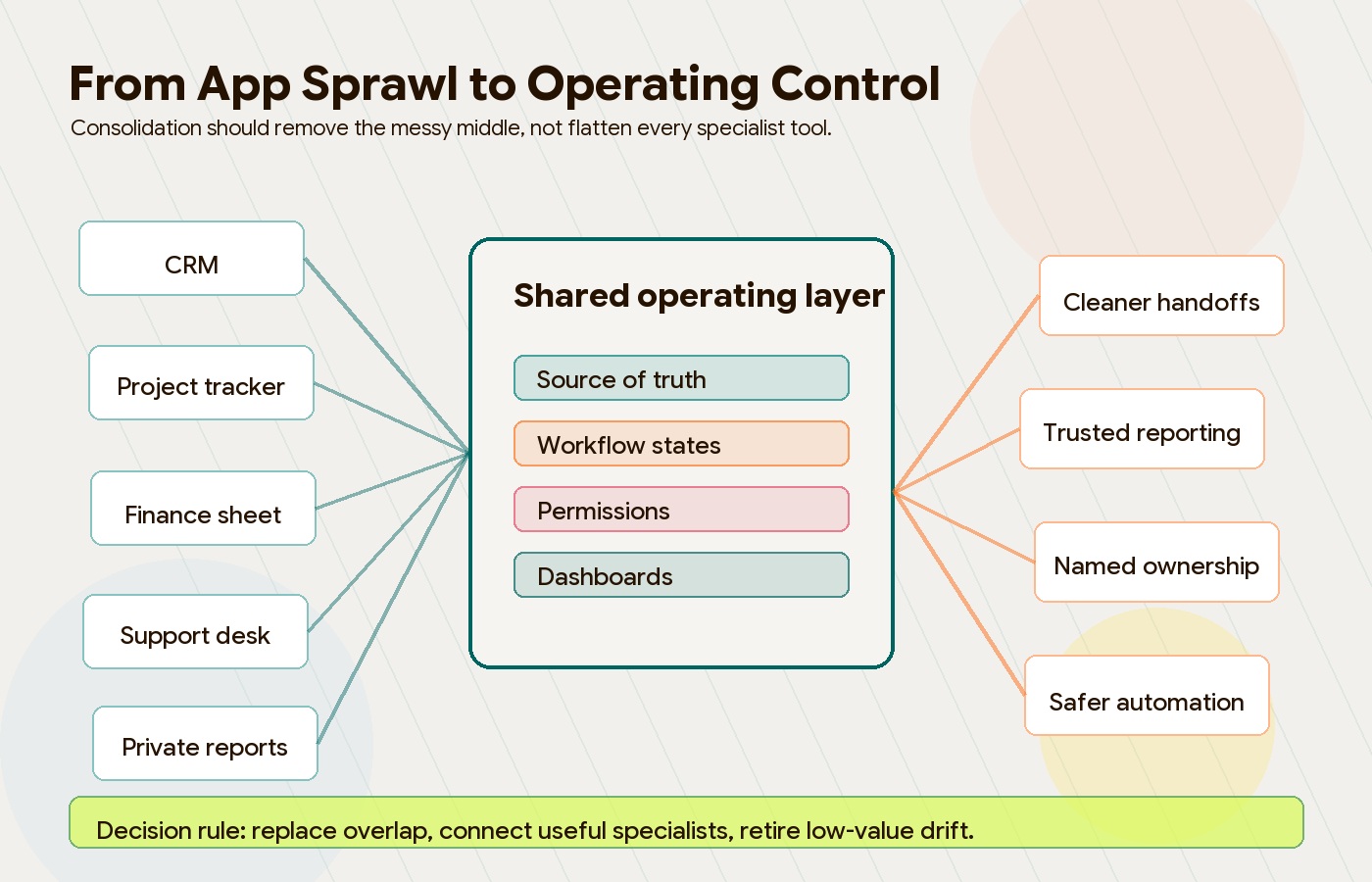
Consolidating internal apps means reducing overlapping tools, duplicated data, manual handoffs, and scattered reporting into a smaller, clearer operating system for the business. The goal is not to force every team into one giant platform. The goal is to make core work easier to see, easier to own, and harder to break.
That distinction matters. App sprawl usually starts for good reasons: sales needs a CRM, delivery needs project tracking, finance needs invoicing, support needs a helpdesk, and leadership needs dashboards. The problem appears later, when the same customer, project, invoice, approval, or support risk lives in five places and no one can say which one is true.
Okta’s 2024 SMBs at Work report notes that businesses of all sizes average about 93 apps, with smaller companies using fewer but often having higher app density per employee. That number is not automatically bad. A 60-app stack can be healthy if ownership is clear and data moves cleanly. A 12-app stack can be a mess if every handoff depends on copying, chasing, and reconciling.
This article is for founders, operators, COOs, IT leaders, and department heads deciding whether to replace multiple business apps, consolidate internal tools, or create a custom operating system for business workflows that have outgrown disconnected SaaS.
The real signs of app sprawl
App sprawl is not the existence of many tools. It is the operational drag created when tools overlap, contradict each other, or lack owners.
The clearest signs are usually visible before finance or IT runs a formal audit:
| App sprawl sign | What it looks like | Why it matters |
|---|---|---|
| Duplicate data entry | The same customer, project, order, or invoice is typed into multiple systems | Errors multiply and employees become the integration layer |
| Broken handoffs | Sales, delivery, finance, and support each use a different source of truth | Context disappears exactly when responsibility changes |
| Weak reporting | Leaders debate which dashboard is right instead of acting on the numbers | Decision speed drops because the business cannot trust its own view |
| Unclear ownership | Apps stay live after teams change, projects end, or champions leave | Costs, access, data quality, and security risk drift without accountability |
The practical test is simple: if people need a spreadsheet, meeting, or private Slack thread to reconcile what the tools should already know, the software stack is not operating as a system.
Duplicate entry is a hidden labor cost
Duplicate entry is often treated as a small annoyance because each copy-and-paste moment feels minor. Across a team, it becomes a tax.
A service company might close a deal in the CRM, recreate the account in the project tool, move billable rates into a finance sheet, and copy delivery dates into a reporting dashboard. Each step seems reasonable in isolation. Together, they create four versions of the same operational object.
That is when replacing multiple business apps becomes worth discussing. Not because fewer tools are always better, but because the business is paying twice: once for the software and again for the labor required to keep the software aligned.
Broken handoffs create invisible customer risk
The most expensive handoff breaks are rarely dramatic. They look like a delivery team missing a sales promise, finance sending an invoice with the wrong scope, support answering without renewal context, or leadership seeing churn risk after the client has already escalated.
These problems often trace back to the same issue: each department has optimized its own view, but no one has designed the handoff between views.
A business operating system does not have to replace every department tool. Hapy’s guide to business operating systems explains the better pattern: connect the data foundation, workflow orchestration, dashboards, permissions, and decision layer so the business can run from one reliable operating model.
When consolidating internal apps helps
Consolidating internal apps helps when several tools manage the same object, workflow, approval, or metric and the business loses time or trust because those tools do not stay aligned.
Use consolidation when the workflow has these traits:
- The same customer, account, project, order, employee, ticket, or invoice appears in multiple systems.
- A handoff fails unless one person manually updates another tool.
- Leaders cannot get reliable reporting without exporting and reconciling data.
- Two or more teams use different tools for the same job.
- The workflow is routine enough to standardize.
- Ownership, permissions, and audit history matter.
- The tool stack blocks automation or AI because the data model is fragmented.
In those cases, consolidation can reduce the number of places work happens, simplify training, tighten permissions, improve reporting, and create a cleaner base for automation.
The keyword is “can.” Consolidation is not magic. If the business has unclear workflow rules, messy source data, and no owner for the new system, one platform will only centralize the confusion. The first move is not software selection. It is workflow design.
When separate tools should stay separate
Separate tools should stay separate when specialization creates more value than consolidation would recover.
That is especially true when a tool supports a regulated, expert, or high-performance function that a generic platform cannot handle well. Legal practice management, advanced marketing attribution, warehouse optimization, financial close, clinical workflows, developer infrastructure, and domain-specific analytics may deserve specialized systems.
Keep a separate tool when it passes four tests:
| Keep-separate test | Good signal |
|---|---|
| Specialized value | The tool enables a workflow the business cannot afford to flatten |
| Clean integration | It sends and receives the right data through stable APIs or governed exports |
| Clear ownership | A named team owns cost, access, configuration, data quality, and renewal |
| Reporting fit | Its outputs reconcile with the core business view without manual heroics |
This is where many consolidation projects go wrong. They confuse “too many tools” with “wrong architecture.” A strong best-of-breed stack can work if each tool has a clear job and the operating layer is designed. A weak all-in-one platform can fail if it forces specialized teams into shallow modules and creates shadow work outside the system.
Replace, connect, or retire: a practical decision matrix
Before you consolidate internal tools, sort each app by business value and technical fit.
The Gartner TIME framework, commonly used in application rationalization, classifies applications as Tolerate, Invest, Migrate, or Eliminate based on technical and functional fit. For an operator-led stack review, the same logic can be translated into plain business decisions:
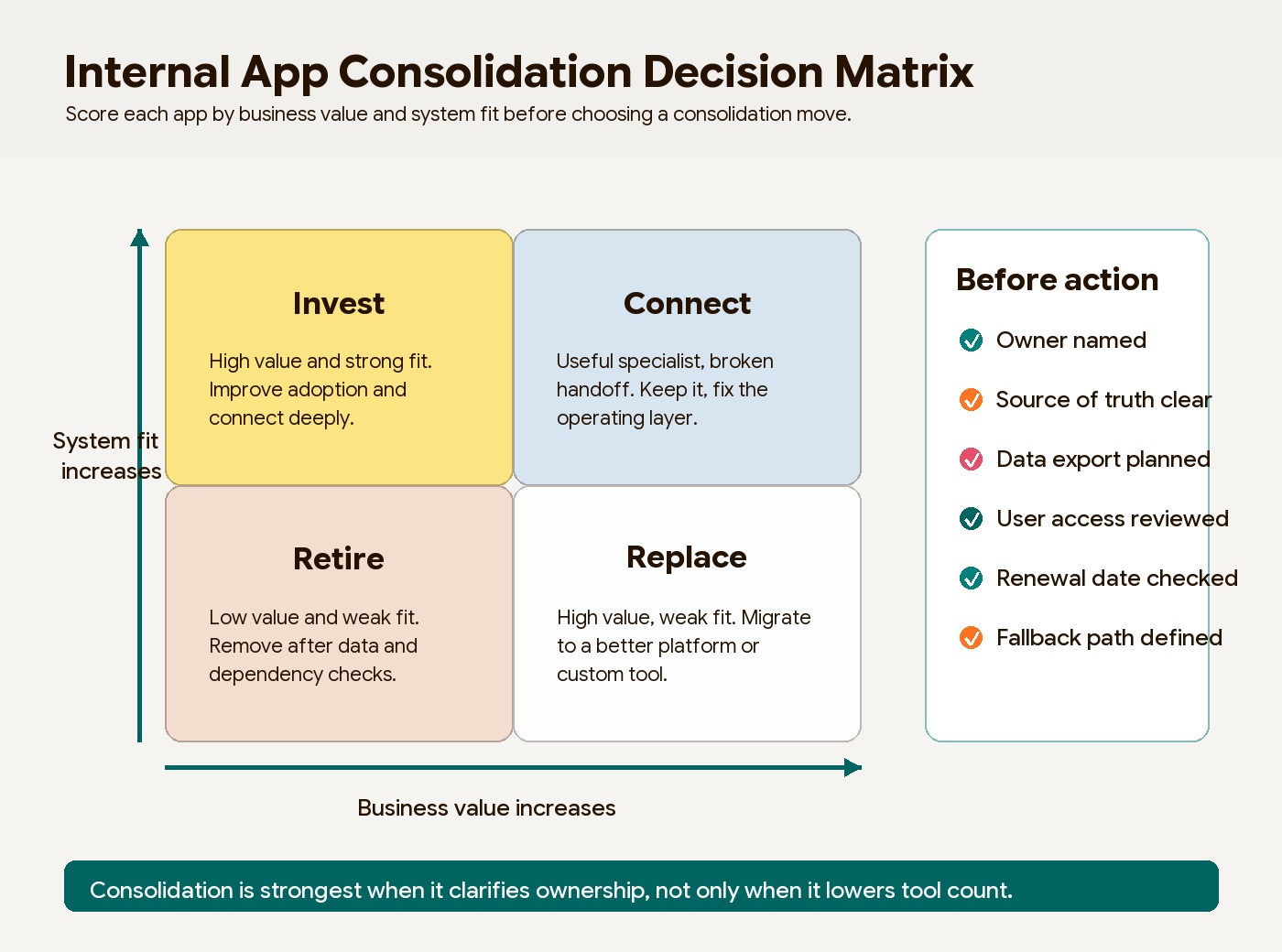
| App condition | Decision | What to do |
|---|---|---|
| High business value, strong fit | Invest | Keep it, improve adoption, and connect it more deeply |
| High business value, weak fit | Replace or rebuild | Migrate the workflow into a better platform or custom internal tool |
| Low business value, strong fit | Tolerate | Keep it temporarily, limit spend, and revisit at renewal |
| Low business value, weak fit | Retire | Decommission it after checking data, users, dependencies, and contracts |
| Useful tool, broken handoff | Connect | Keep the tool but build the missing workflow, data, or reporting layer |
This is also the bridge to the build-vs-buy decision. If the workflow is common and the vendor model fits, buying or consolidating into an existing platform is usually right. If the workflow is proprietary, integration-heavy, or central to margin, speed, or customer experience, Hapy’s build-vs-buy software guide gives a deeper way to compare SaaS, custom software, and a hybrid operating layer.
What a custom operating system for business should mean
A custom operating system for business should not mean a giant bespoke ERP that replaces every useful tool. It should mean a focused operating layer around the workflows the business must control.
In practice, that layer may include:
- A shared customer, project, order, or employee record.
- Role-based access and approval rules.
- Workflow states that define what can happen next.
- Dashboards that show exceptions, not only totals.
- Integrations with CRM, finance, support, documents, and communication tools.
- Audit logs for sensitive changes.
- Admin tools so operations can resolve routine issues without engineering.
- AI or automation only where the underlying workflow is already reliable.
For many companies, the right answer is not one system replacing everything. It is one system replacing the messy middle: the spreadsheet bridges, manual routing, private trackers, duplicated approvals, and stitched-together reports that sit between otherwise useful apps.
If you are still deciding what this might look like, start with Hapy’s internal tools examples. Examples such as approval queues, dispatch boards, reporting dashboards, support consoles, and integration monitors make the consolidation question more concrete than broad platform categories.
Governance is part of consolidation, not a later cleanup
Consolidation increases leverage because more work runs through fewer paths. It also increases risk because more data, permissions, and decisions concentrate in fewer systems.
That matters more as employees and teams create technology outside traditional IT channels. Gartner says that by 2027, 75% of employees will acquire, modify, or create technology outside IT’s visibility, up from 41% in 2022. In plain terms: shadow tools are no longer a fringe IT problem. They are part of how work now gets created.
A consolidation project should therefore answer governance questions early:
- Who owns each workflow after consolidation?
- Which system is the source of truth for each object?
- Who can create, edit, approve, export, delete, and override records?
- What happens to historical data in retired tools?
- How are users provisioned and deprovisioned?
- Which integrations are monitored?
- Which reports are trusted enough to run decisions?
- What happens when an AI agent or automation touches the workflow?
This is where “consolidate internal tools” becomes an operating discipline, not a cleanup project. Reducing licenses is useful. Reducing ambiguity is usually more valuable.
How to run a focused app consolidation review
A useful review can start small. You do not need a six-month enterprise architecture program to find the first consolidation opportunity.
Start with one workflow that crosses teams, such as sales to delivery, order to cash, support escalation, employee onboarding, inventory exceptions, content production, procurement approvals, or project margin reporting.
Then work through five steps:
- Map the workflow as it happens now. List every tool, spreadsheet, inbox, dashboard, and manual step involved.
- Name the core objects. Identify the records that matter: customer, project, invoice, employee, ticket, order, vendor, contract, asset, or approval.
- Find the duplicate entry and handoff points. Mark where people copy data, wait for another team, or reconcile numbers.
- Score each tool. For every app in the workflow, rate business value, technical fit, ownership, data quality, integration quality, and cost.
- Choose the smallest useful move. Retire obvious duplicates, connect valuable tools, replace weak high-value systems, or build a focused internal tool around the broken middle.
The Front example is useful because it shows consolidation as a visibility-and-ownership program, not just a software cut. Productiv says Front saved more than $600,000 in the first year and reduced its SaaS portfolio by 20% from 400-plus applications after centralizing portfolio visibility and license management.
Most companies will not have that exact scale. The lesson still travels: you cannot manage what you cannot see, and you cannot consolidate responsibly if no one owns the post-consolidation workflow.
The decision rule
Consolidating internal apps is worth it when the business is losing time, trust, money, or control because tools overlap and handoffs are broken. It is risky when the project tries to flatten specialized work, replace useful systems for aesthetic simplicity, or centralize workflows before ownership is clear.
Use this rule:
| Situation | Best next move |
|---|---|
| Many tools, but clean ownership and reporting | Leave the architecture alone and review renewals |
| Duplicate tools for the same job | Standardize on one and retire the rest |
| Good tools with bad handoffs | Build integrations, dashboards, or a workflow layer |
| Valuable workflow trapped in a weak tool | Replace the tool or build a custom internal system |
| Low-value tool with low usage | Retire it after checking data and dependencies |
| Core workflow spread across too many apps | Consider a business operating system layer |
The best consolidation work feels pragmatic. It does not start by asking, “How do we get everything into one platform?” It asks, “Where does work slow down, where does data stop being trusted, and which system should own the truth?”
That is the useful center of consolidating internal apps: fewer places to update, fewer handoffs to chase, clearer reporting, and stronger ownership over the workflows that actually run the business.
If the workflow needs a connected operating layer, review Hapy’s business systems automation work against the ownership and integration requirements.