Internal tool adoption is not won by publishing better documentation after launch. It is won by designing the custom web app, rollout plan, training, support model, and measurement system around the way employees actually work.
That is the practical shift: adoption is a product design problem before it is a communications problem.
A custom app can be technically solid and still fail if employees experience it as extra work. If the new system makes a sales rep double-enter notes, a dispatcher wait for a slow screen, or a manager lose the spreadsheet view that helped them catch exceptions, people will route around it. They will go back to spreadsheets, chat threads, shared docs, and the trusted colleague who knows where the real answer lives.
The goal of internal software adoption is not “more logins.” The goal is to make the new tool the easiest trustworthy way to finish the job.
Start internal tool adoption before launch
Internal tool adoption should start while the product is still being designed. If the first adoption conversation happens two weeks before go-live, the team has probably treated the app as a delivery project instead of an internal product.
The internal web app development timeline shows where rollout preparation, user acceptance testing, training, and hypercare belong before launch.
After go-live, pair that rollout with an internal app maintenance plan so support, monitoring, patching, documentation, and product ownership do not become informal work.
That matters because employees adopt tools for two plain reasons: the tool helps them do their job, and the tool feels manageable under pressure. Fred Davis’s original Technology Acceptance Model describes these as perceived usefulness and perceived ease of use. For internal apps, both are non-negotiable.
A tool that is useful but painful will be avoided. A tool that is easy but irrelevant will be ignored.
Before writing the business app rollout plan, answer these questions:
- Which workflow is supposed to change?
- Which roles will use the app daily, weekly, or only by exception?
- What workarounds exist today, especially spreadsheets and chat?
- Which old behaviors must stop for the new system to matter?
- What will make the new behavior easier than the old one?
- What must be measured before rollout so improvement is visible?
This is where user-centered design belongs in internal software. Employees are users. Their context, interruptions, shortcuts, permissions, physical environment, incentives, and anxieties all shape adoption. A warehouse lead using a tablet between tasks needs a different experience from a finance analyst reviewing exceptions at a desk.
The design question is not “Can the app do the workflow?” It is “Can the employee complete the workflow faster, with fewer mistakes, while trusting the system?”
Build the rollout around the real workflow
A strong rollout plan starts with workflow evidence. Watch how people do the work today. Read the spreadsheet tabs. Review the chat threads. Sit with frontline staff while they handle exceptions. Ask managers which reports they rebuild manually before every meeting.
Those artifacts show where the app must earn trust.
Spreadsheets are rarely just bad habits. They are often lightweight operating systems employees built because the official system was too rigid, too slow, or too far away from the messy reality of the work. A spreadsheet may reveal missing filters, unclear ownership, unmodeled exceptions, duplicate entry, or a reporting need the product team never saw.
For Hapy, this connects directly to business process automation. Automating or digitizing a broken workflow does not fix the workflow. It can make the weakness more visible and harder to unwind. The rollout should clarify ownership, simplify handoffs, and remove duplicate work before the new app becomes the default.
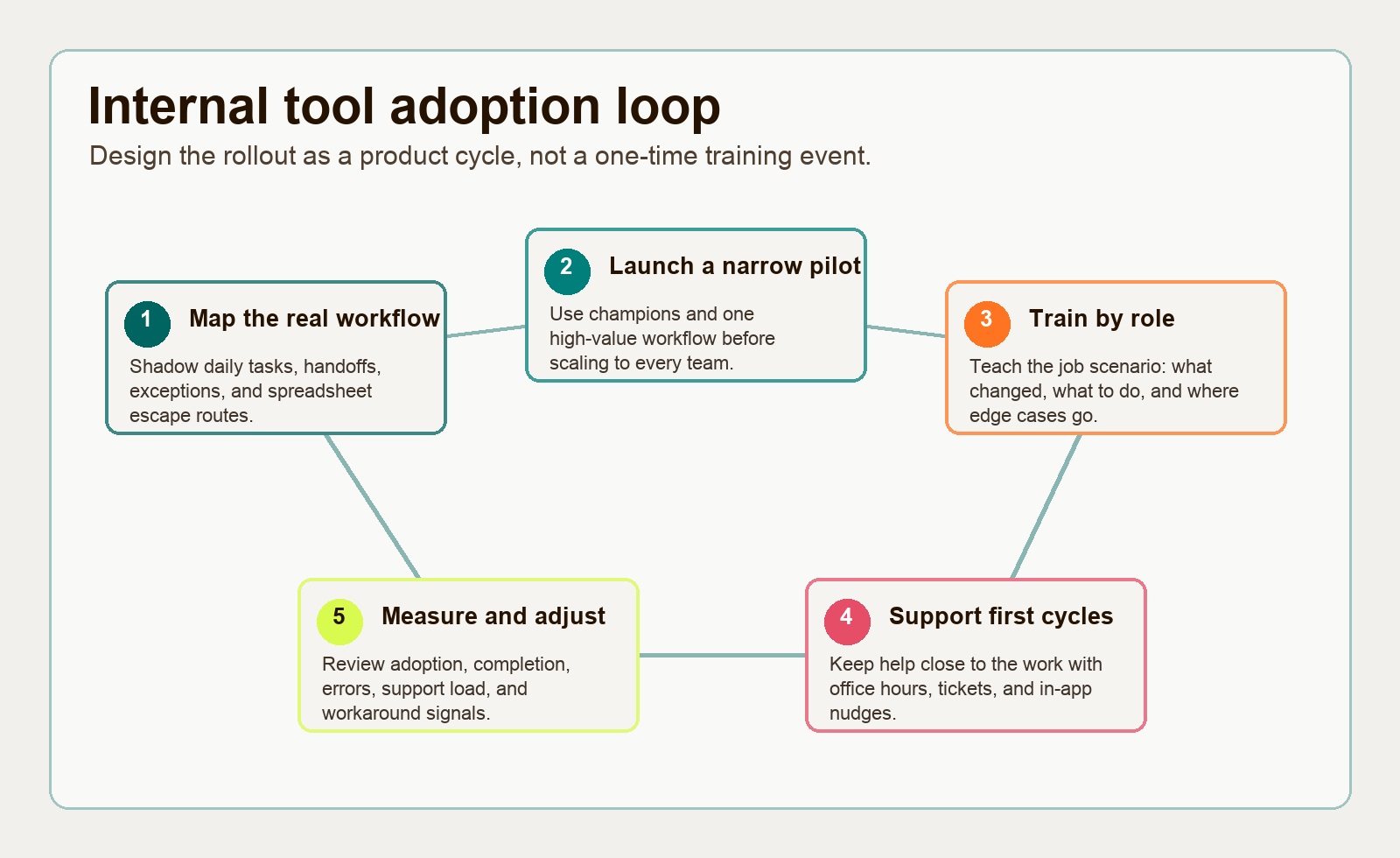
Use a phased rollout instead of a big-bang launch when the workflow crosses multiple teams.
| Phase | Rollout focus | What to prove |
|---|---|---|
| Discovery | Map current work, exceptions, spreadsheet patterns, and baseline metrics | The team understands the real workflow, not just the process diagram |
| Pilot | Launch one high-value workflow with a small cohort | The app works under daily pressure and handles common edge cases |
| Role-based training | Train each group on the tasks they actually own | Employees know what changed, how to do the work, and where to get help |
| Reinforcement | Move recurring rituals and reports into the system | The organization stops rewarding side-channel work |
| Scale | Expand to more roles, locations, workflows, or integrations | Adoption improves without support load growing out of control |
The point is not to slow down. The point is to learn while the blast radius is still manageable.
Train employees on a custom app by job, not feature
Custom app employee training fails when it is organized around screens instead of work.
Employees do not need a tour of every button. They need to know how the new system changes the tasks they are responsible for: intake, review, assignment, approval, correction, escalation, reporting, or handoff. Training should make the normal path easy and the exception path clear.
A useful training plan includes:
| Training element | Better approach | Weak approach |
|---|---|---|
| Role paths | Separate sessions for frontline users, managers, approvers, admins, and support teams | One generic demo for everyone |
| Real scenarios | Use actual workflows, edge cases, and legacy spreadsheet examples | Walk through clean sample data nobody recognizes |
| Practice | Let employees complete tasks in a sandbox before go-live | Send a recording and assume people watched it |
| Support | Offer office hours, quick-reference guides, and visible escalation paths | Tell users to file a ticket if they get stuck |
| Reinforcement | Use team rituals, dashboards, and manager expectations to make the app the default | Celebrate launch week and then disappear |
The Prosci ADKAR model is useful here because it separates awareness, desire, knowledge, ability, and reinforcement. Many rollouts stop at knowledge: the employee attended training, therefore the organization assumes adoption has happened. But knowledge is not ability. Ability is whether the employee can use the app during the real shift, with real data, while a customer, manager, or deadline is waiting.
That is why training should include first-cycle support. If the app launches for month-end reporting, be present during month-end. If the tool changes dispatching, support the first live dispatch window. If it changes sales follow-up, review the first week of notes and handoffs with the team.
The riskiest moment is not the demo. It is the first time the employee hits an edge case and has to decide whether to trust the new system or open the old spreadsheet.
Use champions as product feedback, not internal marketing
Internal champions are useful when they are treated as part of the product system, not as cheerleaders for a decision already made.
The best champions are usually respected operators who know the work and are willing to tell the product team what is awkward. They do not need to be the loudest supporters. They need credibility with peers and enough curiosity to test the new way of working.
Bring champions in before rollout. Ask them to:
- Review prototypes against real workflows.
- Test the pilot with messy data and edge cases.
- Help translate training into team language.
- Notice where peers hesitate, complain, or work around the system.
- Feed issues back to the product owner in a structured way.
Champions should have a lightweight operating model. Thirty minutes a week can be enough if the role is clear: observe, test, answer common questions, and surface friction. If you turn champions into unpaid support desks, the program will burn out.
Give champions prepared materials, a private feedback channel, and visible recognition. More importantly, show that their feedback changes the app. Nothing kills a champion network faster than asking for field insight and then shipping the original plan unchanged.
Design support loops before people need them
Support is part of the product experience. If support feels slow, unclear, or politically risky, employees will avoid the official path and ask a peer in chat.
Good support loops are close to the work:
- In-app feedback for confusing screens, missing options, and broken states.
- A visible support channel during the first production cycles.
- Office hours for the roles with the highest workflow change.
- A triage path for bugs, permission issues, data problems, and training gaps.
- A product owner who reviews feedback weekly and decides what changes.
Separate adoption issues from software bugs. They look similar to users, but they require different fixes.
| Signal | Likely issue | Better response |
|---|---|---|
| Users ask “Where do I click?” | Training or navigation problem | Improve onboarding, labels, defaults, or quick guides |
| Users start but do not finish a workflow | UX friction, missing information, or unclear state | Review abandonment points and simplify the flow |
| Users export data to spreadsheets | Reporting, filtering, trust, or flexibility gap | Add the view they need or redesign the reporting workflow |
| Users ask peers instead of support | Support channel feels slow or unsafe | Make help visible, fast, and non-punitive |
| Managers request side reports | Leadership rituals still reward the old system | Move recurring reviews onto system dashboards |
This is also where security and reliability matter. Internal tools often touch employee data, finance workflows, customer information, operational records, or approvals. The app should be designed with clear permissions, audit logs, and secure delivery practices. NIST’s Secure Software Development Framework is a useful reference point when a custom internal app becomes workplace infrastructure rather than a small side tool.
If employees do not trust the data, permissions, speed, or uptime, adoption will decay no matter how polished the training looks.
Measure adoption with behavior, not attendance
Training completion is not adoption. Login count is not adoption. A launch announcement is definitely not adoption.
Internal software adoption should be measured by whether the new system becomes the normal way work moves through the business.
Track a balanced set of metrics:
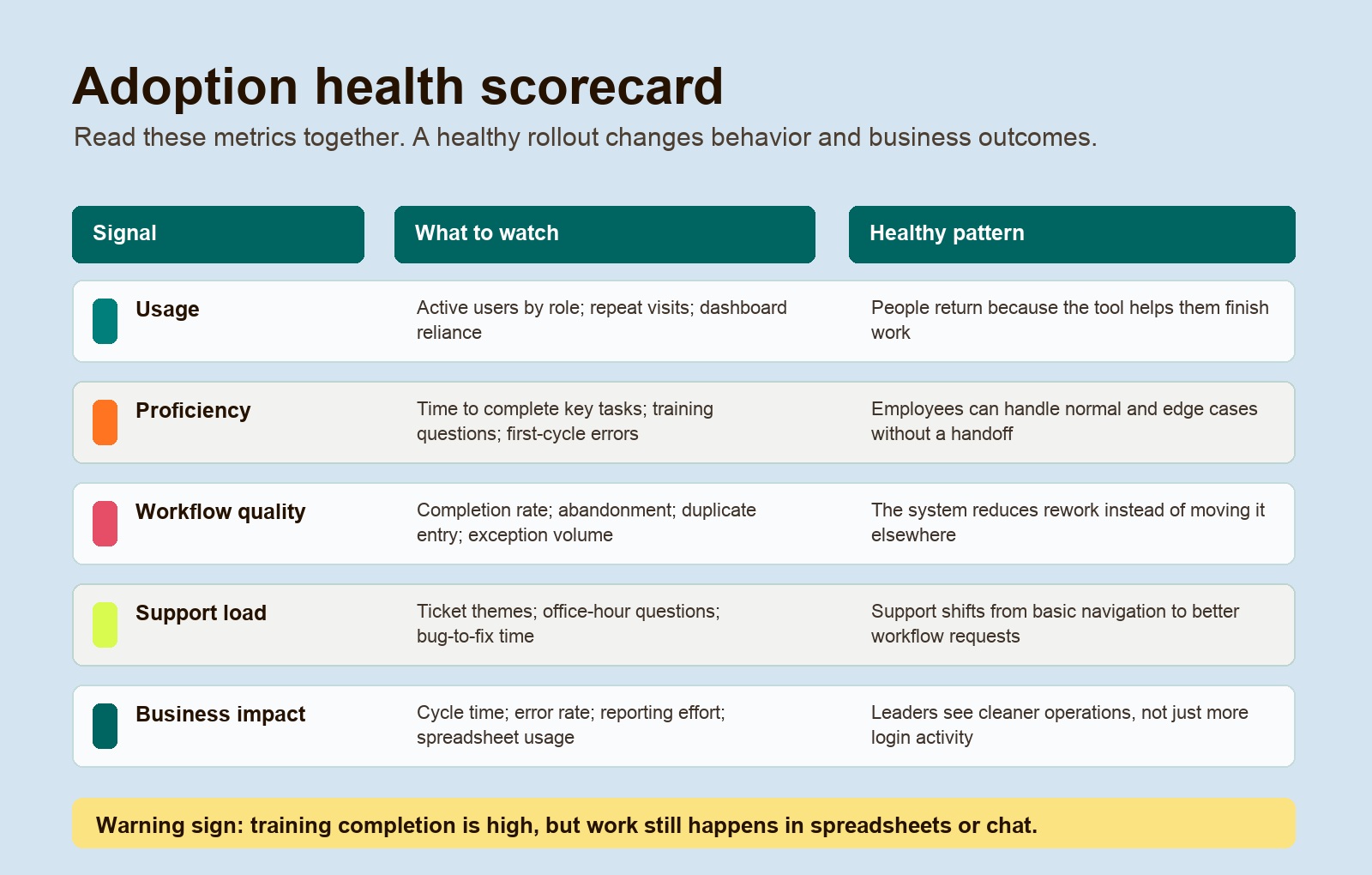
Useful metrics include:
- Active usage by role, team, location, and workflow.
- Workflow completion rate and abandonment rate.
- Time to complete core tasks.
- Error rate, rework, and duplicate entry.
- Support ticket themes and time to resolution.
- Spreadsheet or chat workaround frequency.
- Reporting effort before and after rollout.
- Time to proficiency for new and existing employees.
- Feature usage for the workflows the business actually cares about.
The important move is to read metrics together.
High usage with high abandonment means people need the workflow but struggle to finish it. High training completion with low usage means the training did not change behavior. Low support tickets with visible side-channel work may mean employees have given up on official support.
The most useful adoption dashboard compares system behavior with business outcomes. If the custom app is supposed to reduce approval cycle time, show cycle time. If it is supposed to reduce data errors, show error rate. If it is supposed to replace weekly spreadsheet reporting, show whether the spreadsheet disappeared.
Mistakes that send people back to spreadsheets and chat
Employees return to old tools when the new system violates the practical logic of their work.
The common mistakes are predictable:
- Building for leadership visibility before frontline usability.
- Training on features instead of job scenarios.
- Ignoring the spreadsheet that already encodes the real process.
- Removing flexibility before the app handles common exceptions.
- Making managers approve or review work outside the system.
- Treating post-launch feedback as low-priority maintenance.
- Measuring attendance and logins instead of task completion and business impact.
- Shipping a polished interface on top of unclear ownership, bad data, or weak integrations.
Harvard Business Review has written about the hidden cost of toggling between workplace applications. Internal apps can reduce that cost, but only if they consolidate work. If the rollout adds another place to check, another report to reconcile, or another approval queue to monitor, the app becomes part of the problem.
The design team should treat every workaround as evidence. When employees keep a side spreadsheet, ask what the spreadsheet gives them that the app does not. Speed? Sorting? Scenario planning? Exception notes? A safer way to check the data before committing it? That answer is usually more useful than another reminder email.
Product design and product development both matter
Internal tool adoption sits between product design and product development.
Product design reduces usability and workflow risk: who uses the tool, what they need to do, where they hesitate, what information they need, and how the experience should behave. Product development reduces execution and technical risk: how the system is built, integrated, secured, tested, monitored, and maintained.
Adoption suffers when either side is weak.
If the design is weak, employees experience the app as confusing, slow, rigid, or disconnected from the way work really happens. If the development is weak, employees lose trust because the app is buggy, under-integrated, insecure, or unreliable.
The better model is a shared product rhythm:
- Map the workflow and adoption risks before build.
- Prototype the high-frequency tasks with real users.
- Build the smallest useful version around the workflow that matters most.
- Pilot with champions and live operational data.
- Measure adoption and business outcomes.
- Improve the app, training, and process together.
This is why internal tool rollout should be owned by a product-minded team, not only IT, operations, or training. The work crosses behavior, process, interface, systems, and management habits.
A practical business app rollout plan
Use this checklist before launching a custom web app internally.
| Area | Questions to answer before rollout |
|---|---|
| Workflow | What exact work moves into the app, and what old behavior must stop? |
| Users | Which roles use it daily, weekly, by approval, or by exception? |
| Value | What immediate benefit does each role get from using it? |
| Training | Which scenarios, edge cases, and first-cycle tasks must be practiced? |
| Champions | Which credible users will test, support, and report friction? |
| Support | Where do employees go for help, and who triages feedback? |
| Rituals | Which meetings, dashboards, and reports will use the new system as the source of truth? |
| Metrics | How will adoption, proficiency, workflow quality, and business impact be measured? |
| Governance | Who owns permissions, data quality, security, and future changes? |
This checklist is deliberately operational. Internal adoption does not improve because the launch deck is inspiring. It improves because the new system becomes easier, safer, and more useful than the workaround.
For teams planning a custom tool as part of a broader operating model, Hapy’s Business Systems & Automation work starts with that question: what workflow should change, what system should support it, and how will people actually use it after launch?
The Hapy view
Internal tool adoption fails quietly. The app ships, the training happens, the dashboard shows some activity, and the real work slowly returns to spreadsheets and chat.
The fix is not more documentation. The fix is to design adoption into the product: workflow research, narrow rollout, role-based training, champions, fast support loops, reliable systems, and metrics that show whether behavior changed.
Treat internal tool adoption as a product design problem, and the custom app has a better chance of becoming the way work gets done. Treat it as a launch task, and employees will keep the old operating system running in the background.