An internal app maintenance plan defines what happens after launch: who fixes bugs, who owns hosting, who watches monitoring alerts, who applies dependency updates and security patches, who handles user support, who decides roadmap work, and who keeps documentation accurate.
That plan matters because launch changes the risk. Before launch, the main question is whether the team can build the app. After launch, the question is whether the business can rely on it without creating a new operational burden.
For buyers, the safest view is simple: a custom app is not finished when it goes live. It becomes part of the company’s operating system. If the ownership model is vague, small issues turn into user workarounds, stale data, security exposure, brittle integrations, and roadmap delays.
What an internal app maintenance plan should cover
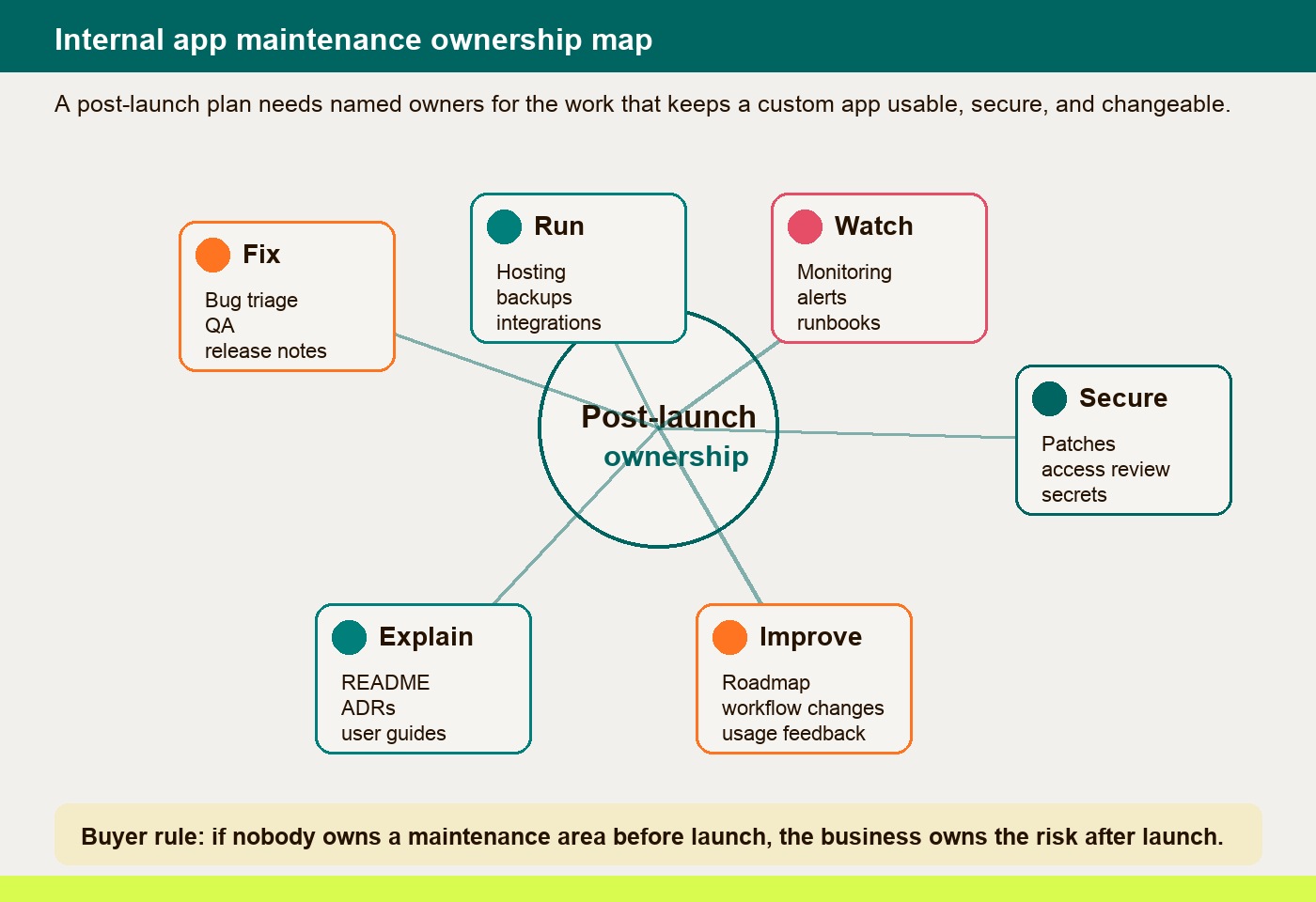
An internal app maintenance plan should cover six areas: bug fixes, hosting, monitoring, dependency and security updates, roadmap improvements, and documentation. The exact depth depends on the app’s role in the business, but every live internal system needs named ownership across those areas.
| Maintenance area | What it includes | Buyer question |
|---|---|---|
| Bug fixes and support | Triage, severity levels, reproduction steps, fixes, QA, release notes | Who responds when users report a problem? |
| Hosting and infrastructure | Cloud accounts, environments, databases, backups, SSL, domains, scheduled jobs | Who owns the production environment? |
| Monitoring and incident response | Uptime checks, logs, alerts, error tracking, performance metrics, runbooks | How will we know something is wrong before users complain? |
| Dependency and security updates | Package updates, CVE review, access review, secrets, patches, vulnerability handling | Who keeps the app safe as libraries and platforms change? |
| Roadmap work | Small improvements, workflow changes, reporting changes, new integrations, feature retirement | How do we choose between fixes and new requests? |
| Documentation | README, architecture notes, runbooks, ADRs, admin guides, user bug-report templates | Could a new engineer or vendor support this app? |
The four classic software maintenance categories are still useful here: corrective, adaptive, perfective, and preventive maintenance. ISO/IEC/IEEE 14764:2022 provides software maintenance guidance based on the maintenance process in ISO/IEC/IEEE 12207:2017. That is a helpful buyer lens because it prevents “maintenance” from becoming a vague bucket for whatever was not priced before launch.
Bug fixes need triage, not inbox chaos
Bug fixes are part of every custom app support plan, but the plan should separate urgent incidents from normal product cleanup. Without triage, the loudest user sets the roadmap and developers spend too much time chasing incomplete reports.
Use a simple severity model:
| Severity | Example | Response posture |
|---|---|---|
| Critical | Core workflow is down, data is corrupting, or there is an active security issue | Immediate investigation, status updates, rollback or hotfix path |
| High | A major workflow is degraded and users have no good workaround | Prioritized fix in the active support window |
| Normal | A localized bug, confusing state, or broken edge case with a workaround | Backlog, estimate, fix in a scheduled release |
| Low | UI polish, wording, minor formatting, small admin inconvenience | Batch with other improvements |
The buyer-side mistake is assuming “bug fixing” is obvious. It is not. A good plan defines where users report issues, what evidence they include, who confirms the bug, who prioritizes it, how fixes are tested, and how users are told when the fix ships.
For internal software support, the bug report template should ask for:
- User role and affected workflow.
- Browser, device, location, and account context.
- Steps to reproduce the problem.
- Expected result and actual result.
- Screenshot, screen recording, error message, or affected record ID.
- Business impact: blocked work, delayed approval, wrong report, duplicate entry, or manual workaround.
This small habit reduces back-and-forth and protects engineering time for real diagnosis.
Hosting, databases, and integrations drift after launch
Hosting maintenance is not only paying the cloud bill. A live internal app has environments, databases, scheduled jobs, logs, certificates, domains, queues, file storage, and sometimes background workers. Any one of those can become the failure point.
The app also has external dependencies: identity providers, CRMs, ERPs, accounting systems, messaging tools, email services, payment tools, reporting databases, spreadsheets, and internal APIs. Those systems change. API versions are deprecated. Permissions are altered. Certificates expire. Vendor pricing changes. An integration that worked on launch day may fail six months later because the outside system moved.
Database maintenance also deserves explicit ownership. PostgreSQL’s routine vacuuming documentation explains maintenance tasks such as vacuuming to recover storage occupied by updated or deleted rows and keep planner statistics current. Buyers do not need to manage that detail personally, but they do need to know whether the vendor, internal engineer, or platform provider owns it.
For custom web app maintenance, hosting ownership should answer:
- Which cloud, database, storage, and third-party services does the app use?
- Who has admin access, billing access, and emergency access?
- What is backed up, how often, and where?
- When was the last restore test?
- What happens if an integration fails?
- Which domains, SSL certificates, API keys, and licenses can expire?
- Which environment is production, staging, testing, and local development?
If the app supports a business-critical workflow, “the platform probably handles it” is not a maintenance plan. It is a hope with a login screen.
Monitoring should watch the user experience, not only uptime
Monitoring should tell the support owner whether the system is available, fast enough, and behaving correctly. A green server status is not enough if approvals are stuck, reports are wrong, or users cannot finish the main workflow.
Google’s Site Reliability Engineering material popularized the four golden signals of monitoring: latency, traffic, errors, and saturation. Those signals are useful for internal apps because they separate “is the app online?” from “is the app healthy enough for daily work?”
Use them in plain business terms:
- Latency: are key actions slow enough to frustrate users?
- Traffic: is usage normal, dropping, or unexpectedly spiking?
- Errors: are requests failing, imports breaking, or jobs retrying?
- Saturation: are CPU, memory, disk, queue depth, or database connections near limits?
Good monitoring usually combines automated checks with real usage data. A synthetic monitor can test whether login or a core workflow works every few minutes. Real user monitoring and logs can show what actual employees experience across roles, browsers, locations, and data volumes.
The maintenance plan should also define an incident runbook. At minimum, the runbook should say who gets alerted, how severity is classified, where updates are posted, how rollback works, how recovery is verified, and which follow-up actions become backlog work.
Dependency updates and security patches need a cadence
Dependency updates are easy to ignore until they become urgent. Modern internal apps rely on open-source packages, runtime versions, SaaS SDKs, database drivers, authentication libraries, UI frameworks, deployment tooling, and cloud services. When those dependencies age, they can create security exposure, compatibility issues, and upgrade traps.
Tools such as GitHub Dependabot and Renovate can help by opening update pull requests automatically. Automation is useful, but it does not remove ownership. Someone still needs to decide which updates can merge quickly, which need QA, and which major upgrades require a planned migration.
A practical update cadence looks like this:
| Update type | Typical handling |
|---|---|
| Security patch | Review quickly, test critical workflows, release as soon as practical |
| Patch version | Review changelog, dependency provenance and affected workflows; batch low-risk updates after tests pass, with staging or manual checks when risk warrants |
| Minor version | Review changelog, test in staging, release on a scheduled cadence |
| Major version | Treat as roadmap work with estimate, migration notes, QA, and rollback planning |
Security maintenance should also include access reviews, secrets management, audit logs, backups, and vulnerability handling. NIST’s Secure Software Development Framework gives teams and software buyers a shared reference for secure development practices, including producing secure software and responding to vulnerabilities.
The point is not to turn every internal app into a compliance program. The point is to stop treating security as a launch-week checklist. Once users, permissions, operational data, and integrations are live, security is an operating responsibility.
Roadmap work should not consume all support capacity
After launch, users will ask for improvements. Some will be good ideas. Some will be workarounds in disguise. Some will be symptoms of unclear training or bad data. Some will be legitimate roadmap work that makes the app more valuable.
The maintenance plan needs a decision model for these requests. Otherwise, the support team gets trapped between urgent fixes and endless enhancement requests.
Use three buckets:
- Keep the app reliable: bugs, security patches, monitoring, backups, dependency updates, performance, support.
- Improve the current workflow: small usability changes, reporting cleanup, clearer states, better admin tools, better notifications.
- Change the product scope: new workflows, new roles, new integrations, data model changes, major reporting needs.
The first bucket is not optional. It is the “keep the lights on” work that protects the system. The second bucket is where maintenance improves adoption. The third bucket should be planned like product work, not slipped quietly into support.
This is where technical debt becomes visible. If every small improvement requires risky code changes, if regression testing takes too long, or if nobody understands why the system was built a certain way, the roadmap is already paying for earlier shortcuts. Hapy’s guide to technical debt cost is the better next read if you need to explain that cost in business terms.
For broader build and ownership planning, pair this article with Hapy’s custom software development process. Maintenance is not a separate chapter after the process. It is the phase that proves whether the process created something the business can own.
What happens when internal apps are not maintained
When an internal app is not maintained, it usually does not fail all at once. It gets less trustworthy, then less used, then harder to change.
The pattern is familiar:
- Users start reporting the same issues repeatedly.
- A few people return to spreadsheets because the app feels slow or incomplete.
- Data becomes inconsistent because some work happens outside the system.
- Integrations fail silently, creating reporting gaps.
- Security patches pile up until a routine update becomes a risky project.
- New features take longer because the codebase is fragile.
- The original vendor or engineer is needed for every change because documentation is thin.
- Leadership loses confidence in the app and funds a replacement sooner than expected.
That is the hidden cost of treating launch as the finish line. The business paid to remove operational friction, but an unsupported app can create a new layer of friction: one more system people have to work around.
Handoff questions buyers should ask before launch
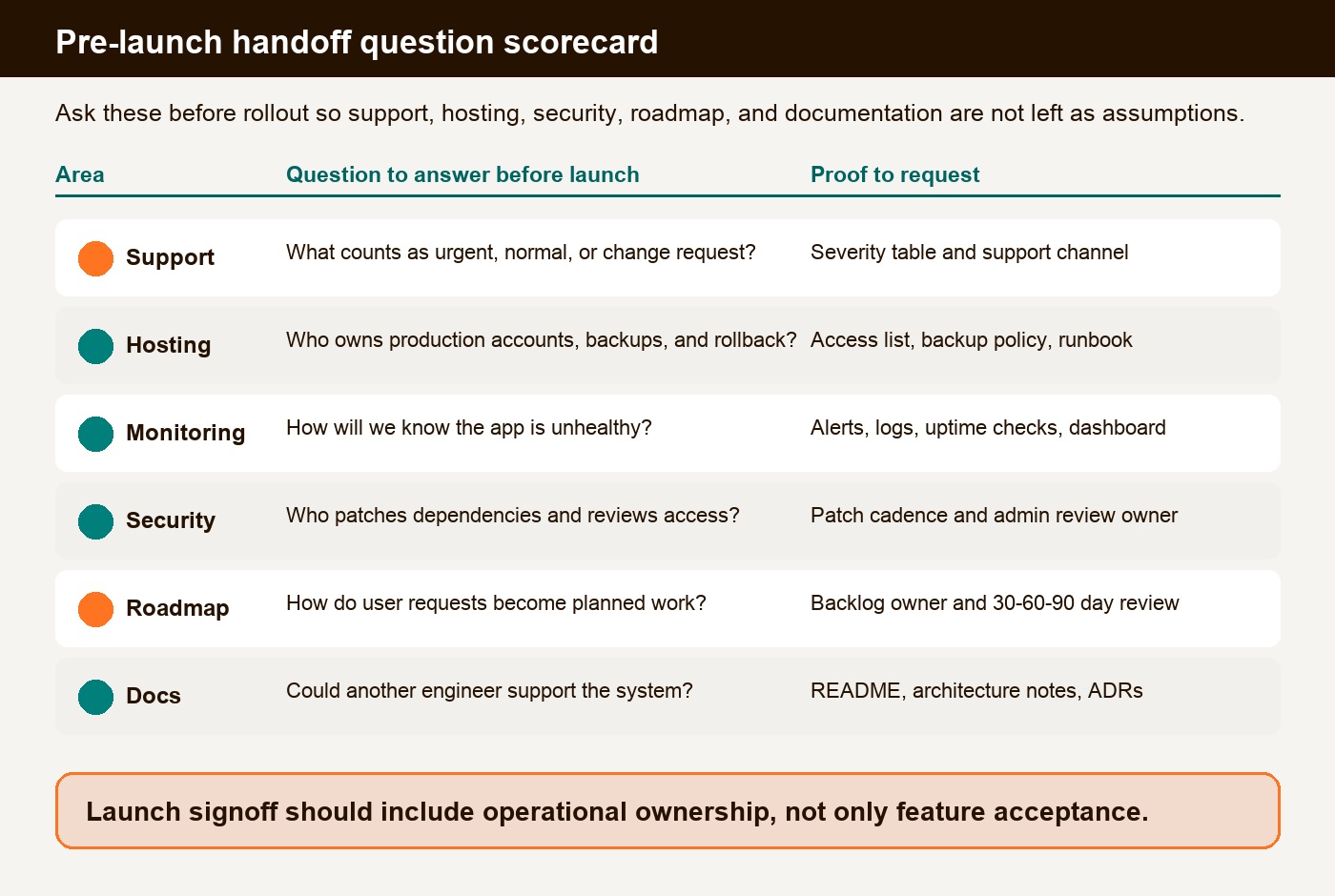
The best time to define a custom app support plan is before launch, while the vendor, product owner, and stakeholders are still focused on the system. Use these questions before final payment, rollout, or handover.
Support and bug fixes
- What support period is included after launch?
- What counts as a bug versus a change request?
- What severity levels and response expectations apply?
- Where should users report issues?
- Who confirms, prioritizes, fixes, tests, and communicates bug fixes?
Hosting and operations
- Who owns cloud accounts, environments, databases, domains, SSL certificates, and billing?
- What monitoring and alerting will be live on launch day?
- What backups exist, and has restoration been tested?
- What rollback path exists if deployment or migration fails?
- Which third-party services, licenses, API keys, and integrations need renewal or monitoring?
Security and access
- Who owns dependency updates and security patches?
- How are admin users, roles, permissions, and audit logs reviewed?
- Where are secrets and environment variables stored?
- What happens if a vulnerability is discovered?
- Who has emergency production access?
Roadmap and ownership
- What happens 30, 60, and 90 days after launch?
- How will user feedback become prioritized backlog work?
- Which improvements are included in support, and which require a new estimate?
- What technical debt was accepted during the build?
- What should be retired, deferred, or revisited before the next phase?
Documentation and handover
- Is there a repository README for setup, testing, and deployment?
- Are architecture notes, data models, environment diagrams, and integration maps available?
- Are key decisions captured in architectural decision records? AWS Prescriptive Guidance explains ADRs as a way to document important architecture decisions, their context, and their consequences.
- Are incident runbooks written for likely failure modes?
- Could another qualified engineer support the system using the documentation?
These questions are not paperwork for its own sake. They reduce vendor dependency and make ownership explicit.
When website maintenance services are relevant
Website maintenance services are relevant when the asset is mainly a marketing site, content site, campaign site, ecommerce front end, or lead-generation website. That work usually focuses on uptime, CMS or dependency updates, performance, SEO health, forms, content accuracy, analytics, accessibility, and conversion paths.
Internal apps need more than normal website maintenance when they include custom workflows, permissions, private data, integrations, dashboards, approvals, job queues, or operational reporting. Hapy’s website maintenance services guide is useful if the system is mostly public-facing. For internal systems, maintenance needs a stronger software ownership model.
How Hapy thinks about post-launch ownership
At Hapy, the practical question is not only “Can we build the app?” It is “Can the client run, improve, and trust the app after launch?”
That changes the work before launch. Discovery should identify the workflow and ownership risks. Architecture should make maintenance tradeoffs visible. QA should test the real operating scenarios. Launch should include monitoring, support, rollback, and documentation. Roadmap planning should leave room for the fixes and improvements that only appear once real users touch the system.
An internal app maintenance plan is not an insurance policy for bad software. It is the operating model for useful software. It keeps the system reliable enough to trust, clear enough to support, and flexible enough to improve when the business changes.
If maintenance ownership is unclear, Hapy’s Business Systems & Automation engagement can help define the workflow, operational responsibilities and handover requirements.