An internal web app development timeline depends on complexity, not optimism. A small workflow app may take 6 to 10 weeks. A mid-complexity internal platform often takes 3 to 5 months. A complex enterprise system can take 6 to 12 months or more when it needs deep integrations, granular permissions, data migration, audit trails, and a serious rollout plan.
The mistake is asking, “How long does it take to build an internal app?” before defining the workflow. A simple request tracker, a field operations dashboard, and a finance approval system may all be internal web apps, but they carry very different requirements.
Use the timeline as a planning model, not a promise. The goal is to understand which phases create time, where the risk sits, and what your team can prepare before development starts.
The internal app feature checklist helps define the roles, workflow states, integrations, reports, audit logs, and support controls that determine which timeline band applies.
Use the internal web app ROI model alongside the schedule when the business still needs to prove whether expected time savings and operating impact justify the build.
Internal web app development timeline by complexity
Use these three illustrative planning bands; they are not a measured distribution of projects:
| Complexity | Illustrative elapsed time | Usually includes |
|---|---|---|
| Small internal app | 6-10 weeks | One core workflow, 1-2 user roles, simple admin, limited reporting, little or no data migration |
| Mid-complexity app | 3-5 months | Multiple roles, dashboards, approvals, integrations, notifications, custom UX, structured QA, staged rollout |
| Complex internal platform | 6-12+ months | Cross-department workflows, SSO, granular permissions, audit logs, data migration, ERP/CRM/finance integrations, compliance, formal training |
This is why a custom web application timeline should be estimated from the workflow backward. The question is not how many screens the app has. The question is how many decisions, roles, systems, edge cases, and risks the team must resolve before users can rely on it.
IBM describes the software development lifecycle as a structured path for planning, analysis, design, coding, testing, deployment, and maintenance. For internal apps, those phases still matter, but they need to be sized to the business risk. A leave-request tool does not need the same process weight as a revenue operations command center.
A realistic phase-by-phase timeline
Internal app development usually moves through discovery, requirements, UX, technical planning, development, integrations, QA, launch, and support. The phases can overlap, but skipping them rarely saves time. It usually moves the work into a more expensive part of the project.
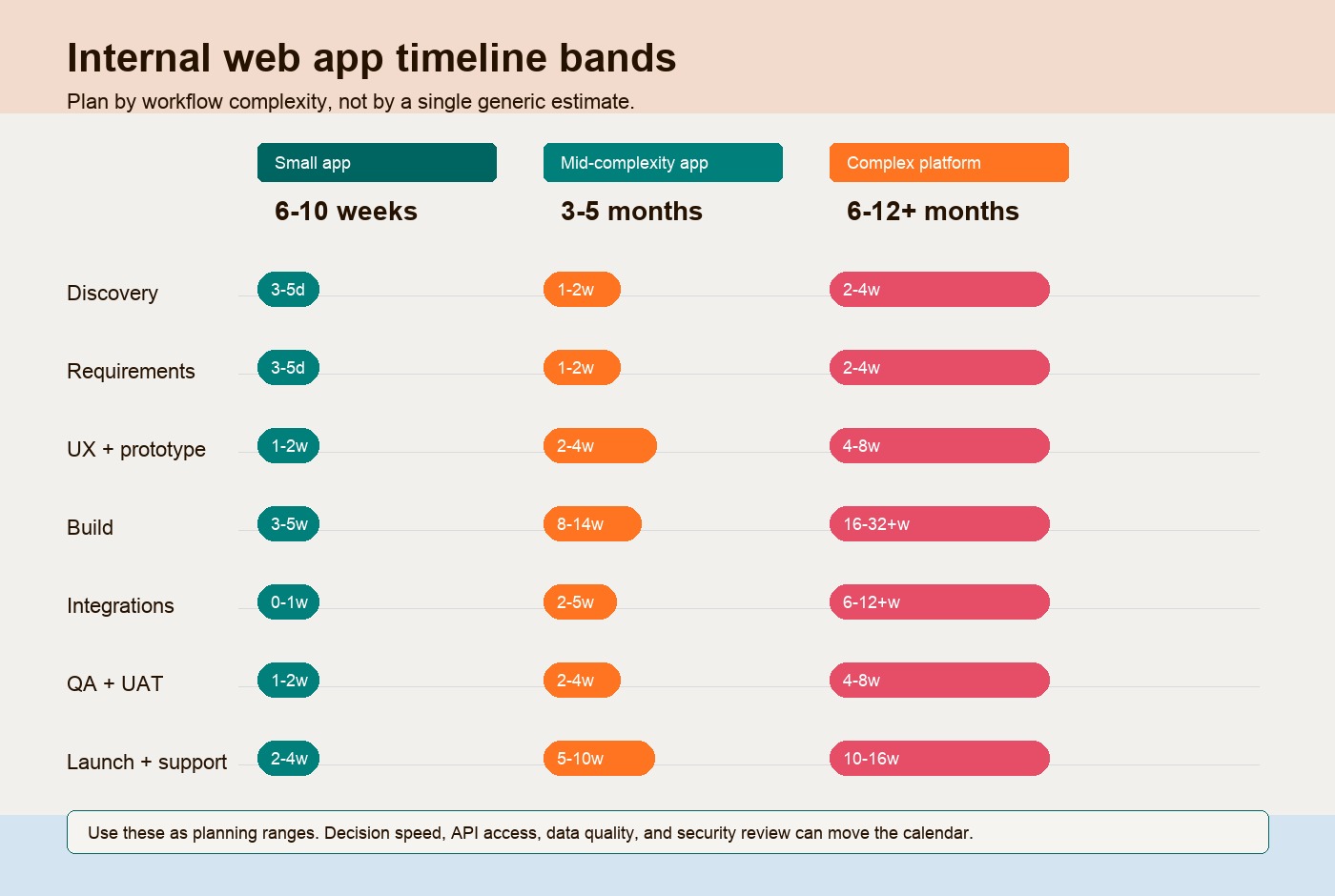
| Phase | Small app | Mid-complexity app | Complex internal platform | Main output |
|---|---|---|---|---|
| Discovery | 3-5 days | 1-2 weeks | 2-4 weeks | Workflow map, risks, goals, success metrics |
| Requirements | 3-5 days | 1-2 weeks | 2-4 weeks | User stories, acceptance criteria, exclusions |
| UX and prototype | 1-2 weeks | 2-4 weeks | 4-8 weeks | Flows, wireframes, prototype, content states |
| Architecture and planning | 3-5 days | 1-2 weeks | 2-4 weeks | Data model, permissions, stack, delivery plan |
| Build | 3-5 weeks | 8-14 weeks | 16-32+ weeks | Working software in reviewable releases |
| Integrations and migration | 0-1 week | 2-5 weeks | 6-12+ weeks | API connections, data mapping, migration checks |
| QA and user acceptance testing | 1-2 weeks | 2-4 weeks | 4-8 weeks | Tested workflows, bug fixes, release confidence |
| Launch and training | 2-5 days | 1-2 weeks | 2-4 weeks | Production release, training, support path |
| Hypercare and iteration | 2-4 weeks | 4-8 weeks | 8-12 weeks | Stabilization, feedback, first improvements |
These ranges assume a focused team and responsive stakeholders. Slow decisions, unclear ownership, missing API access, unreliable source data, procurement delays, or unresolved security reviews can stretch the calendar even when engineering is moving well.
Discovery: map the work before the feature list
Discovery should answer one question: what work needs to become easier, faster, safer, or more visible?
For an internal app, the current workflow is often scattered across spreadsheets, email approvals, chat messages, SaaS exports, and one person who knows how the process really works. If the team starts by listing features, the app may digitize that mess instead of improving it.
Discovery should capture:
- The business outcome the app should improve.
- The users, roles, locations, and permissions involved.
- The current workflow, including exceptions and workarounds.
- The systems of record the app must read from or write to.
- The reports, alerts, and decisions leadership needs.
- The risks that would make the project late, expensive, or hard to adopt.
This is where Hapy’s business systems automation work usually starts: review the tools, sheets, workflows, and reporting habits already in use, then decide what should be cleaned, connected, automated, or built.
Requirements: make scope testable
Requirements are not paperwork for its own sake. They are how the team prevents “almost done” from becoming a recurring meeting.
A useful requirements phase defines what the internal web app must do, how success will be tested, and what will not be built in the first release. ISO’s requirements engineering standard, ISO/IEC/IEEE 29148:2018, is a formal reference for requirements processes and information items. Most growing companies do not need that level of documentation, but they do need the discipline underneath it.
For a practical internal app, requirements should include:
- Functional requirements: the workflows the app must support.
- Non-functional requirements: security, performance, reliability, accessibility, uptime, and compliance expectations.
- Acceptance criteria: how each feature will be approved.
- Role and permission rules: who can view, edit, approve, export, or administer.
- Data requirements: records, fields, statuses, ownership, and retention needs.
- Out-of-scope decisions: what the team is intentionally deferring.
Hapy’s software requirements specification guide is a useful next step if multiple stakeholders need a shared source of truth before development starts.
UX: design the real workflow, not just screens
Internal UX is where many timelines quietly change. A dashboard is simple until each role needs different columns. An approval flow is simple until the finance team needs delegation, thresholds, exceptions, audit history, and exports. A form is simple until users need autosave, bulk actions, mobile access, attachments, and validation.
UX work should clarify behavior before engineering starts:
- What does each role need to do first?
- Which screens need to be fast because users repeat them daily?
- What happens when data is missing, duplicated, or wrong?
- What does a user see when they do not have permission?
- Which actions require confirmation, undo, or audit history?
- What should the admin experience include?
The output does not have to be a polished design system for every project. For a smaller internal app, wireframes and a clickable prototype may be enough. For a complex internal platform, UX should include role-specific flows, dashboard states, empty states, error states, and user acceptance scenarios.
Build and integrations: where hidden work appears
The build phase is not only coding screens. Internal web apps usually need backend logic, data models, authentication, permissions, notifications, reporting, deployment environments, monitoring, and integrations with existing systems.
Integrations can create timeline surprises. A “simple CRM integration” may involve API limits, field mapping, duplicate records, webhooks, retries, authentication, sandbox access, rate limits, failed sync states, and support from the vendor’s admin team.
Plan extra time when the app needs to connect with:
- CRM, ERP, HRIS, accounting, inventory, or ticketing systems.
- Single sign-on, directory groups, or SCIM provisioning.
- Email, Slack, Teams, SMS, or notification services.
- Payment, billing, procurement, or finance workflows.
- Data warehouses, BI tools, spreadsheets, or reporting exports.
- Legacy systems with weak documentation or limited APIs.
If the project is mainly a custom internal system, compare the scope with Hapy’s custom software development services guide. If budget is the pressure point, use the custom software development cost guide before treating the first estimate as final.
QA and UAT: test the workflow under pressure
QA should test the app the way people will actually use it. Internal apps fail when only the happy path works.
A useful QA plan covers:
- Core workflow completion.
- Role and permission boundaries.
- Form validation and required fields.
- Integration success, failure, retry, and duplicate states.
- Dashboard accuracy against source records.
- Mobile or tablet behavior if relevant.
- Export, audit, and reporting requirements.
- Performance for expected user counts and data volume.
- Accessibility basics for keyboard use, contrast, and readable states.
User acceptance testing should involve the people who do the work, not only the sponsor who approved the budget. The most useful testers are often the people who know every spreadsheet workaround and every exception the process diagram forgot.
For internal tools, quality is not just “no bugs.” Quality means users can complete the workflow correctly without asking for help every time something slightly unusual happens.
Launch and support: the timeline does not end at go-live
Launch is when the internal app becomes an operating system, not a demo.
For a small app, launch may be a short training session, a support channel, and a few weeks of bug fixes. For a complex internal platform, launch may need a pilot group, phased rollout, role-based training, support scripts, data migration, rollback planning, and a hypercare period where engineering and operations stay close to real users.
This matters because internal apps compete with existing habits. If the new app is slower, confusing, or missing familiar spreadsheet views, people will route around it. The rollout should make the new behavior easier than the old one.
Track adoption and operational quality after launch:
- Active users by role.
- Workflow completion rates.
- Time to complete the key task.
- Error, exception, and support-ticket themes.
- Data quality issues.
- Manual work that still happens outside the system.
- Requested improvements for the next release.
Google Cloud’s DORA work uses delivery metrics such as deployment frequency, lead time for changes, change failure rate, and time to restore service. Internal app teams can use the same spirit: measure whether the system is getting easier to improve and safer to operate after launch.
What founders and operators can prepare early
The fastest way to shorten an internal app timeline is not to pressure the development team after kickoff. It is to prepare the decisions and access the team will need before kickoff.
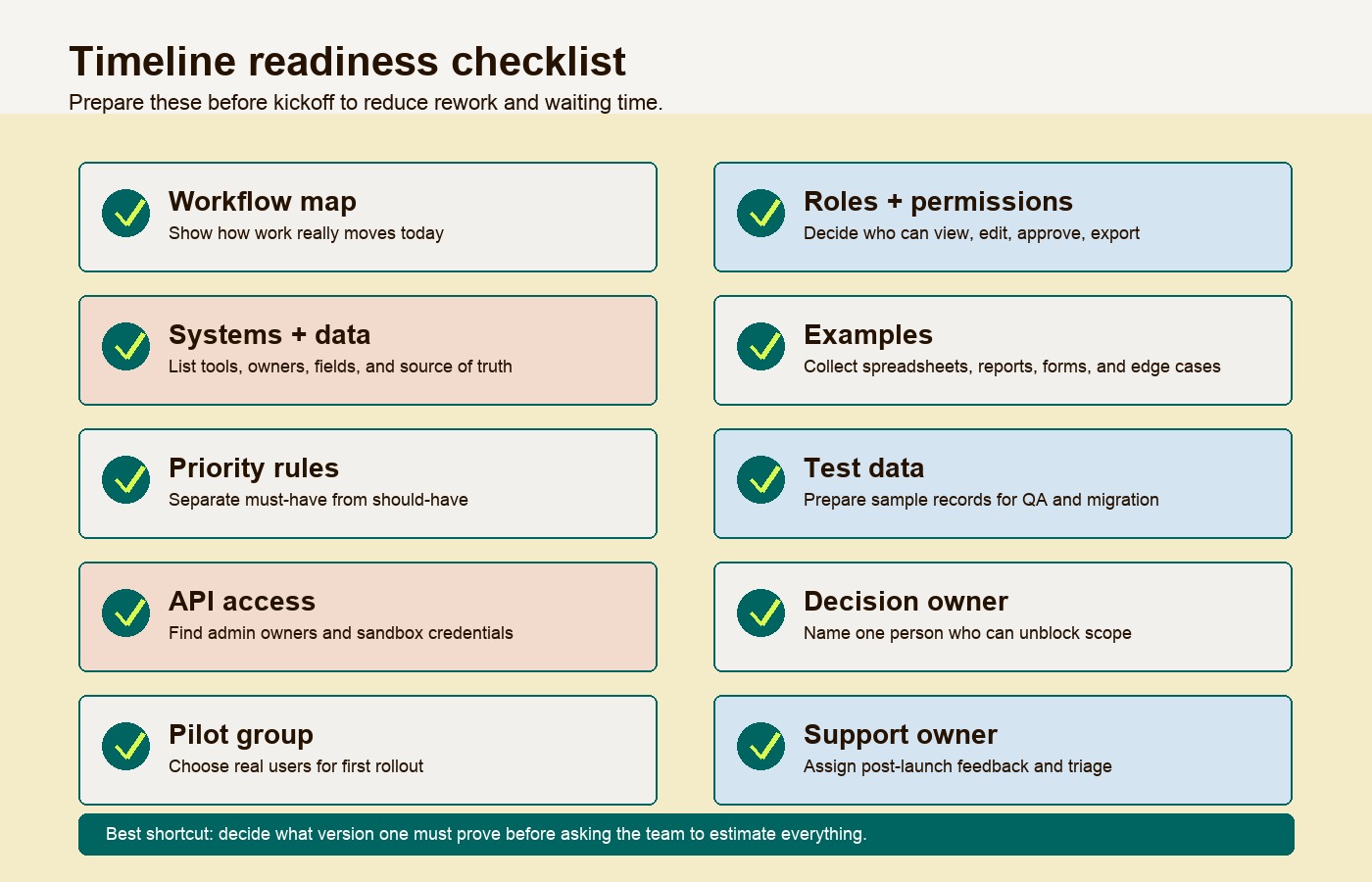
Prepare these before development starts:
| Preparation item | Why it shortens the timeline |
|---|---|
| Current workflow map | Reduces discovery time and exposes hidden exceptions early |
| User roles and permissions | Prevents late security and access-control rework |
| Existing tools and data sources | Helps the team plan integrations and ownership |
| Example spreadsheets and reports | Shows what users already trust and what the app must replace |
| Must-have vs should-have list | Protects version one from scope creep |
| Sample records and test data | Makes QA and migration planning more realistic |
| API access and admin contacts | Prevents integration delays caused by missing credentials or vendor support |
| Approval owner | Keeps product decisions from waiting on a committee |
| Launch cohort | Lets the team pilot with real users before full rollout |
| Support owner | Makes post-launch questions and fixes easier to route |
The most important preparation is deciding what the first version must prove. The Agile Business Consortium’s MoSCoW prioritisation model is useful here because it separates must-haves, should-haves, could-haves, and won’t-haves. For internal apps, a must-have should mean: without this, the workflow cannot run.
Everything else should be treated as a tradeoff.
What makes the timeline longer
Internal app timelines expand when the project hides business complexity under technical labels.
Common timeline stretchers include:
- Stakeholders disagreeing on the “official” process.
- Multiple departments wanting the first version to solve their whole backlog.
- Dirty source data that users no longer trust.
- Permissions that are discussed late.
- Integrations that depend on third-party vendors or legacy systems.
- Compliance, audit, or export requirements discovered after build starts.
- Reporting needs that require a different data model.
- No one available to review prototypes or accept completed work.
- QA squeezed into launch week.
- Training and support planned after users are already frustrated.
Security can also change the timeline. NIST’s Zero Trust Architecture guidance frames access around verifying users and context rather than trusting a network perimeter. In plain terms, an internal app should not assume “inside the company” means “allowed to see everything.” Granular access, audit logs, and sensitive-data handling take time, but they are cheaper to design early than retrofit later.
Low-code, no-code, and AI-assisted builds
Low-code, no-code, and AI-assisted development can shorten some internal app timelines. They are strongest when the workflow is simple, the data model is straightforward, integrations are supported out of the box, and the business accepts the platform’s limits.
They are weaker when the app needs custom permissions, unusual workflows, complex integrations, performance guarantees, owned source code, regulated data handling, or a long-term architecture the business can evolve.
The practical rule: use the fastest tool that can support the workflow safely for the next stage. A no-code admin tool may be perfect for a pilot. A custom app may be necessary when the workflow becomes core infrastructure.
For examples of where custom work makes sense, use Hapy’s guide to custom software examples. For the broader build process, start with the software building process.
The Hapy view
An internal web app development timeline is really a decision timeline. The work moves faster when the team knows the workflow, agrees on scope, has access to the right systems, tests with real users, and plans support before launch.
For a small app, that may mean a focused 6- to 10-week build around one workflow. For a mid-complexity app, it may mean 3 to 5 months of discovery, design, development, integrations, QA, and rollout. For a complex platform, it may mean a staged 6- to 12-month program with security, migration, training, and long-term ownership.
The best custom business app timeline is not the shortest believable one. It is the one that gives the business a usable system without hiding the work that makes it reliable.
If your current workflow already depends on spreadsheets, manual approvals, scattered dashboards, and side-channel reporting, start by mapping the work. The app should make the business easier to run, not just easier to describe in a proposal.
A schedule with explicit assumptions
Consider a hypothetical eight-week purchase-request pilot: two full-time engineers, a half-time designer in weeks 1–3, a half-time QA specialist from week 3, and one operations owner who answers decisions within two working days. The team shares four working hours daily; geography alone does not determine speed. Scope is one department, three roles, one approval rule, one documented email integration, and a clean CSV import. No ERP write-back or new SSO integration is included.
| Calendar | Work and dependencies |
|---|---|
| Week 1 | Map the workflow, agree acceptance criteria, receive representative data and access |
| Weeks 2–3 | Prototype and build the first end-to-end path; review permissions before expanding |
| Weeks 4–5 | Complete workflow and integration, with QA alongside implementation |
| Week 6 | Rehearse import, failure recovery, exports, and access boundaries with operators |
| Week 7 | Pilot, training, fixes, and launch decision |
| Week 8 | Contingency for identified integration or acceptance issues |
Support continues after this release window. Do not add all phase-table durations: design, integration work, and testing overlap here. If API access arrives two weeks late on the critical path, or approvals take a week instead of two days, reforecast the launch or remove dependent scope. Adding developers does not remove an external approval dependency.