Custom CRM vs off the shelf CRM is not a vote on whether Salesforce, HubSpot, Pipedrive, or Zoho are “good.” Mature CRM platforms are often the right answer. The real question is whether your customer workflow is standard enough to fit a platform, or specific enough that forcing it into a generic data model will create cost, friction, and bad reporting.
The practical rule is simple: buy CRM for standard sales motions, build or extend CRM for proprietary operating logic, and use a hybrid model when the packaged platform is useful but the workflow around it is not.
That makes CRM build vs buy a business systems decision before it is a software decision. The team should compare fit, cost, workflow flexibility, integrations, reporting, data ownership, security, and maintenance over the next three to five years. First-year subscription math is not enough.
This article is written for growing teams that already feel the tension: the CRM works well enough to keep using, but not well enough to trust as the operating system for sales, service, onboarding, account management, or reporting.
Custom CRM vs off the shelf CRM: the short answer
Off the shelf CRM is the right default when the team has a familiar sales process, standard objects, common reporting needs, and limited technical capacity. Custom CRM development is worth considering when a demonstrable workflow or integration gap justifies ownership. Sensitive data alone does not favor custom software; compare actual controls and operating capacity in every option.
Use this first-pass comparison:
| Decision area | Off the shelf CRM fits when | Custom CRM fits when | Hybrid fits when |
|---|---|---|---|
| Process fit | Pipeline stages, contacts, companies, deals, and activities are mostly standard | The workflow needs custom entities, approval paths, account logic, or service steps | Standard CRM records work, but one or two workflows need a custom layer |
| Cost shape | The team is small and premium tiers are not required | Seat growth, add-ons, middleware, and consulting make the platform expensive | The CRM license is acceptable, but custom extensions reduce manual work |
| Flexibility | Configuration, fields, automations, and apps cover the workflow | The workflow needs custom screens, rules, permissions, and data models | The platform remains the system of record while custom tools handle edge workflows |
| Integrations | Marketplace connectors are enough | CRM must sync with ERP, billing, product, telephony, warehouse, or internal databases in specific ways | APIs connect the CRM to custom dashboards, quoting tools, or automation layers |
| Reporting | Standard dashboards answer leadership questions | Raw event data, cohort logic, attribution, or operational reporting needs custom structure | CRM data feeds a warehouse or internal reporting layer |
| Ownership | Vendor hosting, updates, and compliance posture are acceptable | The business needs deeper control over code, data, hosting, access, and audit trails | Vendor owns the core CRM; the company owns the high-value operating layer |
| Maintenance | The team wants vendor-managed updates | The company can fund long-term engineering support | The company maintains only the custom extensions |
The mistake is treating the answer as permanent. A ten-person team may be right to start with HubSpot. A 120-person team with regional sales rules, custom onboarding, quoting logic, finance approvals, and sensitive customer data may need a different architecture later.
When off the shelf CRM should stay
Keep off the shelf CRM when the software already supports the way the team should sell, serve, and report. If the process is not a source of competitive advantage, renting a mature platform is usually cheaper, faster, and less risky than owning custom software.
Off the shelf CRM is usually the better choice when:
- The team needs a CRM live in days or weeks.
- Sales stages, lead sources, account ownership, and activities are conventional.
- Managers need standard pipeline, activity, forecast, and revenue reports.
- The team does not have internal product or engineering capacity.
- Vendor-managed uptime, security, backups, and product updates are valuable.
- The company benefits from marketplace apps, playbooks, templates, and training materials.
This is where HubSpot and Salesforce are strong. Their public pricing pages show why small and midsize teams often start there: HubSpot offers published Sales Hub tiers on its Sales Hub pricing page, and Salesforce publishes Sales Cloud editions on its sales pricing page. That transparency lets a team budget a first phase without funding a custom build.
Even at larger scale, a packaged CRM can still be correct. If the company is hiring a sales team around a proven enterprise playbook, the platform’s defaults may be a feature, not a limitation. Standardization can make onboarding, governance, and forecasting easier.
Do not build a custom CRM just because the current CRM is messy. Sometimes the right fix is cleanup: better field governance, fewer required fields, cleaner automations, better training, stronger ownership, and a clearer reporting model.
When custom CRM development is worth considering
Custom CRM development becomes serious when the CRM is no longer just a contact database. It may be the workflow engine for sales, service, onboarding, operations, compliance, partner management, or account intelligence.
Custom CRM is worth exploring when:
- Reps or operators work around the CRM with spreadsheets, chat, or side databases.
- The customer journey crosses several teams and cannot be represented cleanly with standard objects.
- Quotes, commissions, approvals, territories, pricing, or routing logic are specific to the business.
- The CRM needs real-time integration with product usage, billing, ERP, support, telephony, or logistics systems.
- Reporting depends on raw event data, custom attribution, account hierarchies, or operational metrics the CRM cannot expose well.
- Access control needs to match unusual roles, regions, partners, or sensitive fields.
- The company wants to own the code, database, hosting model, and long-term product roadmap.
The strongest build case is not “we want more features.” It is “the business process we need to run does not fit the tool without daily friction.”
For example, a high-volume sales or support team using telephony may need sub-second screen pops, disposition-based callbacks, custom lead recycling, and call outcomes tied directly to account state. A generic marketplace connector may work for basic logging. It may not support the exact data timing, routing, and audit trail the operation needs.
That is the same pattern Hapy looks for in broader build vs buy software decisions: buy the generic parts, own the workflow that affects margin, speed, trust, or customer experience.
The cost question is total ownership, not first-year price
Off the shelf CRM usually wins the launch budget. Custom CRM usually asks for discovery, design, development, QA, deployment, training, and maintenance before the team sees the first production workflow.
But first-year price can hide the real cost curve. A serious CRM build vs buy model should include:
- User seats and future headcount growth.
- Premium tiers needed for advanced objects, reporting, automation, sandboxes, or permissions.
- Implementation, admin, data migration, and consulting costs.
- Marketplace apps, middleware, sync tools, and data warehouse connectors.
- API limits, storage limits, support packages, and add-ons.
- Manual workarounds that continue after launch.
- Custom development needed inside or around the platform.
- Exit cost if the company later needs to migrate.
Vendor pricing can also change. Salesforce announced an average 6% list price increase for some editions in 2025, which is a reminder that SaaS buyers do not control the long-term price curve. That does not make Salesforce a bad choice. It means renewal scenarios belong in the model.
Custom CRM has its own ongoing cost. Maintenance, monitoring, hosting, dependency updates, security patches, bug fixes, minor feature changes, and user support should be budgeted from the beginning. IBM’s overview of the software development lifecycle is useful here because it treats maintenance as part of the lifecycle, not an afterthought.
For early modeling, compare three scenarios:
| Scenario | Best for | Budget implication |
|---|---|---|
| Buy | Small team, standard workflow, low integration burden | Lower upfront cost, recurring subscription and admin cost |
| Hybrid | Standard CRM core plus custom quoting, reporting, portal, or automation layer | Moderate upfront cost, subscription remains, custom scope stays focused |
| Build | Complex workflow, sensitive data, high user count, deep integrations, proprietary process | Higher upfront cost, flatter seat cost, ongoing engineering responsibility |
If a custom build only saves money by ignoring maintenance, it is not really cheaper. If SaaS only looks cheap because the model excludes premium tiers and manual workarounds, it is not really cheap either.
Workflow flexibility: configuration has a ceiling
Most CRM platforms are configurable, not infinitely flexible. Custom fields, layouts, automations, validation rules, and apps can carry a lot of weight. For many teams, that is enough.
The ceiling appears when the team has to reshape the work to satisfy the platform. That is when people create shadow systems: spreadsheets for exceptions, separate docs for account rules, private dashboards for leadership, duplicate notes in support tools, or manual approvals outside the CRM.
The issue is not only inconvenience. Workarounds damage data quality. If reps cannot represent reality in the CRM, reporting becomes a negotiation instead of a source of truth.
A custom CRM or custom CRM extension can model the workflow directly:
- Account, contact, property, product, asset, subscription, case, and partner relationships can be designed around the business.
- Role-based permissions can match how teams actually work.
- Screens can be built around the task instead of the vendor’s default navigation.
- Automations can follow real approval, routing, territory, callback, renewal, and escalation rules.
- Data can be captured once and reused across reporting, billing, service, and operations.
This is where “internal CRM software” may be a better phrase than “CRM replacement.” The company may not need to replace Salesforce or HubSpot. It may need an internal operating layer that makes the CRM usable for the specific work the business actually runs.
Integrations are where CRM decisions get expensive
CRM is rarely alone. It usually touches marketing automation, email, calendar, product analytics, billing, finance, ERP, support, call center tools, data warehouses, enrichment vendors, and internal dashboards.
Off the shelf CRM integrations are convenient when the data flow is common. A standard contact sync or meeting log should not require custom engineering.
The risk appears when integrations need strict timing, bidirectional sync, custom conflict rules, or reconciliation logic. Marketplace connectors may not handle:
- Which system wins when two records update at once.
- How to retry failed sync jobs without creating duplicates.
- How to represent custom account hierarchies.
- How to keep billing, CRM, product, and support status aligned.
- How to preserve historical activity and audit trails.
- How to report on exceptions when a sync fails.
Custom integrations are not maintenance-free either. APIs change. HubSpot defines breaking changes and deprecation expectations in its developer platform guidance. Stripe’s API upgrade documentation is another useful reminder that production systems need version awareness, testing, and release planning around external services.
The question is not whether integrations are possible. The question is who owns the failure modes.
Reporting and data ownership may decide the architecture
Reporting is often the quiet reason a CRM stops working for a growing team. The sales team can enter data, but leadership still rebuilds the real report in a spreadsheet because the CRM dashboard cannot answer the exact business question.
Off the shelf CRM reporting is usually strongest for standard pipeline, activity, forecast, and conversion reporting. It becomes weaker when the business needs:
- Custom revenue recognition or bookings logic.
- Multi-touch attribution across product, marketing, sales, and customer success.
- Cohort analysis by onboarding path, industry, region, or product usage.
- Account health built from CRM, support, billing, usage, and manual judgment.
- Raw event-level data for analysis outside the CRM.
- Fine-grained audit logs around sensitive changes.
Custom CRM development gives the team more control over the data model and reporting layer, but it also gives the team more responsibility. The database schema, permissions, analytics definitions, data quality rules, and reporting views need real ownership.
For security-sensitive teams, this decision should include secure development and governance, not only features. NIST’s Secure Software Development Framework gives a practical reference for discussing secure design, implementation, verification, and vulnerability response.
Decision table by team size, process, and data sensitivity
The headcount bands below are illustrative discussion aids, not calibrated decision cutoffs. Reclassify each row against your workflow, vendor capabilities, and full cost; a large team can still fit packaged software.
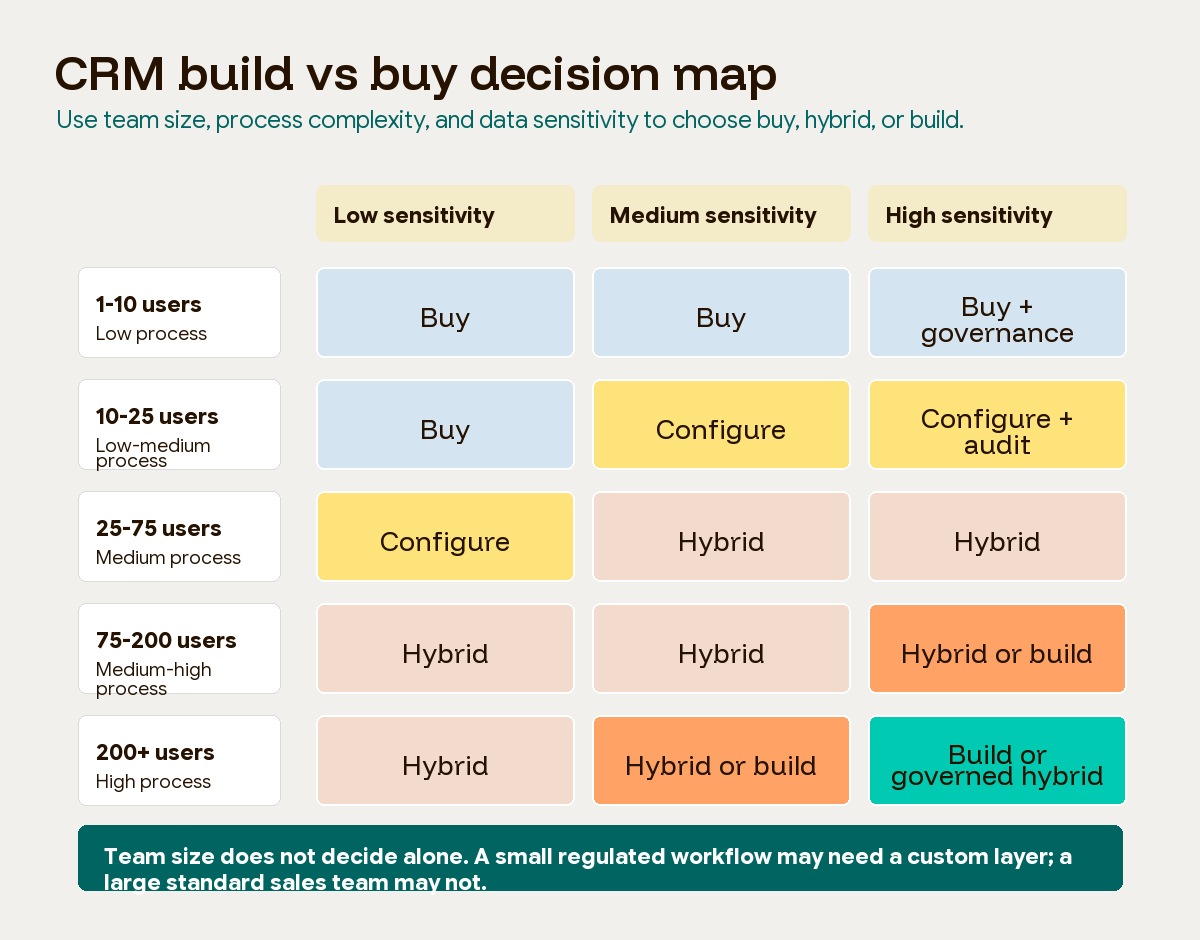
| Team profile | Process complexity | Data sensitivity | Likely CRM path | Why |
|---|---|---|---|---|
| 1-10 users | Low | Low | Buy | Speed matters more than ownership; a standard CRM is enough |
| 10-25 users | Low to medium | Low to medium | Buy or configure | Use SaaS defaults, clean fields, and avoid premature custom scope |
| 25-75 users | Medium | Medium | Hybrid | Keep CRM core, build reporting, routing, quoting, or integration layers where needed |
| 75-200 users | Medium to high | Medium to high | Hybrid or build | Seat cost, reporting gaps, permissions, and integrations need modeling |
| 200+ users | High | High | Build or deeply governed hybrid | Operating control, data governance, and long-term TCO may justify custom ownership |
| Any size | High proprietary workflow | Any | Hybrid or build | Workflow specificity matters more than headcount |
| Any size | Low | High | Buy with strict governance or private custom layer | Security posture, audit trails, and data residency may dominate the decision |
The important nuance: team size alone should not decide. A 15-person company with complex regulated workflows may need a custom layer. A 500-person company with a standard sales process may still be best served by a governed enterprise CRM.
A practical CRM build vs buy scorecard
Use this unweighted Hapy planning heuristic to structure a discussion. A 1 suggests investigating buy, a 3 hybrid, and a 5 custom. The scale, headcount bands, integration counts, and timeline ranges are not validated thresholds.
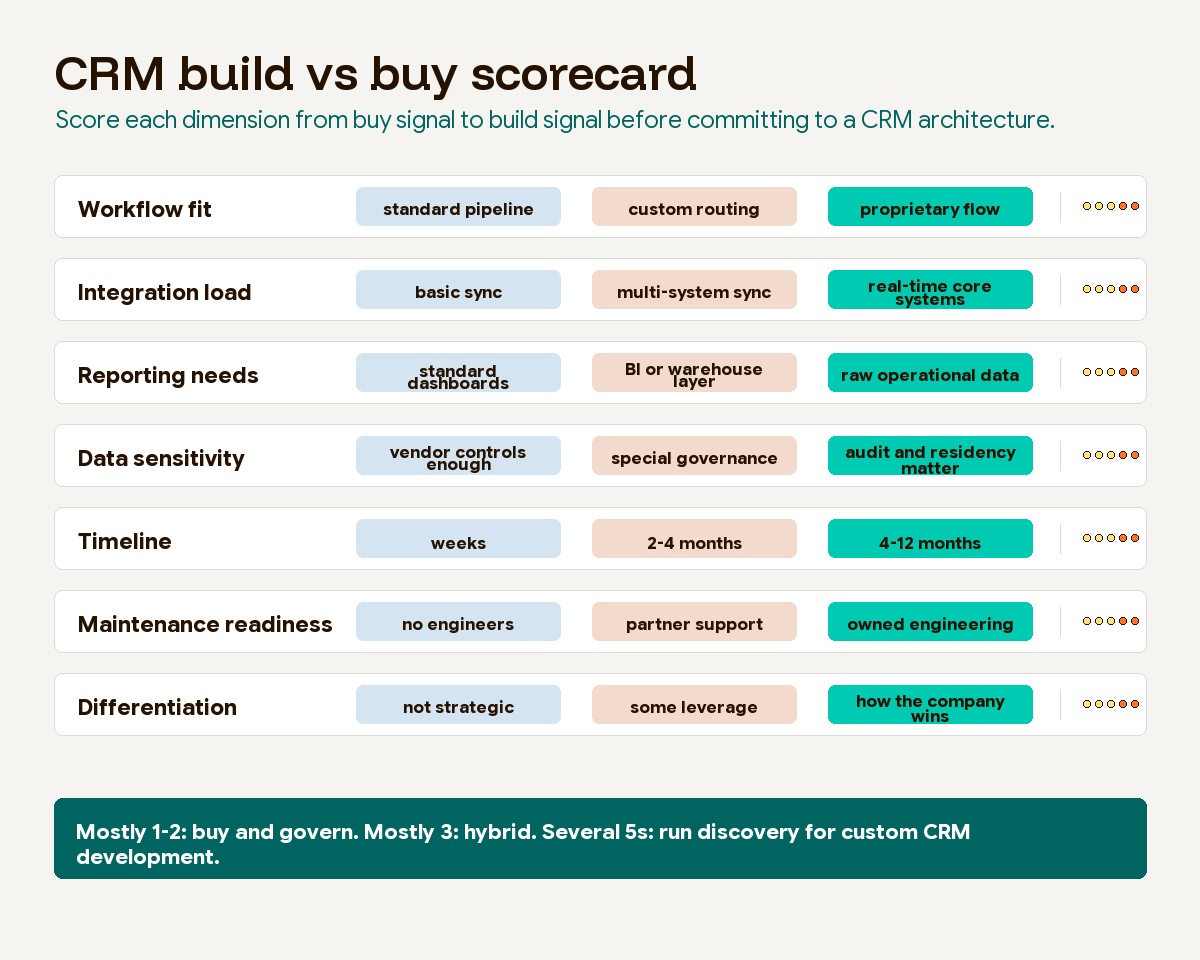
| Dimension | 1: buy signal | 3: hybrid signal | 5: build signal |
|---|---|---|---|
| Workflow fit | Standard pipeline and account management | Some custom routing, quoting, approvals, or account views | Proprietary workflow that generic CRM cannot represent cleanly |
| Integration load | Basic email, calendar, marketing, and form sync | Three or more systems with bidirectional sync | Real-time ERP, billing, telephony, product, or legacy database integration |
| Reporting needs | Standard CRM dashboards are enough | CRM data needs warehouse, BI, or custom dashboards | Raw operational data and custom metrics are core to management |
| Data sensitivity | Vendor compliance posture is sufficient | Some fields or regions need stricter governance | Data residency, audit, regulatory, or field-level controls are central |
| Timeline | Needs to launch in weeks | Can phase over 2-4 months | Can support 4-12 months of discovery, build, migration, and rollout |
| Maintenance readiness | No engineering support available | Partner or fractional technical support available | Internal or retained engineering team can maintain the system |
| Differentiation | CRM process is not strategic | Some workflow control improves performance | The CRM workflow is part of how the company wins |
Use the pattern to choose which option to investigate, not to authorize a build. Engineering and security capacity are hard gates: name and fund owners for access controls, updates, monitoring, incident response, backups, restore tests, and user support. If that coverage is missing, defer custom development regardless of the total. Data sensitivity increases the assurance required for both vendor and custom options; it does not prove either is safer.
The hybrid path is often the safest answer
The cleanest answer is often not build or buy. It is buy and build.
A hybrid CRM approach keeps a mature platform as the system of record for standard objects while custom software handles the parts that make the business specific. That may include:
- A custom quoting tool connected to CRM accounts and deals.
- A sales operations dashboard that combines CRM, billing, and product usage.
- A customer onboarding workflow with role-specific internal tasks.
- A lead routing engine that reflects territories, capacity, and service rules.
- A call center interface tied to telephony and account history.
- A partner portal that writes selected activity back to the CRM.
- A finance approval flow that keeps CRM forecasts aligned with billing reality.
This is also where Hapy’s Business Systems & Automation work often fits. The goal is not to replace every tool. The goal is to make the operating layer clear enough that people stop stitching the business together manually.
If the team is still deciding what to build, Hapy’s custom software development services guide can help clarify discovery, scope, ownership, maintenance, and vendor risk. If the team needs examples before deciding, compare possible CRM extensions against Hapy’s custom software examples.
How to make the decision without overbuilding
Start with the workflow, not the tool.
- Map the real sales, service, onboarding, and reporting process.
- Mark where the current CRM fits well, where it is merely annoying, and where it actively changes behavior.
- Quantify seat growth, premium tiers, apps, middleware, admin time, and manual workarounds.
- Identify data that must be trusted, audited, protected, or queried outside the CRM.
- Separate commodity CRM needs from proprietary workflow needs.
- Model buy, hybrid, and build over 36 months.
- Prototype the riskiest custom workflow before committing to a full CRM rebuild.
That last step matters. Many teams do not need a full CRM replacement. They need one high-friction workflow redesigned, integrated, and measured. Build that first. If it proves the case for a larger internal CRM, the next phase will be based on evidence rather than frustration.
Custom CRM vs off the shelf CRM should end with a calm decision: keep the platform where it helps, configure it where it is close, extend it where it creates leverage, and build only where ownership changes the business outcome.