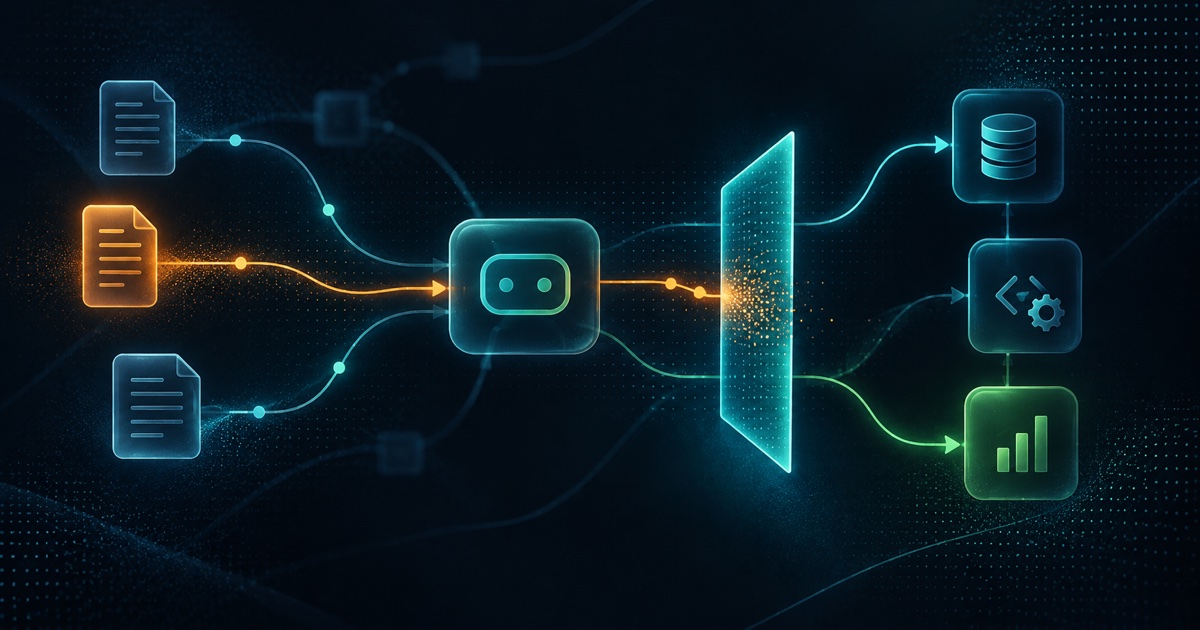
Automated testing is most valuable when it gives a software team fast, repeatable evidence about important behavior. A test can verify that a pricing rule still works, an API still returns the agreed structure, or a customer can still complete checkout after a code change.
That feedback reduces regression risk and shortens the time between writing code and learning that something broke. It does not guarantee quality, eliminate manual testing, or make a weak development process safe.
What is automation testing?
Automation testing uses code and tools to run checks against software and compare the result with an expected outcome.
A typical automated test:
- Sets up a known state.
- Performs an action.
- Observes the result.
- Passes or fails against a clear expectation.
- Reports enough information for the team to investigate a failure.
Tests can run on a developer’s machine, during code review, in continuous integration, before deployment, or on a schedule. The useful part is not the number of tests. It is whether they catch meaningful failures early enough to change a decision.
The main benefits of automation testing
Fast regression feedback
Software changes interact. A small update to authentication can affect checkout, account settings, and admin access. Automated regression tests rerun known workflows after each change and warn the team when existing behavior fails.
Without that protection, testers must repeat the same checks manually or accept more production risk. Automation is particularly useful when a workflow must be checked many times across releases.
Consistent execution
An automated test follows the same steps and assertions every time. It does not become tired, skip a field, or interpret the expected result differently on a busy afternoon.
Consistency does not mean infallibility. A test can contain the wrong expectation or miss an important condition. Reviews and maintenance still matter. The benefit is that the check itself is repeatable.
Earlier defect detection
Tests that run during development and code review can find a defect before it reaches a shared environment. That shortens the distance between the change and the investigation. The engineer still has the context fresh and fewer later changes obscure the cause.
Fast unit and integration tests provide the earliest signal. A smaller number of end-to-end tests can protect the most important user journeys closer to the finished product.
More coverage across inputs and environments
Automation can run the same rule against many values, browsers, devices, configurations, or permission levels. This is useful for calculations, validation, APIs, and compatibility checks that would be slow to repeat manually.
Coverage must follow risk. Running thousands of low-value cases does not compensate for missing the workflow that moves money or grants access.
Safer refactoring
Refactoring changes the structure of code without intending to change its behavior. A useful test suite lets developers improve a system and receive quick warning when behavior changes accidentally.
This is one reason teams with strong tests can address technical debt more confidently. Tests do not prove a refactor is correct, but they protect the behavior the team has explicitly described.
Support for continuous delivery
Continuous delivery depends on frequent, small changes and fast feedback. Automated checks can block a build when a critical test fails, verify a release candidate, and provide a consistent record of what ran.
The test suite must remain fast and dependable enough for developers to trust it. A slow or flaky pipeline encourages people to bypass failures, which removes the safety the process was meant to provide.
Less repetitive manual work
Testers should not spend every release repeating identical checks that a machine can perform reliably. Automation frees time for exploratory testing, accessibility review, edge cases, product judgment, and investigation of new risk.
The goal is not to remove testers. It is to move human attention toward work that needs observation and judgment.
What automated testing does not guarantee
Some common claims go too far.
- It does not guarantee security. Security needs threat modeling, secure design, dependency management, review, scanning, penetration testing, monitoring, and incident response.
- It does not eliminate bugs. Tests only cover behavior the team anticipated and implemented correctly.
- It does not make every release safe. Configuration, infrastructure, data migrations, third-party failures, and production scale can introduce other risks.
- It does not make manual testing obsolete. Humans notice confusing behavior, visual problems, and unexpected interactions that scripted checks may miss.
- It does not automatically save money. Poorly chosen or brittle tests cost more to maintain than the risk they protect.
Automation should sit inside a broader quality assurance methodology.
Which tests should you automate first?
Start with checks that are valuable, stable, repeatable, and easy to judge.
| Candidate | Why it is a good early target |
|---|---|
| Login and account recovery | High-use path with clear success and failure states |
| Checkout or booking | Direct effect on revenue and customer trust |
| Permission rules | A failure can expose or corrupt data |
| Billing and calculations | Many inputs with exact expected outcomes |
| API contracts | Breakage can affect several clients or integrations |
| Data migrations | Errors can damage existing records |
| Core smoke tests | Quick evidence that a deployed system is usable |
Avoid starting with a large collection of fragile interface tests for screens that change every week. Test business rules and service boundaries at lower levels where possible. Use end-to-end tests for a smaller set of critical journeys.
A balanced testing stack
Different tests answer different questions.
Unit tests
Unit tests check a small function, class, or component in isolation. They are fast and useful for calculations, validation, transformation, and business rules.
Integration tests
Integration tests check that parts work together, such as an API with a database or a service with a third-party adapter. They find failures that isolated units cannot show.
End-to-end tests
End-to-end tests run through a product flow using the assembled system. They provide strong confidence in a critical journey but tend to be slower and more sensitive to environmental changes.
Contract tests
Contract tests verify that one service or integration still follows the interface another system expects. They help teams change services independently without silently breaking consumers.
Visual and accessibility checks
Automated tools can catch some visual differences and accessibility violations. Human review is still needed to judge whether the interface is understandable, usable, and appropriate in context.
Manual exploratory testing
Exploratory testing follows observations rather than a fixed script. A tester learns how the product behaves, probes unusual paths, and follows suspicious results. This remains essential for new features and complex user behavior.
When automation is a poor investment
Do not automate a test only because it can be automated.
Automation may be premature when:
- The workflow is still being redesigned every few days.
- The test will run once or twice.
- The expected outcome is subjective.
- Test setup is more complex than the risk warrants.
- The product lacks stable test data or environments.
- The team cannot own the framework after its original author leaves.
- A simple manual check takes less time over the feature’s expected life.
A useful calculation is:
Expected manual effort avoided + defect risk reduced − build and maintenance cost
The numbers will not be exact. Writing them down still exposes when a test is automation theatre rather than useful protection.
Common automation failures
Flaky tests
A flaky test passes and fails without a relevant product change. Common causes include shared data, timing assumptions, network dependencies, and inconsistent environments. Quarantine and repair flaky tests quickly. A noisy suite teaches the team to ignore real failures.
Testing implementation instead of behavior
Tests tied closely to internal code structure break during harmless refactors. Prefer checking observable behavior and stable contracts. Use implementation details only where they are the actual requirement.
Too many end-to-end tests
End-to-end tests are attractive because they resemble real use, but a large suite can become slow and difficult to diagnose. Protect most rules with unit and integration tests. Reserve end-to-end coverage for the journeys that need the complete system.
Weak test data
Tests become unreliable when they depend on mutable shared accounts or production-like data that nobody owns. Use predictable fixtures or factories, isolate runs, and remove sensitive customer information from test environments.
No maintenance owner
The suite is software. It needs review, upgrades, documentation, and deletion of obsolete checks. Assign ownership and include test maintenance in feature work.
How to measure whether automation is helping
Test count and coverage percentage are incomplete metrics. Track signals tied to delivery:
- Time from commit to useful test feedback.
- Flaky-test rate.
- Escaped defects in critical workflows.
- Time spent on repetitive regression checks.
- Failed deployments caught before production.
- Mean time to diagnose a test failure.
- Percentage of critical workflows with dependable protection.
Coverage can show untested code, but a high percentage does not prove that the assertions are useful. Review the risks behind the number.
A practical adoption plan
- List the workflows that carry the most customer, financial, data, or operational risk.
- Record how the team tests them today and where regressions escape.
- Automate one stable workflow at the cheapest effective level.
- Run the test in continuous integration and make its failure clear.
- Track maintenance time and defects caught for several releases.
- Expand only where the evidence supports it.
- Keep manual exploratory testing around every meaningful release.
Automation testing earns its place when it shortens feedback and protects behavior the business depends on. Build the smallest dependable suite that covers those risks, then grow it as the product and team mature.
If you are evaluating automation for a live workflow, review Hapy’s business systems automation work against the risk and maintenance criteria above.